Coastal animals are the creatures that live where the land meets the sea, from puffins and gannets on the cliffs to grey seals on the shore, and from crabs and starfish in the rock pools to oystercatchers and sandpipers on the mudflats. If you are wondering what lives at the coast, the short answer is this: the cliffs hold seabirds, the shore holds seals and waders, the rock pools hold crabs, anemones and limpets, and the dunes and estuaries hold their own animals besides, all of them shaped by the rise and fall of the tide.
This guide covers the best-known coastal animals of the world, from the puffin colonies of the north to the waders of the mudflats, and explains how to watch them without disturbing them.
Key takeaways
- Coastal animals include puffins, gannets, grey seals, common seals, crabs, starfish, anemones, limpets, oystercatchers, sandpipers and waders.
- The tide shapes coastal life: rock pools, mudflats and beaches change twice a day, and their animals must cope with being covered and uncovered by the sea.
- Puffins nest in burrows on grassy cliff tops, and gannets nest in dense colonies on bare rock stacks.
- Grey seals and common seals haul out on beaches and rocky shores to rest, moult and raise their pups.
- Spring and summer are the best seasons for seabirds, autumn is best for migrating waders, and low tide is the best time for rock pools.
What makes coastal animals special
The coast is a meeting place, and that is what makes its animals so remarkable. Twice a day the tide covers the shore and then leaves it bare, so the animals of the coast must live in two worlds at once: under water when the tide is in, and exposed to wind, sun and hungry birds when the tide is out.
The coast is also a place of great gatherings. Seabirds nest in colonies of thousands on cliffs and islands, seals gather on beaches to raise their pups, and waders gather in flocks of tens of thousands on estuaries in winter.
Seabirds of the cliffs: puffins and gannets
The Atlantic puffin is the most loved of all coastal birds. It has a black-and-white body, bright orange legs and a large, triangular beak striped in red, yellow and blue. Puffins nest in burrows dug into the grassy tops of sea cliffs, and they return to the same burrow year after year. A puffin can carry a whole row of small fish, held crosswise in its beak, back to its single chick.
The northern gannet is the largest seabird of the North Atlantic, with a wingspan of nearly two metres. It is white with a yellow head and black wingtips, and it nests in dense colonies on bare rock stacks and cliff ledges, where the birds sit shoulder to shoulder. Gannets hunt by diving from great heights, folding their wings back and plunging into the sea like arrows to catch fish below the surface.
Other cliff birds are just as striking. Guillemots stand upright on narrow ledges like rows of penguins, and lay a single pear-shaped egg that rolls in a circle rather than off the cliff. Razorbills, with their thick black beaks, nest in the cracks of the rock.
Like the ocean animals of the open sea, seabirds spend most of their lives over the water, but they must come to land to breed, and the coast is where they gather. The cliffs are their nurseries, and the sea beyond them is their hunting ground.
Seals of the shore: grey seals and common seals
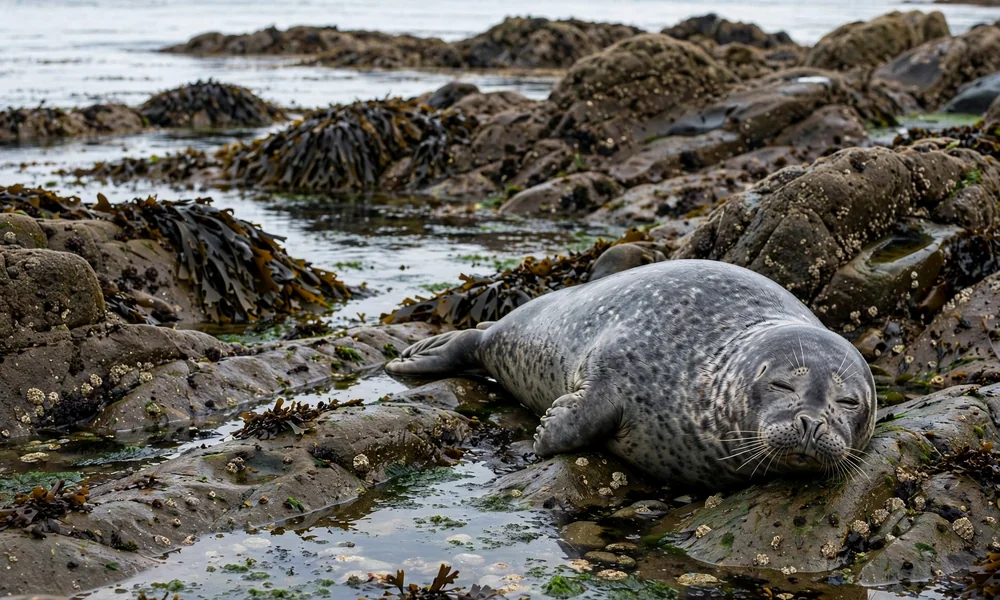
The grey seal is the largest seal of the coasts of Britain, Ireland and the North Sea. Males can be over two metres long, with a long, Roman nose and a mottled grey coat, while females are smaller and paler. Grey seals haul out on rocky shores and beaches to rest, moult and raise their pups, and in autumn the females give birth to white-coated pups on the shore.
The common seal, also called the harbour seal, is smaller and has a shorter, more dog-like face. It hauls out on sandbanks and mudflats at low tide, lying in rows along the shore, and slips into the water when the tide returns or when people come too close.
Seals are strong swimmers and skilled hunters, chasing fish, squid and crabs in the shallow water close to the shore. They can dive for many minutes at a time, and they use their whiskers to sense the movement of fish in murky water. Like the island animals of offshore islands, seals depend on quiet, undisturbed shores for breeding.
Rock pools, crabs and the small animals of the shore
The rock pool is a small world of its own. When the tide goes out, it leaves behind pools of seawater in the hollows of the rocks, and in each pool lives a crowd of small animals waiting for the sea to return. Shore crabs hide under stones and in cracks, darting sideways across the pool when disturbed. Common starfish cling to the rocks with their tube feet, feeding on mussels by prising the shells open. Beadlet anemones sit like red jelly beads on the rock, opening their tentacles to catch tiny animals from the water.
Limpets are the grazers of the rock pool. Each limpet has a cone-shaped shell and a strong foot that clamps it to the rock, and it scrapes algae from the stone with a tongue covered in tiny teeth.
Like the coral reef animals of warm seas, the animals of a rock pool live crowded together in a small space, and each one has found its own corner of it.
Waders, dunes and estuaries
The mudflats of an estuary are among the richest feeding places on the coast. At low tide they are bare mud, but beneath the surface live millions of worms, shellfish and shrimps, and the waders come to eat them. Oystercatchers, black-and-white birds with long orange beaks, hammer and prise open mussels and cockles. Curlews probe the mud with their long, curved bills for worms. Redshanks, dunlins and sandpipers pick over the surface in flocks, and godwits wade belly-deep in the shallow water.
In autumn and winter, the estuaries fill with birds from the far north. Knots, grey plovers and bar-tailed godwits arrive from the Arctic, and a single estuary can hold tens of thousands of waders.
Behind the beach, the dunes hold their own animals. Rabbits graze the short grass, and their burrows shelter sand lizards in the warm sand. Stonechats perch on the tops of bushes, and skylarks sing over the dunes in spring. In the south, mangrove forests shelter crabs, mudskippers and herons among their tangled roots.
Where to see coastal animals
Puffins are best seen in summer on the cliff tops of Scotland, Ireland, Iceland and Norway, where they stand outside their burrows in the evening. Gannets are best at the great colonies of the North Atlantic, where thousands of birds nest on rock stacks.
Grey seals are best seen in autumn on the beaches where they give birth to their pups, and common seals are best at low tide on sandbanks and mudflats, where they lie in rows along the shore. Rock pools are best at low tide on a calm day, when the water is clear and the animals are easy to see.
| Animal | Where to look | Best season | How likely is a sighting |
|---|---|---|---|
| Atlantic puffin | Grassy cliff tops | April to August | Good at a colony |
| Northern gannet | Rock stacks and cliff colonies | Spring to autumn | Good at a colony |
| Grey seal | Rocky shores and beaches | Autumn, pupping season | Good from a distance |
| Common seal | Sandbanks and mudflats | All year, at low tide | Good with binoculars |
| Shore crab | Rock pools | Spring to autumn | Very good at low tide |
| Common starfish | Rock pools and rocky shores | All year, at low tide | Good in clear pools |
| Oystercatcher | Mudflats and estuaries | All year, best in winter | Very good on the shore |
| Curlew | Estuaries and mudflats | Autumn and winter | Good, listen for the call |
Best seasons for coastal wildlife watching
Spring is the finest season for the cliffs, when the puffins return to their burrows and the gannets gather on the rock stacks. Summer is the best season for rock pools and for watching seals with their pups on the shore. Autumn is the best season for waders, when the estuaries fill with birds from the Arctic.
Staying safe around coastal animals
Coastal animals are usually calm, but they deserve respect, and the sea deserves respect too. Never approach a seal, especially a pup, and never get between a seal and the water. Keep your distance from nesting seabirds, because a disturbed colony can abandon its eggs.
Coastal animals checklist
- Watch puffins outside their burrows on a grassy cliff top in summer, and gannets diving from great heights at a colony.
- Look for grey seals and common seals hauled out on beaches and sandbanks at low tide, and keep well back from them.
- Explore a rock pool at low tide for shore crabs, starfish, anemones, limpets and periwinkles, and put every stone back as you found it.
- Scan an estuary at low tide for oystercatchers, curlews, redshanks and sandpipers feeding on the mudflats.
- Walk the dunes for rabbits, stonechats and skylarks, and look for sand lizards basking in the warm sand.
- Leave no trace: take your rubbish home, never disturb nesting birds or seals, and always check the tide times before you go.
Frequently asked questions
What animals live on the coast?
The coast holds puffins, gannets, guillemots, grey seals, common seals, shore crabs, starfish, anemones, limpets, barnacles, oystercatchers, curlews, sandpipers and waders. The cliffs, the shore, the rock pools and the estuaries each hold their own animals.
How do coastal animals differ from ocean and island animals?
Coastal animals live at the edge where land meets sea, in places the tide covers and uncovers twice a day, while ocean animals live in the open sea far from land, and island animals live on islands as a whole, including their inland habitats. This guide focuses on the shore itself: cliffs, beaches, rock pools, dunes and estuaries, not the open ocean or the interior of islands.
When is the best time to see puffins?
Puffins are best seen from April to August, when they are at their cliff-top colonies raising their chicks. They stand outside their burrows in the evening, and they fly low over the waves with fish in their beaks.
Can I approach a seal on the beach?
No. Never approach a seal, especially a pup, and never get between a seal and the water. Seals bite if they feel threatened, and a disturbed colony can abandon its beach.
What lives in a rock pool?
A rock pool holds shore crabs, starfish, beadlet anemones, limpets, barnacles, periwinkles, dog whelks and hermit crabs.
What is the best time to visit a rock pool?
Low tide on a calm day is the best time, when the water in the pools is clear and the animals are easy to see. Check the tide times before you go, and explore in the hour before and after low tide.
Conclusion
Coastal animals reward patience: puffins standing outside their burrows at dusk, gannets plunging into the sea, grey seals resting on the rocks, starfish clinging to the walls of a rock pool, and waders feeding on the mudflats of an estuary are all within reach if you plan around the tide and go quietly at low water.
The next step is to pick one stretch of coast and one tide — a summer evening for the puffins, a low tide for the rock pools, or an autumn morning for the waders — and plan your visit around it.