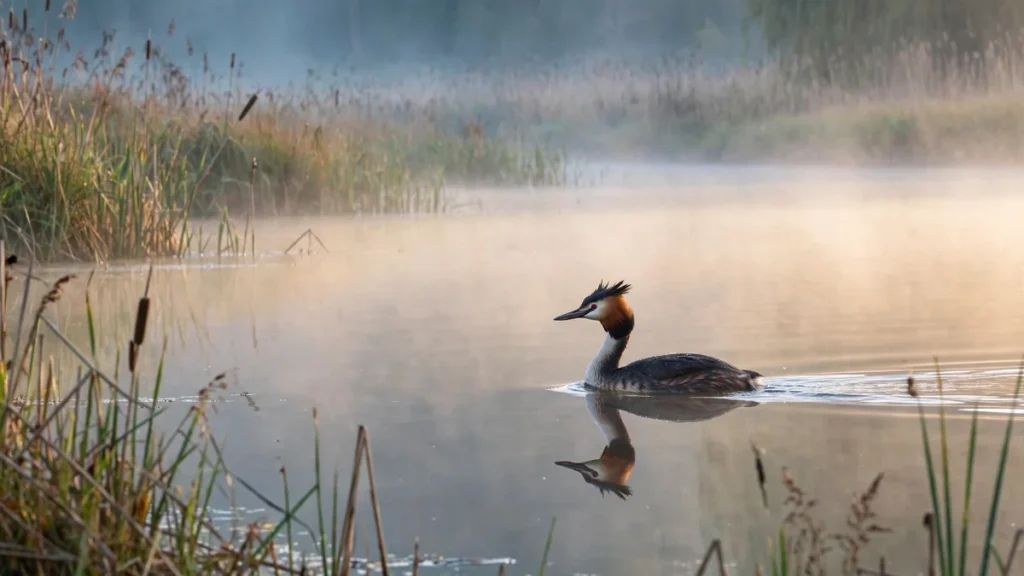
Lake animals are the creatures that live in and around the still waters of lakes, from great crested grebes and loons on the surface to pike and perch below it, and from beavers and otters at the shore to the Baikal seal of Siberia. If you are wondering what lives in a lake, the short answer is this: the open water holds fish and diving birds, the reed beds hold frogs, dragonflies and nesting grebes, and the banks hold beavers, otters and herons, all of them shaped by water that barely moves.
This guide covers the best-known lake animals of the world, from the loons of northern lakes to the only seal that lives entirely in fresh water, and explains how lakes change with the seasons.
Key takeaways
- Lake animals include great crested grebes, loons, ospreys, pike, perch, lake trout, beavers, otters, frogs and dragonflies.
- The Baikal seal of Lake Baikal is the only seal in the world that lives entirely in fresh water.
- Lakes are layered: warm water sits above cold water in summer, and the layers mix again in spring and autumn.
- Beavers shape lakes by building dams, and their ponds create new homes for frogs, dragonflies and ducks.
- Spring and early summer are the best seasons for lake birds, and dawn is the best time to see otters and beavers.
What makes lake animals special
A lake is a body of still water, and that stillness is what sets it apart. Rivers carry everything downstream, and the sea is always moving, but a lake holds its water in place for months or years, and its animals have learned to live in water that warms, cools and layers itself with the seasons.
In summer, most lakes divide into layers. Warm water floats on top, cold water sinks to the bottom, and a middle band separates them. Fish move between the layers as the temperature changes, and the deep water can run short of oxygen by late summer. In autumn the surface cools, the layers mix, and oxygen returns to the depths. In winter, ice covers the northern lakes, and the animals below it slow down and wait for spring.
That cycle shapes everything about lake life. Grebes and loons nest in the reeds when the water is warm, pike hunt in the shallows in spring, and frogs lay their eggs in the sun-warmed margins.
Birds of the lake: grebes, loons and ospreys
The great crested grebe is one of the most elegant of all lake birds. It has a double crest of dark feathers and a chestnut-and-black ruff around its face, and in spring pairs perform a famous dance on the water, rising chest to chest and shaking their heads at each other.
Loons, known as divers in Britain, are the great singers of northern lakes. The common loon has a black-and-white checked back and a haunting, trembling call that carries across still water at dusk. Loons are superb divers, chasing fish deep below the surface, but their legs are set so far back on their bodies that they can barely walk on land, so they come ashore only to nest.
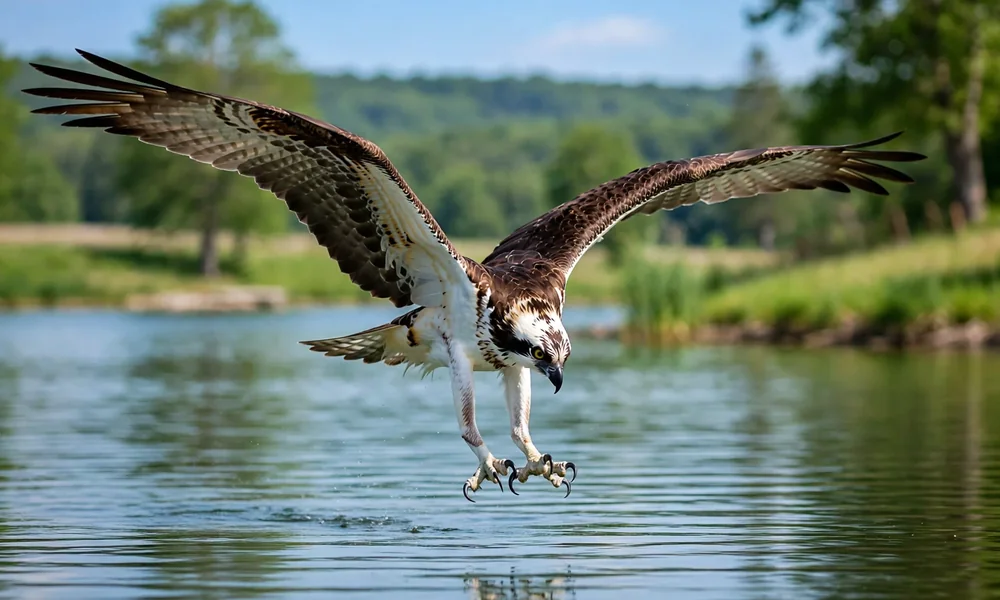
Among the predators of the lake, the osprey is the most spectacular. It circles high above the water, then folds its wings and plunges feet-first into the lake to snatch a fish in its talons, shaking the water from its feathers as it rises. Ospreys nest on dead trees and platforms near the shore, and they return to the same nest year after year. Herons stand motionless in the shallows waiting for fish and frogs, and kingfishers flash blue and orange as they dart from a branch to the water.
Fish of the lake: pike, perch and lake trout
The pike is the hunter of the lake shallows. It is a long, green, torpedo-shaped fish with a mouth full of sharp teeth, and it lies motionless among the reeds, waiting for a smaller fish to swim past before lunging at it in a sudden burst of speed.
Perch are smaller and more sociable. They swim in shoals through the open water, striped in green and gold with spiny fins and red-tipped tails, feeding on insects, small fish and snails.
Lake trout live in the cold, deep water of northern lakes. They are large, spotted fish that follow the cold layer down in summer and rise to the shallows to feed in spring and autumn.
Beavers, otters and the animals of the shore
The beaver is the great builder of the lake shore. It fells trees with its teeth, drags the branches into the water, and builds dams and lodges of sticks and mud. A beaver dam can raise the level of a lake or stream and flood a whole valley, creating a pond where frogs, dragonflies and ducks can breed.
Otters are the most playful of lake animals. They swim with quick, looping dives, slide down muddy banks on their bellies, and hunt fish, frogs and crayfish in the shallows, most often at dawn and dusk.
Like the wetland animals of marshes and fens, the animals of the lake shore live half in water and half on land, and they depend on the reeds and the muddy margins as much as on the open water itself. Keep to the paths at the edge of a lake, because the reed beds are where the birds nest and the frogs breed.
The Baikal seal and the lakes of the world
Lake Baikal in Siberia is the deepest lake on earth, and it holds the most remarkable of all lake animals: the Baikal seal, the only seal in the world that lives entirely in fresh water. It is a small, silver-grey seal that hunts fish in the cold, deep water of the lake, and it rests on the ice in winter, giving birth to its pups in snow dens on the frozen surface.
Like the ocean animals of the open sea, the animals of a great lake live in a world of deep water and open horizons, but a lake is enclosed, and its animals have nowhere else to go. That is why the Baikal seal and the cichlids of Malawi are found in one lake and nowhere else: they evolved in isolation, in water that has been cut off from the sea for a very long time.
Where to see lake animals
Great crested grebes are best seen on lowland lakes with reed beds in spring, when the pairs dance on the open water. Loons are best on the lakes of Canada, Scandinavia and Scotland in summer, where their calls carry across the water at dusk.
Beavers are easiest at dusk, when they swim out from their lodges to feed on bark and branches. Otters are hardest of all to see, and the best chance is a quiet dawn at a lake with a good view of the shore and a local guide who knows the otter’s regular paths.
| Animal | Where to look | Best season | How likely is a sighting |
|---|---|---|---|
| Great crested grebe | Lowland lakes with reed beds | Spring, during the courtship dance | Good in the morning |
| Common loon | Lakes of Canada and Scandinavia | Summer | Good, listen for the call at dusk |
| Osprey | Lakes with nest platforms | Spring to autumn | Good while hunting |
| Pike | Reedy shallows | Spring, when spawning | Fair, look for a still shape in the reeds |
| Eurasian beaver | Wooded lake shores | All year, at dusk | Fair, look for dams and gnawed trees |
| Eurasian otter | Quiet lake shores | All year, at dawn | Low, needs patience and a guide |
| Baikal seal | Lake Baikal, Siberia | Winter, on the ice | Good on a guided trip |
| Lake trout | Deep northern lakes | Spring and autumn | Fair in the shallows |
Best seasons for lake wildlife watching
Spring is the finest season for lake birds. The grebes dance, the ducks return, the frogs spawn, and the ospreys come back to their nests. It is also the most sensitive season, so keep to paths, keep dogs on a lead, and give nesting birds more space than you think they need. Summer is the easiest season for dragonflies, frogs and water voles, and for watching beavers at dusk on a long evening. Autumn brings the migrating wildfowl, and the lakes fill with geese and ducks from the north.
Staying safe around lake animals
Lake animals are usually calm, but they deserve respect, and the water deserves respect too. Never swim alone in a lake, never walk on ice unless local people say it is safe, and never approach a beaver lodge or a nesting bird.
Lake animals checklist
- Watch great crested grebes dancing on a lowland lake in spring, and listen for loons calling at dusk on a northern lake.
- Look for an osprey hunting over the shallows in the morning, and a heron standing motionless in the reeds.
- Search the reed beds for frogs in spring and dragonflies in summer, and look for water voles along the banks.
- Find a beaver dam or lodge at dusk, and look for otter tracks and spraints on rocks at the water’s edge.
- Remember the Baikal seal, the only seal in the world that lives entirely in fresh water, in Lake Baikal.
- Leave no trace: take your rubbish home, keep to marked paths, and never disturb nesting birds or beaver lodges.
Frequently asked questions
What animals live in lakes?
Lakes hold great crested grebes, loons, ospreys, herons, ducks, swans, pike, perch, lake trout, beavers, otters, frogs, dragonflies and water voles.
How do lakes differ from wetlands and swamps?
A lake is a body of open, still water, usually deep enough to have layers of warm and cold water, while a wetland is shallow land that is wet for part of the year, and a swamp is a wetland with trees standing in the water.
What is the only seal that lives in fresh water?
The Baikal seal of Lake Baikal in Siberia is the only seal in the world that lives entirely in fresh water. It hunts fish in the deep, cold water of the lake and raises its pups in snow dens on the ice in winter.
Why do lakes have layers of warm and cold water?
In summer, warm water floats on top of cold water, with a middle band between them, because warm water is lighter than cold water. In autumn the surface cools and the layers mix, bringing oxygen back to the deep water, and in winter ice covers the surface while the water below stays just above freezing.
When is the best time to see beavers and otters on a lake?
Beavers and otters are most active at dawn and dusk. Beavers are easiest at dusk, when they swim out from their lodges to feed, and otters are best at a quiet dawn on a lake with a good view of the shore, ideally with a local guide.
Can I swim in a lake with wild animals?
You can swim in many lakes, but never swim alone, never swim near nesting birds or beaver lodges, and never walk on ice unless local people say it is safe. Keep your distance from wild animals, and never feed them.
Conclusion
Lake animals reward patience: great crested grebes dancing in spring, loons calling at dusk, ospreys plunging into the shallows, beavers building their dams at dusk, and the Baikal seal resting on the ice of the deepest lake on earth are all within reach if you plan around the seasons and go quietly at dawn or dusk.
The next step is to pick one lake and one season — a spring morning for the grebes, a summer evening for the beavers, or a winter trip to Lake Baikal for the seals — and plan your visit around it.














