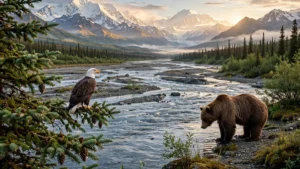
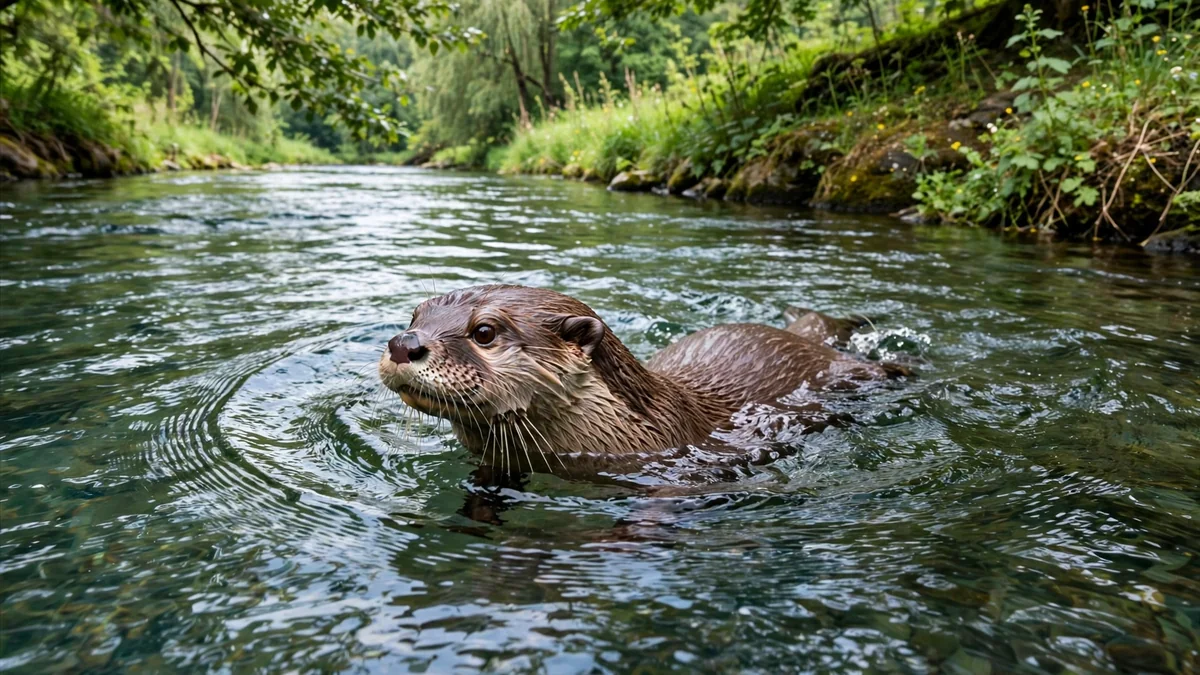
River animals include otters and beavers in the banks, kingfishers, dippers and herons along the water, salmon and trout in the current, and water voles and dragonflies at the margins. If you are wondering which animals live in rivers, the short answer is this: the current sorts every river into riffles and pools, and each animal has its own place in that pattern — the dipper in the fast shallows, the otter in the deep pools, and the salmon on its journey upstream.
Rivers are the most restless of all habitats. The water never stays still, and every animal that lives in a river must hold its place, find food in moving water, and survive floods and droughts. That constant movement is what makes river wildlife so distinctive.
Key takeaways
- Rivers sort into riffles and pools, each with its own animals: dippers in the shallows, otters in the pools, trout in the current.
- Otters and beavers are the great mammals of rivers, hunting fish and shaping the banks with dams and lodges.
- Kingfishers, dippers and grey herons are the characteristic birds of flowing water, each fishing differently.
- Salmon and trout migrate upstream to spawn, linking the river to the sea.
- Dawn and dusk are best for otters and beavers, spring for riverbank birds, and autumn for the salmon run.
What makes river wildlife special
A river is not one habitat but many. The fast, shallow riffles hold different animals from the slow, deep pools, and the shaded headwaters differ from the wide lowland reaches. One river can hold trout, otters, kingfishers and dragonflies within a few hundred metres.
Flowing water is rich in oxygen, and that richness drives the whole river. The current carries food downstream, the stones shelter insect larvae, and the fish that feed on them draw in otters, herons and kingfishers. A healthy river is a chain of feeding, from larva to predator.
Rivers are also corridors. Salmon travel from the sea to the headwaters to spawn, otters patrol long stretches of bank, and kingfishers move from pool to pool. The animals of a river belong to the whole watercourse, not to a single spot.
Riffles, pools and the shape of a river
The riffle is the fast, shallow stretch where water breaks over stones, and the most productive part of a river. Mayfly and stonefly larvae cling under the stones, caddisflies build cases from sand and gravel, and trout hold behind the stones, waiting for food to drift past.
The pool is the slow, deep stretch between the riffles, where the water rests and fish gather. Otters hunt here at dawn, herons stand motionless at the edge, and chub, barbel and pike wait in the shade.
Between the two lie the runs and glides, smooth stretches where the water moves steadily over sand. Water voles burrow in the banks here, dragonflies patrol the margins, and the kingfisher uses overhanging branches as a perch. Each stretch has its own cast, and learning to read the river is the first step in finding its animals.
Otters, beavers and the mammals of the river
The Eurasian otter is the great mammal of the river, hunting fish in the pools at dawn and dusk. Otters are playful and curious, but also shy, and a sighting takes patience, quiet and a good vantage point over a deep pool.

Among the predators of the river, the otter is joined by the American mink, which hunts along the banks, and by the grey heron from above. The beaver is the river’s engineer, building dams that slow the water and create new pools; its lodges and gnawed trees are easy signs of its presence.
The water vole lives in the banks of slow rivers, digging burrows above the waterline and feeding on grasses and reeds. It is smaller and rounder than the brown rat, with a blunt nose and short tail, and most active morning and evening. The forest animals that visit rivers include deer, which come down to drink at dawn, and badgers, which hunt along the banks at night.
Bats hunt over the river at dusk, taking insects that rise from the water, and the Daubenton’s bat skims the surface to snatch insects from the water itself. The river at night belongs to these hunters.
Kingfishers, dippers and herons
The kingfisher is the brightest bird of the river, flashing blue and orange as it dives from an overhanging branch to catch small fish. It needs clear water and a perch, and nests in a burrow in a steep bank, raising its young through the summer.
The dipper is the bird of the fast water, walking the streambed in the mountain torrents and bobbing on the rocks. It is the only songbird that swims underwater, feeding on the insect larvae that cling to the stones of the riffles.
The grey heron is the patient hunter of the river, standing motionless at the edge of a pool before striking. Little egrets hunt the same pools in warmer rivers, and the mountain animals of the headwaters include the grey wagtail, which bobs on the rocks of the fast streams.
Salmon, trout and the migration upstream
The salmon is the great traveller of the river, leaving the sea to return to the stream where it was born. It leaps waterfalls and weirs on its way upstream, and its autumn run is one of the great wildlife spectacles of the northern rivers.
Brown trout live in the river all year, holding in the current behind the stones of the riffles and feeding on insects that drift past. Rainbow trout have been introduced to many rivers, and grayling, with sail-like dorsal fins, live in the clean, cool middle reaches.
The salmon’s journey links the river to the sea. The ocean animals that salmon meet include seals at the river mouth, and the young salmon, the smolts, must run the gauntlet of herons, goosanders and pike on their way downstream.
Dragonflies, insects and the small life of the river
Not all river animals are large. The dragonfly is the great hunter of the river margins, patrolling the banks on summer days and taking flies and midges in the air. The banded demoiselle, with dark blue wings, is common on slow lowland rivers.
Mayflies, stoneflies and caddisflies spend most of their lives as larvae on the riverbed, and their brief adult lives above the water feed trout, dippers and bats. Their presence marks a healthy river: they need clean, well-oxygenated water.
The riverbed also holds freshwater mussels, which filter the water, and crayfish, which hide under the stones. The margins hold frogs and toads, and grass snakes hunt frogs in the shallows. The small life of the river supports everything else.
Where to see river animals
Otters are best on quiet, wooded rivers with deep pools, where a vantage point above a pool at dawn gives the best chance. Go early, sit still, and watch for the V-shaped wake of a hunting otter.
Kingfishers are best on slow rivers with clear water and overhanging branches. The dipper is best on fast mountain streams, where it walks the streambed and bobs on the rocks, and the salmon run is best watched at a waterfall or fish ladder in autumn.
Beavers are easiest at dusk, when they leave their lodges to feed, and their dams and gnawed trees show where to wait. Dragonflies are best on a warm summer day, patrolling the banks in the sun.
| Species | Where to look | Best season | How likely is a sighting |
|---|---|---|---|
| Eurasian otter | Deep pools, wooded banks | All year, at dawn | Low, needs patience |
| Eurasian beaver | Slow rivers, near dams | All year, at dusk | Fair, look for dams |
| Common kingfisher | Slow rivers, overhanging branches | Spring to autumn | Good from a bank |
| White-throated dipper | Fast mountain streams | All year | Good on the rocks |
| Atlantic salmon | Waterfalls and fish ladders | Autumn, during the run | Good at a weir |
| Brown trout | Riffles and runs | Spring to autumn | Good in clear water |
| Water vole | Banks of slow rivers | Spring to autumn | Fair in the morning |
Best seasons for river wildlife watching
Spring is the finest season. The kingfishers return to their banks, the dippers feed their young in the mountain streams, and the margins fill with dragonflies and wildflowers. It is also the most sensitive season, so keep to paths and give every animal more space than you think it needs.
Summer is the easiest season for the river, with long days and the dragonflies, kingfishers and herons at their busiest, and beavers feeding at dusk through the warm months. Autumn brings the salmon run, when fish leap the waterfalls upstream.
Winter is the quiet season, and the hardest for watching, but dippers stay on the fast streams all winter, and otters are easiest to track in the snow along the banks.
Staying safe around river wildlife
Rivers are beautiful, but they deserve respect, and the water most of all. Never wade into a fast river, never stand on a slippery bank above deep water, and never approach a beaver lodge or otter holt. Keep your distance from any animal you meet, and watch from a safe bank.
River wildlife watching checklist
- Find a deep pool with wooded banks and sit still at dawn for otters.
- Watch a slow river with overhanging branches for kingfishers.
- Walk a fast mountain stream for dippers bobbing on the rocks.
- Visit a waterfall or fish ladder in autumn for the salmon run.
- Look for beaver dams and gnawed trees, then wait at dusk near the lodge.
- Leave no trace: take your rubbish home and keep to the banks and marked paths.
Frequently asked questions
What is the most famous river animal?
The otter is the most famous, hunting fish in the pools at dawn and dusk. The kingfisher is the best-loved bird of the river, and the salmon is the great traveller of northern rivers.
Are there beavers in rivers?
Yes, beavers live in slow rivers across Europe, building dams that slow the water and create new pools. Their lodges and gnawed trees are easy signs of their presence.
What is the difference between river animals and wetland animals?
River animals live in flowing water; wetland animals live in still or slow water such as marshes and reed beds. The dipper and salmon belong to rivers, while the bittern and marsh harrier belong to wetlands.
When is the best time to see otters in a river?
Otters are best at dawn and dusk, when they hunt fish in the deep pools. Sit still above a pool on a quiet, wooded river, and watch for the V-shaped wake of a hunting otter.
Can I see salmon in a river?
Yes. Atlantic salmon return from the sea to spawn in autumn, and they are best watched at a waterfall, weir or fish ladder, where they leap upstream to the headwaters.
Where can I see kingfishers?
Kingfishers live on slow rivers with clear water and overhanging branches, where they perch to watch for small fish. They are easiest to spot in spring and summer from a quiet bank.
Conclusion
River wildlife rewards patience: otters in the deep pools at dawn, kingfishers on the overhanging branches, dippers on the rocks of the fast streams and salmon leaping the waterfalls in autumn are all within reach if you learn to read the river and go at the right time.
The next step is to pick one stretch of river and one season — a dawn watch for otters, a spring walk for kingfishers, or an autumn visit to a waterfall for the salmon run — and plan your visit around it.