Thailand animals range from Asian elephants in the rainforests of the west to gibbons calling at dawn in Khao Sok, and the country holds some of the richest wildlife in South-East Asia. If you are wondering which animals live in Thailand and where to see them, the short answer is this: elephants, gibbons, macaques and hornbills live in the forests, tigers survive in small numbers in the western forest complex, and whale sharks, manta rays and sea turtles swim around the islands and reefs of the Andaman Sea and the Gulf of Thailand.
Thailand is one of the best places in the region to watch wildlife, because so much of the country is still rainforest, mountain, mangrove and reef. This guide covers the species you are most likely to meet, where each one lives and the best seasons to see them.
Key takeaways
- Thailand’s most iconic land animals are the Asian elephant, the white-handed gibbon, the great hornbill, the gaur, the sambar deer and the long-tailed macaque.
- Tigers still live wild in Thailand, but only in small numbers in the western forests, so no honest guide should promise a sighting.
- Hornbills, pittas and kingfishers make Thailand one of the best birdwatching countries in South-East Asia, especially at Khao Yai, Kaeng Krachan and Khao Sok.
- Whale sharks, manta rays and sea turtles swim around the Similan and Surin islands and the reefs of the Andaman Sea, and turtles nest on the beaches of the south.
- The cool dry season, from November to February, is the best season for most wildlife watching, and early morning is the best time of day for forest animals.
What makes Thailand’s wildlife special
Thailand sits at the meeting point of the forests of mainland Asia and the tropical world of the Malay Peninsula, and its wildlife reflects both. Species from the mountains of the north, the great forests of the west and the warm seas of the south all meet here.
Honesty matters here: Thailand has very few true endemics, and no large mammal lives only in Thailand. What it has instead is an unusually wide mix of species living side by side, from elephants and gibbons in the rainforest to dugongs and whale sharks in the sea.
That variety comes from the landscape itself. Thailand holds high mountains, deep rainforest, wide rivers, mangrove coasts and two long sea coasts, so animals from many different habitats can live within one country. Like the forest animals of other tropical countries, many Thai species depend on large, quiet woodland, and Khao Yai, Kaeng Krachan and Khao Sok are among the wildest corners of the country.
The great mammals of Thailand
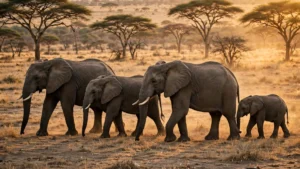
The Asian elephant is Thailand’s most famous animal, living wild in the forests of Khao Yai, Kaeng Krachan and the western forest complex. A few thousand wild elephants remain, and they are most often seen at dawn and dusk. They are shy and avoid people, and they are best looked for with a local guide.
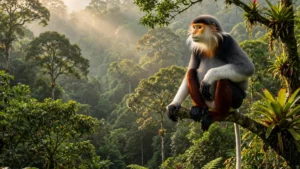
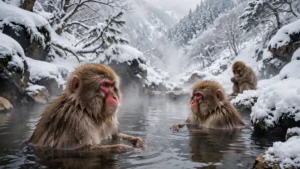
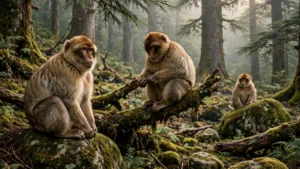
The white-handed gibbon is the sound of the Thai forest at dawn, singing in loud, rising calls from the treetops of Khao Sok and Khao Yai. The pileated gibbon lives in the forests of the east, and both species swing through the canopy in family groups. Long-tailed macaques are common along the coasts and rivers, and pig-tailed macaques live in the forests of the south.
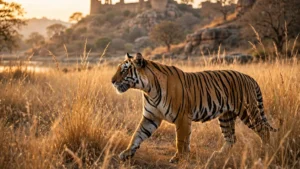
Among the predators, the tiger is the great prize, but it is also the great disappointment for most visitors. Only a small number survive in the wild, mainly in Huai Kha Khaeng and the western forest complex, and sightings are extremely rare. The sun bear, the smallest bear in the world, climbs trees for fruit and honey in the forests of the south and west.
One animal should not be on any visitor’s list in the wild: the Javan rhinoceros. It once lived in Thailand, but it is gone from the country, and Schomburgk’s deer, a deer of the central plains, is extinct. Their disappearance is a reminder of how much of Thailand’s wildlife depends on large, undisturbed habitat, and why the national parks matter so much.
Birds of Thailand
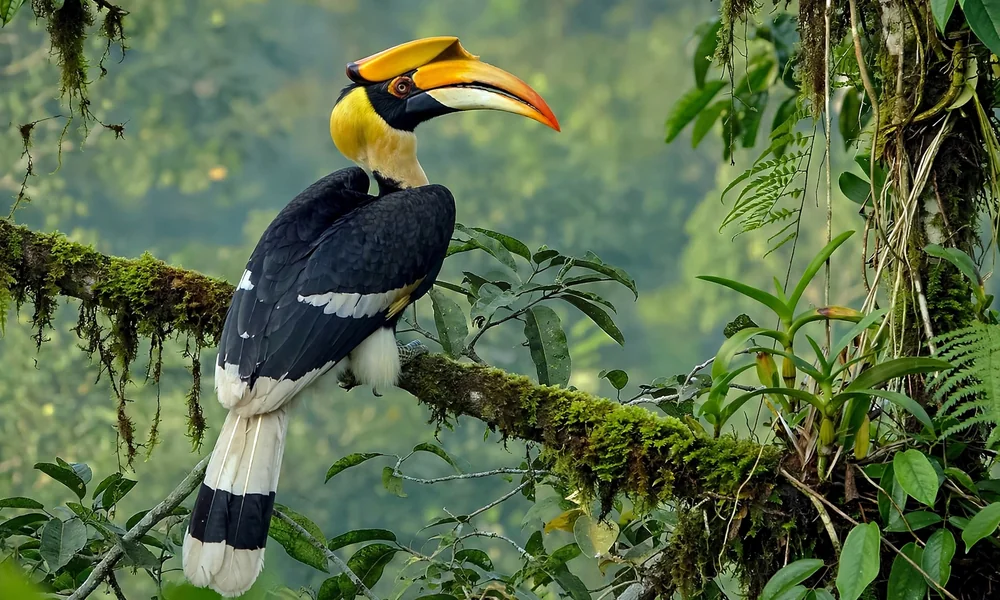
The great hornbill is one of Thailand’s best-loved birds, a huge black-and-white bird with a great yellow casque on its bill, flying heavily through the canopy of Khao Yai and Khao Sok. Thailand is home to thirteen species of hornbill, and the sight of a pair flying across a forest valley at dawn is one of the great moments of a Thai wildlife trip.
Thailand holds more than a thousand bird species, from the forests to the coasts. Pittas, with their jewel-bright colours, live on the forest floor, and the Gurney’s pitta of the southern forests is one of the rarest birds in the country, once thought lost and now known only from a few small areas. The spoon-billed sandpiper, one of the rarest waders in the world, winters in small numbers on the mudflats of the Gulf of Thailand.
Thailand’s position on the migration routes between northern Asia and the Malay Peninsula makes it one of the best birdwatching countries in the region. Kaeng Krachan, on the border with Myanmar, is one of the finest birdwatching sites in the country, with hornbills, broadbills, pittas and birds of prey.
Rivers, coasts and smaller wildlife
Thailand’s rivers and wetlands hold their own wildlife, and the mangrove forests of the south are the best place to see it. The mangroves hold mudskippers, fiddler crabs and herons, and the rivers hold otters, monitor lizards and kingfishers.
Along the coasts, the dugong still survives in small numbers in the seagrass meadows of Trang and the Andaman coast, but it is very rare, and no honest guide can promise a sighting. Green turtles and hawksbill turtles nest on the sandy beaches of the south and the islands, and leatherback turtles return in small numbers to the beaches of Phang Nga. The nesting beaches are protected during the season, and visitors are asked to keep away from marked nests and to avoid bright lights at night.
Smaller mammals are everywhere in Thailand, though they are often overlooked. Sambar deer and barking deer live in the forests, gaur, the huge wild cattle of Asia, graze in the clearings of Khao Yai and Huai Kha Khaeng. Like the wetland animals of other countries, the frogs, dragonflies and water birds of Thailand’s marshes depend on clean, undisturbed water.
| Species | Where to look | Best season | How likely is a sighting |
|---|---|---|---|
| Asian elephant | Khao Yai, Kaeng Krachan and the western forests | November to February, dawn and dusk | Fair with a guide |
| White-handed gibbon | Khao Sok and Khao Yai | November to April, at dawn | Good, heard more often than seen |
| Tiger | Huai Kha Khaeng and the western forest complex | Dry season, dawn and dusk | Very low |
| Great hornbill | Khao Yai, Kaeng Krachan and Khao Sok | November to April | Good in season |
| Gaur | Khao Yai and Huai Kha Khaeng clearings | Dry season, dawn and dusk | Fair with a guide |
| Whale shark | Similan and Surin islands, Richelieu Rock | February to April | Fair on a dive trip |
| Green turtle | Similan islands and southern nesting beaches | November to March | Fair on a snorkelling trip |
Best seasons for wildlife watching
The cool dry season, from November to February, is the finest season. The air is cooler, the forest is easier to walk in, the gibbons call at dawn, the hornbills are active, and the birds from the north arrive in large numbers.
The hot season, from March to May, is the easiest season for forest animals, because the elephants, gaur and deer come to the waterholes and salt licks as the forest dries out. The heat drives most animals into cover by midday, so go out early in the morning or late in the evening.
For the sea, the best season is different. The Andaman Sea is calmest from November to April, and the whale sharks are most often seen around the Similan and Surin islands from February to April. The Gulf of Thailand is calmest from January to September, and the turtles nest on the southern beaches from November to March.
Staying safe around Thailand’s wildlife
Thailand’s large animals are usually calm, but they deserve respect. Keep your distance from elephants, gaur and wild boar, never approach an elephant with young, and never try to feed or touch any wild animal. If you meet an elephant on a forest road, back away slowly and give it a wide berth.
In the sea, keep away from marked turtle nests, avoid bright lights on nesting beaches at night, and never touch a turtle, a whale shark or a manta ray. The tiger and leopard of the western forests are shy and avoid people, but they should always be watched from a distance, with a guide.
Thailand wildlife watching checklist
- Book a local guide for elephants, gibbons and hornbills — they know where the animals are and where to listen at dawn.
- Go out at dawn for gibbons and hornbills, and plan Khao Yai, Kaeng Krachan and Khao Sok trips for November to February.
- Bring binoculars, leech socks for the rainy season, warm layers for cool mountain mornings and waterproofs for sudden showers.
- Keep at least 50 metres from elephants, gaur and nesting birds, and far more from an elephant with young.
- Never feed wild animals, and never use food or calls to lure monkeys or elephants closer for a photograph.
- On turtle beaches, keep away from marked nests and avoid bright lights at night during the nesting season.
- Leave no trace: take your rubbish home and keep to marked paths in sensitive habitats.
Frequently asked questions
What is the most famous animal in Thailand?
The Asian elephant is the most famous animal, and the white-handed gibbon and the great hornbill are the best-loved forest animals. The whale sharks of the Similan islands are the most famous marine animals.
Are there tigers in Thailand?
Yes, but only in small numbers. Wild tigers survive mainly in Huai Kha Khaeng and the western forest complex, and sightings are extremely rare. No tour can promise one.
Can I see an elephant in the wild in Thailand?
Yes. Wild Asian elephants live in Khao Yai, Kaeng Krachan and the western forests, and the best chance is at dawn or dusk in the cool dry season, with a local guide.
When is the best time to see gibbons in Thailand?
At dawn, from November to April, when the white-handed gibbons sing from the treetops of Khao Sok and Khao Yai. You will often hear them long before you see them.
Can I see whale sharks in Thailand?
Yes. Whale sharks visit the Similan and Surin islands and Richelieu Rock, most often from February to April. The best way to see them is on a dive trip in the calm dry season.
How is this guide different from the Japan animals guide?
This guide covers Thailand, a tropical country of rainforest, mangroves and coral reefs, with elephants, gibbons, hornbills and whale sharks. The Japan animals guide covers a temperate island country, with a different mix of species, from snow monkeys and sika deer to very different birds and seas.
Conclusion
Thailand’s wildlife rewards patience: Asian elephants in the forests of Khao Yai, gibbons calling at dawn in Khao Sok, great hornbills flying across the canopy and whale sharks around the Similan islands are all within reach if you plan around the seasons.
The next step is to pick one species and one season — a cool-season birding trip to Kaeng Krachan, a dawn gibbon walk in Khao Sok, or a February dive trip to the Similan islands for whale sharks.