New Zealand animals are unlike the wildlife of almost any other country, because the islands evolved for millions of years without native land mammals. If you are wondering which animals live in New Zealand and where to see them, the short answer is this: flightless kiwis, keas and kakapos in the forests and mountains, penguins, fur seals and sea lions along the coasts, Hector’s dolphins in the bays of the South Island, and the tuatara, a reptile found nowhere else on Earth.
Birds filled the roles that mammals play elsewhere, so New Zealand is one of the best places in the world to watch them. This guide covers the species you are most likely to meet, where each one lives and the best seasons to see them.
Key takeaways
- New Zealand has no native land mammals except two kinds of bat, so its most famous animals are birds: the kiwi, kea and kakapo.
- The moa, the great flightless bird of New Zealand, is extinct, so no honest guide should promise a sighting.
- The kakapo is one of the rarest parrots in the world, with only around 250 birds left on protected predator-free islands.
- Yellow-eyed, Fiordland crested and little blue penguins all breed on New Zealand shores, and Hector’s dolphin lives only in New Zealand waters.
- Spring and summer are the best seasons, and dawn, dusk and night are the best times for kiwis and other nocturnal animals.
What makes New Zealand’s wildlife special
New Zealand broke away from the ancient supercontinent Gondwana about 80 million years ago, and it has been isolated in the South Pacific ever since. Without land mammals to compete with, birds grew large, lost the power of flight and took over the forest floor.
Honesty matters here: New Zealand has no bears, wolves, big cats or deer of its own. Its only native land mammals are two small bats, the long-tailed bat and the lesser short-tailed bat, both rare and hard to see. What it has instead is a remarkable collection of birds, reptiles and sea mammals, many of them found only here.
That variety comes from the landscape itself. New Zealand holds ancient beech forest, alpine valleys, braided rivers, long beaches and cold southern seas, so very different animals can live within one small country. Like the forest animals of other countries, many New Zealand species depend on large, quiet woodland.
The birds of New Zealand
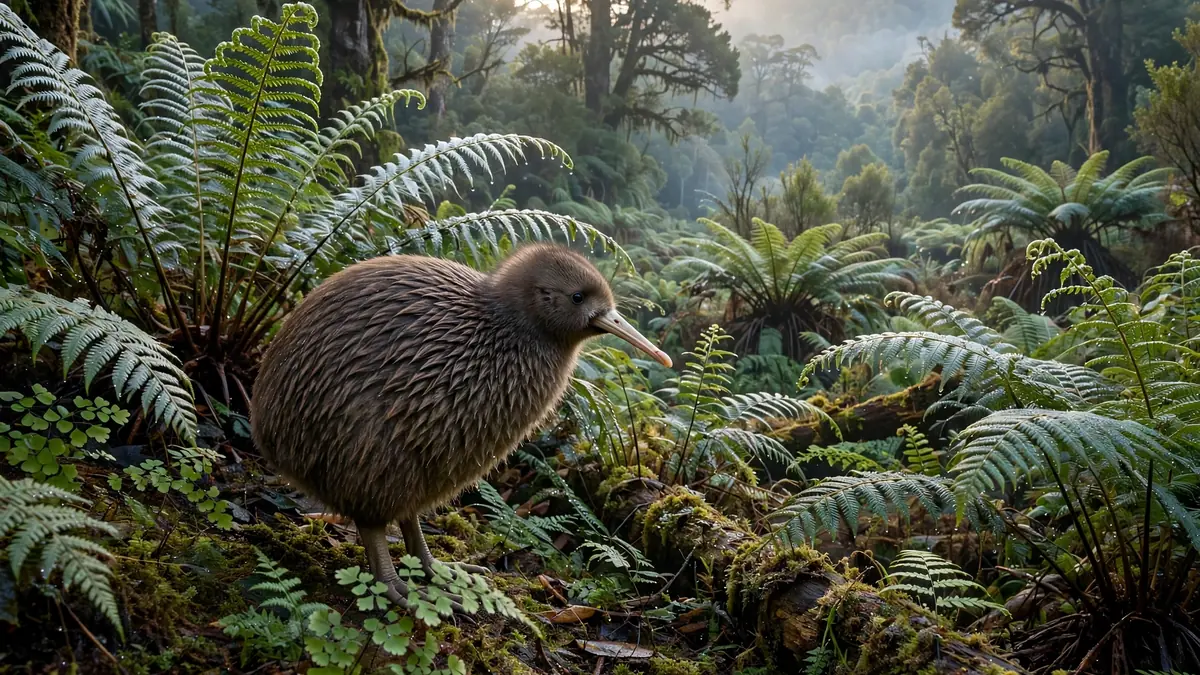
The kiwi is the bird most visitors want to see, and the hardest to find. There are five species of kiwi, all flightless and nocturnal, with a long beak for probing the forest floor. Kiwis are shy and most active at night, so the best chance of seeing one is on a guided night walk on Stewart Island, the Coromandel Peninsula or in a predator-free sanctuary.
The kea is the world’s only alpine parrot, a large olive-green bird that lives in the mountains of the South Island, around Arthur’s Pass and Fiordland. Keas are famously clever and curious, and they often visit car parks and mountain huts to investigate bags, boots and windscreen wipers. The kakapo is even rarer: a large, flightless, nocturnal parrot that lives only on protected islands such as Codfish Island, which cannot be visited without special permission.
Smaller forest birds are much easier to see. The tui sings a rich, two-voiced song from the treetops and flashes a white throat tuft in the sun. The morepork, or ruru, is a small native owl that calls its own name through the night. Like the nocturnal animals of other countries, the kiwi, kakapo and morepork are best looked for after dark, quietly and with a guide.
One bird should not be on any visitor’s list: the moa. It was a giant flightless bird, some species standing taller than a person, and it was once the largest bird in New Zealand. It died out several centuries ago, hunted by the first Polynesian settlers. The moa’s disappearance is a reminder of how much of New Zealand’s wildlife depends on protection from hunting and from introduced predators.
Land mammals, reptiles and the tuatara
New Zealand’s only native land mammals are bats, and they are seldom seen. The long-tailed bat hunts insects over forest edges and rivers at dusk, and the lesser short-tailed bat, one of the few bats in the world that spends much of its time on the ground, forages in the leaf litter of old forest. Both are small, quiet and endangered.
The tuatara is the most remarkable reptile in the country, and one of the most remarkable in the world. It looks like a lizard, but it is the last survivor of an order of reptiles that lived alongside the dinosaurs, and it has changed very little in 200 million years. Tuatara live mainly on predator-free islands, but they can also be seen at sanctuaries such as Zealandia in Wellington.
The mammals most visitors do meet are introduced species, and many are a serious problem for native wildlife. Stoats, rats and possums prey on birds, eggs and chicks, and red deer, goats and rabbits damage the forest. That is why so many of New Zealand’s rarest birds now live on predator-free islands or inside fenced sanctuaries.
Penguins, seals and sea life
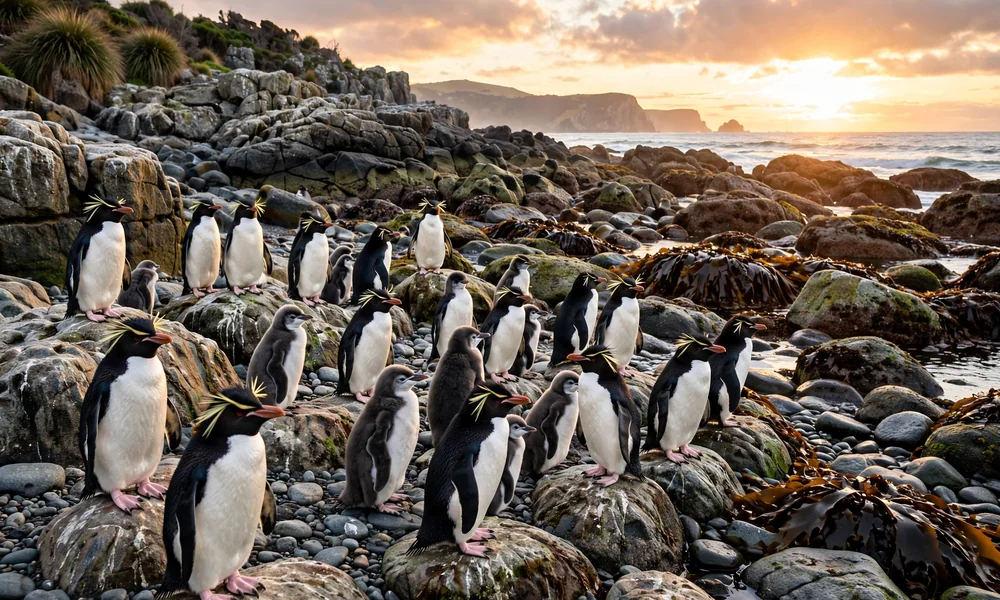
New Zealand’s coasts are rich with sea life, and penguins are the stars. The yellow-eyed penguin, or hoiho, is one of the rarest penguins in the world, and it breeds on the beaches of Otago and the Catlins, on the south-east coast of the South Island. It is shy and easily disturbed, so watch from a hide or from a distance, and never approach a bird on the beach.
The Fiordland crested penguin, or tawaki, breeds in the rainforest of Fiordland and the West Coast. Like the coastal animals of other countries, New Zealand’s penguins depend on clean seas and undisturbed beaches.
New Zealand fur seals, or kekeno, haul out on rocky shores around the country, especially at Kaikoura, the Catlins and the West Coast, and the endangered New Zealand sea lion, or pakake, breeds mainly on the subantarctic Auckland Islands, with a small group on the Otago coast. Hector’s dolphin, the world’s smallest dolphin, lives only in New Zealand waters, and the best place to see it is in the bays around Banks Peninsula, near Christchurch, on a calm summer day.
| Species | Where to look | Best season | How likely is a sighting |
|---|---|---|---|
| Kiwi | Stewart Island, Coromandel and sanctuaries | Year round, at night | Fair on a guided night walk |
| Kea | Arthur’s Pass and Fiordland mountains | Year round | Good in the mountains |
| Kakapo | Codfish Island and other protected islands | Not open to visitors | Almost never, by design |
| Yellow-eyed penguin | Otago Peninsula and the Catlins | October to March | Fair from a hide |
| Fiordland crested penguin | Fiordland and the West Coast | July to November | Low, needs a guide |
| Hector’s dolphin | Banks Peninsula bays | November to April | Good on a calm day |
| Tuatara | Predator-free islands and Zealandia | Year round, sunny days | Good in a sanctuary |
Best seasons for wildlife watching
Spring is the finest season. The forests fill with birdsong, penguins return to their nests, and the days grow long enough for a full day in the bush.
Summer is the easiest season for sea life and for walking. Hector’s dolphins are most often seen in the bays around Banks Peninsula, fur seals crowd the rocky shores, and the long evenings give plenty of time for a guided kiwi walk after dark. Go out early in the morning or late in the evening, when the midday heat has driven most forest birds into cover.
Autumn brings quieter tracks and the start of the penguin moult, when yellow-eyed penguins come ashore for weeks and are best left alone. Winter is the quiet season, but keas are at their boldest in the snow, the forests are full of fantails, and the seas hold southern right whales off Kaikoura.
Staying safe around New Zealand’s wildlife
New Zealand’s native animals are usually calm, but they deserve respect. Keep your distance from fur seals and sea lions, never approach a sea lion on a beach, and never try to feed or touch any wild animal. Penguins on a beach should always be watched from a hide or from well back, and never approached for a photograph.
In the bush, carry water and sun protection in summer, and tell someone where you are going before a long walk, because mountain weather changes fast. Check your bags and boots for rats, mice and seeds before visiting a predator-free island. Keep food out of sight at mountain car parks, where curious keas may damage car parts.
New Zealand wildlife watching checklist
- Book a guided night walk for kiwis — guides know where the birds are.
- Go out at dawn or dusk for forest birds, and plan penguin and dolphin trips for October to April.
- Bring binoculars, warm layers and waterproofs, even in summer — mountain weather changes fast.
- Keep at least 20 metres from penguins, seals and sea lions.
- Never feed wild animals, and never use food or calls to lure them closer for a photograph.
- On predator-free islands, follow every biosecurity rule.
- Leave no trace: take your rubbish home and keep to marked paths in sensitive habitats.
Frequently asked questions
What is the most famous animal in New Zealand?
The kiwi is the most famous animal, and it is also the national symbol of New Zealand. The kea, the kakapo and the tuatara are the most famous animals after it.
Are there any native land mammals in New Zealand?
Only two kinds of bat: the long-tailed bat and the lesser short-tailed bat. There are no native bears, wolves, deer or big cats in New Zealand; all the deer, possums, stoats and rats in the country were introduced by people.
Can I see a kakapo in New Zealand?
Almost certainly not. The kakapo lives only on protected predator-free islands, with only around 250 birds left, and those islands are closed to the public.
When is the best time to see penguins in New Zealand?
October to March is the best time, when yellow-eyed penguins are breeding and little blue penguins are coming ashore at night. Go with a guide or watch from a hide, and keep well back.
Can I see Hector’s dolphins in New Zealand?
Yes. Hector’s dolphin lives only in New Zealand waters, and the best place to see it is in the bays around Banks Peninsula, near Christchurch, from November to April on a calm day.
How is this guide different from the Australia animals guide?
This guide covers New Zealand, an isolated island country with no native land mammals except bats, where flightless birds such as the kiwi and kakapo took the place of mammals. The Australia animals guide covers a much larger mainland country with kangaroos, koalas and wombats that New Zealand never had.
Conclusion
New Zealand’s wildlife rewards patience: kiwis on Stewart Island, keas at Arthur’s Pass, yellow-eyed penguins on the beaches of Otago and Hector’s dolphins in the bays of Banks Peninsula are all within reach if you plan around the seasons.
The next step is to pick one species and one season — a guided night walk for kiwis in summer, a penguin watch on the Otago Peninsula in spring, or a boat trip from Banks Peninsula for Hector’s dolphins on a calm day.