Philippines animals range from the Philippine eagle in the rainforests of Mindanao to whale sharks in the warm seas off Luzon and the Visayas, and the country holds some of the most unusual wildlife in South-East Asia. If you are wondering which animals live in the Philippines and where to see them, the short answer is this: tarsiers and flying lemurs in the forests of Bohol, the tamaraw on Mindoro, hornbills and the Philippine eagle in the remaining rainforest, and whale sharks, turtles and reef fish around the islands of Palawan, Cebu and Bohol.
Much of the country is still island, rainforest, reef and mangrove. This guide covers the species you are most likely to meet, where each one lives and the best seasons to see them.
Key takeaways
- The Philippines’ most iconic land animals are the Philippine eagle, the Philippine tarsier, the tamaraw and the Visayan warty pig.
- The Philippine eagle is critically endangered, with only a few hundred pairs left in the wild, so no honest guide should promise a sighting.
- The tamaraw lives only on Mindoro, and the Philippine tarsier is best seen in the protected sanctuary at Corella in Bohol.
- Whale sharks are seasonal at Donsol, best seen from November to May, while turtles, sardines and reef fish can be seen around Cebu and Palawan for much of the year.
- The dry season, from December to May, is the best time for most wildlife watching, and early morning and late evening are best for forest animals.
What makes the Philippines’ wildlife special
The Philippines is an archipelago of more than 7,000 islands, and its wildlife reflects that long isolation: species that reached one island often stayed there, evolving into forms found nowhere else, so the country has one of the highest rates of endemism in the world. The Philippine eagle, the tamaraw and the Philippine tarsier all live only in the Philippines.
Honesty matters here: the Philippines has lost much of its original forest, and many of its most famous animals are now rare and hard to find. Like the rainforest animals of other tropical countries, many Philippine species depend on large, quiet forest, and the remaining rainforest on Mindanao, Palawan and Luzon is among the wildest country in the archipelago.
That variety comes from the landscape: high mountains, deep rainforest, rice fields, mangrove swamps and coral reefs let animals from many habitats live within one country. The islands also sit at the centre of the Coral Triangle, the richest marine region on earth.
The great mammals of the Philippines
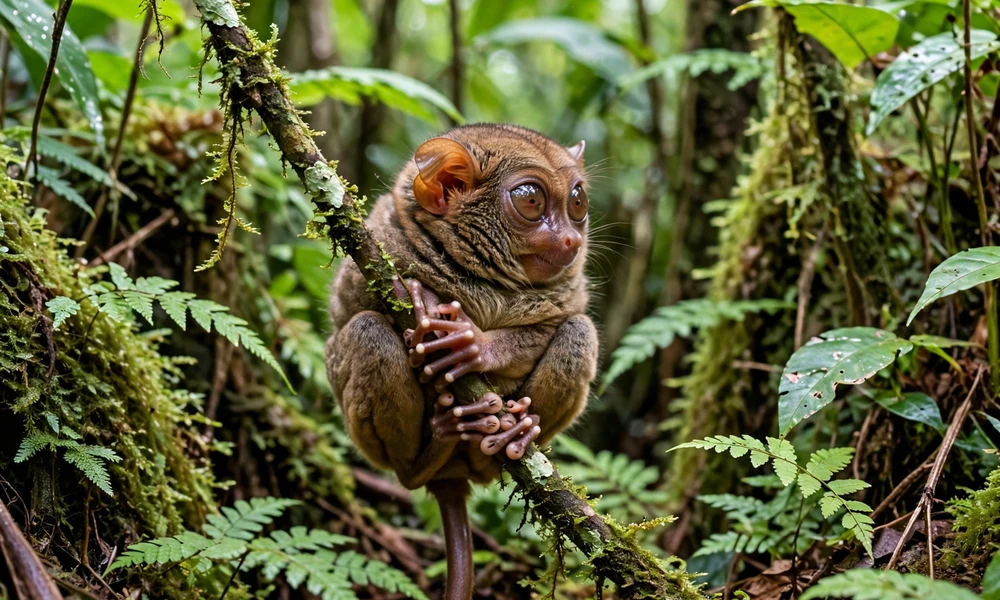
The Philippine tarsier is the country’s most famous small mammal, a tiny nocturnal primate with huge eyes and long fingers that lives in the forests of Bohol, Samar, Leyte and Mindanao. About the size of a human hand, it hunts insects at night, leaping between branches in the dark. Tarsiers are shy and easily stressed, so the best place to see them is the protected sanctuary at Corella in Bohol, where they are watched quietly and from a distance.
The tamaraw is the Philippines’ most remarkable large mammal, a small wild buffalo that lives only on Mindoro. Only a few hundred remain, all in the mountains of the island, and the species is critically endangered. It is a shy forest animal, and sightings are rare even for rangers, so visitors should treat it as a story of conservation rather than a sighting to plan a trip around.
Among the nocturnal animals, the Philippine flying lemur, also called the colugo, glides between trees in the forests of Bohol and Mindanao at night, while the binturong, a slow-moving forest mammal with a long tail, lives in the rainforest of Palawan. Philippine deer, the Visayan warty pig and the tiny mouse deer, or pilandok, live in the forests of the larger islands and Palawan.
One animal should not be on any visitor’s list as a certain sighting: the Philippine eagle. Once the great bird of prey of the Philippine forests, it is now critically endangered, with only a few hundred pairs left, most of them on Mindanao. No honest guide can promise a sighting, and the eagle’s decline is a reminder of how much of the Philippines’ wildlife depends on large, undisturbed rainforest.
Birds of the Philippines
The Philippine eagle is the country’s national bird and one of the largest eagles in the world, with a wingspan of more than two metres and a tall crest of shaggy feathers. It hunts monkeys and flying lemurs in the rainforest canopy of Mindanao, and it is one of the rarest birds of prey on earth. The Philippine Eagle Center near Davao City is the best place to learn about the species and see rescued birds that cannot return to the wild.
Hornbills are the other great birds of the Philippine forest. The Rufous hornbill, with its huge curved bill and loud call, lives in the rainforests of Luzon and Mindanao, and the Palawan hornbill lives only on Palawan. The Philippine cockatoo, a white parrot with a yellow crest, survives in small numbers on Palawan and in the Sulu archipelago.
The Philippines sits on the migration routes between Asia and Australia, making it one of the best birdwatching countries in the region. In the cooler months, birds arrive from the north, from shorebirds and ducks to warblers and birds of prey. Candaba Swamp on Luzon is one of the finest birdwatching sites in the country, with wild ducks, egrets and herons.
Reefs, coasts and smaller wildlife
The whale shark is the Philippines’ most famous marine animal, and Donsol in Sorsogon is the best place to see it. The sharks gather there from November to May, when plankton is plentiful, and visitors can swim with them under strict rules, keeping a safe distance and never touching the animals. At Oslob in Cebu, whale sharks are present for much of the year, but they are fed there, so many travellers prefer Donsol, where encounters are natural.
Around the reefs of Palawan, Cebu and Bohol, the smaller marine life is just as rich. Green and hawksbill turtles feed on the reefs and nest on the sandy beaches of the Turtle Islands and Palawan, and the sardine run at Moalboal in Cebu brings millions of small fish together in a shimmering ball just off the beach, all year round. Like the coastal animals of other tropical countries, the reef fish, corals and turtles of the Philippines depend on clean, undisturbed water.
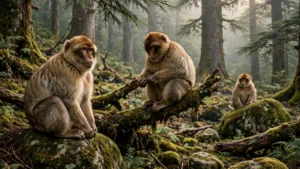
Smaller land animals are everywhere, though often overlooked. Long-tailed macaques live in the forests and mangroves of many islands, monitor lizards bask on riverbanks, and the frogs and dragonflies of the rice fields are at their busiest after rain.
| Species | Where to look | Best season | How likely is a sighting |
|---|---|---|---|
| Philippine eagle | Rainforest of Mindanao, Philippine Eagle Center | December to May | Very low in the wild |
| Philippine tarsier | Corella sanctuary, Bohol | Year-round, daytime visits | Good at the sanctuary |
| Tamaraw | Mountains of Mindoro | Dry season | Very low, do not expect one |
| Whale shark | Donsol, Sorsogon | November to May | Good in season |
| Palawan hornbill | Rainforest of Palawan | December to May | Fair with a guide |
| Green turtle | Reefs of Palawan, Cebu and Bohol | Year-round | Good while snorkelling |
| Sardine run | Moalboal, Cebu | Year-round | Very good |
Best seasons for wildlife watching
The dry season, from December to May, is the finest time for wildlife watching. The seas are calm, the reefs are clear, the forest trails are dry, and the birds are at their most active. Keep to paths and give every animal more space than you think it needs.
The whale shark season at Donsol runs from November to May, and the diving season at Tubbataha Reefs runs from March to June, when the seas are at their calmest. The sardine run at Moalboal and the turtles of Palawan and Cebu can be seen all year.
The wet season, from June to November, brings heavy rain and rough seas, and many boat trips are cancelled, but the forests are at their greenest and the rice fields fill with frogs, dragonflies and water birds. December to February is also the best time for migratory birds from Asia.
Staying safe around the Philippines’ wildlife
The Philippines’ large animals are usually calm, but they deserve respect. Keep your distance from wild pigs and deer, never approach a macaque with young, and never try to feed or touch any wild animal. If you meet a wild pig, back away slowly and never run, and keep food and bags out of reach of bold monkeys at viewpoints.
In the sea, keep away from nesting turtles, never touch a whale shark or a turtle, and never stand on coral. In the forest, carry water and sun protection, and tell someone where you are going before a long walk. Snakes are shy and avoid people, but watch them from a distance, and wear sturdy shoes on forest trails.
Philippines wildlife watching checklist
- Book a local guide for hornbills, eagles and forest birds.
- Visit the tarsier sanctuary at Corella in Bohol, and watch the tarsiers quietly and from a distance.
- Plan whale shark trips to Donsol from November to May, and choose natural encounters over feeding sites.
- Bring binoculars, reef-safe sunscreen and waterproofs — island weather changes fast.
- Keep at least 50 metres from nesting birds and deer, and far more from wild pigs with young.
- Never feed wild animals, and never use food or calls to lure them closer for a photograph.
- Leave no trace: take your rubbish home and keep to marked paths in sensitive habitats.
Frequently asked questions
What is the most famous animal in the Philippines?
The Philippine eagle is the most famous land animal, and the Philippine tarsier is the best-loved small mammal. The whale sharks of Donsol and the sardine run at Moalboal are the most famous marine sights.
Are there tarsiers in the Philippines?
Yes. Philippine tarsiers live in the forests of Bohol, Samar, Leyte and Mindanao, and the best place to see them is the protected sanctuary at Corella in Bohol.
Can I see a Philippine eagle in the Philippines?
Not in any realistic sense in the wild. The Philippine eagle is critically endangered, with only a few hundred pairs left, most of them on Mindanao, and no honest guide or tour can promise a sighting. The Philippine Eagle Center near Davao City is the best place to see rescued birds.
When is the best time to see whale sharks in the Philippines?
From November to May at Donsol in Sorsogon, when the sharks gather to feed on plankton. Go early in the morning for the calmest seas and the best light.
Can I see turtles in the Philippines?
Yes. Green and hawksbill turtles feed on the reefs of Palawan, Cebu and Bohol all year, and nest on the beaches of the Turtle Islands and Palawan. The best way to see them is while snorkelling with a local guide.
How is this guide different from the Indonesia animals guide?
This guide covers the Philippines, an archipelago of more than 7,000 islands with very high endemism, including the Philippine eagle, the tamaraw and the Philippine tarsier, which live nowhere else. The Indonesia animals guide covers a much larger archipelago, with a different mix of species, including orangutans, Komodo dragons and Sumatran tigers, which do not live in the Philippines.
Conclusion
The Philippines’ wildlife rewards patience: tarsiers in Bohol, hornbills in Palawan, whale sharks off Donsol and turtles on the reefs of Cebu are all within reach if you plan around the seasons.
The next step is to pick one species and one season — a dry-season trip to Bohol for tarsiers, a whale shark trip to Donsol from November to May, or a snorkelling trip to Moalboal for the sardine run.