Rainforest animals are the creatures that live in the warm, wet forests near the equator, from the jaguar and the orangutan to the toucan, the sloth and the poison dart frog. If you are wondering what lives in the rainforest, the short answer is this: more kinds of animals than anywhere else on earth, most of them living high in the trees, in a warm, damp world where it rains almost every day and the forest never really sleeps.
This guide covers the best-known rainforest animals, grouped by the kind of animal they are. Rainforests grow in South America, Central America, Africa, Asia and Australia, and this guide looks at them all, not just the Amazon.
Key takeaways
- Rainforest animals include jaguars, orangutans, toucans, sloths, poison dart frogs, capybaras and many more — rainforests hold more species than any other habitat on land.
- The jaguar is the largest cat of the Americas, and it is one of the strongest biters of any big cat.
- The sloth spends almost its whole life hanging upside down in the trees, moving so slowly that algae grows in its fur.
- Poison dart frogs are tiny, brightly coloured frogs, and their skin carries toxins that warn predators to stay away.
- Most rainforest animals live in the canopy, the treetop layer, and rarely come down to the forest floor.
Big cats and primates
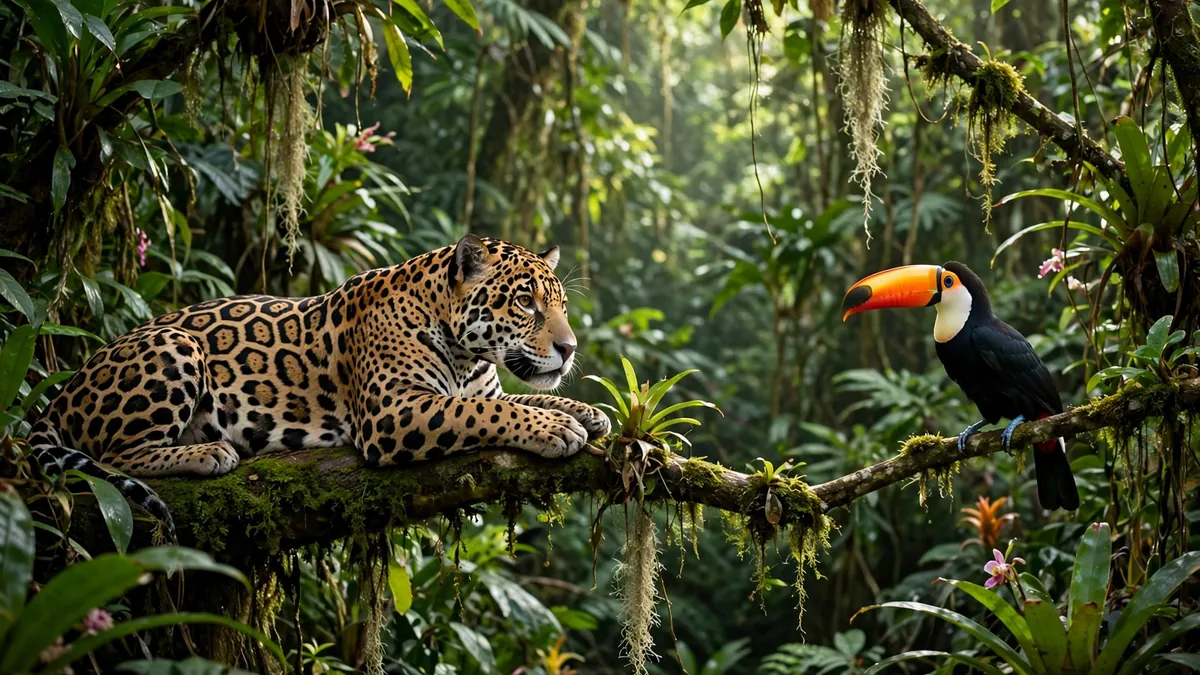
The jaguar is the largest cat of the Americas and the top predator of the rainforests of Central and South America. It is a powerful, spotted hunter that swims well and takes fish, turtles, capybaras and deer, and it has one of the strongest bites of any big cat, strong enough to pierce the shell of a turtle. Jaguars hunt alone, mostly at night, and they need large areas of forest to find enough prey.
The orangutan is a great ape of the rainforests of Borneo and Sumatra, and it spends almost its whole life in the trees. It has long arms and a reddish coat, and it builds a new nest of leaves and branches high in the canopy every night. Orangutans are among the cleverest of animals, using sticks as tools and learning from their mothers for years. Like the predator animals of other habitats, the jaguar keeps the numbers of the animals below it in balance.
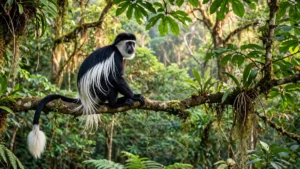
Monkeys are everywhere in the rainforest. Howler monkeys are the loudest land animals in the world, and their dawn calls can be heard for miles through the forest. Spider monkeys swing through the canopy on long arms and a gripping tail, while capuchin monkeys use stones as tools to crack nuts. In Africa, gorillas and chimpanzees live in the rainforests of the Congo, and in Asia, gibbons sing duets from the treetops at dawn.
Birds of the rainforest
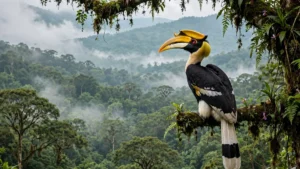
The toucan is one of the best-known rainforest birds, with a huge, brightly coloured bill and a black body. Its bill looks heavy, but it is light and hollow inside, and the toucan uses it to reach fruit on thin branches that would not hold its weight. Toucans live in small groups in the canopy, and they nest in holes in trees.
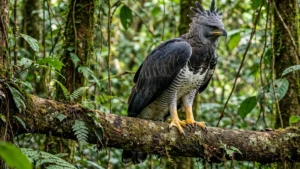
Macaws are large, long-tailed parrots, and they are among the loudest and most colourful birds in the forest. Scarlet macaws, blue-and-gold macaws and hyacinth macaws fly in pairs or small flocks, calling loudly as they cross the canopy, and they eat fruit, nuts and seeds, cracking the hardest nuts with their strong bills. The harpy eagle is the most powerful eagle of the rainforest, with huge talons, and it hunts monkeys and sloths in the canopy. The owl species of the rainforest hunt there at night.
Hummingbirds are the smallest birds in the forest, and they can hover in the air, beating their wings so fast they hum, as they drink nectar from flowers. The birds of paradise of New Guinea are famous for the males’ displays, with bright plumes and strange dances to win a mate. The cassowary, a large flightless bird of Australia and New Guinea, has a tall helmet on its head and can be dangerous when cornered.
Frogs, reptiles and the forest floor
Poison dart frogs are tiny, brightly coloured frogs of the rainforests of Central and South America, and their skin carries toxins that warn predators to stay away. The red-eyed tree frog is one of the best known, with a bright green body, red eyes and orange feet, and it spends its life on leaves in the canopy, coming down only to lay eggs.
Snakes are common in the rainforest, and most are harmless to people. The green anaconda of South America is the heaviest snake in the world, and it lives in the rivers and swamps of the forest, taking fish, birds and mammals. The emerald tree boa is a bright green snake that coils on a branch and waits for birds and small mammals to come close. Chameleons, the colour-changing lizards of Madagascar and Africa, catch insects with a tongue longer than their body.
On the forest floor, the capybara is the largest rodent in the world, a gentle, semi-aquatic animal that lives in groups near rivers and lakes. Tapirs, with their short trunks, browse on leaves and fruit in the undergrowth, and peccaries move through the forest in noisy herds. Leafcutter ants march in long columns, carrying pieces of leaf back to their nests, where they grow a fungus to eat. Like the small animals of other habitats, these forest-floor animals are the prey of the jaguar and the harpy eagle.

Life in the canopy
The canopy, the treetop layer of the rainforest, is where most rainforest animals live. It is warm, bright and full of fruit, flowers and leaves, and it is a world of its own, with its own animals that rarely come down to the ground. Sloths spend almost their whole lives hanging upside down from branches, moving so slowly that algae grows in their fur, which helps them blend into the trees. They come down to the ground only about once a week.
Many canopy animals never touch the ground at all. Flying squirrels glide from tree to tree on flaps of skin, and the kinkajou, a relative of the raccoon, uses its long tail to grip branches as it feeds on fruit and nectar at night. Tree frogs lay their eggs on leaves above pools of water, and when the tadpoles hatch they drop into the water below.
The rainforest is layered like a building. The emergent trees rise above the canopy, the canopy forms the roof, the understorey is dim and damp, and the forest floor is dark and quiet. Each layer has its own animals. Like the forest animals of cooler lands, rainforest animals depend on the trees themselves, but here the forest is taller, wetter and far richer in species.
Rainforest animals and people
People have lived in rainforests for thousands of years, and many forest peoples know the animals, the plants and the seasons of the forest better than anyone. Rainforests give the world fruit, medicines, timber and clean air, and they are home to animals found nowhere else on earth.
Not every story is a happy one. Rainforests are being cut down for farms, for cattle, for timber and for mining, and every patch of forest that is lost takes its animals with it. The orangutan is in danger because its forest in Borneo and Sumatra is being cleared, and the jaguar is losing the large areas of forest it needs to hunt.
Protecting rainforest animals means protecting the whole forest: the tall trees, the rivers and the corridors that let animals move between patches of forest. National parks and reserves, and the work of the people who live in and near the forest, are the best hope for the jaguar, the orangutan and the thousands of smaller animals that share their home.
| Animal | Type | Where it lives | Best-known fact |
|---|---|---|---|
| Jaguar | Mammal | Central and South America | Strongest bite of any big cat |
| Orangutan | Mammal | Borneo and Sumatra | Builds a new nest every night |
| Sloth | Mammal | Central and South America | Algae grows in its fur |
| Toucan | Bird | Central and South America | Huge, light, colourful bill |
| Scarlet macaw | Bird | Central and South America | Loud, long-tailed parrot |
| Poison dart frog | Amphibian | Central and South America | Bright colours warn of toxins |
| Green anaconda | Reptile | South American rivers | Heaviest snake in the world |
| Capybara | Mammal | South American rivers | Largest rodent in the world |
Rainforest animals checklist
- Start with the big ones: jaguar, orangutan, gorilla, tapir and capybara.
- Remember the canopy: sloth, toucan, macaw, howler monkey and harpy eagle.
- Do not forget the small and bright: poison dart frog, red-eyed tree frog and hummingbird.
- Add the forest floor: leafcutter ants, peccaries and the green anaconda.
- Check the facts: the jaguar is the largest cat of the Americas, and the sloth rarely comes down to the ground.
- Use this guide for quizzes, school projects and trips, and add your own favourites.
Frequently asked questions
What is the most famous rainforest animal?
The jaguar is the most famous rainforest animal of the Americas, and the orangutan is the most famous of Asia. The jaguar is the strongest hunter in its forest, and the orangutan is the largest tree-living ape.
How many animals live in the rainforest?
Rainforests hold more species than any other habitat on land, and many rainforest animals have not yet been described. New species of frogs, insects and even mammals are found every year.
Do sloths really move that slowly?
Yes. Sloths spend almost their whole lives hanging upside down in the trees, moving so slowly that algae grows in their fur. They come down to the ground only about once a week, and they are good swimmers when they need to cross a river.
Are poison dart frogs dangerous to people?
Poison dart frogs carry toxins in their skin, and their bright colours warn predators to stay away. They are not aggressive, and they are dangerous only if handled or eaten, so the best rule is to look and not touch.
What animals live in the rainforest canopy?
The canopy is home to sloths, monkeys, toucans, macaws, tree frogs and the harpy eagle. Most canopy animals rarely come down to the forest floor, and many spend their whole lives in the trees.
Why are rainforest animals in danger?
Rainforests are being cut down for farms, cattle, timber and mining, and every patch of forest that is lost takes its animals with it. The orangutan and the jaguar are both losing the large areas of forest they need, and many smaller animals are losing their homes too.
Conclusion
The rainforest holds more kinds of animals than anywhere else on earth, from the jaguar in the shadows to the toucan in the canopy and the tiny frog on a leaf. Pick a favourite, learn its story, and the forest will never look like just a wall of green again.
Visit a rainforest trail at dawn, listen to the calls from the canopy, and remember that above and around you there is a world as rich as any on the planet.