The european starling species is a single bird, Sturnus vulgaris, and it is one of the most familiar songbirds on Earth, a glossy black bird with a green and purple sheen that gathers in flocks of thousands and fills the evening sky with swirling murmurations. If you are asking how many european starling species there are, the answer is one: there is a single european starling species, Sturnus vulgaris, one of more than 120 starling species in the family Sturnidae, and it is native to Europe and western Asia but now lives on every continent except Antarctica.
At a distance a European starling looks plain, almost black, but up close it is one of the most colourful garden birds, with iridescent feathers, pale spots in winter and a yellow bill in the breeding season. It is also one of the cleverest: starlings copy the songs of other birds and even the sounds of machines, and they have followed people into cities, farms and suburbs all over the world.
Key takeaways
- There is one european starling species, Sturnus vulgaris, one of more than 120 starling species in the family Sturnidae.
- European starlings are about 19 to 23 centimetres long, weigh roughly 58 to 101 grams, and have a wingspan of about 31 to 44 centimetres.
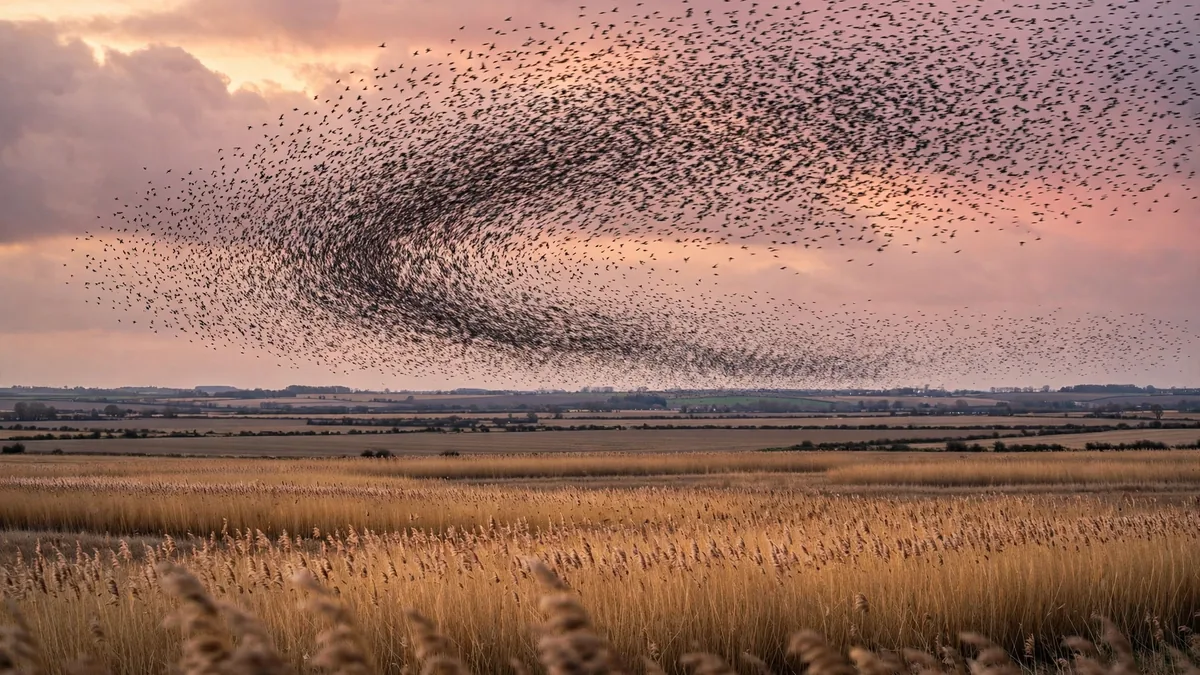
- European starlings are famous for murmurations, huge swirling flocks that can number in the hundreds of thousands before they settle to roost.
- They eat insects and other soil invertebrates in the breeding season, and seeds, fruit and scraps outside it.
- European starlings are listed as Least Concern worldwide, though the British breeding population has fallen by more than 80 percent since the 1960s and the bird is Red-listed in the United Kingdom.
What makes a European starling a European starling
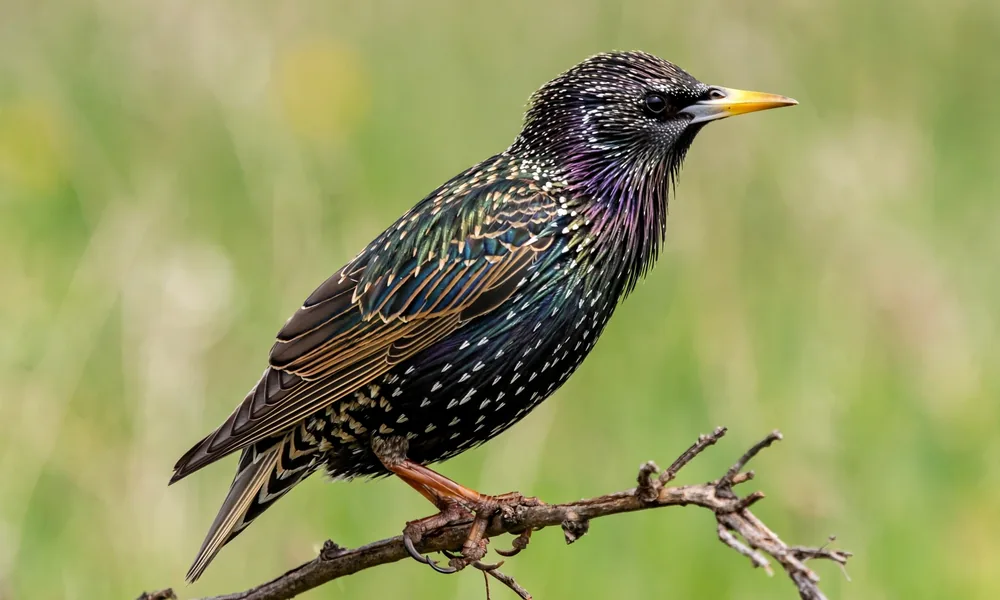
A European starling in breeding plumage is a striking bird: glossy black feathers that shine green and purple in sunlight, a long pointed yellow bill, pinkish legs and a short tail. In winter the same bird looks quite different, heavily spotted with pale stars, because the tips of its fresh feathers are pale and wear away through the year to reveal the glossy black underneath.
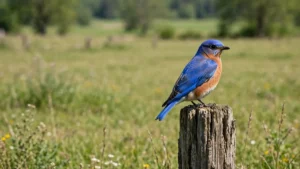
The body is built for life on the ground as much as in the air. A European starling is stocky and short-tailed, with strong legs for walking across lawns and a pointed bill it uses for open-bill probing, pushing its closed bill into soft soil and then opening it to find insects hiding below. Its wings are pointed and triangular, giving it fast, direct flight, and it can walk, run and hop with equal ease. Like eastern bluebirds, which also nest in holes and feed on the ground, a starling is a bird of open country that has learned to live alongside people.
The European starling species and their relatives
There is one european starling species, Sturnus vulgaris, and it belongs to the family Sturnidae, a large family of more than 120 starling species found mostly in Europe, Asia and Africa. The European starling has about 12 subspecies across its native range, from Britain and Ireland east to western Mongolia, each slightly different in size and gloss. Its closest relative is the spotless starling of Iberia and North Africa, a very similar bird without the pale winter spots.
The wider starling family is full of colour and variety. The rosy starling of eastern Europe and Asia is pink and black and follows locust swarms, the common myna of Asia is a bold brown bird with a yellow face that has spread through the tropics, and the superb starling of East Africa is one of the most colourful birds of the savanna, with a blue back, orange belly and white breast band. Most starlings share the same habits: they are social, noisy, good mimics and quick to exploit new food.
| Type | Animal | Where it lives | Best-known food | Length or Weight |
|---|---|---|---|---|
| Family | Starlings (family Sturnidae) | Europe, Asia and Africa | Insects, fruit and seeds | About 19 to 30 cm long |
| Species | European starling (Sturnus vulgaris) | Europe and western Asia, introduced worldwide | Beetle grubs, leatherjackets and berries | About 19 to 23 cm long |
| Species | Spotless starling (Sturnus unicolor) | Iberia, North Africa and Mediterranean islands | Insects, fruit and seeds | About 19 to 22 cm long |
| Species | Rosy starling (Pastor roseus) | Eastern Europe and central Asia | Locusts, insects and fruit | About 19 to 22 cm long |
| Species | Common myna (Acridotheres tristis) | Asia, introduced to many tropical regions | Insects, fruit and scraps | About 23 to 26 cm long |
| Species | Superb starling (Lamprotornis superbus) | Savannas of East Africa | Insects, seeds and fruit | About 18 to 19 cm long |
How European starlings live
European starlings eat mostly insects in the breeding season, and they feed their chicks on soil invertebrates such as beetle grubs, leatherjackets, earthworms and spiders, which they find by probing lawns and pasture. Outside the breeding season they turn to seeds, grain, fruit, berries and human food scraps, and they visit garden feeders in large noisy groups. This flexible diet is one reason the species adapts so well to farmland, gardens and towns.
Breeding begins in spring, when males claim a nest hole and sing from a high perch to attract a mate. Starlings nest in tree holes, gaps in buildings, eaves and nest boxes, and the male starts an untidy nest of grass and straw. The female usually lays four or five glossy pale blue eggs, which hatch after about two weeks, and both parents feed the chicks for about three weeks in the nest and for another week or two after they leave.
Starlings are famous for two things above all: their murmurations and their mimicry. In autumn and winter, huge flocks gather at dusk and wheel together in shifting clouds before dropping into a roost, a display that can involve hundreds of thousands of birds and that helps them confuse predators such as hawks and falcons. Their song is a long warbling chatter full of whistles, rattles and copied sounds, and individual starlings have been heard imitating other birds, car alarms and even human speech.
Where European starlings live
European starlings are native to temperate Europe and western Asia, from Britain and Ireland east to western Mongolia, and to parts of North Africa. They live in open country: farmland, grassland, parks, gardens, towns and the edges of woodland, wherever there are short grass to feed on and holes to nest in. They avoid dense forest and high mountains, and they are most common where people farm the land.
People have carried the starling far beyond its native range. About 100 birds were released in Central Park in New York in 1890, and their descendants now number around 200 million across North America. Starlings were also introduced to Australia, New Zealand, South Africa and South America, where they are often considered invasive because they compete with native cavity-nesting birds for nest holes. In North America they compete with birds such as bluebirds, flickers and swallows for nest holes.
European starlings are listed as Least Concern, because they are widespread and still enormously numerous, with a global population estimated at about 310 million. They are not free of trouble, though: the British breeding population has fallen by more than 80 percent since the 1960s, and the bird is now Red-listed in the United Kingdom. Starlings depend on healthy farmland, and the loss of insect-rich pasture is thought to be the main cause of the decline.
Best seasons for European starling watching
The best time to watch European starlings is autumn and winter, from October to February, when the murmurations are at their biggest and the birds gather at their roosts at dusk. The largest displays often come in early February, when flocks from northern Europe have joined the resident birds. Arrive an hour before sunset, find a reedbed, pier or woodland roost, and watch the sky as the flocks build into a swirling cloud.
Staying safe around European starlings
A European starling is a small, bold bird that is used to people, but it is still wild and should be watched from a distance. Never try to catch or handle one, and never reach into a nest hole. At a roost, keep quiet and stay back from the reedbed so the flock is not flushed into the dark, and keep dogs on a lead near feeding flocks.
European starling watching checklist
A little preparation turns a winter evening at a roost into a real chance of seeing a murmuration, so pack for cold dusk hours, open skies and long quiet waits.
- Binoculars, because the flock is best watched as it builds high in the sky.
- Warm layers, a hat and gloves, for standing still at dusk in winter.
- A visit to a reedbed, pier or woodland roost in October to February, when the flocks are biggest.
- A plan to arrive an hour before sunset, so you see the flock gather and settle.
- A garden feeder with fat balls and mealworms, for close views of starlings in daylight.
- Patience and silence, because a noisy group will send a nervous flock elsewhere.
- A field guide to birds, for telling a starling in winter plumage from a spotless starling.
Frequently asked questions
How many european starling species are there?
There is one european starling species, Sturnus vulgaris. It has about 12 subspecies across its native range, and it is one of more than 120 starling species in the family Sturnidae.
What is a murmuration?
A murmuration is a huge flock of starlings flying together in a swirling, shape-shifting cloud, usually at dusk in autumn and winter before the birds settle into a communal roost. Flocks can range from a few hundred birds to hundreds of thousands.
What does a European starling eat?
European starlings eat insects and other soil invertebrates such as beetle grubs, leatherjackets, earthworms and spiders in the breeding season, and seeds, grain, fruit, berries and human food scraps outside it. They find hidden prey by open-bill probing, pushing their closed bill into soft ground and opening it to expose the food.
Why are European starlings considered invasive in North America?
European starlings were released in New York in 1890 and spread across the continent, where they now number around 200 million. They compete aggressively with native cavity-nesting birds such as bluebirds, flickers and swallows for nest holes.
How is this guide different from the angelfish species guide?
This guide covers the European starling, a single songbird species that lives in fields, gardens and towns, feeds on insects and seeds, and gathers in huge murmurations at dusk, while our angelfish species guide covers the angelfish, about 88 species of brightly coloured fish that live on coral reefs and in Amazon rivers. Starlings fly in great clouds over open farmland, and angelfish glide through warm South American water.
Are European starlings endangered?
No. European starlings are listed as Least Concern worldwide, with a global population estimated at about 310 million. They have declined sharply in Britain, where the breeding population has fallen by more than 80 percent since the 1960s and the bird is Red-listed, so insect-rich pasture and nest holes help them most.
Conclusion
The european starling species shows how completely one bird can belong to open country and to people: a single species, Sturnus vulgaris, with glossy feathers, a gift for mimicry and flocks that turn the evening sky into a living cloud.
If you go looking for one, go to a reedbed roost at dusk in winter, go quietly, and go with patience. Watch the flock gather, swell and swirl overhead, and listen for the warbling chatter as the birds settle, and you will understand why keeping its farmland rich in insects matters most.