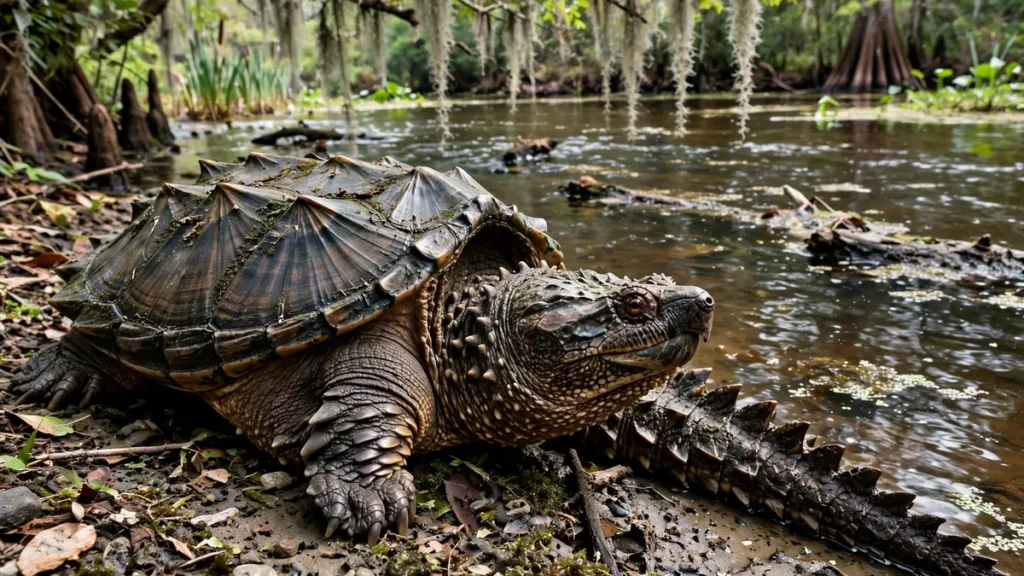
The alligator snapping turtle species number one, a single species called Macrochelys temminckii, the largest freshwater turtle in North America, a prehistoric-looking animal with a spiked shell, a hooked beak and a worm-shaped lure on its tongue. If you are asking how many there are, the answer is one: there is one recognised alligator snapping turtle species in the world.
It lives in the rivers, bayous and lakes of the southeastern United States, where it spends almost its whole life underwater, lying motionless on the river bottom with its jaws open, waiting for a fish to mistake its tongue for a worm. It can stay submerged for 40 to 50 minutes, and its bite is powerful enough to break bone.
Key takeaways
- There is one alligator snapping turtle species, Macrochelys temminckii.
- Males average about 66 centimetres in shell length and 79 kilogrammes, with some reaching 100 kilogrammes, while females are much smaller at about 23 kilogrammes.
- They live for 20 to 70 years in the wild, and some may live for 50 to 100 years.
- They lure fish with a bright red worm-shaped appendage on their tongue, then snap their jaws shut with great speed and force.
- They are listed as Vulnerable, after heavy harvesting for meat and shells reduced their numbers.
What makes an alligator snapping turtle an alligator snapping turtle
An alligator snapping turtle is a huge freshwater turtle with a large triangular head, a hooked beak-like jaw, a thick scaled tail, and a heavy dark shell with three high ridges of pointed scales down its back. Males average about 66 centimetres and 79 kilogrammes, while females top out at around 23 kilogrammes. The shell is grey, brown, black or olive green, and is often covered in algae, which helps it blend into the river bottom.
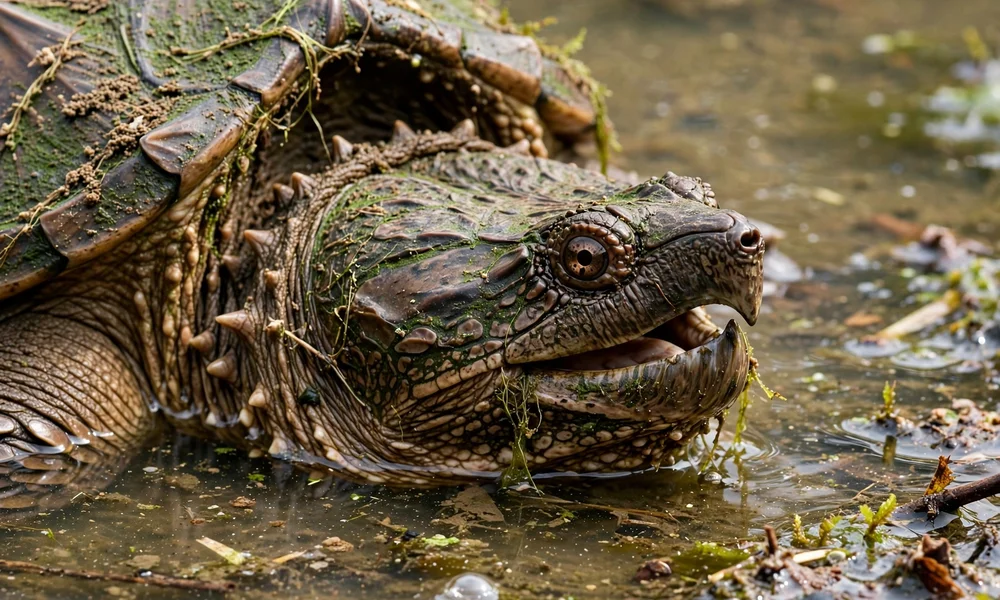
The mark that sets the species apart is the worm-shaped lure on its tongue, a bright red piece of flesh that wiggles like a worm when it lies still with its mouth open. No other living turtle fishes this way, and the lure, the three ridges and the extra row of scales along each side of the shell separate it from its closest relative, the common snapping turtle, which has a smoother shell and no lure. Like other turtles, it is a reptile, but its size, its spiked shell and its fishing trick make it unmistakable.
The alligator snapping turtle species and their relatives
There is one alligator snapping turtle species. It belongs to the family Chelydridae, the snapping turtles, and is the largest member of that family. In 2014, scientists separated the Suwannee River populations as a distinct species, so this species as now defined ranges from the Choctawhatchee River in Florida westward to the San Antonio River in Texas.
The common snapping turtle is its closest relative, a smaller and far more aggressive turtle that lives across much of North America and has a smoother shell. The leatherback sea turtle is the largest turtle in the world, a giant of the open ocean that can weigh 500 kilogrammes, while the green sea turtle grazes on seagrass in warm shallow seas, and the loggerhead crushes crabs and molluscs with its powerful jaws.
| Type | Animal | Where it lives | Best-known food | Length or Weight |
|---|---|---|---|---|
| Species | Alligator snapping turtle (Macrochelys temminckii) | Rivers of the southeastern United States | Fish, molluscs and other turtles | About 66 cm shell, about 79 kg |
| Close relative | Common snapping turtle | North America | Fish, frogs and plants | About 40 cm shell, 10 to 16 kg |
| Close relative | Suwannee alligator snapping turtle | Suwannee River, Florida and Georgia | Fish and molluscs | About 60 cm shell, up to 80 kg |
| Close relative | Leatherback sea turtle | Open oceans worldwide | Jellyfish | About 180 cm shell, up to 500 kg |
| Close relative | Green sea turtle | Warm shallow seas | Seagrass and algae | About 120 cm shell, up to 200 kg |
| Close relative | Loggerhead sea turtle | Warm oceans worldwide | Crabs and molluscs | About 100 cm shell, up to 200 kg |
| Close relative | Red-eared slider | Ponds and rivers of North America | Plants and small animals | About 25 cm shell, about 2 kg |
How alligator snapping turtles live
Alligator snapping turtles are creatures of deep slow water. It is generally solitary, lying still on the muddy river bottom for hours at a time, so still that algae grows on its back. It can stay underwater for 40 to 50 minutes before surfacing for air, and is most active at night, though it also hunts by day, using its lure. Females come ashore only to nest, and they may walk about 50 metres inland to lay their eggs.
The lure is the heart of its hunting. The turtle lies motionless with its jaws wide open, wiggling the bright red worm-shaped appendage on its tongue, while the grey-brown speckled inside of its mouth completes the disguise. A curious fish or frog comes close to inspect the worm, and the turtle snaps its jaws shut in a fraction of a second, with a bite powerful enough to break bone and to sever a human finger. The lure is used most by young turtles, and as the animals grow it becomes smaller in proportion to the body, and the adults shift to more active foraging at night, hunting by scent as well.
They are hunters and scavengers, eating fish, molluscs, frogs, snakes, snails, crayfish, insects, other turtles, small mammals and aquatic plants, along with carrion. Fish are eaten most often, but in one Louisiana study acorns made up most of the stomach contents by volume. They live for 20 to 70 years in the wild, and some may live for 50 to 100 years. They are slow to mature, taking more than a decade to reach breeding age, which is one reason their numbers recover so slowly after they are harvested.
In late winter and early spring the female lays a single clutch of about 10 to 50 eggs in sandy soil, usually in late April and May, digging a nest well away from the water. The eggs incubate for about 100 days, and most hatch in mid-August, with the sex of the young decided by nest temperature, warmer nests producing females and cooler nests producing males. The hatchlings dig themselves out and make for the water alone, because there is no parental care.
Where alligator snapping turtles live
It lives almost exclusively in the rivers, canals, lakes, bayous and oxbow lakes of the southeastern United States, in the river systems that drain into the Gulf of Mexico. Its range runs from the Choctawhatchee River in Florida westward to the San Antonio River in Texas, and north up the Mississippi drainage as far as Iowa. It prefers deep slow-moving water with a muddy bottom, submerged logs and overhanging trees, and does not usually occur in isolated ponds or wetlands.
They are listed as Vulnerable, with the population trend unknown, and are protected through most of their range. Adults have no natural predators other than humans, who captured them for meat, shells and the exotic animal trade, and unregulated harvesting for turtle soup in the twentieth century cut their numbers severely. Habitat loss has added to the pressure, and because they mature slowly and lay only one clutch a year, a harvested population takes decades to recover.
Best seasons for alligator snapping turtle watching
There is no closed season, because they are active all year in the warm rivers of the south, but the best months are often late spring to early autumn, when they are feeding and moving most. The best hours are dawn and dusk, when they are most active and their dark shells are easiest to spot.
The best chance of all comes in the nesting season, in late April and May, when females leave the water to lay their eggs and may be seen crossing river banks at night. Even then, sightings are rare, because they spend almost all of their lives hidden underwater.
Staying safe around alligator snapping turtles
It is a wild animal with extremely powerful jaws, and its bite can easily break bone and has been known to sever human fingers, though they almost never attack people and are not aggressive when left alone. Keep your distance, never put a hand near its head, and never pick one up by its tail. If you see one on land, stay calm, give it plenty of room, and let it move on in its own time, and if one is in trouble, call your local wildlife authorities rather than handling it yourself.
Alligator snapping turtle watching checklist
A little preparation turns a visit to a southern river into a real chance of seeing one, so pack for heat and mosquitoes and long quiet hours.
- Sun protection and a hat, for standing on bright river banks in the southern sun.
- Binoculars, because the turtles lie low in the water and are best watched from a distance.
- A camera with a zoom lens, for the ridged shell and hooked beak without getting close.
- A visit to a slow river or bayou at dawn, when they are most active and feeding.
- A plan to be out in the late spring, when females come ashore to nest and are easiest to see.
- Patience and silence, because turtles are shy animals and a noisy group will send them away.
- A field guide to turtles, for telling it from its common cousin at a glance.
Frequently asked questions
How many alligator snapping turtle species are there?
There is one, Macrochelys temminckii. The Suwannee River populations were separated as a distinct species in 2014, so this species now ranges from Florida westward to Texas.
How does the alligator snapping turtle catch fish?
It lies motionless on the river bottom with its jaws open and wiggles a bright red worm-shaped appendage on its tongue. A fish that comes close to inspect the worm is caught when the turtle snaps its jaws shut.
What do alligator snapping turtles eat?
They eat fish, molluscs, frogs, snakes, snails, crayfish, insects, other turtles, small mammals and aquatic plants, along with carrion. Fish are the most frequently eaten item, though in one Louisiana study acorns made up most of the stomach contents by volume.
How big do alligator snapping turtles get?
Males average about 66 centimetres in shell length and about 79 kilogrammes, although some exceed 100 kilogrammes. Females are much smaller, topping out at around 23 kilogrammes.
How is this guide different from the Aldabra giant tortoise species guide?
This guide covers the single alligator snapping turtle species, a freshwater turtle that hunts fish with a worm-shaped lure, while our Aldabra giant tortoise species guide covers the Aldabra giant tortoise, a land tortoise that eats grasses and leaves. The alligator snapping turtle weighs about 79 kilogrammes and spends its life underwater, and the Aldabra giant tortoise can weigh up to 250 kilogrammes and spends its life grazing on land.
Are alligator snapping turtles endangered?
They are listed as Vulnerable, with the population trend unknown. They were heavily harvested for meat and shells in the twentieth century, and are now protected through most of their range, though habitat loss still threatens them.
Conclusion
The alligator snapping turtle species shows how much character one river turtle can hold: a single species, with a spiked shell, a hooked beak, and a worm on its tongue that is not a worm at all, but a lure for catching fish in the dark rivers of the south.
If you go looking for one, go to a slow river or bayou in the late spring, go quietly, and go with patience. Watch one lie still on the river bottom, and you will understand why it is called the dinosaur of the turtle world.