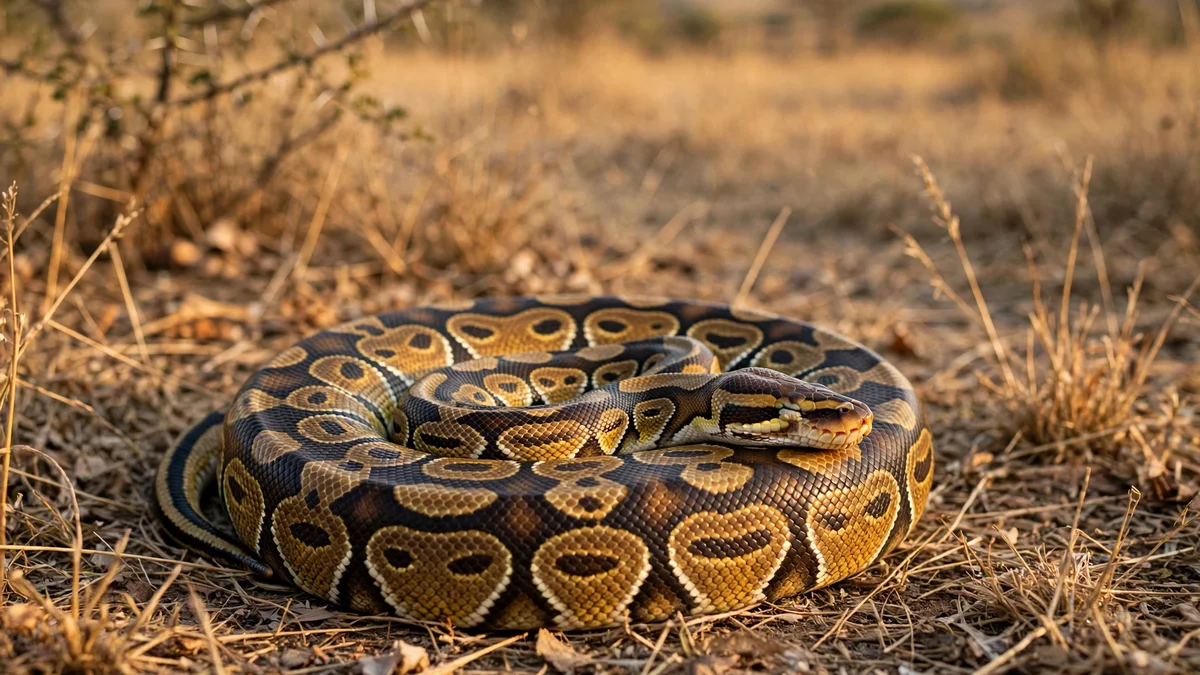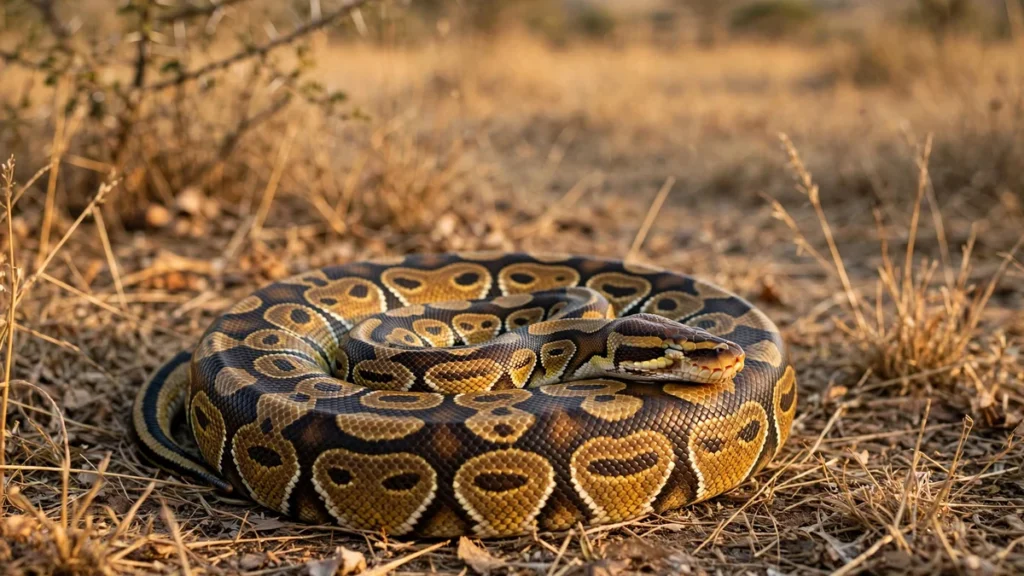
The ball python species is a single snake, Python regius, also called the royal python, the smallest of the African pythons and one of the best-known snakes in the world. If you are asking how many ball python species there are, the answer is one: a single recognised species, Python regius, a nonvenomous constrictor from the grasslands and open forests of West and Central Africa.
A ball python is a shy, heavy-bodied snake that spends its days hidden away and its nights hunting small mammals. When it feels threatened, it does the thing that gave it its name, tucking its head into the middle of its coils and rolling itself into a tight ball. That gentle nature, its modest size and its striking brown and gold pattern have made it the most popular pet snake on the planet, even as wild numbers fall under pressure from the pet trade.
Key takeaways
- There is just one ball python species, Python regius, also known as the royal python.
- Ball pythons are nonvenomous constrictors from the grasslands and open forests of West and Central Africa.
- Most adults are between 90 and 150 centimetres long, the smallest of the African pythons.
- A ball python defends itself by curling into a tight ball with its head tucked in the centre.
- The species is listed as Near Threatened, largely because of collection for the pet trade.
What makes a ball python a ball python
A ball python is a stocky, heavy-bodied snake with smooth, glossy scales, a relatively small head on a slender neck, and a short tail. Its back is dark brown or black, marked with light brown and gold blotches edged in cream, and its belly is white or cream, scattered with dark markings. The pattern varies a little from snake to snake, and captive breeders have produced a huge range of colour patterns, but a wild ball python is always brown, gold and black, colours that melt into dry grass and leaf litter.
The ball is the signature. When a ball python is frightened, it does not flee or strike like many snakes; instead it pulls its head and neck into the centre of its coils and winds itself into a tight, hard ball. A predator that finds a ball python in this state meets a knot of muscle with nothing soft to grab, and most give up and move on. Like the king cobra, a ball python can hunt in the dark, using heat-sensitive pits along its upper lip to pick out the warmth of a rat or mouse in a burrow.
The ball python species and their relatives
There is a single ball python species. It belongs to the family Pythonidae, the Old World pythons, and to the genus Python, which it shares with larger African and Asian relatives. The ball python is the smallest member of its family in Africa, and its scientific name, Python regius, means royal python, a name that comes from a story that the rulers of ancient Egypt wore these snakes as ornaments.
Its closest relatives are the other pythons of Africa and Asia. The African rock python is its big African cousin, growing to several metres, while the Burmese and reticulated pythons of Asia are among the longest snakes in the world. The green tree python of New Guinea and the carpet python of Australia show how the family has spread through the tropics, and all of them are nonvenomous constrictors that kill by wrapping around their prey.
| Type | Animal | Where it lives | Best-known food | Length or Weight |
|---|---|---|---|---|
| Family | Pythons (family Pythonidae) | Africa, Asia and Australia | Mammals and birds | About 1 to 6 metres long |
| Species | Ball python (Python regius) | West and Central Africa | Rats, mice and small birds | About 90 to 150 cm long |
| Species | African rock python (Python sebae) | Sub-Saharan Africa | Mammals, birds and reptiles | About 3 to 5 metres long |
| Species | Burmese python (Python bivittatus) | South and Southeast Asia | Mammals and birds | About 3 to 5 metres long |
| Species | Reticulated python (Malayopython reticulatus) | Southeast Asia | Mammals and birds | About 3 to 6 metres long |
| Species | Green tree python (Morelia viridis) | New Guinea and Australia | Small mammals and birds | About 120 to 180 cm long |
| Species | Carpet python (Morelia spilota) | Australia and New Guinea | Mammals and birds | About 2 to 3 metres long |
How ball pythons live
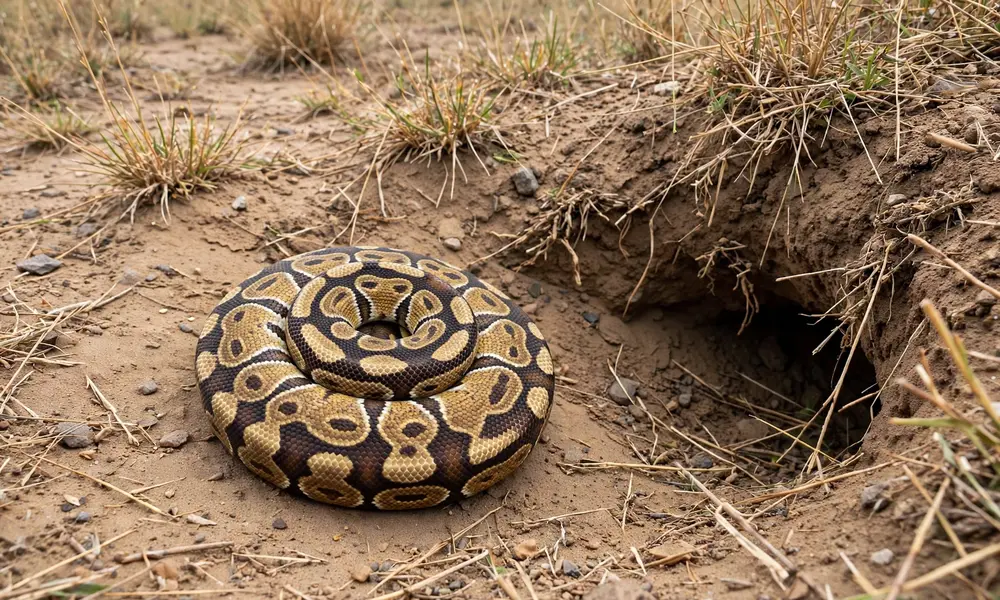
Ball pythons are snakes of the night, most active at dusk and after dark, and they spend the daylight hours tucked away in abandoned mammal burrows, termite mounds and hollow logs. They are ambush hunters rather than chasers: a ball python picks a good spot along a rodent run, waits in stillness, and strikes fast when prey comes close, seizing it and wrapping coils around it before swallowing it whole. They eat rarely, and a single meal can keep an adult going for weeks.
Rats and mice make up most of the diet, along with gerbils and shrews, and the menu changes with the snake’s size. Young ball pythons under about 70 centimetres feed mostly on small birds, while larger adults feed mostly on mammals, and females tend to take more mammals than males. A ball python can go for months without eating, especially in the cool, dry season, when it shelters underground until the warmth returns.
Breeding follows the rains. The female lays three to 11 large, leathery eggs in a sheltered burrow, then coils around them and stays with them until they hatch, about 55 to 60 days later, fasting for most of that time. The hatchlings are 25 to 43 centimetres long. Males reach breeding age at about 11 to 18 months, females at about 20 to 36 months. A ball python can live 20 to 30 years in captivity, and one is reported to have lived to 47 in a zoo.
Where ball pythons live
Ball pythons live in a broad belt of West and Central Africa, from Senegal in the west through Ghana, Togo, Benin and Nigeria, and east through Cameroon towards Sudan and Uganda. They prefer dry, open country: savanna grasslands, shrubland and the edges of open forest, and they do well in farmland, where rats and mice are plentiful and old burrows are easy to find.
Within that range, a ball python’s home is a small patch of ground with good cover: a burrow or termite mound to hide in by day, open ground to hunt across by night, and warm, humid air. Like turtles, which also favour warm, sheltered ground, a ball python is a creature of the floor of its habitat rather than the canopy.
The species is listed as Near Threatened, after being reclassified in 2021, and its numbers are believed to be falling in much of West Africa. The main threat is collection for the international pet trade: millions have been exported from a small number of West African countries over recent decades, and it is also hunted for skin, meat and traditional medicine. Habitat loss adds to the pressure as grasslands are cleared.
Best seasons for ball python watching
The best time to look for a ball python in the wild is the wet season, roughly May to October across much of West Africa, when the snakes are most active and their rodent prey is plentiful. Go out at dusk or just after dark, and look along the edges of fields, tracks and grassland where rats run. A local guide is the surest way to find one, and night walks in Ghana and Togo are the best-known way to see a wild ball python.
Staying safe around ball pythons
A ball python is not dangerous to people. It is nonvenomous, and its first response to a threat is to curl into a ball rather than to bite, so a wild ball python will almost always choose stillness over a fight. Even so, never pick up or handle a wild snake, and never put a hand into a burrow, because a frightened snake of any kind can bite. Give the snake space, watch it from a few steps away, and let it move off in its own time.
Ball python watching checklist
A little preparation turns a night walk in the West African savanna into a real chance of seeing a ball python, so pack for warm nights and long quiet hours.
- A red-filtered torch, for finding a snake at night without blinding it.
- Sturdy closed shoes and long trousers, for dry grass and rough ground after dark.
- A local guide, because ball pythons are shy and well hidden, and a guide knows the burrows.
- A camera with a good low-light setting, for the patterned coils without getting close.
- Water and insect repellent, for warm, humid nights in the grassland.
- Patience and silence, because a ball python hunts by ambush and noise will keep it in its burrow.
- A field guide to West African reptiles, for telling a ball python from other savanna snakes.
Frequently asked questions
How many ball python species are there?
There is just one ball python species, Python regius, also called the royal python. It is the only member of its kind, a single species in the genus Python, and the smallest of the African pythons.
Why is it called a ball python?
It is named for its defence. When a ball python feels threatened, it tucks its head into the middle of its coils and rolls itself into a tight ball, a shape that gives a predator nothing soft to grab and no head to bite.
Are ball pythons venomous?
No. Ball pythons are nonvenomous constrictors that kill prey by wrapping coils around it and squeezing, then swallow it whole. They are not dangerous to people and almost never bite.
What do ball pythons eat?
Ball pythons eat small mammals, above all rats and mice, and young snakes also eat small birds. They are ambush hunters that wait in stillness for prey to come close, and they can go for weeks between meals.
How is this guide different from the argentine tegu species guide?
This guide covers the ball python, a single snake species from West and Central Africa that curls into a ball when threatened and hunts rats and mice at night, while our argentine tegu species guide covers the Argentine tegu, a large, intelligent lizard from South America that is active by day and eats almost anything it can catch. The ball python is a shy nocturnal constrictor, and the tegu is a bold daytime forager.
Are ball pythons endangered?
Ball pythons are listed as Near Threatened, not yet endangered, but their numbers are believed to be falling in much of West Africa. The main pressure is heavy collection for the international pet trade, along with hunting for skin and meat and the loss of grassland.
Conclusion
The ball python species is a study in doing one thing well: a single, small, quiet constrictor that hides by day, hunts by night, and answers danger by curling into a ball instead of fighting. Its brown and gold pattern, its heat-sensing pits and its patience at an ambush site have carried it through the grasslands of West and Central Africa for far longer than people have kept it as a pet.
If you go looking for one, go in the wet season, go at dusk, and go with a guide who knows the burrows. Watch a ball python uncoil at the edge of a field and glide away into the grass, and you will understand why this shy snake has become the world’s favourite pet snake, and why keeping its wild grasslands standing matters.