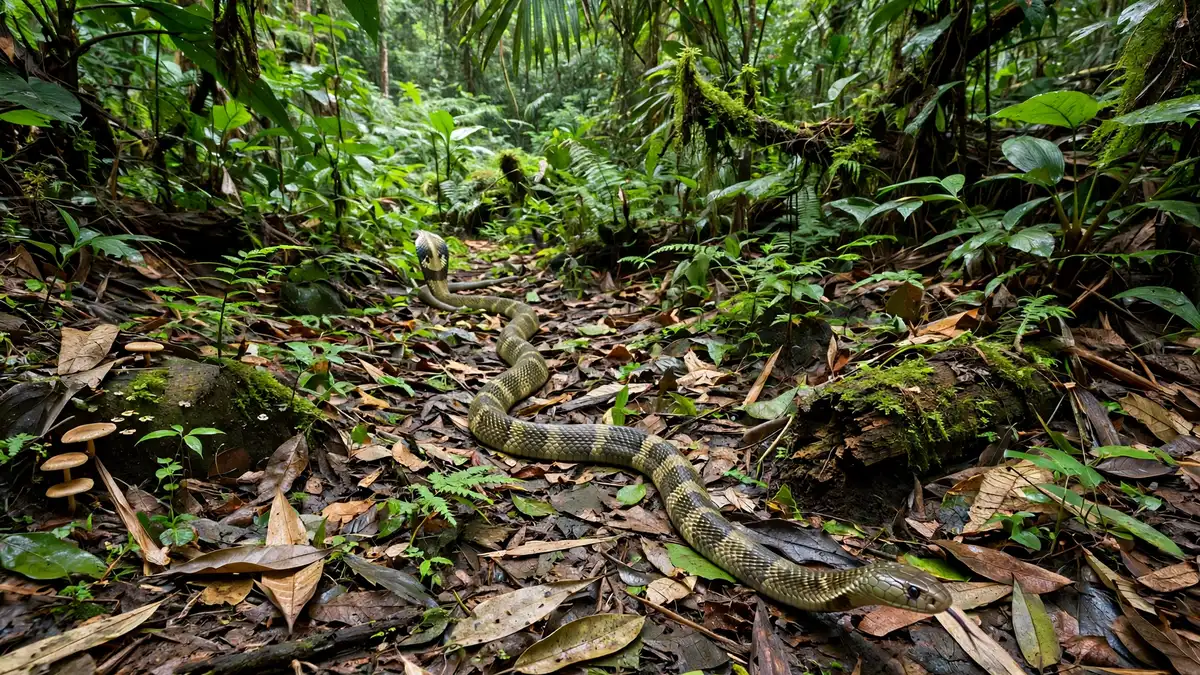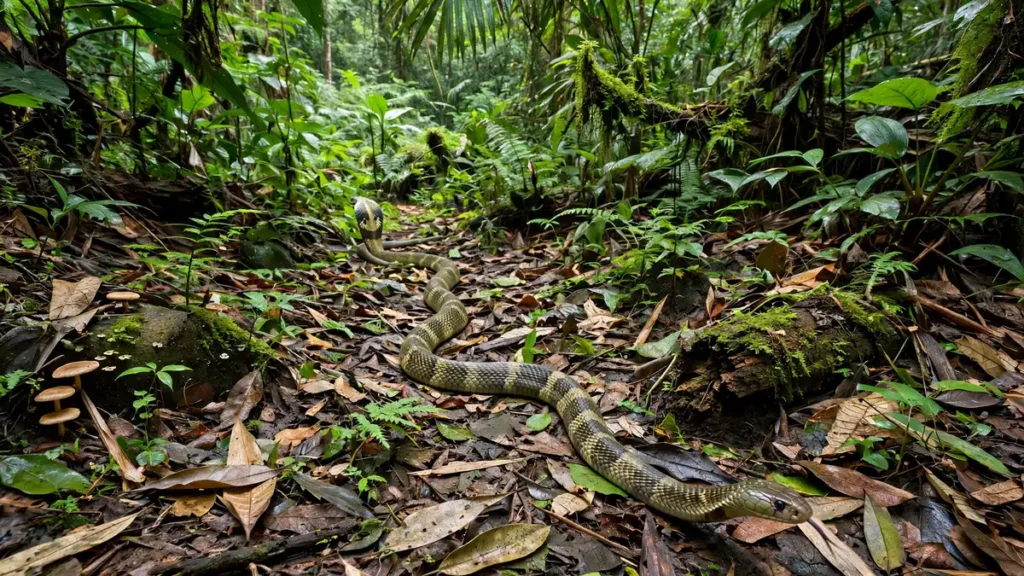
The king cobra species are four species, recognised in 2024, the world’s longest venomous snakes, and the only snakes that build a nest for their eggs and guard it until they hatch. If you are asking how many king cobra species there are, the answer is four: there are four recognised king cobra species in the world, split from one in a 2024 revision, and every king cobra alive today belongs to one of them.
The king cobra belongs to the elapid family, Elapidae, and it is the only snake that eats other snakes for most of its diet. Its broad hood, its olive and tan bands and its size, up to 5.5 metres long, make it one of the most recognisable snakes on Earth.
Key takeaways
- There are four king cobra species, recognised in a 2024 revision: the Northern, Sunda, Western Ghats and Luzon king cobras.
- King cobras are the world’s longest venomous snakes, reaching 3 to 4 metres, and up to 5.5 metres in the largest animals.
- King cobras eat mainly other snakes, including rat snakes, pythons and other cobras, and they hunt by smell and sight.
- The female king cobra builds a nest of leaves and guards her eggs until they hatch, the only snake that does so.
- King cobras are listed as Vulnerable under the broad treatment, and habitat loss is the main threat to their future.
What makes a king cobra a king cobra
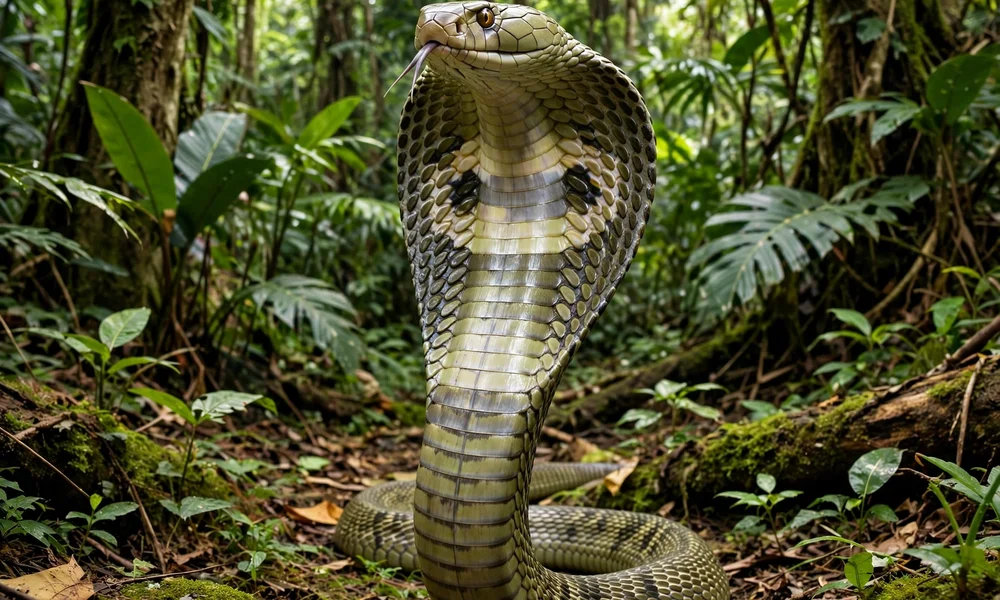
A king cobra is a very large venomous snake with a broad hood, a flat head, olive or tan skin with pale bands, and a length of 3 to 4 metres, with the largest animals reaching 5.5 metres. It is the longest venomous snake in the world, and it weighs up to 6 kilogrammes.
The nest defines the king cobra: the female gathers leaves into a mound, lays her eggs inside it, and stays with the nest for two to three months, guarding it against anything that comes near, which no other snake does. Its venom is a neurotoxin that can kill a person, and it delivers a large dose in a single bite, though it would rather flee than fight. Like other Asian animals, it lives in forests and near water, and it can raise a third of its body off the ground to look a person in the eye.
The king cobra species and their relatives
There are four king cobra species, recognised in a 2024 revision by Shankar and colleagues. The Northern king cobra, Ophiophagus hannah, lives across northern India, Nepal, Myanmar, Thailand, Laos, Cambodia, Vietnam and southern China. The Sunda king cobra, Ophiophagus bungarus, lives in Malaysia, Singapore, Indonesia and the Philippines. The Western Ghats king cobra, Ophiophagus kaalinga, lives only in the Western Ghats of south-west India. The Luzon king cobra, Ophiophagus salvatana, lives only on the island of Luzon in the Philippines.
The Indian cobra is the king cobra’s most famous relative, a smaller hooded snake that lives across India and is one of the “big four” venomous snakes of the country. The monocled cobra is another Asian cobra with a single eye-spot on its hood, while the spectacled cobra, the Philippine cobra and the Egyptian cobra are other hooded elapids of Asia and Africa. The black mamba is a fast African elapid that shares the king cobra’s long body and potent venom.
| Type | Animal | Where it lives | Best-known food | Length or Weight |
|---|---|---|---|---|
| Species | Northern king cobra (Ophiophagus hannah) | Northern India to southern China | Other snakes | 3 to 4 m, up to 5.5 m |
| Species | Sunda king cobra (Ophiophagus bungarus) | Malaysia, Indonesia, Philippines | Other snakes | 3 to 4 m |
| Species | Western Ghats king cobra (Ophiophagus kaalinga) | Western Ghats, India | Other snakes | 3 to 4 m |
| Species | Luzon king cobra (Ophiophagus salvatana) | Luzon, Philippines | Other snakes | 3 to 4 m |
| Close relative | Indian cobra | India and South Asia | Rats, frogs and birds | 1 to 1.5 m |
| Close relative | Monocled cobra | South and Southeast Asia | Rats, frogs and fish | 1 to 1.5 m |
| Close relative | Black mamba | East and southern Africa | Small mammals and birds | 2 to 3 m |
How king cobras live
King cobras are creatures of the forest. A king cobra lives alone, moving through dense forest and bamboo by day, and it comes together with others only to breed in the hot season. Like other Asian animals, it follows the seasons, breeding when the rains end and the forest warms.
Other snakes make up most of the diet, along with lizards and the occasional bird or small mammal, and the king cobra hunts by smell, following a snake’s scent trail through the leaf litter, then striking and holding on until its venom works. It swallows its prey whole, head first, and it can go for weeks without eating after a large meal. A king cobra’s venom is strong enough to kill an elephant, and a single bite can deliver enough venom to kill 20 people, though the snake bites only when cornered.
Breeding happens in the hot season, and the female builds a nest of dry leaves, lays 20 to 40 eggs inside it, and stays with the nest for two to three months, guarding it and keeping the eggs warm with her body heat. She leaves just before the eggs hatch, so she does not eat her own young, and the hatchlings are about 50 centimetres long and already venomous. King cobras live for around 20 years in the wild.
Where king cobras live
The king cobra lives in the forests of South and Southeast Asia, from India and Nepal through Myanmar, Thailand, Laos, Cambodia and Vietnam to southern China, Malaysia, Indonesia and the Philippines. It is most common in dense rainforest and bamboo thickets, near streams and ponds, and it has spread into farmland and villages where rats and other snakes are plentiful.
Forest is the key requirement. A king cobra needs dense cover to hide in and hunt in, so it follows the forest as it grows and shrinks with the seasons, and when the forest is cleared the snake has nowhere to live. It depends on the forest staying intact, like the snakes and lizards it eats, and when the forest is logged the king cobra disappears. The Northern king cobra is the most widespread of the four species, while the Western Ghats and Luzon species live only in small areas.
The species is listed as Vulnerable under the broad treatment, and its numbers are falling. The main pressures are the loss of forest to farming and logging, the killing of snakes by people, and the collection of king cobras for the pet trade and for traditional medicine. The two new species, the Western Ghats and Luzon king cobras, have not yet been assessed, but they are thought to be highly endangered because their ranges are so small.
Best seasons for king cobra watching
There is no safe watching season, because king cobras are dangerous wild animals and should never be approached, but the best time to see one from a distance is the dry season, when the snakes bask in the sun and are easier to spot. In India and Thailand the best months are often November to March, when the weather is cool and dry.
The dry season has its own rewards: the forest is at its most open and the snakes are active in the morning sun, though they are shy and will flee if they sense a person. Good places to try include the Western Ghats in India and the forests of Thailand, always with a licensed guide and from a safe distance.
Staying safe around king cobras
A king cobra is a wild animal with a powerful venom, and it can kill a person, so keep your distance, never approach one, and never try to handle one, because a king cobra can strike from a great distance and its bite is a medical emergency. If you see a king cobra, stay still, back away slowly, and let it leave, because a king cobra would rather flee than fight. In king cobra country, watch from a safe distance and use your eyes, or better, do not go looking at all.
Like other wild snakes, king cobras can bite without warning, and any bite should be treated as an emergency and taken to a hospital without delay. Never try to suck out venom or apply a tourniquet, because these do more harm than good.
King cobra watching checklist
A little preparation turns a forest walk into a real chance of seeing a king cobra from a safe distance, so pack for heat, dense forest and long quiet hours.
- Binoculars with good low-light performance, for picking a large snake out of the leaf litter.
- A camera with a long lens, because king cobras should always be watched from a great distance, never approached.
- Sturdy boots and long trousers, because the forest floor hides snakes and thorns.
- Water and snacks for long days, because the best sightings come after hours of searching.
- A licensed local guide who knows the forest, the snakes and the safe routes, and a first-aid kit.
- A plan to be out in the dry season, when the snakes bask in the morning sun.
- Patience and silence, because king cobras are shy animals and a noisy group will send them away.
Frequently asked questions
How many king cobra species are there?
There are four king cobra species, recognised in a 2024 revision: the Northern king cobra, the Sunda king cobra, the Western Ghats king cobra and the Luzon king cobra. Before 2024 they were all treated as one species, Ophiophagus hannah.
Why do king cobras build nests?
King cobras build nests because the female needs a warm, safe place to lay her eggs, and the mound of leaves holds heat as it rots. She stays with the nest for two to three months, guarding it against predators, which no other snake does.
How long is the longest king cobra?
The longest king cobra ever measured was 5.5 metres long, and most adults are 3 to 4 metres. King cobras are the world’s longest venomous snakes, longer than any other cobra or viper.
Can you keep a king cobra as a pet?
No. A king cobra is a wild animal with a deadly venom, and it needs a huge forest enclosure, live snakes to eat and expert care. King cobras are protected by law in most of their range, and they are not pets.
How is this guide different from the clownfish species guide?
This guide covers four king cobra species, the world’s longest venomous snakes that eat other snakes and build nests, while our clownfish species guide covers thirty clownfish species, small orange reef fish that live inside stinging sea anemones. The king cobra lives in Asian forests and hunts snakes, and the clownfish lives on a coral reef in the sea.
Are king cobras endangered?
King cobras are listed as Vulnerable under the broad treatment, so they are not classed as endangered, but their numbers are falling. The two new species, the Western Ghats and Luzon king cobras, have not yet been assessed, but they are thought to be highly endangered.
Conclusion
The king cobra species show how much power one snake can hold: four species, with hoods spread wide, bodies up to 5.5 metres long, diets of other snakes, nests built of leaves, and venom strong enough to kill an elephant. They are the longest venomous snakes on Earth, and they have lived in the forests of Asia for thousands of years.
If you go looking for one, go in the dry season to the Western Ghats or the forests of Thailand, go with a licensed guide, and go with great care. Watch a king cobra rearing with its hood spread and you will understand why it has earned its place as the king of snakes, and why keeping its forest matters most.