Asian animals include some of the most famous wildlife on Earth, from Bengal tigers and giant pandas to orangutans, snow leopards and Asian elephants. The central question is simple: what makes Asia’s wildlife so varied, and where can you see its most remarkable species? The answer is that Asia stretches from Arctic tundra to tropical rainforest, so its animals range from snow leopards in high mountains to orangutans in lowland jungle, and many of them live nowhere else in the world.
Key takeaways
- Asia’s wildlife is shaped by its size: Arctic tundra, temperate forest, desert and tropical rainforest all sit on one continent.
- Bengal tigers, giant pandas, snow leopards, orangutans and Asian elephants are among Asia’s best-known animals.
- Many Asian animals are endemic, meaning they live nowhere else in the wild.
- Habitat loss is the main threat to most large Asian animals, rather than hunting alone.
- The best places to see Asian wildlife are national parks and reserves, with a local guide.
Why Asia Has Such Varied Wildlife
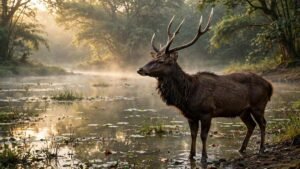
Asia is the largest continent, and its wildlife reflects that scale. In the far north, Siberia has cold forests and tundra, home to brown bears, wolves and reindeer. Further south, the steppes of Central Asia support wild horses, saiga antelope and eagles. The Himalayas rise between south and central Asia, with snow leopards, red pandas and blue sheep at high altitude. South and south-east Asia have tropical rainforests, home to tigers, elephants, orangutans and gibbons. Islands such as Borneo, Sumatra and Japan add species found nowhere else.
Climate, altitude and isolation all play a part. Mountains separate populations, so animals evolve apart and become distinct species. Islands do the same, which is why Indonesia and the Philippines have so many endemic animals. Rivers, monsoons and seasons shape when animals breed, feed and move, and many species time their lives around the rains.
Big Cats of Asia
The Bengal tiger is the best-known Asian animal, and one of the largest cats in the world. It lives in India, Bangladesh, Nepal and Bhutan, mainly in grassland, mangrove forest and dense jungle. A male can weigh well over 200 kilograms, with an orange coat, black stripes and a white belly. Tigers are solitary hunters, feeding mainly on deer and wild pigs, and they are most active at dawn and dusk. Each tiger has a unique stripe pattern, like a fingerprint.
The snow leopard lives higher than almost any other big cat, in the mountains of Central Asia, including the Himalayas, the Pamirs and the Altai. It has thick grey fur with dark rosettes, a long tail for balance and large paws that work like snowshoes. It hunts blue sheep, ibex and smaller mammals, often leaping across steep rock faces. Snow leopards are shy and rarely seen, which makes a sighting a rare event even for experienced trackers.
The Asiatic lion lives only in the Gir Forest of western India, the last wild home of this subspecies. It is slightly smaller than the African lion, with a fold of skin along the belly that African lions lack. Males have a shorter mane, so their ears are often visible. The Amur leopard, found in the far east of Russia and north-east China, is one of the rarest big cats, with a pale coat and widely spaced rosettes. The clouded leopard of south-east Asian forests is smaller, with cloud-shaped markings and long canine teeth for its size.
Elephants, Pandas and Primates
The Asian elephant is smaller than the African elephant, with smaller ears, a rounded back and a twin-domed head. Only some males grow long tusks. Asian elephants live in India, Sri Lanka, Thailand, Myanmar and other parts of south and south-east Asia, feeding on grasses, leaves, fruit and bark. They live in family groups led by an older female, and they need large areas of forest to find enough food. In Sri Lanka and parts of India, elephants are also part of cultural and religious life.

The giant panda lives only in the mountain forests of central China, eating almost entirely bamboo. It is a bear, despite its black-and-white coat, and it has a wrist bone that works like a thumb for holding bamboo stems. Pandas spend much of the day feeding and resting, and they are solitary except when mating or raising cubs. The red panda, a smaller bamboo eater from the Himalayas, is a different animal entirely, living in trees and belonging to its own family.
Asia is also rich in primates. Orangutans live in the rainforests of Borneo and Sumatra, spending most of their lives in trees and building a new nest each night. They are the world’s largest tree-dwelling animals, and males develop wide cheek pads as they mature. Gibbons swing through the forests of south-east Asia, singing duets at dawn. Proboscis monkeys, with their long noses, live in the mangroves of Borneo, while Japanese macaques, the famous snow monkeys, bathe in hot springs in winter.
Endemic Species: Animals Found Nowhere Else
An endemic species is one that lives naturally in only one place. Asia has many, because its mountains and islands have isolated populations for thousands of years. The giant panda is endemic to China, the orangutan to Borneo and Sumatra, and the Komodo dragon to a few small islands in Indonesia. The Komodo dragon is the world’s largest lizard, growing to around three metres, and it hunts deer and other animals on dry, rocky islands.
Asian Animals Compared
Asia’s best-known animals differ widely in size, habitat and diet. The table below compares six of them at a glance.
| Animal | Size | Habitat | Main diet |
|---|---|---|---|
| Bengal tiger | 220–310 cm long, 140–260 kg | Grassland and jungle, India and neighbours | Deer, wild pigs |
| Giant panda | 120–190 cm long, 80–125 kg | Mountain forest, central China | Bamboo |
| Asian elephant | 2.7–3 m at the shoulder | Forest and grassland, south and south-east Asia | Grasses, leaves, fruit |
| Snow leopard | 90–130 cm long, 25–55 kg | High mountains, Central Asia | Blue sheep, ibex |
| Orangutan | 1.1–1.4 m tall, 40–90 kg | Rainforest, Borneo and Sumatra | Fruit, leaves, insects |
| Komodo dragon | Up to 3 m long, 70–90 kg | Dry islands, Indonesia | Deer, carrion |
The table shows how habitat shapes each animal. Tigers need large hunting grounds, pandas need bamboo forest, and snow leopards need high, rocky ground. Protecting the habitat is therefore the first step in protecting the animal, a point that applies to wildlife everywhere, including the taiga animals of northern forests.
Where to See Asian Animals
The best places to see Asian wildlife are national parks and reserves, with a local guide who knows the animals and the ground. In India, Ranthambore and Bandhavgarh are known for tigers, while Kaziranga in Assam is famous for Indian rhinoceroses and elephants. In Nepal, Chitwan National Park offers rhinos, elephants and, with luck, tigers. In China, the panda reserves of Sichuan are the place to see giant pandas in a natural setting.
For orangutans, the rainforests of Borneo and Sumatra are the only wild home, and visiting a reserve with a guide is the responsible way to see them. In Mongolia and Kyrgyzstan, guided trips offer a chance, though never a promise, of seeing snow leopards. In Indonesia, Komodo National Park is the place to see Komodo dragons, always with a ranger. In Japan, the snow monkeys of Jigokudani can be watched bathing in hot springs in winter.
Checklist: Planning a Wildlife Trip in Asia
- Choose one region and one or two target animals, rather than trying to see everything.
- Book a national park or reserve with a licensed local guide.
- Travel in the dry season for easier access, and check the best months for your animal.
- Pack binoculars, a field guide, sun protection and sturdy walking shoes.
- Keep a safe distance, stay quiet, and never feed wild animals.
- Bring water and snacks, and leave no litter behind.
- Learn the local rules before you go: permits, park fees and photography rules vary.
Threats and Conservation
Habitat loss is the main threat to most large Asian animals. Forests are cleared for farming, palm oil, timber and towns, which shrinks the space animals need to feed and breed. When forest is broken into small patches, animals cannot move between them, and small populations become isolated. Roads, railways and fences add to the problem, cutting across migration routes and territories.
Poaching is a second threat, driven by demand for tiger parts, ivory, rhino horn and exotic pets. It is now illegal in most countries, and enforcement has improved, but it still happens. Human-wildlife conflict is a third problem: elephants raid crops, tigers take livestock, and leopards enter villages, which can lead to animals being killed in retaliation. Conservation work now focuses on protecting habitat, linking forest patches, paying farmers for losses and giving local people a reason to protect wildlife.
Asian Animals and Norway
Asia and Norway may seem far apart, but their wildlife is linked by migration and by shared habitats. Many birds that breed in Norway spend the winter in Asia, and Arctic animals such as reindeer and wolves range across northern Asia and northern Europe. The animal migration guide explains how these journeys work, and the animals in Norway guide shows which northern species Norway shares with Siberia.
Frequently Asked Questions
What is the most famous Asian animal?
The Bengal tiger is probably the most famous, followed by the giant panda. Both are symbols of Asian wildlife, and both are used in conservation campaigns around the world.
Which animals are only found in Asia?
Giant pandas, orangutans, Komodo dragons, snow leopards, Asiatic lions and proboscis monkeys are all found only in Asia in the wild. Many more, including the saola and the Philippine eagle, are endemic to a single country or island group.
Where is the best place to see tigers in Asia?
India offers the best chances, in parks such as Ranthambore, Bandhavgarh and Kaziranga. Nepal’s Chitwan National Park is another good choice. A sighting is never certain, so allow several days and travel with a local guide.
Are Asian elephants smaller than African elephants?
Yes. Asian elephants are smaller, with smaller ears, a rounded back and a twin-domed head. Only some males grow long tusks, while African elephants of both sexes usually have tusks.
Do snow leopards live in the Himalayas?
Yes, snow leopards live in the Himalayas and in other high mountain ranges across Central Asia. They are shy, well camouflaged and rarely seen, even in places where they are known to live.
What is the largest animal in Asia?
The Asian elephant is the largest land animal in Asia. In the sea, the blue whale, which visits Asian waters, is the largest animal in the world.
Conclusion
Asian animals show what happens when one continent holds almost every habitat on Earth. Tigers, pandas, elephants, orangutans and snow leopards each depend on a habitat that needs protection. The next step is to choose one animal that interests you, learn where it lives and what it needs, and then explore the wider world of wildlife in our guides to predator animals and grassland animals, which show how the same ideas of habitat, diet and balance apply everywhere.