Bird names are the first step into birdwatching, and this list gives you 200 of them, from the albatross to the zebra finch, each with one fact worth remembering. The question this guide answers is simple: which birds are there to know, and how do you tell them apart? The answer is that 200 names, organised A to Z, cover the world’s most familiar, most remarkable and most loved birds — and by the end of this list you will know them all.
Key takeaways
- This list gives 200 bird names, from A to Z, each with one short fact.
- The birds range from tiny hummingbirds to ostriches, the world’s largest bird.
- Many of the birds on this list live in Norway, including robins, blackbirds and sea eagles.
- Learning bird names is easiest in groups — by letter, by habitat or by family.
- Use the list for quizzes, school projects, or as a checklist on your next walk.
Bird Names A–B
- Albatross — A seabird with the longest wingspan of any bird.
- American Goldfinch — A small yellow finch that turns olive in winter.
- American Robin — A familiar garden thrush with a red breast.
- Anna’s Hummingbird — A tiny hummingbird with a flashing pink crown.
- Arctic Tern — Migrates further than any other bird each year.
- Atlantic Puffin — A clown-faced seabird that nests in burrows.
- Australian Magpie — A black and white songbird famous for its carolling.
- Avocet — A wader with an upcurved bill and black and white plumage.
- African Grey Parrot — A grey parrot known for copying human speech.
- Alpine Swift — A fast-flying swift that sleeps on the wing.
- Anhinga — A waterbird that swims with only its neck above water.
- African Penguin — A small penguin that brays like a donkey.
- Bald Eagle — A white-headed eagle and the national bird of the USA.
- Barn Owl — A pale owl with a heart-shaped face that hunts silently.
- Barn Swallow — A blue-backed swallow that nests in barns and sheds.
- Bearded Vulture — A large vulture that drops bones to crack them.
- Blackbird — A common garden thrush with a rich, fluting song.
- Blue Jay — A noisy blue crested bird of North American woodland.
- Blue Tit — A small blue and yellow garden bird.
- Budgerigar — A small Australian parakeet kept as a pet worldwide.
- Bullfinch — A stocky finch with a pink breast and black cap.
- Bustard — A heavy ground bird, one of the world’s largest fliers.
- Black Swan — An Australian swan with black plumage and a red bill.
- Brown Pelican — A coastal pelican that dives headfirst for fish.
Bird Names C–D
- Canary — A small yellow songbird from the Canary Islands.
- Cardinal — A red crested songbird of North American gardens.
- Cassowary — A flightless Australian bird with a tall head casque.
- Cedar Waxwing — A sleek crested bird that eats berries in flocks.
- Chaffinch — A common European finch with a pink breast.
- Chicken — The world’s most common domestic bird.
- Cockatoo — A crested Australian parrot with a loud call.
- Common Cuckoo — Lays its eggs in other birds’ nests.
- Condor — A huge vulture with a wingspan over three metres.
- Cormorant — A dark fishing bird that dries its wings upright.
- Crane — A tall wading bird with a loud, bugling call.
- Crow — A clever black bird found on every continent except Antarctica.
- Dalmatian Pelican — One of the largest flying birds in the world.
- Dodo — A flightless bird of Mauritius, extinct since the 1600s.
- Dove — A gentle bird linked with peace in many cultures.
- Duck — A waterbird with webbed feet and a broad bill.
- Dunnock — A small brown garden bird with a shy, shuffling walk.
- Dartford Warbler — A dark warbler of southern heathland.
- Demoiselle Crane — A small grey crane that migrates over the Himalayas.
Bird Names E–F
- Eagle Owl — Europe’s largest owl, with orange eyes and ear tufts.
- Eastern Bluebird — A blue and rust songbird of North American fields.
- Eider — A sea duck whose soft down fills pillows and jackets.
- Egret — A white heron with long plumes and a dagger bill.
- Emu — A tall flightless Australian bird, second only to the ostrich.
- European Robin — A red-breasted garden bird that sings all winter.

- Emperor Penguin — The tallest penguin, breeding on Antarctic ice.
- Eurasian Jay — A pinkish woodland bird with blue wing patches.
- Falcon — A fast bird of prey that hunts on the wing.
- Flamingo — A pink wading bird that feeds with its head upside down.
- Frigatebird — A seabird that steals food from other birds in flight.
- Fulmar — A gull-like seabird that spits oil at intruders.
- Fieldfare — A winter thrush that arrives in noisy flocks.
- Firecrest — A tiny kinglet with a bright orange crown stripe.
- Fairy Wren — A small Australian bird with bright blue breeding plumage.
- Feral Pigeon — A city pigeon descended from the rock dove.
Bird Names G–H
- Gannet — A white seabird that plunge-dives from great heights.
- Goldcrest — Europe’s smallest bird, with a golden crown stripe.
- Golden Eagle — A powerful mountain eagle with a golden head.
- Goldfinch — A colourful finch with a red face and yellow wings.
- Goose — A honking waterbird that migrates in V-shaped flocks.
- Goshawk — A fierce woodland hawk that hunts through trees.
- Great Tit — A large tit with a black head and yellow breast.
- Green Woodpecker — A green woodpecker that feeds on ants on lawns.
- Grey Heron — A tall grey heron that stands still in shallow water.
- Guillemot — A black and white seabird that nests on narrow ledges.
- Harris’s Hawk — A social hawk that hunts in family groups.
- Hawfinch — A large finch with a huge bill for cracking cherry stones.
- Hen Harrier — A grey harrier that quarters low over moorland.
- Heron — A long-legged wading bird that spears fish with its bill.
- Herring Gull — A large grey and white gull of coasts and towns.
- Hoopoe — A pink bird with a fan crest and a long curved bill.
- Hornbill — A tropical bird with a huge bill and a casque on top.
- House Sparrow — A small brown sparrow that lives close to people.
- Hummingbird — The only bird that can fly backwards.
- Hyacinth Macaw — A large blue parrot, the longest of all parrots.
Bird Names I–K
- Ibis — A wading bird with a long downcurved bill.
- Indian Peafowl — A peacock with a shimmering blue-green train.
- Indigo Bunting — A small North American songbird, vivid blue in summer.
- Ivory Gull — A pure white gull of the high Arctic.
- Inca Tern — A grey seabird with a curly white moustache.
- Jackdaw — A small grey crow with pale eyes and a chacking call.
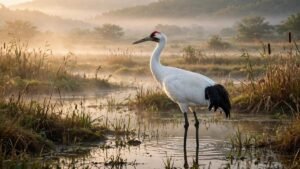
- Japanese Crane — A tall white crane with a red crown, sacred in Japan.
- Jay — A shy woodland bird that hides acorns for winter.
- Junco — A small grey sparrow of North American mountains and gardens.
- Jacana — A tropical wader that walks on floating leaves.
- Jabiru — A huge black-headed stork of Central and South America.
- Kestrel — A small falcon that hovers over fields hunting voles.
- Kingfisher — A bright blue and orange bird that dives for fish.
- King Penguin — A tall penguin with orange and yellow neck patches.
- Kite — A graceful bird of prey with a forked tail.
- Kiwi — A flightless New Zealand bird with a long beak and no tail.
- Kookaburra — An Australian kingfisher whose call sounds like laughter.
- Kakapo — A flightless, nocturnal New Zealand parrot.
- Kea — A clever alpine parrot that plays with cars and boots.
Bird Names L–M
- Lapwing — A black and green plover with a wispy crest.
- Lark — A brown songbird that sings high above open fields.
- Laughing Gull — A black-headed gull with a laughing call.
- Linnet — A small brown finch with a red forehead in spring.
- Little Egret — A small white heron with black legs and yellow feet.
- Long-tailed Tit — A tiny pink and white bird with a very long tail.
- Loon — A diving bird with a haunting wailing call.
- Lyrebird — An Australian bird that mimics chainsaws and cameras.
- Macaw — A large, long-tailed South American parrot.
- Magpie — A black and white bird famous for collecting shiny objects.
- Mallard — The most common duck, ancestor of most domestic ducks.
- Mandarin Duck — A brightly coloured duck from East Asian woodland.
- Marsh Harrier — A brown harrier that hunts over reedbeds.
- Merlin — A small, fast falcon that chases small birds.
- Mistle Thrush — A large thrush that defends mistletoe berries fiercely.
- Mute Swan — A white swan with an orange bill and curved neck.
- Meadowlark — A yellow-breasted songbird of North American grassland.
Bird Names N–O
- Nene — A rare Hawaiian goose, the state bird of Hawaii.
- Nightingale — A plain brown bird with one of the richest songs.
- Nightjar — A nocturnal bird that churrs at dusk over heaths.
- Nuthatch — A blue-grey bird that climbs down trees head first.
- Northern Flicker — A brown woodpecker with a spotted belly that feeds on ants on the ground.
- Nicobar Pigeon — A metallic green pigeon from South-East Asian islands.
- Nanday Parakeet — A green and black parakeet from South America.
- Osprey — A fish-eating hawk that plunges feet-first into water.
- Ostrich — The world’s largest bird, flightless and fast-running.
- Oystercatcher — A black and white wader with a long orange bill.
- Orchard Oriole — A small dark oriole of North American orchards.
- Ovenbird — A warbler that builds a domed nest like an oven.
- Oriental Magpie-Robin — A black and white songbird of Asian gardens.
- Olive Thrush — A grey-brown thrush of African gardens and forests.
- Olive-tree Warbler — A large warbler of Mediterranean olive groves.
Bird Names P–Q
- Parrot — A colourful bird with a hooked bill and zygodactyl feet.
- Peacock — A male peafowl with a huge iridescent tail fan.
- Pelican — A large waterbird with a pouch under its bill.
- Penguin — A flightless seabird that swims with flippers.
- Peregrine Falcon — The fastest animal alive, diving over 300 km/h.
- Pheasant — A long-tailed game bird of Asian origin.
- Pigeon — A grey bird with a cooing call, found in every city.
- Pipit — A small brown bird that walks and bobs its tail.
- Plover — A small wader that runs in short bursts on beaches.
- Puffin — A colourful-billed seabird that nests in cliff burrows.
- Pied Wagtail — A black and white bird that wags its tail constantly.
- Ptarmigan — A grouse that turns white in winter.
- Quail — A small ground bird with a distinctive three-note call.
- Quelea — A small African weaver, the world’s most numerous wild bird.
- Quetzal — A dazzling green bird with a very long tail.
Bird Names R–S
- Raven — A large black crow with a deep croaking call.
- Red Kite — A reddish bird of prey with a forked tail.
- Redstart — A small bird with a rusty-red tail that shivers constantly.
- Red-winged Blackbird — A black bird with red shoulder patches that sings in marshes.
- Rock Dove — The wild ancestor of the city pigeon.
- Roller — A bright blue bird that rolls in flight displays.
- Rook — A sociable black crow with a bare grey face.
- Roseate Spoonbill — A pink wading bird with a spoon-shaped bill.
- Ruddy Duck — A small stiff-tailed duck with a bright blue bill.
- Reed Warbler — A brown warbler that sings from reedbeds.
- Sandpiper — A small wader that probes mud with its bill.
- Scarlet Macaw — A large red, yellow and blue parrot.
- Sabine’s Gull — A small Arctic gull with a forked tail.
- Secretarybird — An African bird of prey that hunts snakes on foot.
- Shag — A dark green seabird with a crest, related to cormorants.
- Shelduck — A large duck with bold green, white and chestnut plumage.
- Short-eared Owl — A pale owl that hunts over open ground by day.
- Siskin — A small yellow-green finch of conifer forests.
- Skylark — A brown songbird that sings while hovering high above fields.
- Snowy Owl — A white Arctic owl that hunts in daylight.
- Song Thrush — A brown thrush that repeats each phrase three times.
Bird Names T–V
- Tawny Owl — A brown woodland owl that hoots “tu-whit, tu-whoo”.
- Teal — A small duck with a green wing patch and a fast flight.
- Tern — A slender seabird with a forked tail and a sharp bill.
- Thrush — A spotted songbird with a rich, varied song.
- Toucan — A tropical bird with a huge, colourful bill.
- Treecreeper — A small brown bird that spirals up tree trunks.
- Trumpeter Swan — A large North American swan with a trumpet-like call.
- Turkey — A large game bird native to North America.
- Turtle Dove — A small dove with a soft purring call.
- Tawny Frogmouth — An Australian bird that looks like a broken branch.
- Umbrellabird — A black tropical bird with an umbrella-like crest.
- Ural Owl — A large pale owl of northern European forests.
- Upland Sandpiper — A grassland wader with a wolf-like whistle.
- Vulture — A large scavenging bird that soars on broad wings.
- Velvet Scoter — A dark sea duck with a white wing patch.
- Verdin — A small grey desert bird with a yellow head.
- Vaux’s Swift — A small swift that roosts in hollow trees.
- Victoria Crowned Pigeon — A large blue pigeon with a lacy crest.
- Violet-backed Starling — A glossy starling with a violet back.
Bird Names W–Z
- Wagtail — A slender bird that wags its long tail up and down.
- Warbler — A small insect-eating songbird with a sweet song.
- Waxwing — A crested bird with waxy red tips on its wing feathers.
- Weaverbird — An African bird that weaves hanging nests from grass.
- Wheatear — A small bird with a white rump that breeds on moorland.
- White-tailed Eagle — Europe’s largest eagle, also called the sea eagle.
- Whooper Swan — A large swan with a yellow and black bill.
- Woodpecker — A bird that drums on trees and digs for insects.
- Wood Pigeon — A large grey pigeon with a white neck patch.
- Wren — A tiny brown bird with a very loud song.
- Xantus’s Hummingbird — A small hummingbird found only in Baja California.
- Yellowhammer — A yellow bunting that sings “a little bit of bread”.
- Yellow Wagtail — A yellow wagtail of wet meadows and farmland.
- Zebra Finch — A small Australian finch with striped markings.
- Zitting Cisticola — A tiny warbler with a buzzing, zitting song.
How Many Bird Names Are There in Each Letter?
The 200 bird names in this list are spread across the alphabet as follows. Some letters have many birds, and a few — X, Y and Z — have very few, which is true of bird names in general.
| Letter group | Bird names | Notes |
|---|---|---|
| A | 12 | Albatross to African Penguin |
| B | 12 | Bald Eagle to Brown Pelican |
| C | 12 | Canary to Crow |
| D | 7 | Dalmatian Pelican to Demoiselle Crane |
| E | 8 | Eagle Owl to Eurasian Jay |
| F | 8 | Falcon to Feral Pigeon |
| G | 10 | Gannet to Guillemot |
| H | 10 | Harris’s Hawk to Hyacinth Macaw |
| I | 5 | Ibis to Inca Tern |
| J | 6 | Jackdaw to Jabiru |
| K | 8 | Kestrel to Kea |
| L | 8 | Lapwing to Lyrebird |
| M | 9 | Macaw to Meadowlark |
| N | 7 | Nene to Nanday Parakeet |
| O | 8 | Osprey to Olive-tree Warbler |
| P | 12 | Parrot to Ptarmigan |
| Q | 3 | Quail, Quelea, Quetzal |
| R | 10 | Raven to Reed Warbler |
| S | 11 | Sandpiper to Song Thrush |
| T | 10 | Tawny Owl to Tawny Frogmouth |
| U | 3 | Umbrellabird, Ural Owl, Upland Sandpiper |
| V | 6 | Vulture to Violet-backed Starling |
| W | 10 | Wagtail to Wren |
| X | 1 | Xantus’s Hummingbird |
| Y | 2 | Yellowhammer, Yellow Wagtail |
| Z | 2 | Zebra Finch, Zitting Cisticola |
| Total | 200 | A to Z |
The table shows a useful pattern for learners: letters A, B, C and P are the richest, while Q, U and X are the hardest. If you are building a quiz, start with the rich letters and save X, Y and Z for the bonus round. For more animal lists in the same style, see our 200 animal names and the animals that start with O list.
Learning Bird Names: How to Remember Them
The best way to learn bird names is to meet the birds, not just read the list. Start with the birds outside your own window: blackbirds, robins, blue tits and magpies are common in most of Norway, and our guides to animals in Norway and forest animals will help you place them in their habitats.
Learn in small groups of ten, and say each name out loud with its fact. “Kingfisher — dives for fish” sticks better than a bare name. Group birds by where they live: garden birds, seabirds, birds of prey and waders are easier to remember as families than as a long alphabet. A notebook or a phone app lets you tick off birds as you see them, and the list grows into a personal record.
Checklist: Learning 200 Bird Names
- Learn ten names at a time, with one fact for each bird.
- Start with the birds you can see from your own window or garden.
- Group birds by habitat: garden, forest, coast, wetland and mountain.
- Say each name out loud, and picture the bird while you do it.
- Keep a notebook and tick off each bird the first time you see it.
- Use the quiz trick: cover the facts and test yourself on the names.
- Learn the hard letters last — Q, U, X, Y and Z are the bonus round.
- Take the list on a walk and match real birds to their names.
Frequently Asked Questions
How many bird species are there in the world?
There are more than 11,000 known bird species in the world, so this list of 200 covers the best-known and most loved ones, not every species that exists.
Which bird names start with X?
Very few. The best-known is Xantus’s Hummingbird, a small hummingbird found only in Baja California, Mexico. Most bird-name lists have only one X entry.
What is the most common bird name to learn first?
The robin, blackbird and blue tit are the easiest first birds in northern Europe, because they are common, easy to see and easy to recognise by colour and song.
Which bird is the fastest?
The peregrine falcon is the fastest animal alive, reaching over 300 km/h in a hunting dive, called a stoop. The fastest level flyer is the white-throated needletail, a type of swift.
Do all the birds on this list live in Norway?
No. Many do — robins, blackbirds, white-tailed eagles and many more — but birds such as the cassowary, kiwi and toucan live in other parts of the world. Our guide to animal migration explains how some birds travel thousands of kilometres between continents.
What is the difference between a bird name and a species?
A bird name can be a common name, like “robin”, while a species is a precise scientific group. Some common names cover several species, and some species have more than one common name, so birdwatchers also use scientific names when they need to be exact.
Conclusion
Two hundred bird names is a good start, not a finish. It takes you from the albatross over the open ocean to the zebra finch in an Australian garden, and it gives you one fact to hold on to for every bird. The names matter because they let you notice: once you can name the kingfisher, the skylark and the white-tailed eagle, you start seeing them everywhere.
The next step is to use the list outside. Pick ten birds from it, learn their facts, and go looking for them — in your garden, on a forest walk, or by the coast with binoculars. Tick them off as you see them, and when you have found all ten, learn ten more. For more lists to work through, read our 200 animal names and the animals that start with O guide, and keep this list handy for your next quiz.