Dominican Republic animals include some of the rarest wildlife in the Caribbean, from the venomous Hispaniolan solenodon to the rhinoceros iguana and the humpback whales that gather in Samaná Bay each winter. The country shares the island of Hispaniola with Haiti, and its mix of rainforest, dry scrub, mangroves, mountains and coral reefs supports animals found nowhere else on Earth. The central question is simple: what makes the wildlife here so special? The answer is endemism — many species evolved in isolation on this island, so they live here and nowhere else.
Key takeaways
- The Dominican Republic shares the island of Hispaniola with Haiti, and many of its animals live nowhere else on Earth.
- The Hispaniolan solenodon and Hispaniolan hutia are the island’s two surviving native land mammals, and both are rare and nocturnal.
- Rhinoceros iguanas, American crocodiles and flamingos thrive in the dry south-west, around Lago Enriquillo and Laguna de Oviedo.
- Humpback whales visit Samaná Bay each winter, and sea turtles nest on the country’s beaches.
- National parks such as Los Haitises, Jaragua and Cotubanamá protect the best wildlife habitats.
What Makes Dominican Republic Wildlife Special?
The Dominican Republic occupies the eastern two-thirds of Hispaniola, the second-largest island in the Caribbean. Its landscapes change fast: the high peaks of the Cordillera Central, the rainforests of the Samaná Peninsula, the dry thorn scrub of the south-west and the mangrove-lined bays of Los Haitises all sit within a few hours of each other. Each habitat holds its own animals, and many of them are endemic, meaning they evolved on Hispaniola and live nowhere else.
Much of that wildlife is hard to see. The most famous mammals are nocturnal, the rarest reptiles live in remote dry forest, and the whales only visit for part of the year. Visitors who plan around habitats and seasons, rather than hoping for a lucky sighting, see far more. The guides to animals in Norway show how habitat shapes what lives where, and the same rule applies on a Caribbean island.
Endemic Mammals: Solenodon and Hutia
Hispaniola’s two surviving native land mammals are both rare, both nocturnal, and both found nowhere else. The Hispaniolan solenodon (Solenodon paradoxus) is a small, shrew-like insect-eater with a long flexible snout, coarse fur and a scaly tail. It hunts at night for insects, worms and other small invertebrates, using its snout to probe leaf litter and soil. Unusually for a mammal, it produces venom, delivered through grooves in its lower teeth, which helps it subdue prey.
The solenodon is one of the oldest surviving mammal lines in the Caribbean, and it is listed as endangered. It lives mainly in forest, where it shelters in burrows, hollow logs and rock crevices during the day. It is rarely seen by visitors, and most records come from researchers working at night with traps and cameras.
The Hispaniolan hutia (Plagiodontia aedium) is a stocky rodent that climbs trees and feeds on leaves, bark, fruit and roots. It is also endangered, and it survives mainly in remote forest and in the karst limestone country of Los Haitises National Park. Like the solenodon, it is nocturnal and shy, so a sighting is a matter of luck and patience rather than something a visitor can plan on.
Reptiles: Iguanas, Crocodiles and Lizards
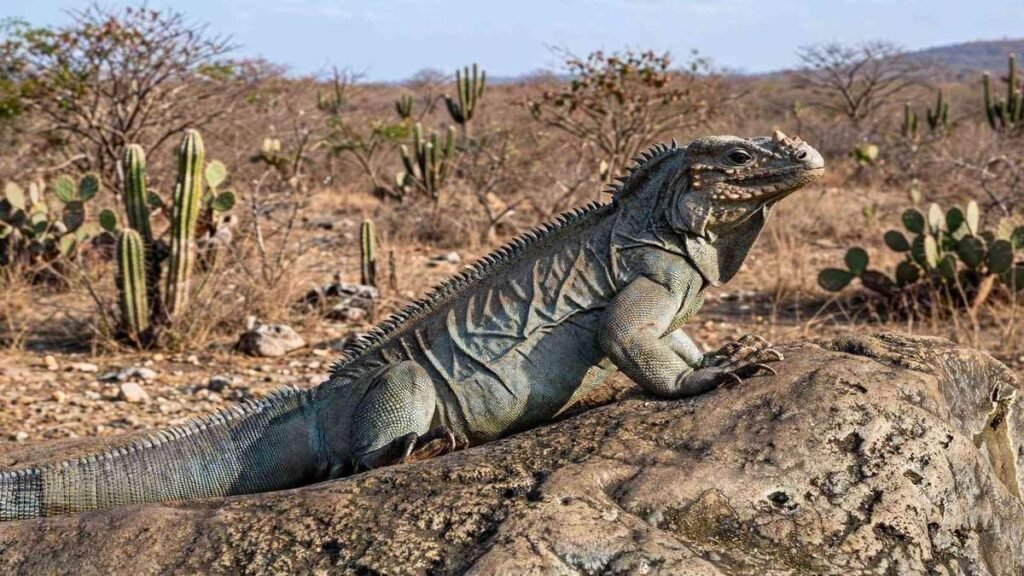
The Dominican Republic’s best-known reptiles live in the dry south-west. The rhinoceros iguana (Cyclura cornuta) is a large, heavy-bodied lizard with a row of horn-like scales on its snout, which gives it its name. It lives in dry scrub and rocky ground, feeds mainly on leaves, fruit and flowers, and basks in the sun during the day. It is the largest lizard in the Caribbean, and adults can reach well over a metre in length including the tail.
The rhinoceros iguana is easiest to see in Jaragua National Park and around Laguna de Oviedo, where it is often spotted on rocks and low branches near the shore. A second iguana, Ricord’s iguana (Cyclura ricordii), is rarer and lives in a small area of dry forest around Lago Enriquillo. It is one of the most endangered iguanas in the world, and its range is limited to a few patches of thorn scrub.
Lago Enriquillo is also home to the American crocodile (Crocodylus acutus). The lake is a large saltwater lake below sea level, ringed by dry forest and cactus, and it holds one of the largest crocodile populations in the Caribbean. Crocodiles are usually seen basking on the shore or floating in the shallows, and boat trips on the lake give visitors a safe way to watch them.
Birds of the Dominican Republic
Birdwatchers come to the Dominican Republic for its endemic birds, and the island has more than two dozen species found nowhere else. The national bird is the palmchat (Dulus dominicus), a small brown bird that lives in flocks and builds large communal nests in palm trees, sometimes with many separate chambers under one roof. It is common and easy to see, even in towns and gardens.
The Hispaniolan trogon (Priotelus roseigaster) is the bird many visitors hope for most. It has a green back, a red belly and a long tail, and it lives in mountain forest, especially in the Cordillera Central and the Sierra de Bahoruco. The Hispaniolan parrot (Amazona ventralis) is a green parrot with a white forehead and a blue wash on the wings, and it is listed as vulnerable, largely because of trapping for the pet trade and loss of nesting trees.
Flamingos gather in the shallow lagoons of the south-west, especially Laguna de Oviedo in Jaragua National Park, where flocks feed on algae and tiny crustaceans in the pink-tinted water. The park’s mangroves and offshore islands also hold herons, egrets, pelicans, frigatebirds and ospreys.
Whales, Manatees and Sea Turtles

The Dominican Republic’s best-known marine wildlife event is the humpback whale season in Samaná Bay. Each winter, humpback whales migrate from cold northern waters to the warm, sheltered bay to breed and give birth. The season runs roughly from January to March, and licensed boat trips from Samaná town take visitors out to watch the whales breach, slap their tails and sing.
The West Indian manatee lives in coastal waters, lagoons and river mouths around the island, grazing on seagrass and floating plants. It is shy, slow-moving and rarely seen, but it is protected, and boat operators in areas such as Samaná and Los Haitises are asked to keep their distance and cut their engines when one is nearby.
Sea turtles nest on the country’s beaches. Leatherback, hawksbill and green turtles all visit Dominican shores, and the leatherback is the largest turtle in the world. Nesting takes place mainly at night, and protected beaches such as those in Cotubanamá National Park are monitored during the season. Visitors should never disturb a nesting turtle or its nest, and should keep lights away from the beach at night.
Where to See Dominican Republic Animals
The table below brings together the best places to look, what lives there, and when to go.
| Place | Best for | When to go |
|---|---|---|
| Samaná Bay | Humpback whales, manatees | January to March |
| Jaragua National Park | Rhinoceros iguanas, flamingos, Ricord’s iguana | Dry season, November to April |
| Lago Enriquillo | American crocodiles, flamingos, dry-forest birds | Dry season, November to April |
| Los Haitises National Park | Hutias, cave swallows, mangrove birds | Year-round, best in the dry season |
| Sierra de Bahoruco | Hispaniolan trogon, endemic birds, solenodon habitat | November to April |
| Cotubanamá National Park | Sea turtles, coastal birds, reef fish | Nesting season, spring and summer |
| Cordillera Central | Mountain birds, Hispaniolan parrot | Year-round |
Planning a Wildlife Trip
A little planning goes a long way in the Dominican Republic, because the best wildlife is spread across the country. Start by choosing one or two regions rather than trying to cover the whole island: the north-east for whales and rainforest, or the south-west for iguanas, crocodiles and flamingos. Both regions have national parks, licensed guides and boat operators who know where the animals are.
The animal facts collection is a useful reminder that behaviour follows habitat: a dry-forest iguana, a mountain trogon and a bay full of whales each need a different place, a different season and a different approach. The same is true of the forest animals of cooler climates — the habitat decides what you will find.
Checklist: Wildlife Watching in the Dominican Republic
- Visit in the dry season, November to April, and time a trip for January to March to see humpback whales.
- Hire a licensed local guide, especially for birds, iguanas and cave wildlife.
- Bring binoculars, sun protection, water and sturdy shoes for forest and rocky ground.
- Book whale-watching and boat trips with licensed operators who follow distance rules.
- Keep a respectful distance from all wildlife, and never feed wild animals.
- Do not disturb nesting turtles, and keep lights away from nesting beaches at night.
- Stay on marked trails in national parks, and take all litter with you.
- Carry cash for park fees and small local guides, as card payment is not always available.
Frequently Asked Questions
What animals are only found in the Dominican Republic?
Many animals live only on the island of Hispaniola, including the Hispaniolan solenodon and the Hispaniolan hutia, the rhinoceros iguana and Ricord’s iguana, and more than two dozen endemic birds such as the palmchat, the Hispaniolan trogon and the Hispaniolan parrot.
What is the national animal of the Dominican Republic?
The national bird is the palmchat, a small brown bird that builds large communal nests in palm trees.
Can you see whales in the Dominican Republic?
Yes. Humpback whales visit Samaná Bay each winter, roughly from January to March, to breed and give birth. Licensed boat trips run from Samaná town during the season.
Are there crocodiles in the Dominican Republic?
Yes. American crocodiles live in Lago Enriquillo, a saltwater lake below sea level in the south-west, and in some coastal lagoons. Boat trips on the lake are the safest way to see them.
Is the solenodon dangerous?
The Hispaniolan solenodon produces venom, delivered through grooves in its lower teeth, but it is a small, shy, nocturnal animal that avoids people. It is not regarded as a danger to visitors, and sightings are very rare.
When is the best time to visit for wildlife?
The dry season, November to April, is best for most wildlife watching. January to March is the peak for humpback whales in Samaná Bay, while the dry months are also best for iguanas, crocodiles and flamingos in the south-west.
Conclusion
Dominican Republic animals are far more than a beachside extra. The solenodon and the hutia are survivors from an ancient mammal line, the rhinoceros iguana and the American crocodile rule the dry south-west, and the humpbacks of Samaná Bay put on one of the Caribbean’s great wildlife shows. The thread that ties them together is Hispaniola itself: an island where isolation created animals found nowhere else, and where national parks now protect the places they need.
The next step is simple: pick one region, book a licensed guide, and plan around the season — January to March for whales, the dry months for the south-west. If you want a broader sense of how habitat shapes wildlife, start with our guides to tundra animals and savanna animals.
Safety disclaimer: This guide is for general information only. Keep a safe distance from all wild animals, including crocodiles and iguanas, and never approach, feed or touch them. Use licensed guides and boat operators, follow park rules, and seek local advice before swimming or walking in unfamiliar areas.