Animals with big eyes include some of the cutest creatures on Earth, from tarsiers and slow lorises to owls, bushbabies and wide-eyed frogs. The central question is simple: why do some animals have such large eyes, and which species have the biggest eyes for their size? The answer is that large eyes gather more light, which helps animals see in the dark, spot prey at a distance and judge depth, and the animals with the largest eyes are usually nocturnal hunters or small animals that need to see danger early.
Key takeaways
- Animals with big eyes usually live at night, hunt in low light, or need to spot danger quickly.
- The tarsier has the largest eyes relative to body size of any mammal.
- Owls have large, forward-facing eyes that cannot move in their sockets, so they turn their heads instead.
- Large eyes are not only cute: they are a practical tool for seeing in the dark.
- Many big-eyed animals are nocturnal, shy and vulnerable to bright light and habitat loss.
Why Do Some Animals Have Big Eyes?
Eyes work by gathering light, and larger eyes gather more of it. That is the simple reason why nocturnal animals often have large eyes: they need to make the most of very little light. A large eye also has a larger retina, the layer at the back that senses light, which gives a clearer picture in dim conditions. For a small animal that hunts at night, that difference can mean the difference between catching food and going hungry.
Large eyes also help with depth perception. Animals whose eyes face forward, such as owls, primates and cats, can judge distance well, because each eye sees the scene from a slightly different angle and the brain combines the two views. Animals with eyes on the sides of the head see a wider field, which helps them spot predators, but they judge distance less well. Big eyes on the front of the face therefore suit hunters, while big eyes on the sides suit prey animals that need an early warning.
There is a trade-off. Large eyes take up space in the skull, use more energy and can be more vulnerable to injury. They also need a large brain area to process what they see. That is why not every animal has large eyes: the size of the eye is a balance between what the animal needs to see and what its body can afford.
Primates With Big Eyes: Tarsiers, Lorises and Bushbabies
The tarsier is the classic example of an animal with big eyes. It is a small primate from the forests of South-East Asia, about the size of a human hand, with enormous eyes that are larger than its brain. Each eye is about 16 millimetres across, which is huge for an animal that weighs only about 100 grams. Tarsiers cannot move their eyes in their sockets, so they turn their heads almost 180 degrees in either direction, like owls. They are nocturnal hunters, leaping between branches to catch insects, and their large eyes help them spot prey in the dark.
The slow loris is another big-eyed primate, found in the forests of South-East Asia. It has large, round, forward-facing eyes, a small body and a slow, deliberate way of moving. Slow lorises eat insects, fruit, tree sap and small animals, and they are active at night. Their large eyes help them see in low light, but they also make them popular in the illegal pet trade, which is a serious threat. Slow lorises should never be kept as pets: they are wild animals, and many die in captivity.
Bushbabies, also called galagos, are small African primates with very large eyes and large ears. They are nocturnal, leaping through trees at night in search of insects and fruit. Their eyes are so large that they cannot move them, so they turn their heads to look around, just like tarsiers. The aye-aye of Madagascar also has large eyes, along with long fingers for finding insects in wood, and it is one of the most unusual primates in the world.
Owls and Other Birds With Big Eyes
Owls have some of the largest eyes of any bird, relative to body size. Their eyes face forward, giving them excellent depth perception, and they are packed with light-sensitive cells that help them hunt at night. An owl’s eyes are tubular rather than round, which lets in more light, but it also means the eyes cannot move in their sockets. Owls solve this by turning their heads up to 270 degrees, using extra vertebrae in the neck that let blood flow even when the head is turned sharply.
The snowy owl, which visits northern Norway in some winters, has large yellow eyes that stand out against its white plumage. It hunts lemmings and other small mammals in the Arctic, often in daylight during the long summer days. The tawny owl, common in European woodland, has dark eyes and hunts mainly at night, listening for mice and voles in the leaf litter. The great horned owl of North America has large yellow eyes and ear tufts that are not ears at all, but feathers.
Big-Eyed Animals in the Water and on the Ground
The axolotl, a salamander from Mexico, has small but striking eyes set in a wide, smiling face, and it is often listed among cute big-eyed animals because of its overall appearance. The giant squid has the largest eyes in the animal kingdom, up to 27 centimetres across, which help it spot prey and predators in the deep, dark ocean. The colossal squid has even larger eyes, and both species live in depths where almost no light reaches.
Animals With Big Eyes Compared
The animals below are some of the best-known big-eyed species, and the table compares them by eye size, habitat and the reason their eyes are large.
| Animal | Eye size | Habitat | Why the eyes are large |
|---|---|---|---|
| Tarsier | About 16 mm across | South-East Asian forest | Hunting insects at night |
| Slow loris | Large, round, forward-facing | South-East Asian forest | Seeing in low light at night |
| Great horned owl | Large, yellow, tubular | Forests, North America | Hunting at night, depth perception |
| Bushbaby | Very large for body size | African woodland | Leaping and hunting at night |
| Ostrich | About 5 cm across | African savanna | Spotting predators at distance |
| Giant squid | Up to 27 cm across | Deep ocean | Seeing in near darkness |
The table shows a clear pattern: most big-eyed animals are nocturnal, or they live in places where light is scarce. The ostrich is the exception, using large eyes for long-distance vision in daylight, which shows that big eyes can serve different purposes in different habitats. For more on how eyes and other features fit an animal’s way of life, see our guide to animal adaptations.
Big Eyes and Cuteness
Humans find large eyes cute, and there is a reason for that. Babies have large eyes relative to their faces, and adults are wired to respond to baby-like features with care and protection. That response, sometimes called the baby schema, explains why animals with big eyes, such as tarsiers, slow lorises and owls, are so popular in photographs and films. It also explains why cartoon animals are often drawn with oversized eyes.
Seeing Big-Eyed Animals in Norway
Norway has its own big-eyed animals, although none as extreme as the tarsier. Owls are the best example, including the tawny owl, the long-eared owl and the snowy owl, which visits in some winters. Their large eyes and silent flight make them skilled night hunters, and they are most often heard rather than seen, calling from woodland at dusk.

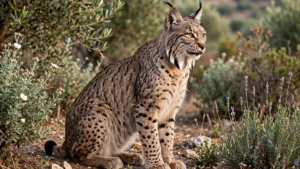
Other Norwegian animals with notably large eyes include the lynx, whose eyes help it hunt at dawn and dusk, and the red squirrel, whose dark eyes stand out against its russet fur. The lynx is a shy forest hunter, and the animals in Norway guide gives a fuller list of the species you might meet on a walk in Norwegian forest or mountain country.
Checklist: Watching Nocturnal Animals Responsibly
- Go out at dusk or dawn, when nocturnal animals are most active.
- Use a torch with a red filter, which disturbs animals less than white light.
- Keep your distance and use binoculars instead of walking closer.
- Never use flash photography on nocturnal animals at close range.
- Stay quiet and move slowly, so you do not startle the animal.
- Do not feed wild animals or lure them with food for a photograph.
- Learn the calls first: many owls and night animals are heard before they are seen.
Frequently Asked Questions
Which animal has the biggest eyes relative to its body?
The tarsier has the largest eyes relative to body size of any mammal. Each eye is about 16 millimetres across, larger than its brain, and the eyes cannot move in their sockets, so the tarsier turns its head to look around.
Why do owls have such big eyes?
Owls have large, forward-facing eyes that gather a lot of light, which helps them hunt at night. Their eyes are tubular and fixed in their sockets, so they turn their heads up to 270 degrees to look around.
Are slow lorises dangerous?
Slow lorises are venomous, which is unusual for a primate, and they can bite if threatened. They are also wild animals that suffer in captivity, and they should never be kept as pets.
Do big eyes mean an animal can see in the dark?
Large eyes help an animal see in low light, but they do not give perfect night vision. Most nocturnal animals also rely on hearing, smell and touch, and even owls cannot see in complete darkness.
Which big-eyed animal lives in Norway?
Several owls live in Norway, including the tawny owl and the long-eared owl, and the snowy owl visits in some winters. The lynx also has large eyes for hunting at dawn and dusk in forest country.
Why do humans find big eyes cute?
Humans respond to baby-like features, including large eyes, with care and protection. That response helps parents care for babies, and it also makes big-eyed animals seem cute, which is why they are popular in photographs and films.
Conclusion
Animals with big eyes are more than cute: their eyes are a tool, shaped by the need to see in the dark, judge distance and spot danger early. From the tarsier’s enormous eyes to the owl’s forward-facing gaze and the giant squid’s huge eyes in the deep ocean, each species shows a different answer to the same problem of seeing in low light. The next step is to look for big-eyed animals closer to home, starting with owls at dusk, and then explore our guides to predator animals and small animals to see how eyes, ears and other senses fit together in the wider world of wildlife.