The sambar deer is the largest deer in Asia, a heavy-bodied forest animal known scientifically as Rusa unicolor, and it is one of the most important animals in the forests where it lives. The central question is what makes this deer so different from the deer of Europe and North America. The answer is a mix of size, habitat and behaviour: sambar live in dense tropical forest, spend much of their time in and near water, and form the main prey of tigers and leopards across much of their range.
Key takeaways
- The sambar deer is the largest deer in Asia, with stags often weighing well over 200 kilograms.
- It lives in forests across India, Sri Lanka and South-East Asia, and has been introduced to Australia and New Zealand.
- Sambar are strong swimmers that feed near water and wallow in mud to cool down and escape insects.
- Stags grow three-tined antlers, shed each year, and use them in contests during the rut.
- Its loud alarm call warns other animals of danger, and tigers and leopards depend on sambar as prey.
- The species is listed as vulnerable, mainly because of habitat loss and hunting.
What Is a Sambar Deer?
The sambar deer (Rusa unicolor) belongs to the deer family, Cervidae, and is the largest deer species native to Asia. Stags are much bigger than hinds, with a shoulder height of up to about 160 centimetres and a weight that can reach around 300 kilograms in large males, although most animals are smaller. Hinds are lighter and slimmer, usually weighing well under 200 kilograms.
The coat is dark brown, often with a grey or yellowish tinge, and it is coarser and shaggier than the coat of most other deer. The underside, the throat and the tail are paler. Older stags tend to be darker, almost black in some cases, and their necks grow a thick mane of hair.
Sambar are found across a wide range, from the foothills of the Himalayas through India and Sri Lanka to Myanmar, Thailand, Malaysia, Indonesia and southern China. They have also been introduced to Australia, New Zealand and parts of the United States, where they have formed wild populations. Within that range they live in many forest types, from dry deciduous forest to wet evergreen forest, and they are usually found close to water.
Habitat and Range
Sambar need three things: cover, water and food. They favour forests with dense undergrowth, where they can hide during the day, and they stay near rivers, streams, ponds and marshes, where they drink, feed on waterside plants and wallow. They are strong swimmers and will take to water readily, sometimes swimming across rivers or standing in water up to their bellies to feed on aquatic plants.
In India, sambar are common in the well-known tiger reserves of the central and southern forests, including Kanha, Bandhavgarh, Ranthambore and Periyar. In Sri Lanka they live in the hill country and in the forests of the dry zone. In South-East Asia they are found in the forests of Thailand, Malaysia and Indonesia, although numbers there have fallen sharply. The forest animals of cooler regions face different pressures, but the rule is the same everywhere: lose the forest, and the deer go with it.
Sambar can live at a wide range of altitudes, from lowland forest up to mountain slopes of more than 3,000 metres in the Himalayan foothills. They are most active at dawn and dusk, resting in thick cover during the heat of the day and feeding in the cooler hours. In places where they are hunted, they become more nocturnal, feeding at night and hiding by day.
Diet and Daily Life
Sambar are browsers and grazers, feeding on a wide mix of leaves, shoots, buds, fruit, grass and water plants. They eat the leaves of shrubs and young trees, fallen fruit, and the soft growth along riverbanks, and they will also feed on bark in the dry season when other food is scarce. They need to drink regularly, and they often feed close to water, where the vegetation is lush.
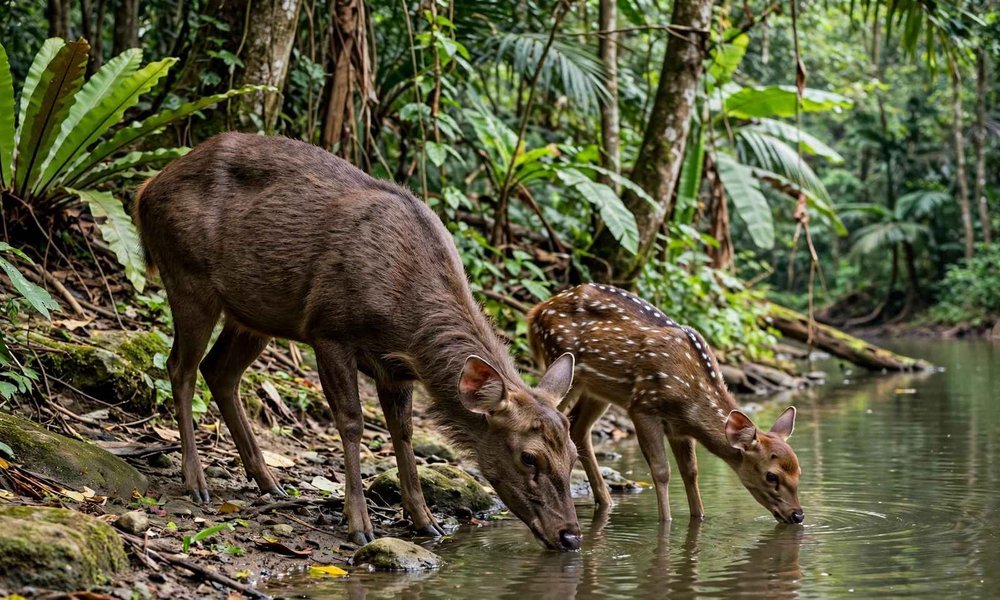
Sambar are usually solitary or live in small groups. Hinds with fawns keep together in loose groups, while stags are often alone except during the breeding season. They are not strongly territorial, and home ranges overlap. Their senses are sharp: hearing and smell are their main defences, and a sambar that catches a scent or a sound will freeze, stare, and then give its alarm call if the danger is real.
The alarm call is one of the sambar’s best-known features. It is a loud, sharp bark that carries a long way through the forest, and it is used to warn other animals of a predator. Other species listen for it too: langur monkeys, spotted deer and wild pigs all react to a sambar alarm, and tiger trackers use it as a sign that a big cat is moving nearby.
Antlers, Rut and Breeding
Stags grow antlers that are shed and regrown each year. A mature stag’s antlers are thick, rugged and usually have three tines on each side: a brow tine low on the beam, a second tine part-way up, and a forked tip. The antlers can reach a length of more than a metre in large stags, and they are used in contests between males during the breeding season, or rut.
The rut varies with location. In India it often falls in the cooler months, roughly from November to January, while in other parts of the range it may come at a different time of year. During the rut, stags become more active and more aggressive, marking trees with their antlers, wallowing in mud mixed with their own scent, and calling with a deep, booming voice that carries through the forest.
Sambar and Their Predators
Sambar are a key prey species for Asia’s big cats. Tigers hunt them more than any other deer, and a single adult sambar provides a large meal that can feed a tiger for several days. Leopards also hunt sambar, usually taking hinds and young animals, while dholes — the wild dogs of Asia — hunt in packs and can bring down an adult. In the water, large crocodiles are a threat to deer that cross rivers or feed at the edge.
The sambar’s defences are its senses, its alarm call and the forest itself. It stays in thick cover, feeds near escape routes, and relies on hearing and smell to detect danger early. When it senses a predator, it barks loudly, which warns other animals and may make the predator give up, since a warned deer is harder to catch. If it is chased, it runs into dense undergrowth or into water, where it can swim well and where a tiger is less willing to follow.
Sambar Deer Compared With Other Deer
The table below compares the sambar with other well-known deer species, showing how size, habitat and antlers differ.
| Deer species | Size | Main habitat | Antlers |
|---|---|---|---|
| Sambar deer | Largest in Asia, stags up to about 300 kg | Tropical forest near water | Thick, three tines per side |
| Red deer | Large, stags up to about 240 kg | Temperate forest and moorland | Branched, many tines |
| Moose | Largest deer in the world, up to about 700 kg | Northern forest and wetlands | Broad, palmate |
| Chital (spotted deer) | Medium, around 50 to 100 kg | Open forest and grassland | Slender, three tines |
| Roe deer | Small, around 20 to 30 kg | Woodland and farmland edges | Short, usually three points |
Conservation Status
The sambar deer is listed as vulnerable by the International Union for Conservation of Nature (IUCN), which means its numbers have fallen and it faces a high risk of decline. The main threats are loss of forest habitat, hunting for meat and antlers, and competition with livestock. In parts of South-East Asia, numbers have fallen sharply, and the species has disappeared from some areas where it was once common.
Checklist: Spotting Sambar Deer in the Wild
- Visit a forest reserve at dawn or dusk, when sambar are most active.
- Look near water: riverbanks, ponds and marsh edges are the best places.
- Listen for the loud, sharp alarm bark, which often gives away a sambar before you see it.
- Watch for fresh tracks, droppings and wallows in mud near water.
- Scan the forest edge rather than the open ground — sambar stay close to cover.
- Keep quiet and still, and use binoculars rather than walking closer.
- Go with a local guide or tracker who knows the area and the animals’ habits.
- Never approach a stag during the rut, and keep a safe distance from any wild deer.
Frequently Asked Questions
How big is a sambar deer?
The sambar is the largest deer in Asia. Large stags can stand about 160 centimetres at the shoulder and weigh up to around 300 kilograms, while hinds are smaller and lighter, usually well under 200 kilograms.
Where do sambar deer live?
Sambar live in forests across India, Sri Lanka and South-East Asia, from the Himalayan foothills to Indonesia, and they have been introduced to Australia, New Zealand and parts of the United States. They favour dense forest close to water.
What do sambar deer eat?
They feed on leaves, shoots, buds, fruit, grass and water plants, and will eat bark in the dry season. They drink regularly and often feed on vegetation along riverbanks and in shallow water.
Are sambar deer dangerous?
Sambar are shy and usually run from people, but a stag during the rut, or a hind with a young fawn, can be aggressive if cornered or approached too closely. Wild deer should always be watched from a distance.
What is the sambar deer’s alarm call?
It is a loud, sharp bark that carries through the forest and warns other animals of danger. Other species, including monkeys, spotted deer and wild pigs, react to it, and tiger trackers use it as a sign that a big cat is nearby.
Why are sambar deer important?
They are the main prey of tigers and leopards across much of Asia, so their numbers directly affect the big cats. Protecting sambar and their forest habitat is one of the most effective ways to protect tigers.
Conclusion
The sambar deer is a quiet giant of the Asian forest: the largest deer on the continent, a strong swimmer, a browser of dense cover, and the animal that keeps tigers and leopards fed. Its alarm bark is the sound of the forest warning itself, and its presence is one of the best signs that a forest is healthy. Without sambar, the great predators of Asia would struggle, and the forest would be a poorer place.
The next step is simple. If you visit a forest reserve in India or Sri Lanka, go out at dawn, find water, and listen. The sambar may stay hidden, but its tracks, its wallows and its bark will tell you it is there. To understand the wider world of deer and their predators, read our guides to forest animals and predator animals, and plan your visit around the seasons when the forest is at its most active.
Safety disclaimer: This guide is for general information only. Wild deer can be unpredictable, especially stags during the rut and hinds with young. Keep a safe distance, never approach or feed wild deer, and follow the advice of local guides and park staff.