Brazil animals are among the most spectacular on Earth. Brazil animals include jaguars in the Pantanal, pink river dolphins in the Amazon, toucans in the Atlantic Forest, and capybaras on riverbanks across the country — and the central question is why Brazil holds more wildlife than almost any other country. The answer is size and variety: Brazil covers nearly half of South America, with the world’s largest rainforest, the world’s largest tropical wetland, savanna, dry forest and a long Atlantic coast.
Brazil is one of the world’s megadiverse countries, home to more species of mammals, birds, amphibians and freshwater fish than almost anywhere else. Much of that wildlife is found nowhere else, and much of it is still being studied. For a wildlife watcher, Brazil offers three great destinations — the Amazon, the Pantanal and the Atlantic Forest — each with its own animals.
Key takeaways
- Brazil animals include jaguars, capybaras, toucans, pink river dolphins and giant otters.
- The Amazon, the Pantanal and the Atlantic Forest are the three great wildlife regions.
- The Pantanal is the best place in the world to see a wild jaguar.
- Many species live nowhere else, including the golden lion tamarin and the maned wolf.
- Habitat loss is the main threat, and protected areas and responsible tourism help.
Why Brazil Has So Much Wildlife
Brazil’s diversity comes from its size and its habitats. The country stretches from the equator to the subtropics, and from the Atlantic coast to the Andes foothills. That range of latitude, rainfall and altitude creates many different habitats, and each one has its own animals.
The Amazon rainforest covers much of northern Brazil. It is the largest rainforest in the world, with more tree species than any other forest, and it holds about one in ten of the world’s known species. The Pantanal, in the west, is the world’s largest tropical wetland, a flat plain of grassland, rivers and forest that floods each year. The Atlantic Forest runs along the coast, a narrow strip of rainforest that holds a remarkable number of species found nowhere else. Inland, the Cerrado is a vast savanna of grass and scattered trees, home to the maned wolf and the giant anteater.
Brazil’s rivers add more variety. The Amazon river system is the largest in the world, with thousands of kilometres of waterways that hold river dolphins, giant otters, piranhas and many fish found nowhere else. The country’s long coast has coral reefs, mangroves and islands, with sea turtles, whales and seabirds.
Iconic Brazil Animals
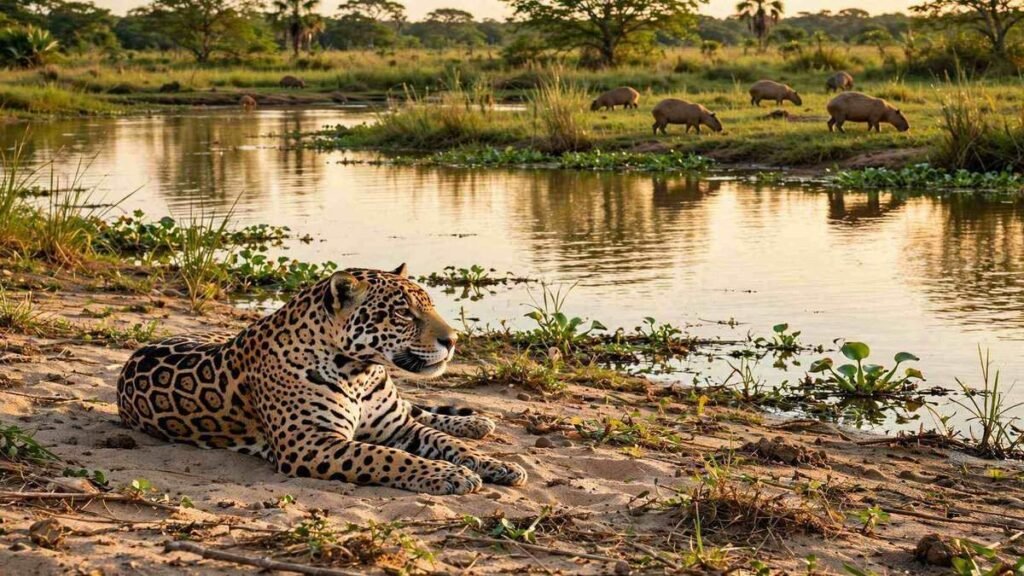
The jaguar is Brazil’s most famous animal. It is the largest cat in the Americas, and the Pantanal is the best place in the world to see one. Jaguars there are larger than in most other countries, and they hunt capybaras, caimans and deer along the rivers. They are strong swimmers and often hunt in the water. In the Amazon, jaguars are harder to see, because the forest is dense and the animals are shy.

The capybara is the world’s largest rodent, weighing as much as a large dog. It lives in groups along rivers and lakes, grazing on grass and water plants, and it is an excellent swimmer. Capybaras are calm and social, and they are a main food source for jaguars, caimans and anacondas.
The pink river dolphin, also called the boto, lives in the Amazon and Orinoco rivers. It is a freshwater dolphin with a pink colour that deepens with age, a long beak and a flexible neck that lets it turn among flooded trees. It is one of only a few river dolphin species in the world, and it is a symbol of the Amazon.
The toucan, with its huge colourful beak, is one of the most recognisable birds in Brazil. It lives in the canopy of the Amazon and the Atlantic Forest, eating fruit and moving in small groups. The giant otter is another Amazon icon: a social animal that lives in family groups along rivers, hunts fish together, and is larger than any other otter species.
The golden lion tamarin is a small monkey with a bright orange mane, found only in the Atlantic Forest near Rio de Janeiro. It was once close to extinction, but captive breeding and forest restoration have brought its numbers back. The maned wolf, with its long legs, red coat and black mane, roams the Cerrado savanna at dawn and dusk, eating fruit, small mammals and birds.
Brazil Animals by Region
Brazil’s three great wildlife regions each have their own character. The table below gives an overview.
| Region | Key animals | Best place to see them |
|---|---|---|
| Amazon | Pink river dolphin, giant otter, macaw, sloth | Manaus, Amazon lodges |
| Pantanal | Jaguar, capybara, caiman, giant anteater | Porto Jofre, Cuiaba river |
| Atlantic Forest | Golden lion tamarin, toucan, muriqui monkey | Rio de Janeiro state reserves |
| Cerrado | Maned wolf, giant anteater, rhea | Emas National Park |
| Coast and islands | Humpback whale, sea turtle, seabirds | Abrolhos, Fernando de Noronha |
The Amazon is the richest region, but also the hardest to explore. Most visitors stay at a river lodge near Manaus and take boat trips at dawn and dusk, when animals are active. The forest canopy holds monkeys, sloths and macaws, while the rivers hold dolphins, otters and caimans.
Endemic Species: Found Only in Brazil
Brazil has more endemic species than almost any other country. The golden lion tamarin is the best known, but there are many more. The maned wolf lives mainly in Brazil’s Cerrado, although it also occurs in neighbouring countries. The Brazilian merganser, a rare duck, lives only in a few clear rivers in central Brazil. Hundreds of bird, frog and fish species are found only in the Atlantic Forest, and many live in a single valley or a single mountain range.
The Amazon holds many species that are still being described by science. New species of monkey, frog and fish are found every year, and many live in a small area that is at risk from deforestation. These animals are often the most vulnerable, because their whole world is one patch of forest, and one road or one farm can destroy it.
Endemic species matter because they are irreplaceable. Once the golden lion tamarin or the Brazilian merganser is gone, it is gone everywhere. That is why Brazil’s protected areas matter so much.
Threats and Conservation
Brazil’s wildlife faces serious pressure. Deforestation is the largest threat: the Amazon and the Atlantic Forest are cleared for cattle ranching, soy farming and timber, and the Cerrado is ploughed for crops. The Atlantic Forest has lost most of its original cover, and what remains is broken into fragments. The Pantanal is threatened by drainage, dam building and wildfire.
Hunting and the illegal pet trade are also threats. Parrots and other birds are taken for the pet trade, and jaguars are killed when they take livestock. River dolphins are threatened by fishing nets, dam building and pollution, and their numbers are falling.
There is also good news. Brazil has a large network of national parks and reserves, and the golden lion tamarin has recovered from the edge of extinction through captive breeding and forest restoration. Ecotourism in the Pantanal gives local people an income from jaguars rather than from killing them, and jaguar numbers there are now closely watched and protected. The animal migration of humpback whales to the Abrolhos coast each winter is now a major whale-watching attraction.
Tourists can help by choosing responsible operators, keeping a distance from wildlife, and not buying products made from wild animals. Money spent on wildlife tourism gives local communities a reason to protect animals rather than hunt them.
Where to See Brazil Animals
The best place to see a jaguar is the Cuiaba river near Porto Jofre in the Pantanal, from July to October, when the dry season concentrates animals along the rivers. Boat trips at dawn and late afternoon give the best chances, and a good guide is essential.
For the Amazon, a river lodge near Manaus is the usual base, with boat trips and forest walks at dawn and dusk. For the Atlantic Forest, reserves near Rio de Janeiro offer golden lion tamarins, toucans and muriqui monkeys on guided walks. For the Cerrado, Emas National Park is the best place to see maned wolves and giant anteaters, especially in the dry season.
Humpback whales gather off the Abrolhos coast from July to November, and sea turtles nest on beaches in Bahia and Fernando de Noronha. The Pantanal’s birdlife is at its best in the dry season, when herons, storks, ibises and macaws gather at the pools.
Checklist: Wildlife Watching in Brazil
- Travel with a licensed local guide, who knows the animals and the rules.
- Visit in the right season: Pantanal jaguars from July to October, whales from July to November.
- Keep your distance from all wildlife, and never feed wild animals.
- Do not touch or chase river animals, and never swim near caimans.
- Bring binoculars, water, sun protection and insect repellent.
- Book boat trips and lodges with operators that follow wildlife rules.
- Leave no litter, and stay on marked paths in forests and reserves.
- Do not buy souvenirs made from animals, shells or coral.
Frequently Asked Questions
What is the most famous animal in Brazil?
The jaguar is the most famous land animal, the pink river dolphin is the most famous river animal, and the toucan is the most famous bird. All three are symbols of Brazil’s wildlife.
Where is the best place to see a jaguar in Brazil?
The Cuiaba river near Porto Jofre in the Pantanal, from July to October. It is the best place in the world to see a wild jaguar, and most visitors see one on a boat trip.
What is a capybara?
A capybara is the world’s largest rodent, weighing as much as a large dog. It lives in groups along rivers and lakes, grazes on grass and water plants, and is an excellent swimmer.
Are Brazil’s animals dangerous?
Most are shy and avoid people. Jaguars and caimans are dangerous if approached, and anacondas are powerful animals, but attacks on people are rare. Keep your distance and follow your guide’s advice.
Which animals live only in Brazil?
Many, including the golden lion tamarin, the Brazilian merganser and hundreds of Atlantic Forest birds, frogs and fish. Brazil has more endemic species than almost any other country.
When is the best time to visit Brazil for wildlife?
The dry season, from July to October, is best for the Pantanal and the Cerrado. The Amazon can be visited year-round, and humpback whales are best from July to November.
Conclusion
Brazil animals are a reminder of how much life one country can hold. From jaguars on the Pantanal rivers to pink river dolphins in the Amazon, from toucans in the Atlantic Forest to maned wolves on the Cerrado, Brazil’s wildlife is the product of a vast and varied land.
The next step is to plan a visit with the animals in mind. Choose one region and one season — jaguars in the Pantanal in the dry season, or the Amazon by river lodge — and go with a local guide who knows the wildlife. If you want to compare Brazil’s wildlife with what lives closer to home, start with our guide to animals in Norway and the forest animals of northern Europe. The wild is worth the journey, and the best sightings come to those who travel with patience and respect.