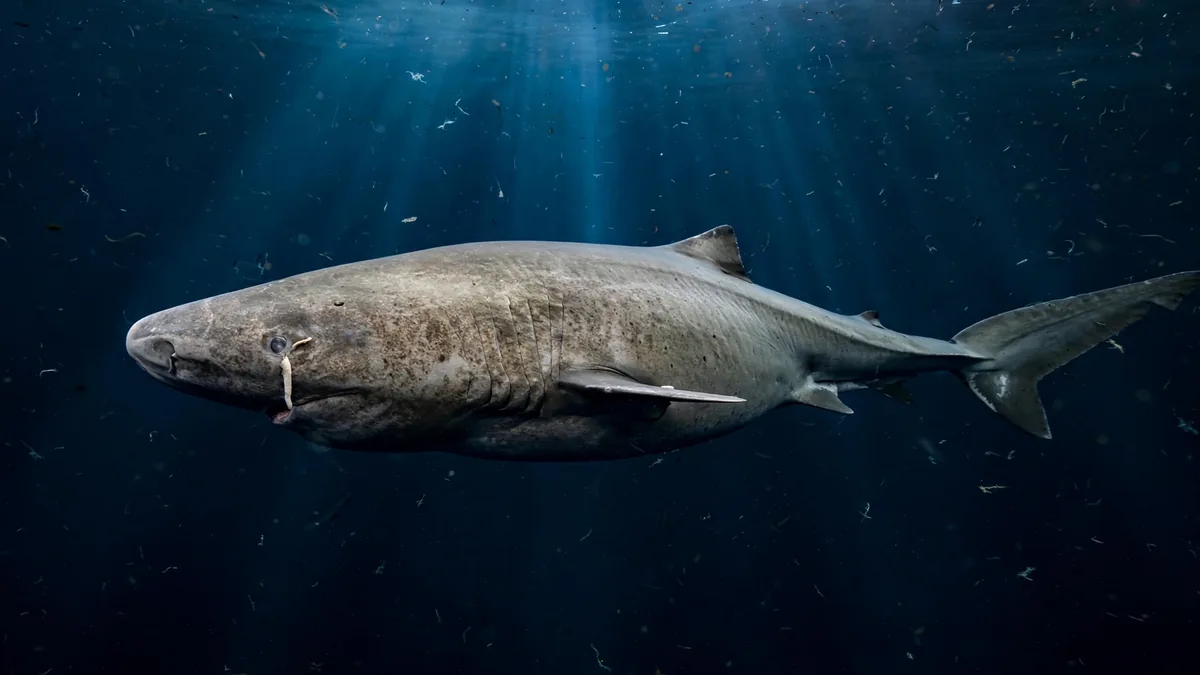
The Greenland shark species is the slowest shark in the sea and quite possibly the longest-lived animal with a backbone on earth. If you are asking what a Greenland shark is, the short answer is Somniosus microcephalus, a huge, grey-brown sleeper shark of the Arctic and sub-Arctic that most adults meet at 2.4 to 4.3 metres long, though the biggest reach about 7 metres and 1,400 kilograms. It swims at a pace a person could walk past, it lives in water so cold and dark that few people ever see it, and a study in 2016 estimated that some of these sharks are 272 to 512 years old, which would make them the oldest vertebrates known to science.
You will probably never meet a Greenland shark by accident. It lives hundreds of metres down in the cold waters around Greenland, Iceland, Svalbard and northern Canada, in a world of near-darkness where the water is close to freezing. Yet this is an animal worth knowing, because it turns almost everything we assume about sharks upside down: it is slow where other sharks are fast, it is nearly blind where other sharks see well, and it grows so slowly that it does not breed until it is about 150 years old. This guide covers the whole animal, from its family tree and its extraordinary age to where it lives, what it eats, how it breeds, and why its flesh is poisonous unless it is prepared in the old Icelandic way.
Key takeaways
- The Greenland shark species is Somniosus microcephalus, a huge sleeper shark of Arctic and sub-Arctic waters, with most adults measuring 2.4 to 4.3 metres and the biggest reaching about 7 metres and 1,400 kilograms.
- It is the slowest shark in the sea, cruising at a pace a person could walk past, and it lives in cold water 200 to 2,000 metres deep.
- A 2016 study estimated Greenland sharks live 272 to 512 years, with the oldest at about 392 years, give or take 120 years, and they do not breed until they are about 150 years old.
- Most Greenland sharks have their eyes parasitised by a small copepod, Ommatokoita elongata, yet they hunt well by smell, and they eat fish, squid, seals and carrion.
- The flesh contains trimethylamine N-oxide and is toxic unless it is fermented and dried, and the species is listed as Vulnerable by the International Union for Conservation of Nature.
The Greenland shark species and its relatives
Greenland sharks belong to the family Somniosidae, the sleeper sharks, and to the genus Somniosus, a group of large, slow, deep-water sharks found in cold seas around the world. The scientific name, Somniosus microcephalus, tells the story in two words: Somniosus comes from the Latin for sleepy, and microcephalus means small-headed, and both fit a shark that moves as if it were half asleep and carries a small, blunt head on a huge body. It was described in 1801 by the German naturalists Marcus Elieser Bloch and Johann Gottlob Schneider, and it has kept its name ever since.
Sleeper sharks as a family are a varied lot, and they range from barely over a metre long to about 7 metres, so the family spans roughly 1 metre to 7 metres from end to end. What they share is a life in cold, deep water, a slow and steady way of swimming, and a body built for endurance rather than speed. The Greenland shark is the largest of them, and it is also the one that lives furthest north, in the Arctic waters where few other sharks can survive at all. National Geographic keeps a profile of the Greenland shark among its fish facts, and it is a good place to start for the basic shape of the animal, but it leaves the deeper questions, such as how the shark really lives to such an age and how it hunts when it can barely see, for guides like this one to answer.
| Type | Animal | Where it lives | Best-known food | Length or Weight |
|---|---|---|---|---|
| Family | Sleeper sharks (Somniosidae) | Cold deep waters worldwide | Fish, squid and carrion | About 1 m to 7 m long |
| Genus | Sleeper sharks (Somniosus) | Arctic and deep temperate waters | Fish, squid and seals | About 1 m to 7 m long |
| Species | Greenland shark (Somniosus microcephalus) | Arctic and sub-Arctic waters | Fish, squid and seals | About 2.4 m to 4.3 m long, up to 7 m |
| Species | Pacific sleeper shark (Somniosus pacificus) | North Pacific deep water | Fish, squid and octopus | About 2 m to 4.4 m long |
| Species | Southern sleeper shark (Somniosus antarcticus) | Southern Ocean | Fish and squid | About 2 m to 4 m long |
| Species | Little sleeper shark (Somniosus rostratus) | Eastern Atlantic and Mediterranean deep water | Small fish and squid | About 1 m to 1.4 m long |
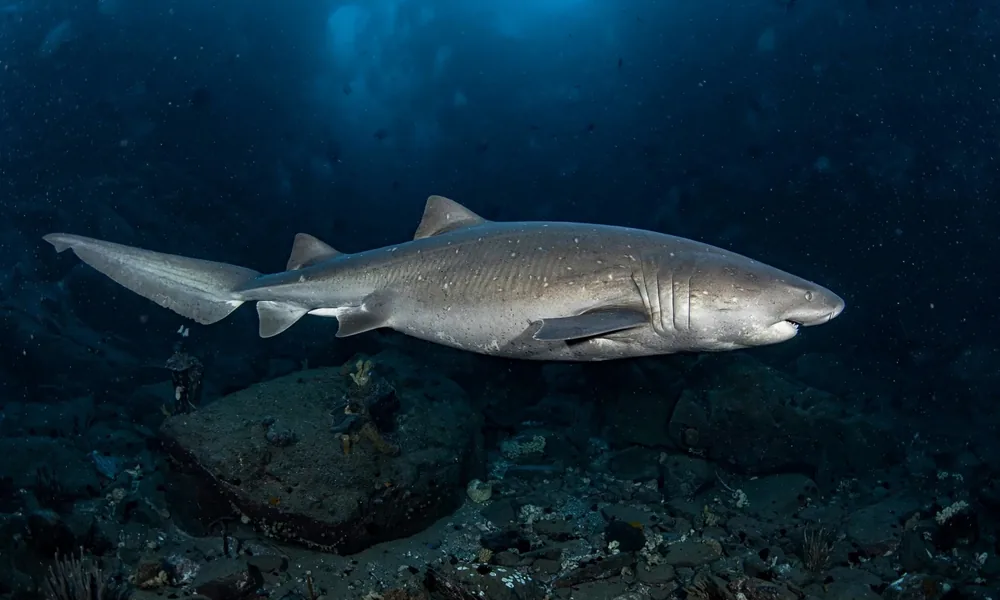
The closest relatives of the Greenland shark are the other Somniosus species, and the most useful comparison is with the Pacific sleeper shark, which reaches about 4.4 metres and lives in the deep water of the North Pacific. The two are so alike that they were long confused with each other, and it took careful study of their teeth and their genes to sort them out. The southern sleeper shark, at about 2 to 4 metres, patrols the Southern Ocean around Antarctica, which makes the genus a mirror image: one giant in the far north, one in the far south, and the little sleeper shark, barely 1 to 1.4 metres long, living in the deep water of the eastern Atlantic and the Mediterranean.
There is one more relationship worth knowing, and it is the one that explains the Greenland shark’s place in the sea. Like the basking shark, a Greenland shark is a huge, slow-moving animal that feeds in cold water, but the two live very different lives: the basking shark swims near the surface with its mouth open, filtering plankton, while the Greenland shark hunts in the deep, taking fish, squid and seals, and that difference is written all over its body. The basking shark is built like a sieve; the Greenland shark is built like a submarine, slow, heavy and almost silent in the dark.
What a Greenland shark looks like
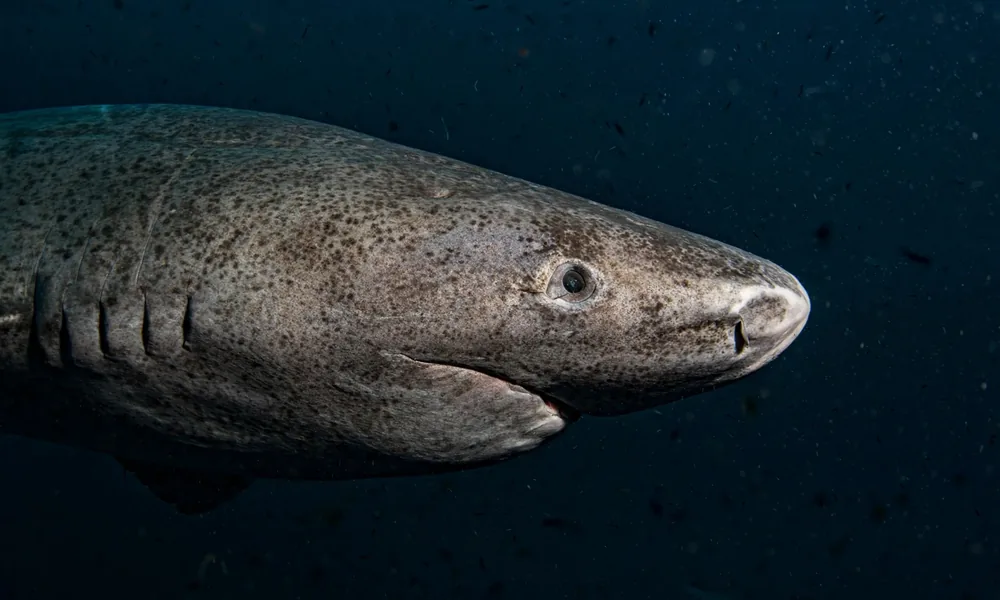
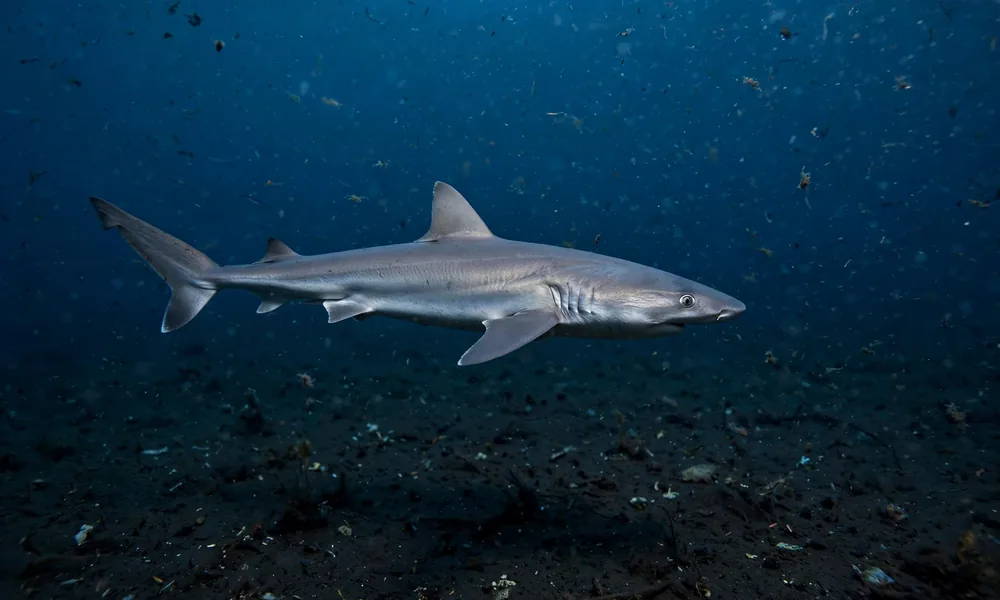
A Greenland shark is a huge, heavy, grey-brown shark that looks more like a torpedo with fins than like the sleek sharks most people picture. Most adults measure 2.4 to 4.3 metres from snout to tail, and a big female can weigh 800 to 1,000 kilograms, with the largest on record reaching about 7 metres and 1,400 kilograms. The body is thick and cylindrical, almost the same width from the head to the tail, and the skin is rough and mottled, a dark grey-brown on the back fading to a paler grey underneath, sometimes with darker blotches and scars from a long life in the deep.
The head is small and blunt, with a short, rounded snout and a mouth set low underneath it, and the eyes are tiny, dark and set far forward, almost too small for the size of the animal. The teeth are the most telling feature: the upper teeth are narrow and pointed, made for gripping, while the lower teeth are broad and blade-like, made for cutting, and the two work together like a saw, letting the shark take bites out of prey far too large to swallow whole. The fins are small for the size of the body, the tail is long with a much larger upper lobe, and there is no anal fin at all, which is one of the marks of a sleeper shark.
The most famous feature of the Greenland shark is not part of the shark at all. Most adults carry a small copepod, Ommatokoita elongata, attached to each eye, a pale, worm-like parasite about 3 centimetres long that dangles from the cornea and damages the shark’s vision. It is a strange sight, and it raises the obvious question of how a nearly blind shark hunts at all, but the answer is that the shark does not need its eyes the way a reef shark does. It hunts in the dark by smell, and its sense of smell is superb, able to follow the scent of a dead seal or a wounded fish through hundreds of metres of black water.
Males and females look much alike, though females grow considerably larger than males, which is common in sharks that produce large numbers of young. A male of 3 metres is a big fish; a female of the same length is still growing, and the very largest Greenland sharks ever measured, close to 7 metres, have all been females. The best clue to a shark’s age is its length, because the animal grows so slowly, less than a centimetre a year, that a shark of 4 metres is already more than a century old, and a shark of 5 metres may be two centuries old or more.
Where Greenland sharks live
Greenland sharks live in the Arctic and sub-Arctic waters of the North Atlantic and the Arctic Ocean, in a range that runs from Baffin Bay and the waters around Greenland, through the seas off Iceland and Svalbard, to the Barents Sea and the far north of Russia, and south to the Gulf of St Lawrence and the coast of New England. They are a cold-water shark, and they follow the cold, which is why they are found in water from close to freezing to about 12 degrees Celsius, and why they are almost never seen in warm seas.
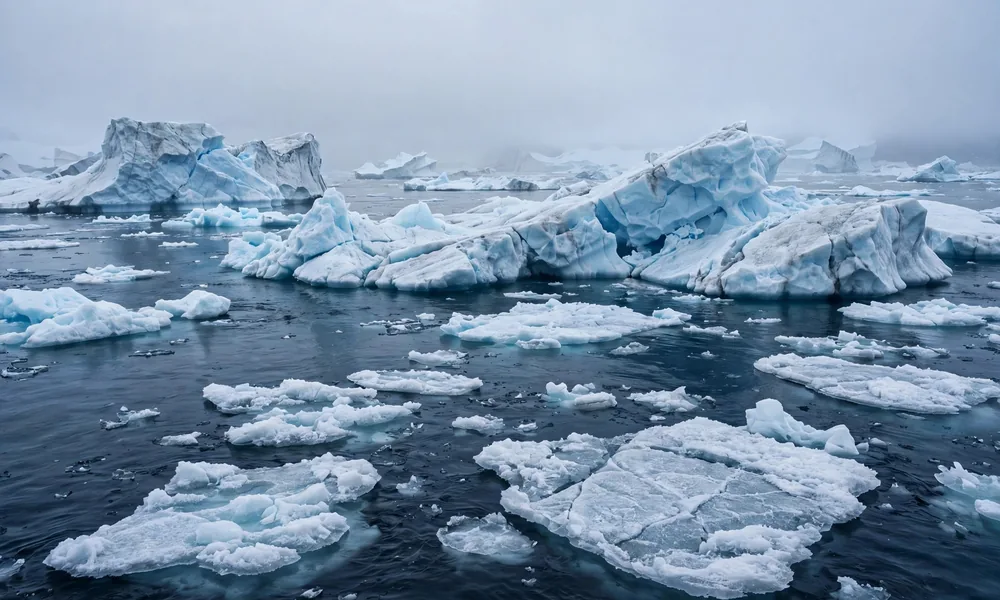
The habitat they choose is deep, dark and cold. A Greenland shark spends most of its life at depths of 200 to 2,000 metres, drifting slowly over the continental slope and the deep seabed, where the light never reaches and the water is close to freezing. It is one of the deepest-living sharks in the Arctic, and it is also one of the most patient: it moves at about a third of a metre a second, barely faster than a walking person, and it can spend hours drifting over the same patch of seabed, waiting for a scent to reach it in the dark.
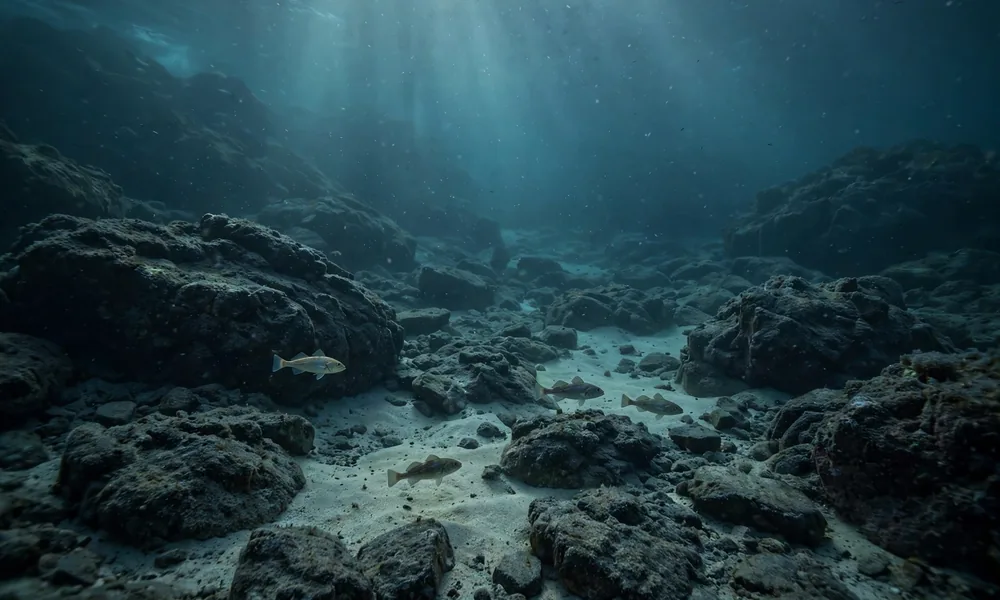
In the Arctic winter, Greenland sharks do something that surprises people who think of them as purely deep-water animals: they come up into shallow water, sometimes into fjords less than 100 metres deep, and occasionally right up under the sea ice. The cold water they prefer is found near the surface in winter, so the shark follows it up, and it is in those shallow winter waters that fishermen have caught them through the ice for centuries. In summer, when the surface warms, the sharks sink back down to the deep, which is why the best chance of meeting one is in the cold months, or from a boat working the deep water off the Arctic coast.
What Greenland sharks eat
Greenland sharks eat fish, squid, seals and carrion, and they are not fussy about which kind, as long as it is dead, dying or slower than they are. The everyday diet is made up of fish such as cod, Greenland halibut, redfish and wolffish, along with squid and skates, and the shark takes what is commonest in its own patch of deep water. It is a generalist of the deep, and its stomach has turned up some remarkable things, including the remains of seals, porpoises, and even a reindeer and a polar bear, all of which were almost certainly scavenged as carrion rather than hunted alive.
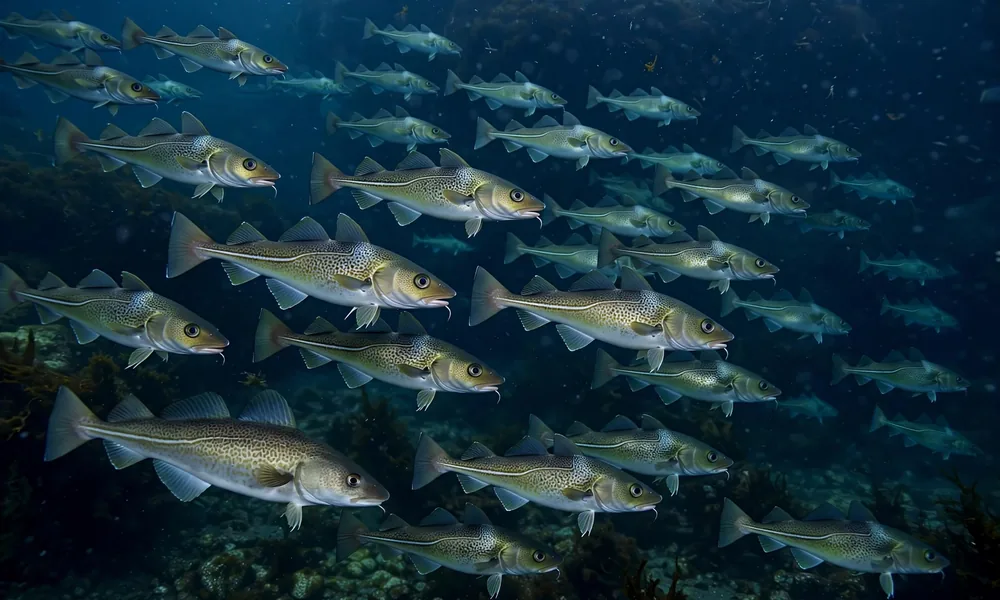
The hunting style is the slowest of any shark, and it works because the shark does not chase. A Greenland shark drifts through the dark, following a scent, and when it finds a sleeping seal or a resting fish, it moves in quietly and bites. Seals sleep in the water, and a seal that is dozing at the surface or resting on the seabed is vulnerable to a shark that approaches without a sound. The shark’s lower teeth cut a plug of flesh out of its prey, and it takes its time over a meal, feeding slowly and then drifting on. It is not a dramatic hunt, and there is no burst of speed, but in water where everything moves slowly, it does not need one.
Feeding is closely tied to the seasons and to what is dying in the water above. In the Arctic summer, when the sea is full of life, the shark feeds on fish and squid, and in the winter it scavenges more, taking dead seals and the remains of animals that have died in the ice. Like the whale shark, a Greenland shark is a giant that feeds without speed, but the whale shark filters tiny plankton from warm surface water, while the Greenland shark takes whole fish and seals from the freezing deep, and that difference shapes everything from its teeth to its daily rhythm.
How Greenland sharks behave
Greenland sharks are solitary for most of their lives, and a single shark will usually be found alone, drifting slowly over the seabed or hanging in the deep water, with no other shark in sight. They are not social animals, and they do not school or gather in groups, though several may be drawn to the same dead whale or the same fishing boat, where the scent of food brings them together for a while. They are not aggressive, and they are not fast, and their usual response to anything unfamiliar is to keep drifting, slow and unbothered, as if nothing in the world were in a hurry.
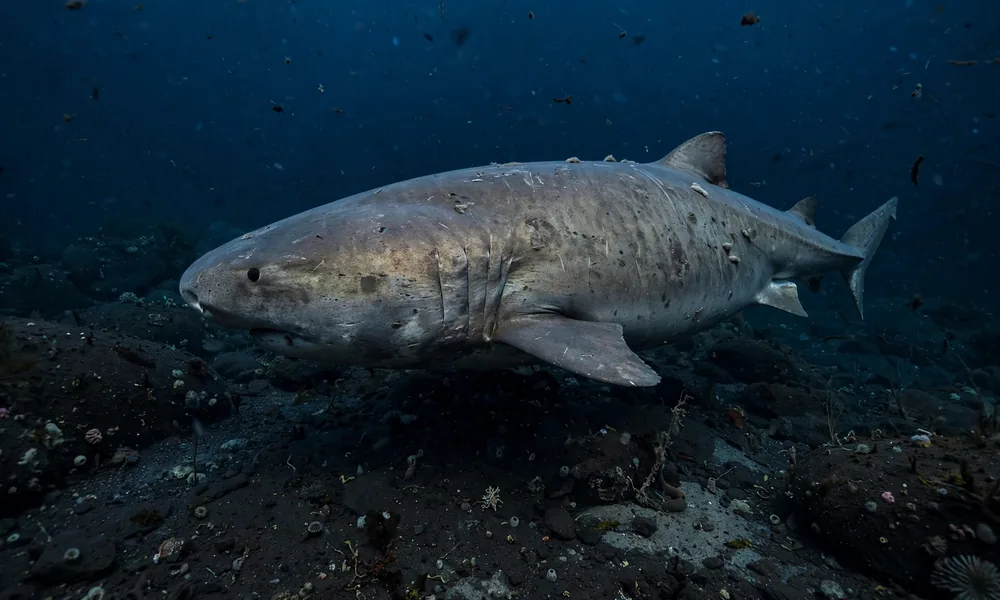
The slowness is the behaviour people ask about most, and it is worth describing properly. A Greenland shark cruises at about a third of a metre a second, which is the slowest of any shark, and it can go for hours without seeming to hurry at all. The reason is the cold: in water close to freezing, a shark’s muscles work slowly, and the Greenland shark has turned that slowness into a strategy, spending almost no energy and living off very little food. It is not a lazy fish, and it is not a sick one: it is an animal that has matched its whole life to the pace of the deep, where nothing moves fast and nothing needs to.
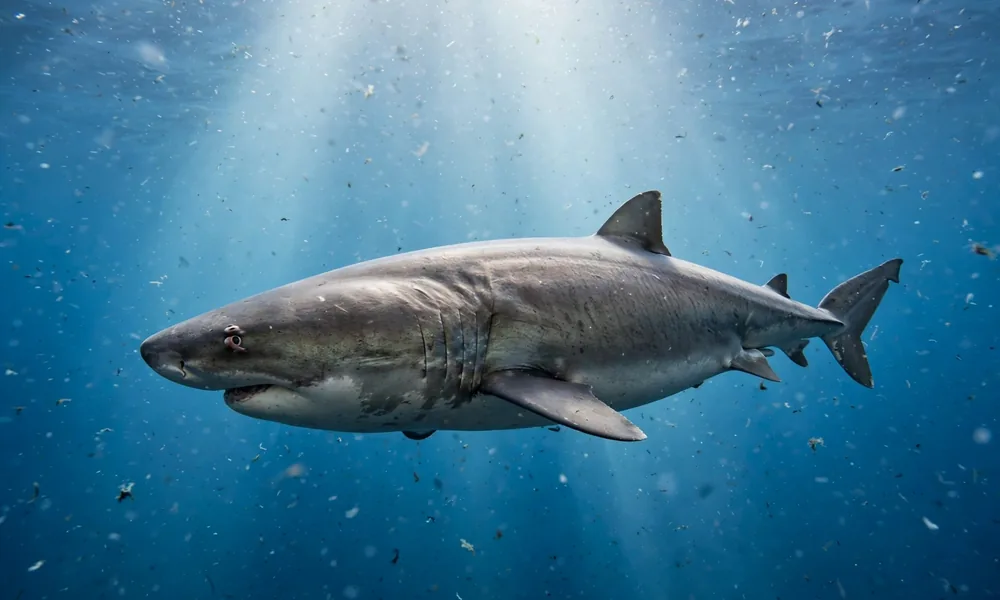
Young Greenland sharks behave much like adults, which is unusual for a shark: there is no nursery ground and no school of youngsters, and a young shark simply lives the same slow life in the same deep water, growing a fraction of a centimetre a year. The only real difference is depth: the smallest sharks are sometimes found in shallower water than the adults, and they move deeper as they grow, which may be a way of avoiding the bigger sharks that would eat them. Even a young Greenland shark is a tough animal, and it has few enemies in the deep apart from other sharks and the occasional orca.
Breeding and life cycle
Greenland sharks breed very slowly, and that slowness is the heart of the animal’s story. They are among the slowest-growing of all sharks, putting on less than a centimetre a year, and they do not reach breeding size until they are about 150 years old, when a female is roughly 4 metres long. No other vertebrate waits so long to breed, and it means that a Greenland shark alive today may have been born before the first steamships crossed the Atlantic, and may not have its first young until well into the next century.
The details of how they breed are still poorly known, because nobody has ever seen a Greenland shark give birth, and most of what we know comes from examining dead animals. They are live-bearers, and the females carry their young inside them, giving birth to pups about 40 centimetres long, in litters thought to number around ten. The pups are born in deep water, fully formed and able to swim, and they are on their own from the moment they are born, with no parental care at all. It is a hard start, and the pups grow so slowly that a young shark of a metre long may already be decades old.

The age of the Greenland shark was only settled in 2016, when a team led by Julius Nielsen measured the radiocarbon in the eye lenses of 28 sharks and estimated their ages at 272 to 512 years, with the oldest at about 392 years, give or take 120 years. The range matters, and it should not be quoted as a single number: 512 years is the upper end of an estimate, not a settled fact, and the honest way to put it is that Greenland sharks live for centuries, with the best estimate for the oldest animals at around 392 years, plus or minus 120. Even the lower end of that range makes them the longest-lived vertebrates known to science, and it means that the sharks swimming in Arctic waters today may have been alive when the first Europeans reached Greenland.
Conservation status
The Greenland shark is listed as Vulnerable by the International Union for Conservation of Nature, in its 2023 assessment, and the reasoning is straightforward: it is a slow-growing, late-breeding animal that cannot replace its numbers quickly, and it is caught, often by accident, in deep-water fisheries across its range. It is not a fish that is targeted heavily for food, except in Iceland, where it is eaten as hakarl, but it is taken as bycatch in fisheries for Greenland halibut and shrimp, and many of the sharks caught in nets do not survive.

The real pressure on the Greenland shark is not hunting but the slow arithmetic of its life. A female that does not breed until she is 150 years old, and then produces only a small litter every few years, cannot make up for losses quickly, and a population that loses its big breeding females can take centuries to recover. That is why the conservation advice is practical: limit the bycatch in deep-water fisheries, protect the deep habitats where the sharks feed and breed, and treat the shark as an animal whose timescale is not ours. A Greenland shark killed today was born before the modern world, and its replacement will not be ready to breed until long after we are gone.
There is one more issue that matters to people who eat shark, and it is worth stating plainly. The flesh of the Greenland shark contains trimethylamine N-oxide, a chemical that helps the shark survive in deep, cold water, and in a person it acts as a poison, causing stomach pain, vomiting and confusion. The flesh is safe to eat only after it has been fermented and dried for months, in the Icelandic tradition that makes hakarl, and fresh or poorly prepared Greenland shark meat is toxic. It is a reminder that this is not a fish to be eaten casually, and that the old ways of preparing it exist for a reason.
Best seasons for Greenland shark watching
The best time to look for a Greenland shark depends on where you are, because the shark lives in cold water all year round and there is no single season for the whole Arctic. In the Arctic summer, from about June to September, expedition boats run to Svalbard, Greenland and Iceland, the sea ice breaks up, and the midnight sun lights the water for twenty-four hours a day, which makes it the easiest time to get out on the water. It is also the time when the sharks are deepest, having sunk away from the warming surface, so the watching is done from boats working the deep water, not from the shore.
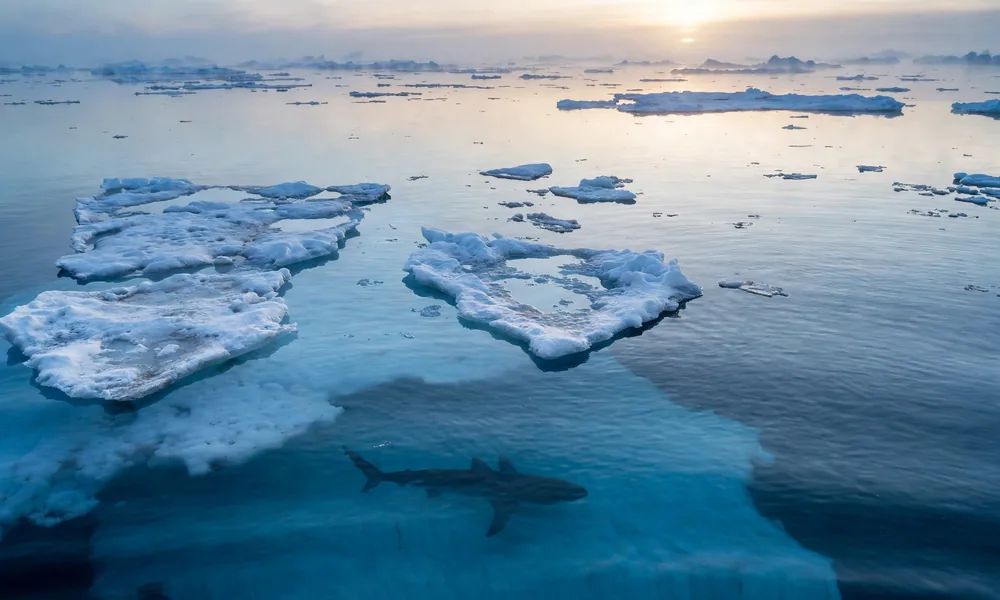
In the Arctic winter, the sharks come shallower, following the cold water up into the fjords, and that is when fishermen have caught them through the ice for centuries, and when the rare winter expeditions have their best chance. It is a harder season to travel in, with short days and bitter cold, but it is the season when the shark is closest to the surface. A traveller who wants to meet one should go with a proper expedition, in the summer for the journey and the light, or in the winter for the shallow water, and should expect to wait: a Greenland shark is not an animal that performs on demand, and the meeting, when it comes, is usually a slow grey shape passing in the dark below the boat.
Staying safe around Greenland sharks
A Greenland shark is not a danger to people in the way a great white shark is, and there is no reliable record of one attacking a swimmer. It lives in deep, cold water, it moves slowly, and it has no interest in anything as large as a person. The safety rules are mostly about the Arctic itself: the cold, the ice, the deep water and the boats that work in it. Nobody should be in Arctic water without a drysuit, a proper boat and a crew that knows the ice, and nobody should try to approach a shark that has been brought up in a net, because a frightened animal of that size can injure a person with a single sweep of its tail.
There is one practical point that matters more than the rest, and it is about the flesh. Never eat Greenland shark meat unless it has been properly fermented and dried as hakarl, because fresh meat contains trimethylamine N-oxide and is toxic, causing stomach pain, vomiting and confusion. Like the great white shark, a Greenland shark is a large predator that deserves respect rather than fear, but the great white is a fast, warm-water hunter that can be dangerous to a swimmer, while the Greenland shark is a slow, cold-water animal whose real danger is the poison in its flesh and the cold of the sea it lives in.
Greenland shark watching checklist
A little preparation turns an Arctic expedition into a real chance of meeting one of the oldest animals on earth.
- A visit in the Arctic summer, from June to September, when expedition boats run to Svalbard, Greenland and Iceland and the sea ice breaks up.
- A proper expedition boat with a crew that knows the deep water and the ice, because the shark lives hundreds of metres down in water close to freezing.
- Warm, waterproof clothing and a drysuit for any time in or near the water, since Arctic water can kill an unprotected person in minutes.
- Patience for a long wait, because a Greenland shark moves slowly and does not perform on demand, and the meeting may be a grey shape passing below the boat.
- A camera with a fast lens and a good light, since the shark lives in dim water and the light fades quickly with depth.
- A guide who knows the local waters, the weather and the ice, and who can read the sea well enough to keep the boat safe.
- Respect for the animal and its sea, keeping your distance, never feeding it, and leaving the ice and the water as you found them.
Frequently asked questions
How long do Greenland sharks live?
A 2016 study estimated Greenland sharks live 272 to 512 years, with the oldest at about 392 years, give or take 120 years. The range matters: 512 years is the upper end of an estimate, not a settled fact, and the honest figure is that they live for centuries, making them the longest-lived vertebrates known to science.
Why are Greenland sharks nearly blind?
Most adult Greenland sharks have their eyes parasitised by a small copepod, Ommatokoita elongata, which attaches to the cornea and damages their vision. They hunt well anyway, because they live in near-darkness and find their food by smell, following the scent of fish, seals and carrion through hundreds of metres of black water.
Are Greenland sharks dangerous to people?
No, there is no reliable record of a Greenland shark attacking a swimmer. It lives in deep, cold water, it moves very slowly, and it has no interest in anything as large as a person. The real dangers are the cold of the Arctic sea and the poison in the shark’s flesh if it is eaten fresh.
What do Greenland sharks eat?
A Greenland shark eats fish such as cod, Greenland halibut, redfish and wolffish, along with squid, skates, seals and carrion. It hunts by drifting slowly through the dark and following scent, taking sleeping seals and resting fish, and scavenging the remains of animals that have died in the ice.
Can you eat Greenland shark meat?
Only after it has been fermented and dried for months, in the Icelandic tradition that makes hakarl. Fresh Greenland shark meat contains trimethylamine N-oxide and is toxic, causing stomach pain, vomiting and confusion, so it should never be eaten raw or poorly prepared.
How is this guide different from the great barracuda guide?
This guide covers the Greenland shark, a huge, slow sleeper shark of freezing Arctic deep water that lives for centuries, is nearly blind and eats fish, squid and seals, while our great barracuda guide covers a long, silver ambush hunter of warm tropical reefs that strikes in a burst of speed and eats fish and squid. One is the slowest shark in the cold dark; the other is one of the fastest fish on a sunlit reef.
Conclusion
The Greenland shark species is a reminder that the sea keeps animals whose lives run on a timescale we can barely imagine. A grey-brown shark that grows less than a centimetre a year, that does not breed until it is about 150 years old, that hunts by smell in water close to freezing and that may have been alive when the first Europeans reached Greenland has made Somniosus microcephalus the most extraordinary shark in the ocean, at home in the deep, under the ice and far from almost every human eye.
If you go looking for one, go in the Arctic summer, go with a proper expedition, and be ready to wait. Find the deep water, watch the dark below the boat, and when a slow grey shape passes underneath, you will have met an animal that was old before the modern world began.