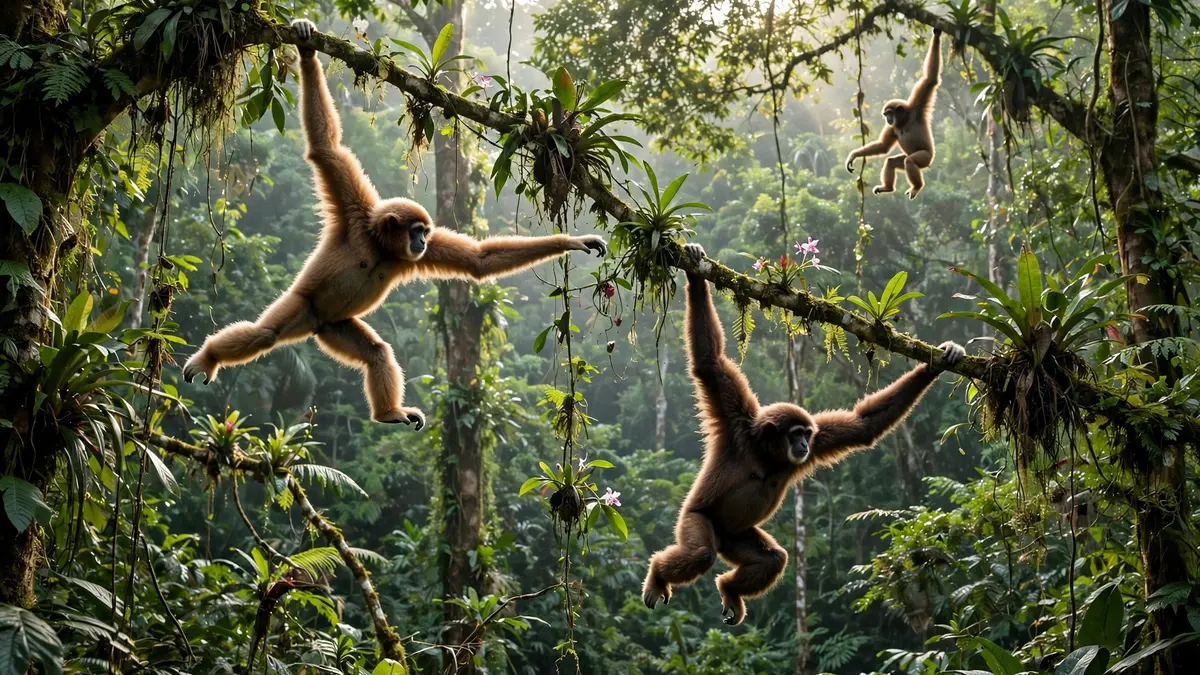
The gibbon species are twenty species, small singing apes of the Southeast Asian rainforest, and the most acrobatic primates on Earth, swinging through the trees on arms longer than their legs. If you are asking how many gibbon species there are, the answer is twenty: there are twenty recognised gibbon species in the world, in four genera, and every gibbon alive today belongs to one of them.
The gibbon belongs to the gibbon family, Hylobatidae, and it is the smallest ape on Earth, living high in the canopy of the rainforests of Southeast Asia. Its long arms, its loud dawn duets and its fruit diet make it one of the most recognisable animals of the Asian forest.
Key takeaways
- There are twenty gibbon species, in four genera: Hylobates, Hoolock, Nomascus and Symphalangus.
- Gibbons are the most acrobatic primates on Earth, swinging through the trees at up to 56 kilometres per hour.
- Gibbons sing loud duets at dawn, and each pair has its own song that marks its territory.
- Gibbons eat mainly fruit, along with leaves, flowers and the occasional insect.
- Most gibbons are listed as Endangered or Critically Endangered, and the Hainan gibbon, with about 35 animals left, is the rarest ape on Earth.
What makes a gibbon a gibbon
A gibbon is a small ape with very long arms, a slender body, no tail, and a length of 45 to 90 centimetres, weighing between 5 and 13 kilogrammes, depending on the species. Its arms are longer than its legs, and its hands are hooked for gripping branches.
The singing defines the gibbon: pairs sing loud duets at dawn, and the song can be heard for kilometres through the forest, marking the pair’s territory and strengthening their bond. Its arms let it swing from branch to branch in great leaps, and it can travel through the trees faster than any other primate. Like other Asian animals, it lives in the rainforest canopy, and it rarely comes down to the ground.
The gibbon species and their relatives
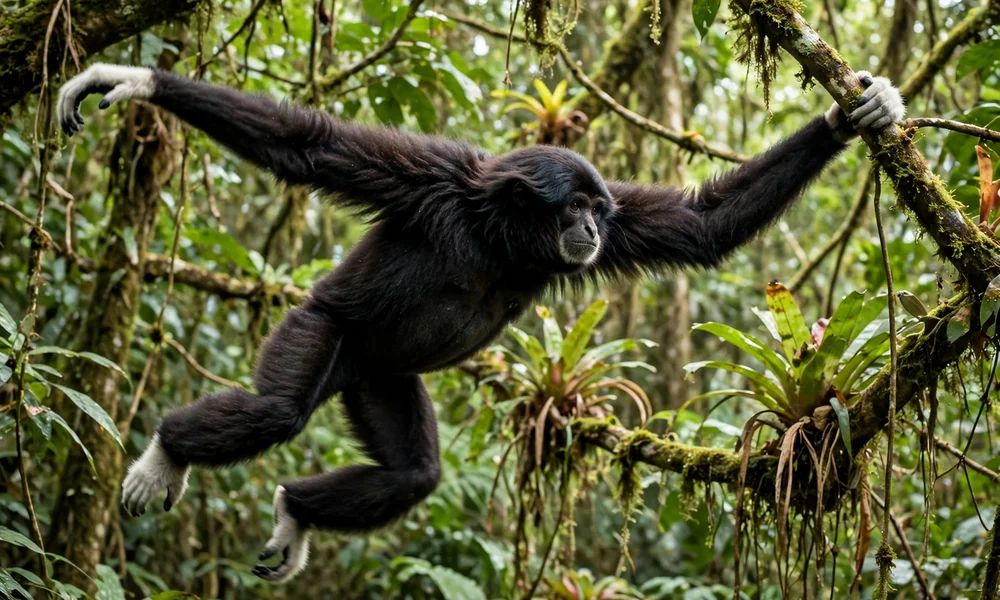
There are twenty gibbon species, in four genera. Hylobates has nine species, including the lar gibbon, the agile gibbon and the silvery gibbon. Hoolock has three species, the western, eastern and Skywalker hoolock gibbons, living in India, Myanmar and China. Nomascus has seven species, the crested gibbons of Vietnam, Laos and China, including the Cao Vit gibbon, with about 100 animals left. Symphalangus has one species, the siamang, the largest gibbon, with a throat sac that amplifies its call.
The lar gibbon is the best-known gibbon, with a white face ring and a pale body, and it lives across Southeast Asia. The siamang is the largest gibbon, black-furred and twice the weight of a lar gibbon, with a balloon-like throat sac. The agile gibbon is a dark gibbon of Sumatra and Borneo, while the silvery gibbon lives only on Java. The bonobo and the chimpanzee are African apes that share the gibbon’s love of fruit and trees, and the orangutan is a larger Asian ape that also lives in the rainforest canopy.
| Type | Animal | Where it lives | Best-known food | Length or Weight |
|---|---|---|---|---|
| Species | Lar gibbon (Hylobates lar) | Southeast Asia | Fruit, leaves and flowers | 45 to 60 cm, 5 to 8 kg |
| Close relative | Siamang | Sumatra and Malay Peninsula | Fruit and leaves | 70 to 90 cm, 10 to 13 kg |
| Close relative | Agile gibbon | Sumatra and Borneo | Fruit, leaves and insects | 45 to 60 cm, 5 to 8 kg |
| Close relative | Silvery gibbon | Java | Fruit and leaves | 45 to 65 cm, 5 to 8 kg |
| Close relative | Hainan gibbon | Hainan Island, China | Fruit and leaves | 45 to 60 cm, 5 to 8 kg |
| Close relative | Bonobo | Congo rainforest | Fruit, leaves and flowers | 70 to 83 cm, 30 to 45 kg |
| Close relative | Bornean orangutan | Borneo | Fruit, leaves and bark | 120 to 140 cm, 50 to 90 kg |
How gibbons live
Gibbons are creatures of the rainforest canopy. A gibbon lives in a small family group, usually a mated pair and their young, and the group defends a territory of 20 to 40 hectares, singing at dawn to warn other gibbons away. Like other Asian animals, it follows the fruiting seasons, moving through the canopy as different trees come into fruit.
Fruit makes up most of the diet, along with leaves, flowers and the occasional insect, and the gibbon eats by picking fruit with its long fingers and eating it in the trees. It also eats young leaves and buds, and it drinks by dipping its hand in water and licking it. Gibbons are famous for their brachiation, swinging from branch to branch with their arms, and they can leap gaps of up to 15 metres between trees.
Breeding happens all year round, and the female gives birth to a single baby after about seven months, carrying it on her belly for the first months and then on her back. The baby stays with its parents for six to eight years, learning to swing and to sing, and it leaves to find a mate at about eight to ten years. Gibbons live for around 25 to 30 years in the wild, and longer in captivity.
Where gibbons live
The gibbon lives in the rainforests of Southeast Asia, from India and Bangladesh through Myanmar, Thailand, Laos, Vietnam and Cambodia to Malaysia, Indonesia and southern China. It is most common in the tall rainforest canopy, where fruit trees are plentiful, and it has spread to islands such as Sumatra, Borneo and Java, where different species evolved in isolation.
Rainforest is the key requirement. A gibbon needs tall trees to swing through, fruit trees to feed from and thick canopy to hide in, so it follows the fruiting trees as they come into season, and when the forest is cleared the gibbon has nowhere to live. It depends on the forest staying intact, like the orangutans and hornbills that share its home, and when the forest is logged the gibbons disappear. The Hainan gibbon lives only on Hainan Island, with about 35 animals left, making it the rarest ape on Earth, and the Cao Vit gibbon has about 100 animals left on the Vietnam-China border.
Most gibbon species are listed as Endangered or Critically Endangered, and their numbers are falling. The main pressures are the loss of forest to farming, logging and palm oil, hunting for food and for the pet trade, and the fragmentation of the forest into small patches that the gibbons cannot cross. Gibbons are protected by law across their range, and they live in many protected areas, but the forest keeps shrinking.
Best seasons for gibbon watching
There is no closed season, because gibbons are active all year round in the rainforest, but the best time to look for them depends on where you go. In Southeast Asia the best months are often the dry season, when the forest paths are passable and the gibbons are easier to find.
The dry season has its own rewards: the forest is at its most open and the gibbons sing loudly at dawn, though they are shy and will flee if they sense a person. Good places to try include Khao Sok National Park in Thailand and the forests of Borneo, always with a licensed guide and from a safe distance.
Staying safe around gibbons
A gibbon is a wild animal with strong arms and sharp teeth, and it can hurt a person, though gibbons are shy and almost never aggressive. Keep your distance, never approach a gibbon, and never get between a mother and her baby, because a frightened mother can be dangerous. In gibbon country, watch from a safe distance and use your eyes.
Like other wild apes, gibbons can carry diseases that pass to people, and any bite or scratch should be washed at once and checked by a doctor without delay. Admire from a distance, and never feed a gibbon, because a fed ape becomes a danger to itself and to people.
Gibbon watching checklist
A little preparation turns a rainforest trek into a real chance of seeing a gibbon, so pack for heat, humidity and long quiet hours.
- Binoculars with good low-light performance, for picking a dark ape out of the green canopy.
- A camera with a long lens, because gibbons should always be watched from a distance, never approached.
- Sturdy boots and long trousers, because the forest floor is muddy and full of thorns.
- Water and snacks for long days, because the best sightings come after hours of searching.
- A licensed local guide who knows the forest, the gibbons and the safe routes.
- A plan to be out at dawn, when the gibbons sing their duets and are easiest to find.
- Patience and silence, because gibbons are shy animals and a noisy group will send them away.
Frequently asked questions
How many gibbon species are there?
There are twenty gibbon species, in four genera: Hylobates, with nine species, Hoolock, with three, Nomascus, with seven, and Symphalangus, with one, the siamang. The lar gibbon is the best-known species, and it lives across Southeast Asia.
Why do gibbons sing at dawn?
Gibbons sing at dawn to mark their territory and to strengthen the bond between a mated pair. Each pair has its own song, and the duet can be heard for kilometres through the forest, warning other gibbons to stay away.
How fast can gibbons swing through the trees?
Gibbons can swing through the trees at up to 56 kilometres per hour, and they can leap gaps of up to 15 metres between branches. They are the fastest and most acrobatic of all primates in the trees.
Can you keep a gibbon as a pet?
No. A gibbon is a wild animal that needs rainforest, tall trees and a family group, and it is fully protected by law across its range. Gibbons in zoos need huge enclosures with trees and climbing frames, and they are not pets.
How is this guide different from the bonobo species guide?
This guide covers twenty gibbon species, small singing apes that swing through the rainforest canopy of Southeast Asia, while our bonobo species guide covers the single bonobo species, a peaceful great ape of the Congo rainforest with a female-led society. The gibbon lives in Asian trees and sings at dawn, and the bonobo lives in African forests and grooms for peace.
Are gibbons endangered?
Most gibbons are listed as Endangered or Critically Endangered, so they are classed as endangered. The Hainan gibbon, with about 35 animals left, is the rarest ape on Earth.
Conclusion
The gibbon species show how much song one ape can hold: twenty species, with long arms and loud duets, swinging through the canopy at 56 kilometres per hour, fruit eaten in the trees, and lives spent high above the forest floor. They are the smallest apes on Earth, and they have lived in the rainforests of Southeast Asia for thousands of years.
If you go looking for one, go at dawn to Khao Sok or the forests of Borneo, go with a licensed guide, and go with patience. Listen for a gibbon duet ringing through the trees and you will understand why it has earned its place as the singer of the forest, and why keeping its rainforest matters most.