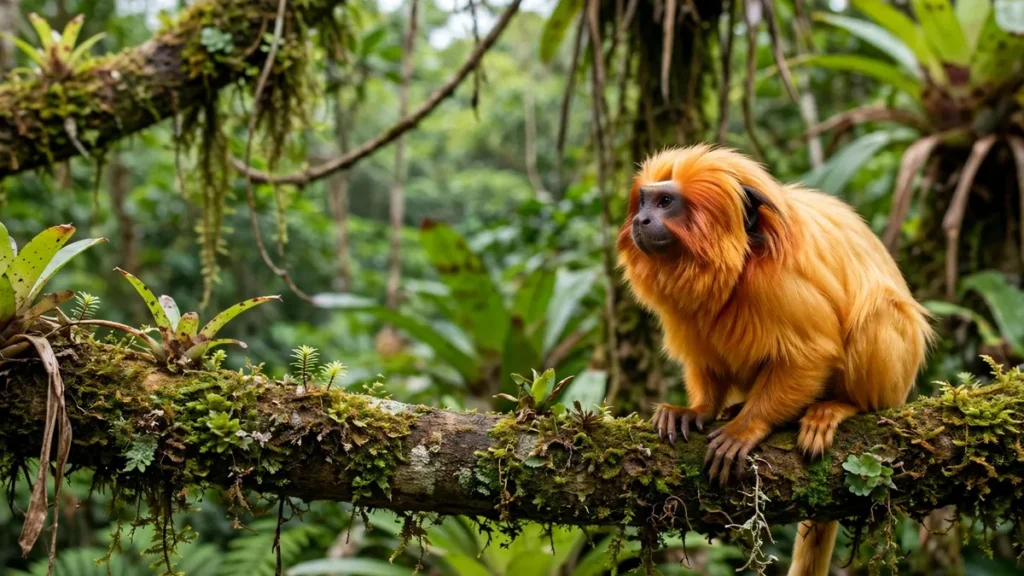
The golden lion tamarin species is a single species, Leontopithecus rosalia, a small golden-orange monkey that lives only in the Atlantic Forest of Rio de Janeiro state, Brazil. If you are asking how many golden lion tamarin species there are, the answer is one, and it is one of the most famous conservation stories in the world: fewer than 200 animals were left in the wild in the 1960s, yet breeding, release and forest restoration have brought the wild population back to about 4,800.
The golden lion tamarin gets its name from its bright reddish-gold coat and the long hairs around its face and ears, which form a mane like a tiny lion. It is the largest of the callitrichid monkeys, and it spends almost its whole life high in the trees, sleeping in tree holes at night and searching the canopy by day for fruit and insects.
Key takeaways
- There is one golden lion tamarin species, Leontopithecus rosalia, though its genus holds four lion tamarin species in total.
- An adult is about 20 to 26 centimetres long, with a tail of about 26 to 40 centimetres, and weighs roughly 480 to 680 grams.
- They live in family groups of about two to eight animals, usually around a single breeding pair, and twins are the norm.
- The wild population fell below 200 in the 1960s but had recovered to about 4,800 by a 2022 to 2023 census, after zoo-born tamarins were released from 1984.
- It is listed as Endangered, and its greatest threats are the loss and fragmentation of the Atlantic Forest, yellow fever and the pet trade.
What makes a golden lion tamarin a golden lion tamarin
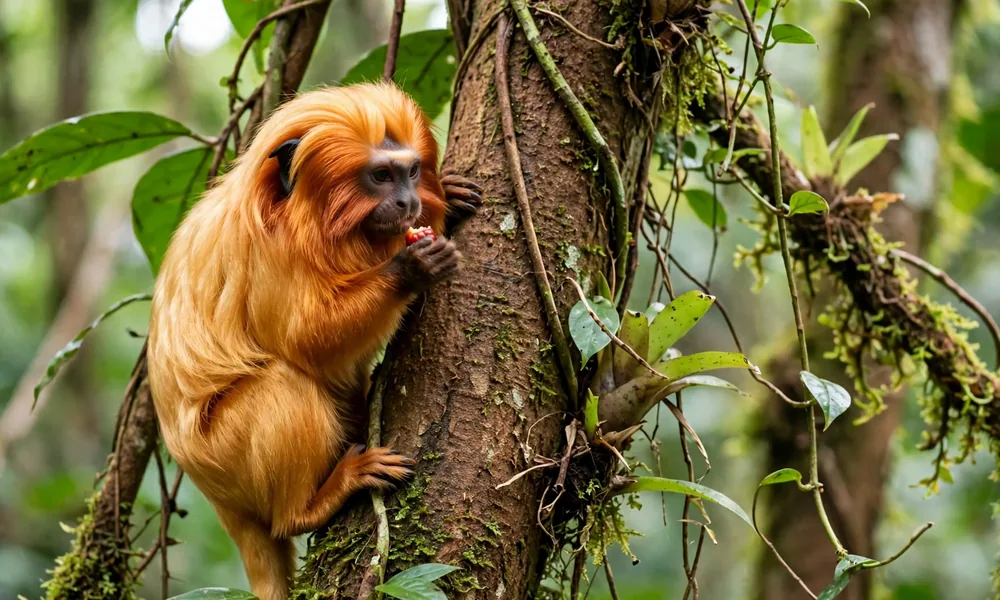
A golden lion tamarin is covered in silky golden-orange fur, with extra-long hairs around the face and ears that form its mane. Its face is dark and almost bare, and its long slender fingers reach deep into tree holes, bromeliads and bark crevices to pull out insects and grubs. Its tail is long but not prehensile, so it cannot grip branches, and it uses it for balance as it leaps through the canopy.
An adult is about 20 to 26 centimetres from head to body, with a tail of about 26 to 40 centimetres, and weighs roughly 480 to 680 grams, less than a bag of sugar. Like the squirrel monkey, another small New World monkey, it is active by day and almost never comes down to the ground, but it is far more brightly coloured.
The golden lion tamarin species and their relatives
The golden lion tamarin belongs to Leontopithecus, a genus of four lion tamarin species that live only in the Atlantic Forest of Brazil. The other three are the golden-headed, the black and the black-faced lion tamarins, and all four are threatened, because the Atlantic Forest has been cut down to a small fraction of its original size. The golden lion tamarin is the best known of the four, because it became the symbol of the effort to save the forest.
The golden lion tamarin is a member of the family Callitrichidae, the marmosets and tamarins, and it is the largest species in that family. The capuchin monkey is not a close relative at all, since capuchins belong to a different family, yet the two share the same forests and fruit trees in parts of Brazil. The golden lion tamarin differs from its cousins in its solid golden colour, its long mane and its habit of sleeping in tree holes, which it lines with leaves.
| Type | Animal | Where it lives | Best-known food | Length or Weight |
|---|---|---|---|---|
| Genus | Lion tamarins (genus Leontopithecus) | Atlantic Forest of eastern Brazil | Fruit, insects and tree gum | About 20 to 26 cm long |
| Species | Golden lion tamarin (Leontopithecus rosalia) | Rio de Janeiro state, Brazil | Fruit, insects and tree gum | About 480 to 680 g |
| Species | Golden-headed lion tamarin (Leontopithecus chrysomelas) | Bahia state, Brazil | Fruit, insects and nectar | About 500 to 700 g |
| Species | Black lion tamarin (Leontopithecus chrysopygus) | Sao Paulo state, Brazil | Fruit, insects and tree gum | About 550 to 700 g |
| Species | Black-faced lion tamarin (Leontopithecus caissara) | Parana and Sao Paulo states, Brazil | Fruit, insects and fungi | About 550 to 700 g |
How golden lion tamarins live
Golden lion tamarins are omnivores. Ripe fruit is the mainstay of the diet, along with insects, spiders, snails and small lizards, plus nectar, flowers and the gum that oozes from tree bark. Their long fingers are perfect for probing into bromeliads, the water-holding plants that grow on branches, where frogs and insects hide, and a tamarin spends much of the day working through the canopy, searching every crevice.
Golden lion tamarins live in family groups of about two to eight animals, usually a single breeding pair with their offspring, and the whole group helps to raise the young. Twins are the norm, born after about four and a half months, and the father and older brothers and sisters carry the babies for much of the day, handing them back to the mother only to feed.
Golden lion tamarins are diurnal, and they spend the day moving through the canopy, usually 10 to 30 metres above the ground. At dusk the group returns to a favourite tree hole, where the animals sleep huddled together for warmth. They are territorial and defend a home range of roughly 40 to 100 hectares, marked with scent and patrolled each day. They live for about 15 years in the wild and for more than 20 years in human care, though many die in their first year.
Where golden lion tamarins live
Golden lion tamarins live only in the lowland Atlantic Forest of Rio de Janeiro state in south-eastern Brazil, mostly around the Sao Joao and Macae river basins. They prefer humid forest thick with vines and bromeliads, usually below about 300 metres above sea level. The forest they need is now broken into separate blocks, cut apart by roads, towns and pasture, and the tamarins cannot cross the open ground between them.
The Atlantic Forest once covered a huge stretch of the Brazilian coast, but only a small fraction survives, and the golden lion tamarin lives in only about 3,000 square kilometres of it. Conservationists have planted forest corridors to reconnect the separate blocks, so tamarins can move between them and find mates, and numbers have grown as the forest has grown back. Like the colobus monkey, another forest monkey that depends on unbroken canopy, it shows how quickly a monkey can become rare when its forest is cut into pieces.
The golden lion tamarin is listed as Endangered on the IUCN Red List, downlisted from Critically Endangered in 2003 as its numbers recovered. The recovery began in 1984, when zoo-born tamarins were first released into the forest, about 146 captive-born animals in total. A yellow fever epidemic in 2017 and 2018 killed about a third of the wild population, cutting it from about 3,600 to about 2,500 animals, but the 2022 to 2023 census found about 4,800 in the wild, and more than 500 have since been vaccinated against yellow fever. The illegal pet trade and the continuing loss of forest remain threats, and the species is on CITES Appendix I, which bans commercial international trade.
Best seasons for golden lion tamarin watching
The best time to watch golden lion tamarins is the dry season, from about May to September, when the forest is easier to walk through and the tamarins are active from early morning. The groups leave their sleeping holes at dawn and feed noisily in the fruiting trees, their golden coats catching the light. The Poco das Antas Biological Reserve in Rio de Janeiro state is the best-known place to see them, and visits are best arranged through a local guide.
Staying safe around golden lion tamarins
A golden lion tamarin is a wild animal and should be watched from a distance, never approached or fed. Feeding teaches tamarins to come to people, which puts them at risk from dogs, traffic and disease, and human food can make them ill. Tamarins can bite if they feel cornered, so keep a respectful distance and stay quiet. In a reserve, follow the guide’s instructions and stay on the marked paths.
Golden lion tamarin watching checklist
A little preparation turns a dawn walk in the Atlantic Forest into a real chance of seeing gold in the canopy.
- A visit to the Poco das Antas Biological Reserve or another protected forest in Rio de Janeiro state, with a local guide.
- An early morning start, when the groups leave their sleeping holes and feed noisily in the canopy.
- Binoculars, because tamarins feed high in the trees, usually 10 to 30 metres above the ground.
- Quiet feet and patience, because a tamarin group will slip away if it feels watched from below.
- A camera with a zoom lens, for close views of the golden mane without disturbing the animals.
- Light rain gear and insect repellent, because the Atlantic Forest is humid and showers are common.
- A field guide to Brazilian primates, for telling a golden lion tamarin from the other lion tamarins.
Frequently asked questions
How many golden lion tamarin species are there?
There is one golden lion tamarin species, Leontopithecus rosalia, but its genus holds four lion tamarin species in total: the golden, the golden-headed, the black and the black-faced, all living only in the Atlantic Forest of Brazil.
Why are golden lion tamarins golden?
The bright golden-orange coat and the long mane around the face give it its name. The colour may help tamarins recognise each other in the dim canopy, and the mane makes the small monkey look bigger, which may help it face down rivals and predators.
What does a golden lion tamarin eat?
Golden lion tamarins are omnivores that eat ripe fruit, insects, spiders, snails, small lizards, nectar, flowers and tree gum, probing into bromeliads and bark crevices with their long fingers, where frogs and insects hide.
How many golden lion tamarins are left in the wild?
A census from 2022 to 2023 estimated about 4,800 in the wild, up from about 3,700 in 2014. In the 1960s there were fewer than 200 left, so the recovery is one of the great conservation successes, though the species is still listed as Endangered.
How is this guide different from the blue tang guide?
This guide covers the golden lion tamarin, one species of golden-orange monkey that lives in the trees of the Atlantic Forest of Brazil and eats fruit and insects, while our blue tang species guide covers the blue tang, a bright blue reef fish of the tropical Indo-Pacific that grazes on algae around coral reefs. Golden lion tamarins leap through the forest canopy in family groups, and blue tangs swim in schools over reefs.
Are golden lion tamarins endangered?
Yes. The golden lion tamarin is listed as Endangered on the IUCN Red List, and it is also on CITES Appendix I, which bans commercial international trade. Its numbers have grown from fewer than 200 in the 1960s to about 4,800 today, but its forest home remains broken into separate blocks, and yellow fever and the pet trade remain threats.
Conclusion
The golden lion tamarin species shows how close a single species can come to disappearing, and how far it can come back: Leontopithecus rosalia, reduced to fewer than 200 in the 1960s, and now about 4,800 strong in the forests of Rio de Janeiro state.
If you go looking for one, go at dawn, go quietly, and look for a flash of gold in the canopy. Watch it probe a bromeliad with its long fingers and carry its twins on its back, and you will see why this small monkey became the symbol of the Atlantic Forest itself.