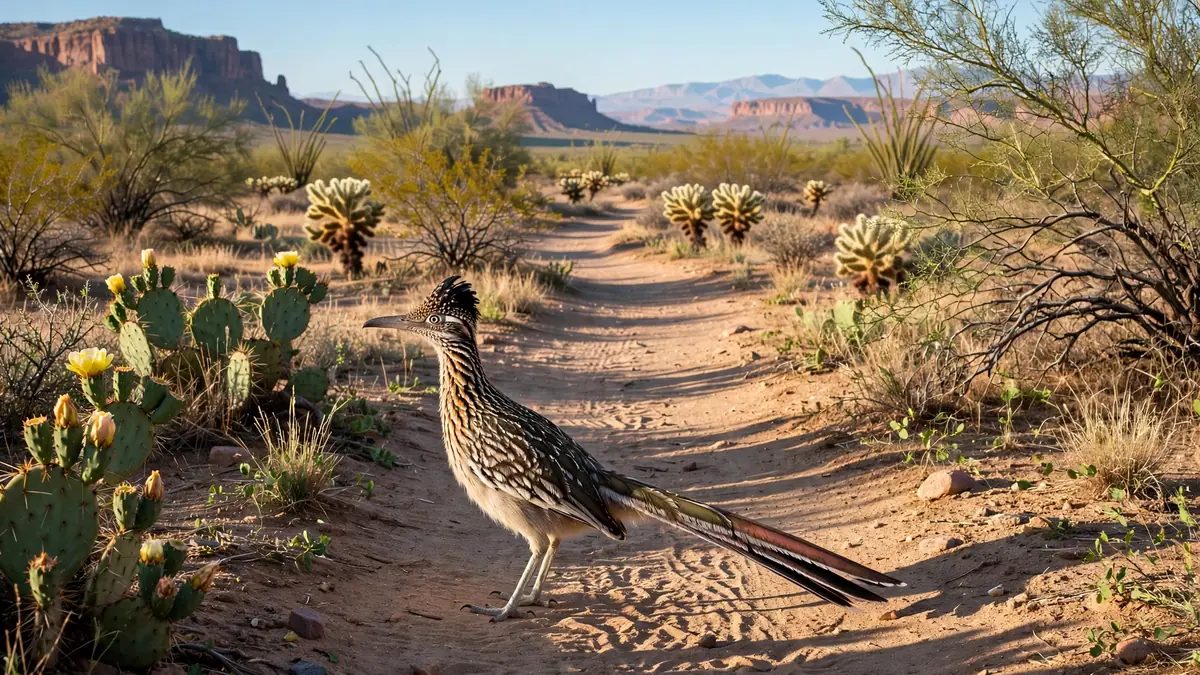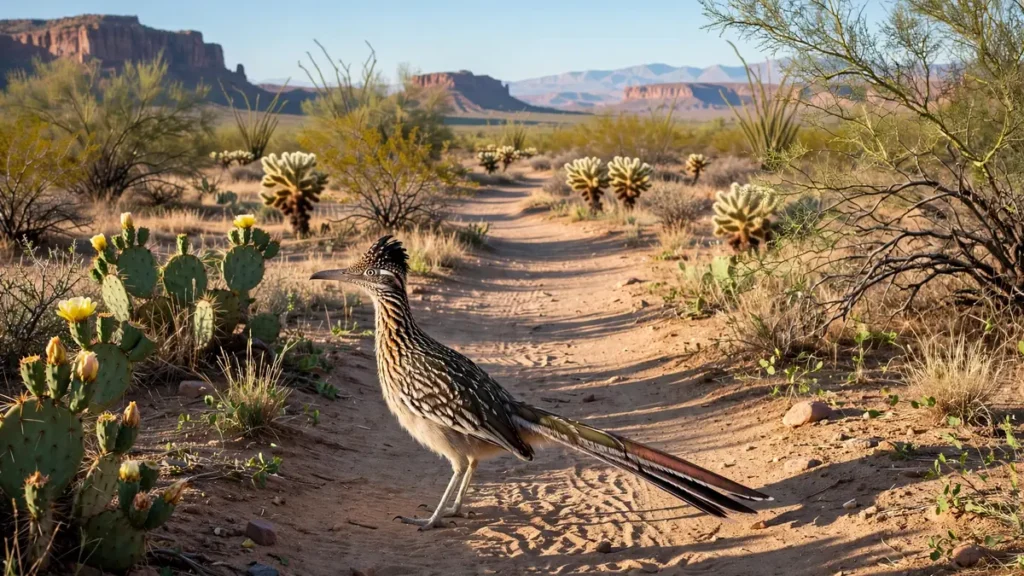
The greater roadrunner species is a single bird, Geococcyx californianus, and it is one of the most famous birds of the American desert, a long-legged ground runner with a shaggy crest, a long tail and a speed that has made it a legend of the Southwest. If you are asking how many greater roadrunner species there are, the answer is one: there is a single greater roadrunner species, Geococcyx californianus, the largest cuckoo in the Americas, and it lives on the ground in the deserts and scrublands of the southwestern United States and Mexico.
A greater roadrunner looks like a bird that was built in a hurry and then perfected: streaked brown and white plumage, a heavy dark bill, strong legs and a tail so long it works like a rudder when the bird turns at speed. It can fly, but it rarely bothers, preferring to run down its food on foot, and it can reach about 32 kilometres per hour, which makes it the fastest running bird that still flies. It is also the state bird of New Mexico and the inspiration for the Road Runner of the Looney Tunes cartoons.
Key takeaways
- There is one greater roadrunner species, Geococcyx californianus, the largest cuckoo in the Americas.
- Greater roadrunners are about 52 to 62 centimetres long, weigh roughly 221 to 538 grams, and can run at up to about 32 kilometres per hour.
- They eat lizards, snakes including young rattlesnakes, rodents, small birds, insects, spiders and scorpions.
- They cool themselves with a salt gland near the eye and warm themselves by sunbathing with their feathers raised each morning.
- Greater roadrunners are listed as Least Concern, with a breeding population estimated at about 1.1 million birds.
What makes a greater roadrunner a greater roadrunner
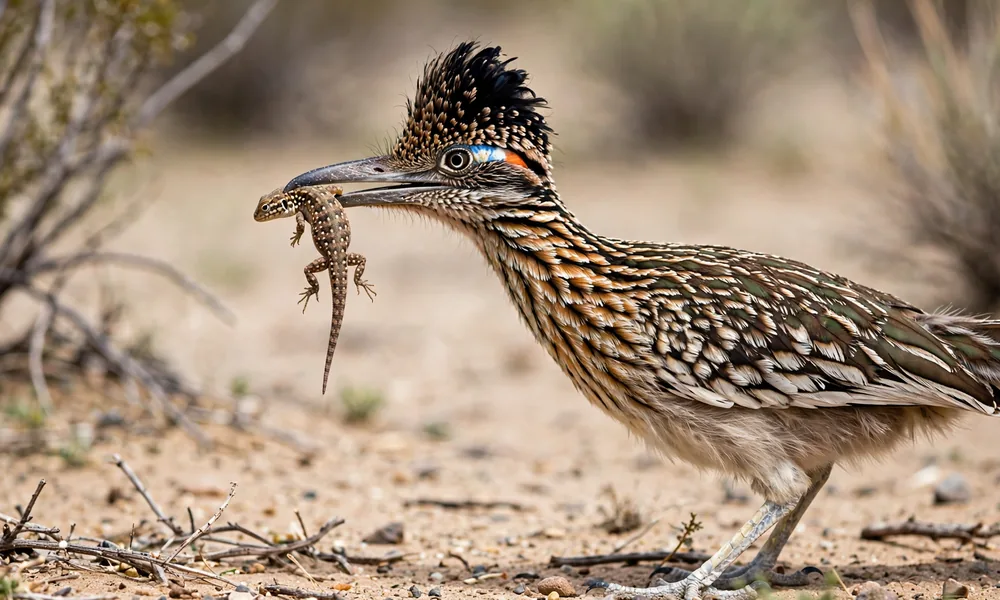
A greater roadrunner in full view is unmistakable: a streaked brown, black and white body, a bushy black crest that it can raise and lower, a long heavy bill, and a tail that is nearly as long as the rest of the bird put together. Behind each eye is a patch of bare skin, blue grading into orange, which is usually hidden by feathers and only shows when the bird is excited or displaying. The feet are those of a cuckoo, with two toes pointing forward and two pointing back, so its tracks on a desert trail look like a neat row of crosses.
The body is built for running rather than flying. The wings are short and rounded, the legs are long and strong, and the bird holds its head and tail level with the ground as it runs, steering with its tail like a rudder.
The greater roadrunner species and their relatives
There is one greater roadrunner species, Geococcyx californianus, and it belongs to the cuckoo family, Cuculidae, a large family of birds found around the world. Most cuckoos are shy birds of trees and thickets, but unlike them the greater roadrunner builds its own nest, raises its own young and spends its life on the ground. Its closest relative is the lesser roadrunner, Geococcyx velox, a smaller bird that takes over in southern Mexico and Central America where the greater roadrunner’s range ends.
The wider cuckoo family includes the yellow-billed and black-billed cuckoos of North American woodlands, the common cuckoo of Europe and Asia, famous for laying its eggs in other birds’ nests, and the groove-billed ani of the tropics, a black cuckoo that lives in noisy flocks. Like owls, roadrunners are hunters with sharp bills and keen eyes, but where owls hunt by night from the air, the roadrunner hunts by day on foot.
| Type | Animal | Where it lives | Best-known food | Length or Weight |
|---|---|---|---|---|
| Family | Cuckoos (family Cuculidae) | Worldwide | Insects, lizards and small animals | About 20 to 70 cm long |
| Species | Greater roadrunner (Geococcyx californianus) | Southwestern United States and Mexico | Lizards, snakes and rodents | About 52 to 62 cm long |
| Species | Lesser roadrunner (Geococcyx velox) | Southern Mexico and Central America | Lizards and insects | About 46 to 51 cm long |
| Relative | Yellow-billed cuckoo (Coccyzus americanus) | Woodlands of North and South America | Caterpillars and insects | About 26 to 30 cm long |
| Relative | Black-billed cuckoo (Coccyzus erythropthalmus) | Woodlands of North America | Caterpillars and insects | About 28 to 31 cm long |
| Relative | Common cuckoo (Cuculus canorus) | Europe, Asia and Africa | Hairy caterpillars and insects | About 32 to 34 cm long |
| Relative | Groove-billed ani (Crotophaga sulcirostris) | Scrub and open country in the tropics | Insects and lizards | About 30 to 34 cm long |
How greater roadrunners live
Greater roadrunners eat a wider range of food than almost any other bird their size. Lizards are the main prey, and the bird chases them down on foot, snatches them in its bill and often beats them against the ground before swallowing them whole. It also eats snakes, including young rattlesnakes, which it kills by striking at the head, along with mice, small birds including hummingbirds, grasshoppers, beetles, spiders including black widows and tarantulas, centipedes and scorpions. In winter, when animal prey is scarce, it adds seeds, fruit and other plant material to its diet.
Breeding begins in spring, when a pair that often stays together for life defends a territory of about 700 to 800 square metres. The nest is a flat platform of sticks built low in a cactus, a thorny bush or a small tree, and the female lays three to six white or pale yellow eggs. Both parents share the incubation for about 20 days, and the chicks, which hatch covered in dark down, leave the nest after about 18 days.
Life in the desert demands clever ways of coping with heat and cold, and the roadrunner has several. On cold desert nights it lets its body temperature fall into a slight torpor to save energy, then warms up each morning by sunbathing with its back feathers raised, exposing a patch of black skin that soaks up the sun. Like falcons, which also hunt with speed and sharp eyesight, a roadrunner is a daytime hunter that relies on keen vision to spot prey at a distance.
Where greater roadrunners live
Greater roadrunners live in the arid and semi-arid country of the southwestern United States and northern Mexico, from California, Arizona, New Mexico and Texas through Nevada, Utah, Colorado and Oklahoma, and south through Mexico as far as Mexico City. They are also seen less often in Kansas, Louisiana, Arkansas and Missouri, and their range has expanded eastwards over the last century. They do not migrate, staying in the same territory all year round.
Their home is open scrubland with scattered bushes, cactus and mesquite, usually with less than half the ground covered by plants, from about 61 metres below sea level up to about 2,300 metres. A roadrunner prefers to run along roads, dry riverbeds and packed trails rather than through dense vegetation.
Greater roadrunners are listed as Least Concern, because they are widespread, adaptable and still common, with a breeding population estimated at about 1.1 million birds. They are not free of trouble, though: housing and road building eat away at the open scrub they need, and their main predators are raccoons, hawks and coyotes. Like eastern bluebirds, which also live in open country with scattered trees, roadrunners do best where the land is left open and quiet.
Best seasons for greater roadrunner watching
The best time to look for greater roadrunners is spring and early summer, from March to June, when pairs are breeding and the birds are active all day, calling and chasing prey in the open. Early morning is best of all, when roadrunners sunbathe on a rock, a fence post or a low branch with their feathers raised to catch the first warmth. In the heat of a summer afternoon they rest in the shade.
Staying safe around greater roadrunners
A greater roadrunner is a wild bird with a long, heavy bill, and a cornered bird can peck hard enough to draw blood, so never try to pick one up and never corner one against a fence or a wall. Give a nesting bird plenty of room, because a disturbed pair may abandon the nest, and keep dogs on a lead near roadrunner country, since dogs chase roadrunners and roadrunners will lead them into cactus and thorn scrub.
Greater roadrunner watching checklist
A little preparation turns a morning walk in the desert into a real chance of seeing a roadrunner at full speed, so pack for sun, dust and long quiet hours.
- Binoculars, because roadrunners often hunt a long way off across open scrub.
- A visit to desert scrubland in March to June, when pairs are breeding and active all day.
- An early start, to catch the birds sunbathing on rocks and fence posts at dawn.
- Sun cream, a hat and plenty of water, for hot mornings on open desert trails.
- A quiet walk along a dirt road or dry riverbed, where roadrunners prefer to run.
- Patience and stillness, because roadrunners freeze and melt into the scrub when startled.
- A field guide to birds, for telling a greater roadrunner from a thrasher or a quail at a distance.
Frequently asked questions
How many greater roadrunner species are there?
There is one greater roadrunner species, Geococcyx californianus. Its only close relative is the lesser roadrunner, Geococcyx velox, a smaller bird of southern Mexico and Central America.
How fast can a greater roadrunner run?
A greater roadrunner can run at up to about 32 kilometres per hour, or 20 miles per hour, and speeds of up to 42 kilometres per hour have been reported. It is the fastest running speed recorded for a bird that can still fly.
What does a greater roadrunner eat?
Greater roadrunners eat lizards, snakes including young rattlesnakes, mice, small birds, insects, spiders, centipedes and scorpions, along with seeds and fruit in winter. They chase prey on foot and swallow it whole, often after beating it against the ground.
Can greater roadrunners fly?
Yes, but they are weak flyers and rarely do it. A greater roadrunner usually flies only in short glides downhill or up to a low perch, and it prefers to run everywhere else.
How is this guide different from the greater rhea species guide?
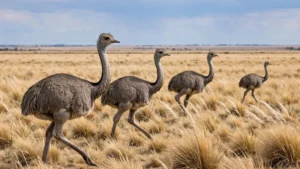
This guide covers the greater roadrunner, a single desert bird species that runs down lizards and snakes on foot in the scrublands of the southwestern United States and Mexico, while our greater rhea species guide covers the greater rhea, a huge flightless bird of the South American grasslands that stands about 1.5 metres tall. The roadrunner is a small, fast cuckoo that flies in short glides, and the rhea is a giant ground bird that never flies at all.
Are greater roadrunners endangered?
No. Greater roadrunners are listed as Least Concern, with a breeding population estimated at about 1.1 million birds. Habitat loss from building and roads is their main threat, so keeping desert scrub open and undisturbed helps them most.
Conclusion
The greater roadrunner species shows how completely one bird can belong to the desert: a single species, Geococcyx californianus, with legs built for running, a tail that steers like a rudder, a salt gland that saves water, and a morning sunbathing habit that warms it for the hunt.
If you go looking for one, go to a quiet desert trail at dawn in spring, go with water and patience, and watch the open ground ahead. See a roadrunner streak after a lizard with its crest raised, and you will understand why this unlikely cuckoo became the very symbol of the Southwest.