The fisher species is a single mammal, Pekania pennanti, and it is one of the most misunderstood animals of the northern forest, a dark, long-bodied hunter that is called a fisher cat and yet is not a cat, and is named for fishing and yet almost never eats fish. If you are asking how many fisher species there are, the answer is one: there is a single fisher species, Pekania pennanti, a forest mustelid of Canada and the northern United States, and it is famous above all as one of the very few predators that can kill a porcupine.
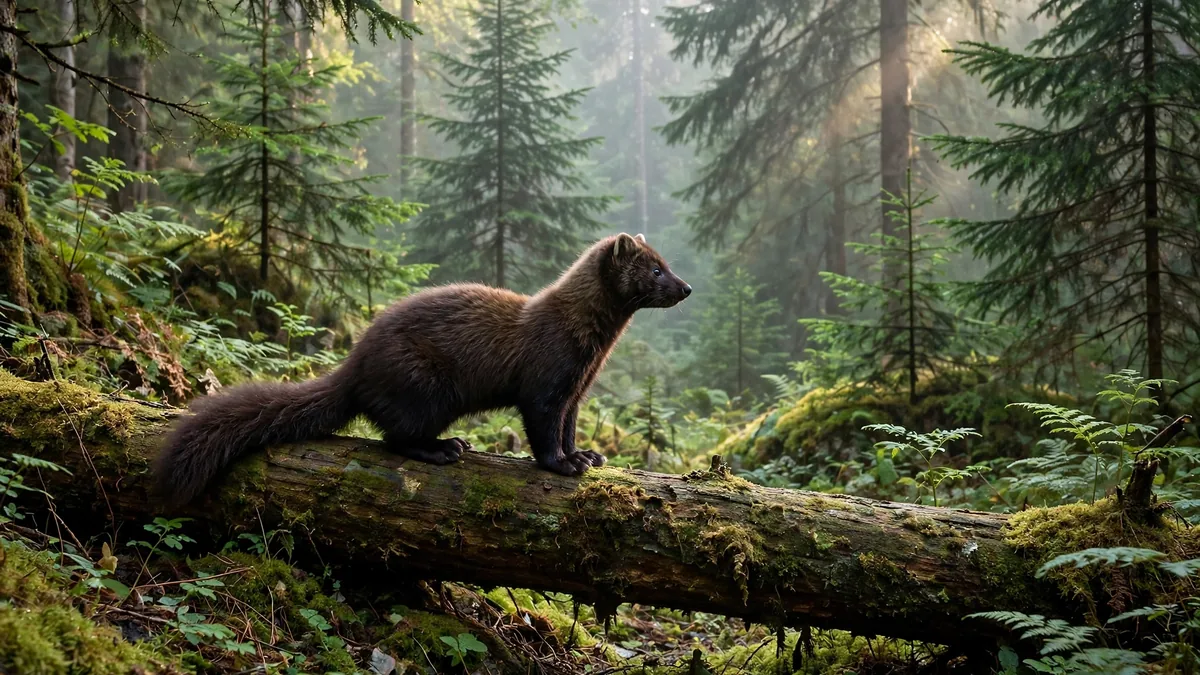
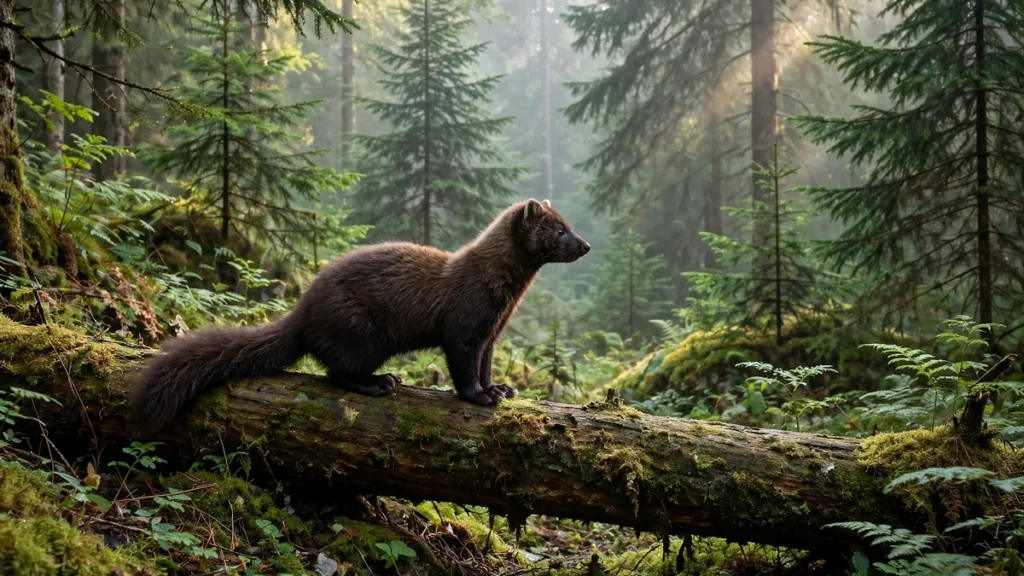
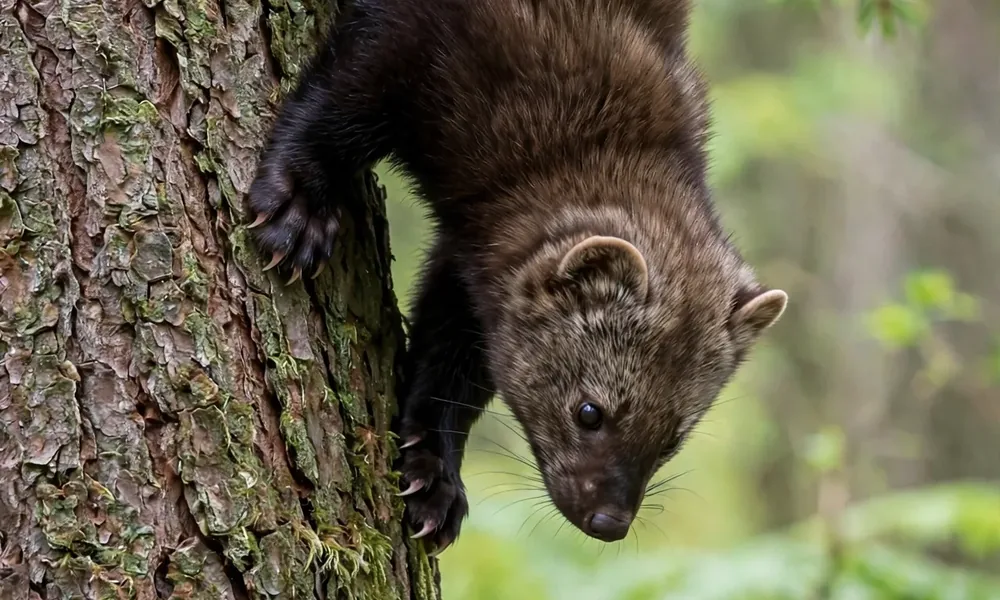
A fisher looks like a very large mink with a bushy tail, dark glossy brown fur and a paler grey-brown face, and it moves through the forest with the confidence of an animal that has few enemies. It climbs trees with ease, can come down a trunk head-first, and hunts both on the forest floor and high in the branches.
Key takeaways
- There is one fisher species, Pekania pennanti, a member of the weasel family and not a cat at all.
- Males are 90 to 120 centimetres long and weigh 3.5 to 5.5 kilograms, while females are 75 to 95 centimetres long and weigh 2.0 to 2.5 kilograms.
- Fishers eat snowshoe hares, porcupines, squirrels, mice, birds and carrion, along with berries, nuts and fungi.
- They can rotate their hind feet to climb down trees head-first, which helps them attack porcupines in the branches.
- Fishers are listed as Least Concern, though they need large areas of unbroken forest to thrive.
What makes a fisher a fisher
A fisher is a long, low-slung animal with short legs, a pointed face, rounded ears and a thick coat of dark brown fur that looks almost black in shadow and shows a silvery or greyish wash over the head and neck in good light. The tail is long and bushy and makes up about a third of the animal’s total length, and the paws are large and well furred, with five toes and sharp, partly retractable claws.
The fisher’s most remarkable feature is its feet. Like the American marten, its close relative, a fisher can rotate its hind feet so that its claws point backwards, letting it grip the bark and climb down a tree trunk head-first, a trick few other mammals can manage. This makes it a hunter of the branches as well as the forest floor, able to chase squirrels through the canopy and to attack porcupines where they shelter in the trees.
The fisher species and their relatives
There is one fisher species, Pekania pennanti, and it belongs to the mustelid family, Mustelidae, the family of weasels, martens, otters, badgers and wolverines. Scientists once placed the fisher with the martens, but it is distinct enough for its own genus, Pekania, named from the Abenaki word pekan. The fisher is the second largest member of the weasel family in North America, after the wolverine, and it is the only living species in its genus.
Its closest relatives are the American marten, a smaller tree-climbing mustelid of the same northern forests, and the wolverine, a much larger and more powerful cousin. The wider family includes the American mink, the North American river otter and the American badger, all of them long-bodied hunters with short legs and a taste for meat. Like wolves, fishers are wide-ranging forest carnivores that need large territories, but where wolves hunt in packs, the fisher hunts alone.
| Type | Animal | Where it lives | Best-known food | Length or Weight |
|---|---|---|---|---|
| Family | Mustelids (family Mustelidae) | Worldwide | Small mammals and birds | About 30 to 120 cm long |
| Species | Fisher (Pekania pennanti) | Boreal and mixed forests of North America | Hares and porcupines | About 75 to 120 cm long |
| Relative | American marten (Martes americana) | Northern forests of North America | Voles and squirrels | About 50 to 68 cm long |
| Relative | Wolverine (Gulo gulo) | Arctic and boreal regions worldwide | Carrion and small mammals | About 65 to 110 cm long |
| Relative | American mink (Neogale vison) | Wetlands across North America | Fish and small mammals | About 45 to 70 cm long |
| Relative | North American river otter (Lontra canadensis) | Rivers and lakes of North America | Fish and crayfish | About 90 to 130 cm long |
| Relative | American badger (Taxidea taxus) | Open grasslands of North America | Ground squirrels | About 60 to 75 cm long |
How fishers live
Fishers eat mostly mammals, and the snowshoe hare is their most important prey across much of their range, along with red squirrels, mice, voles, chipmunks and birds. Their most famous prey is the North American porcupine, which almost no other predator dares to attack. A fisher attacks the porcupine’s unprotected face again and again until the animal weakens, then flips it over and tears open its soft belly, sometimes skinning the whole porcupine and returning to the carcass over several days. Some fishers are badly hurt or killed by quills in the attempt.
Fishers are solitary animals that come together only to mate, in late March and early April. After mating, the fertilised egg does not begin to develop for about ten months, a delay called delayed implantation, so the total gestation lasts about 352 days, almost a year. The female gives birth to one to six kits, most often two or three, in a den inside a hollow tree, a hollow log or a rock cavity. The kits weigh less than 50 grams at birth and do not open their eyes for about seven weeks, and they depend on their mother’s milk for eight to ten weeks before they start on solid food.
A fisher spends most of its time on the forest floor, hunting by day and by night but most often at dawn and dusk, and it can travel up to 18 miles in a day within a home range that may cover 5 to 10 square miles for a female and up to 32 square miles for a male. Like owls, which also hunt the northern forests at dawn and dusk, a fisher is a quiet hunter that is far more often heard about than seen.
Where fishers live
Fishers live in the boreal and mixed coniferous and deciduous forests of northern North America, from Maine and the eastern seaboard across Canada to British Columbia, and south in places to Pennsylvania, Maryland and Virginia. They were once trapped to very low numbers, but they have recovered and are now expanding into the south-eastern Yukon and south-east Alaska, where they were not historically found.
Their home is dense forest with a closed canopy, plenty of hollow trees for dens, fallen logs and brush piles for cover, and a thick understorey where hares and voles live. They avoid open ground and need large areas of unbroken forest, though in the north-eastern United States they also use mixed woodlots broken up by farmland.
Fishers are listed as Least Concern, because they are widespread and their numbers have grown again after the heavy trapping of the past, and they are not listed under the Endangered Species Act. They are not free of trouble, though: forests broken up by roads and clearings leave them exposed, trapping still takes a toll in some areas, and a changing climate is shifting the forests they depend on. Their main natural predators are bobcats, coyotes, bears, lynxes, mountain lions, wolverines and eagles.
Best seasons for fisher watching
The best time to look for a fisher is late winter and early spring, from February to April, when the snow makes their tracks easy to read and the animals are travelling widely in search of mates. Dawn and dusk are the best hours, when fishers are most active, and a quiet walk along a forest trail after fresh snow can reveal the paired, bounding prints of a fisher crossing the path.
Staying safe around fishers
A fisher is a wild predator with sharp teeth and claws, and a cornered animal can bite hard, so never approach one and never try to handle a fisher, even one that looks injured: call a wildlife rescue service instead. Keep small pets indoors at dawn and dusk, and never leave pet food outside, because it draws fishers close to houses. If you meet a fisher on a trail, stand tall, make noise and give it room to slip away into the trees.
Fisher watching checklist
A little preparation turns a winter walk in the northern forest into a real chance of finding fisher tracks, so pack for cold, snow and long quiet hours.
- Warm layers and waterproof boots, for cold mornings on snowy forest trails.
- A visit to dense boreal or mixed forest in February to April, when fishers travel widely.
- A plan to be out at dawn or dusk, when fishers are most active.
- A field guide to animal tracks, for telling fisher prints from those of a marten or a mink.
- Binoculars, because a fisher in a tree is easily missed without them.
- Patience and silence, because fishers are shy and a noisy group will send them into cover.
- A camera with a fast shutter, for the brief moment a fisher crosses an open trail.
Frequently asked questions
How many fisher species are there?
There is one fisher species, Pekania pennanti. It is the only living species in its genus, Pekania, and it is a member of the weasel family, Mustelidae.
Is a fisher a cat?
No. A fisher is not a cat at all. The name fisher cat is only a folk name used in parts of New England, and the fisher is a mustelid, related to martens, mink, otters and wolverines. Its name probably comes from the old word fitch, meaning a European polecat.
Do fishers eat fish?
Almost never. Despite its name, a fisher does not fish. It eats snowshoe hares, porcupines, squirrels, mice, birds and carrion, along with berries, nuts, insects and fungi.
How do fishers kill porcupines?
A fisher attacks the porcupine’s face again and again until it weakens, then flips it over and tears open its soft belly, where there are no quills. Its ability to climb down trees head-first helps it attack porcupines that have climbed up to escape.
How is this guide different from the greater roadrunner species guide?
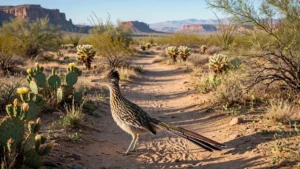
This guide covers the fisher, a single dark forest mammal that climbs trees head-first and hunts porcupines in the boreal forests of North America, while our greater roadrunner species guide covers the greater roadrunner, a long-legged desert bird of the American Southwest that runs down lizards and snakes on foot. The fisher is a solitary mustelid of cold northern forests, and the roadrunner is a fast cuckoo of hot dry scrubland.
Are fishers endangered?
No. Fishers are listed as Least Concern and are not listed under the Endangered Species Act. Their numbers have recovered strongly after heavy trapping, though they still need large areas of unbroken forest to thrive.
Conclusion
The fisher species shows how completely one animal can belong to the northern forest: a single species, Pekania pennanti, with rotating hind feet for climbing down trees, a taste for the porcupines no other predator will touch, and a life lived alone across miles of dense, quiet woodland.
If you go looking for one, go to a snowy forest trail at dawn in late winter, go quietly, and look for the paired prints of a bounding hunter in the fresh snow. See one slip through the trees and you will understand why this shy mustelid is a legend of the north woods.