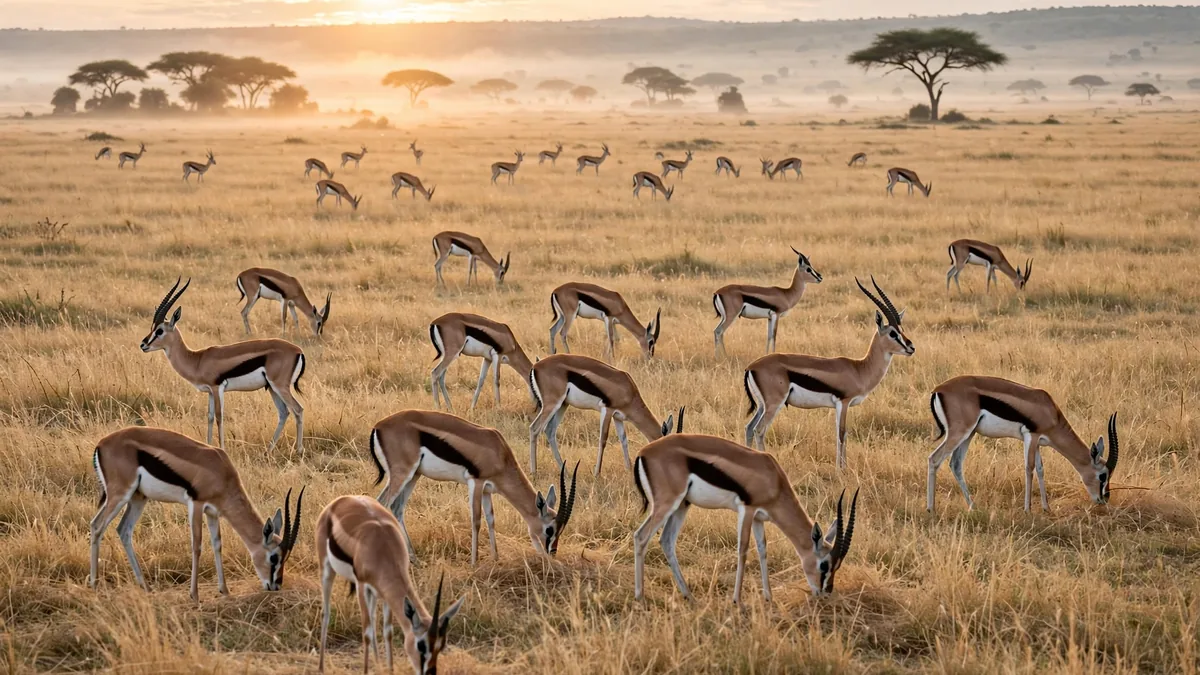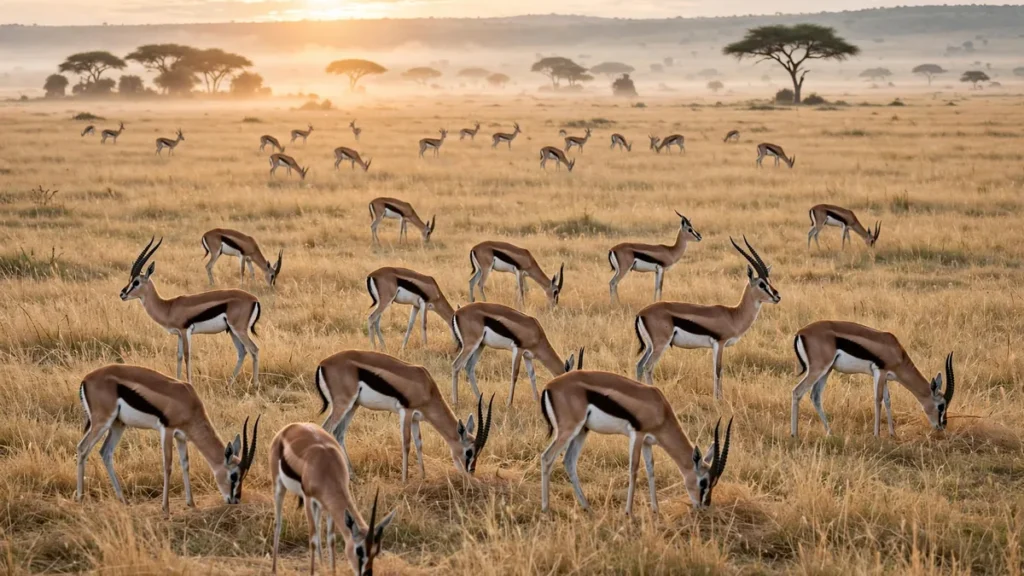
The gazelle species are about 19 swift antelopes, graceful grassland runners with long legs, curved ringed horns and tan coats, spread across the savannas and deserts of Africa and Asia. If you are asking how many there are, the answer is about 19, and they are not one species but a group: the core genus Gazella holds about 10 species, with three more in Eudorcas and three in Nanger, plus a few extinct species in the count.
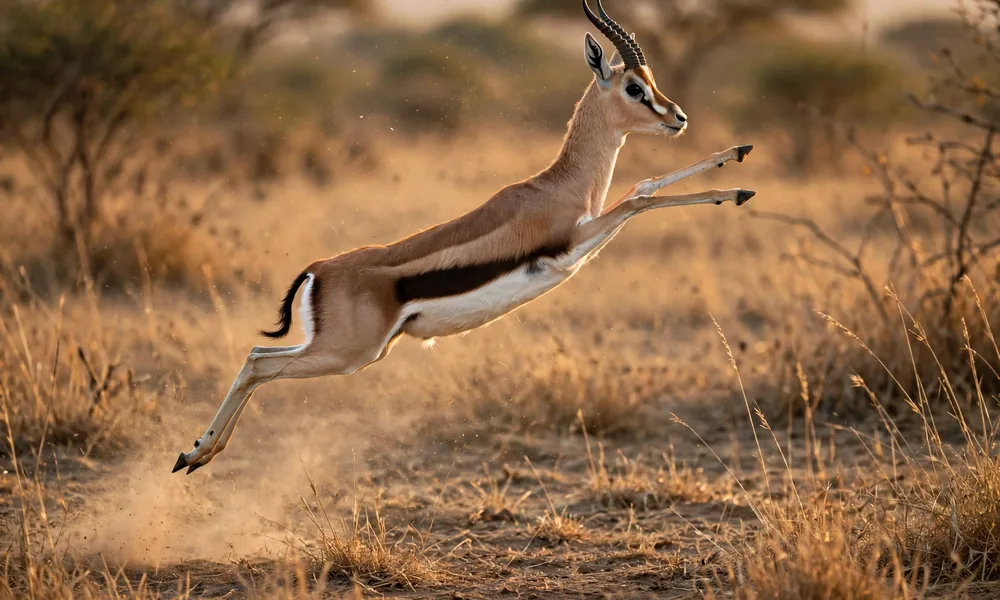
A gazelle is built for speed and for open country. Its light body, long legs and springy tendons let it sprint at up to 60 miles per hour in short bursts, and its famous stotting leap, a stiff-legged bounce into the air, warns predators that it is fit and hard to catch. Gazelles live in herds that can number in the hundreds, graze on grasses and leaves, and can go long stretches without drinking water.
Key takeaways
- There are about 19 gazelle species across three genera: Gazella with about 10, Eudorcas with three and Nanger with three, plus extinct species in the count.
- Gazelles can sprint at up to 60 miles per hour in short bursts and sustain 30 to 40 miles per hour.
- Gazelles are herbivores that eat grasses, leaves, shoots and desert plants, and desert species can live without drinking water.
- Stotting, or pronking, is a stiff-legged leap into the air that shows a predator the gazelle is strong and alert.
- Gazelles live in herds of up to 700 animals, and most live for about 10 to 15 years in the wild.
What makes a gazelle a gazelle
A gazelle is a slender antelope with a tan or reddish-brown back, a white belly and rump, and a dark stripe along each flank in many species. Both males and females usually carry horns, long, slender and ringed, curving gently backwards, with the males’ horns thicker and longer. The legs are long and thin, the hooves small and hard, and the body light, so a gazelle can change direction at full speed. The eyes are large and set wide, giving a broad view of the open plain.
Size varies widely. The smallest, such as Speke’s gazelle and Thomson’s gazelle, stand about 51 to 70 centimetres at the shoulder and weigh about 12 to 35 kilograms, while the largest, the dama gazelle, stands up to 120 centimetres and weighs up to 75 kilograms. Like eagles, which also hunt on open ground, a gazelle depends on sharp senses and open space, but where the eagle is the hunter, the gazelle is the hunted, and its speed is its defence.
The gazelle species and their relatives
Gazelles belong to the antelope tribe Antilopini in the family Bovidae, the family that also includes cattle, goats and sheep. Their taxonomy is famously unsettled: the genus Gazella was once thought to hold 14 species, but genetic studies showed that gazelles descend from several different ancestors, so six African species were moved into two new genera. In the revised classification Gazella holds about 10 species, Eudorcas three and Nanger three, and the total is about 19 when extinct ones are counted.
The best known are Thomson’s gazelle of East Africa, with its black side stripe and white rump; Grant’s gazelle, a larger East African species; the dama gazelle of the Sahara and the Sahel, the largest of all; the dorcas gazelle of North Africa and the Middle East; and the goitred gazelle of Central Asia. Their closest relatives are the other antelopes of the tribe Antilopini, such as the springbok of southern Africa, which also stots. A third former subgenus, Procapra, holds three Asian gazelle species of its own.
| Type | Animal | Where it lives | Best-known food | Length or Weight |
|---|---|---|---|---|
| Group | Gazelles (genera Gazella, Eudorcas and Nanger) | Grasslands and deserts of Africa and Asia | Grasses, leaves and shoots | About 12 to 75 kg |
| Species | Thomson’s gazelle (Eudorcas thomsonii) | East Africa | Short grasses | About 15 to 35 kg |
| Species | Grant’s gazelle (Nanger granti) | East Africa | Grasses and leaves | About 35 to 80 kg |
| Species | Dama gazelle (Nanger dama) | Sahara and Sahel | Leaves, shrubs and grasses | Up to about 75 kg |
| Species | Dorcas gazelle (Gazella dorcas) | North Africa and the Middle East | Leaves, flowers and desert plants | About 15 to 20 kg |
| Species | Goitred gazelle (Gazella subgutturosa) | Central Asia | Grasses and shrubs | About 30 to 45 kg |
| Relative | Springbok (Antidorcas marsupialis) | Southern Africa | Grasses and shrubs | About 30 to 45 kg |
How gazelles live
Gazelles are herbivores, feeding on grasses, leaves, shoots and herbs, and they choose the youngest, most nutritious plants they can find. Thomson’s gazelles graze on fresh grass in the rainy season and switch to leaves and shrubs in the dry season, often following larger grazers such as wildebeest and zebra, which crop the tall grass down to the short shoots gazelles prefer. Desert species get most of their water from the plants they eat, and some can live their whole lives without drinking. Studies have found that gazelles in the driest places can shrink their heart and liver in the dry season to cut their need for water.
Gazelles are highly social, and herds can hold a few animals or as many as 700. Female Thomson’s gazelles live in herds of 10 to 30 with their young, while males live alone or in small bachelor herds, and territorial males mark their ground by digging with their horns. When a gazelle spots danger it flicks its tail, stamps a foot and stots, leaping high into the air with all four legs stiff, a display that tells the predator it has been seen and is fit enough to outrun.
Gazelles breed in step with the rains, so that fawns are born when grass is plentiful. After a pregnancy of about five to six months, the female gives birth to a single fawn, which can stand and walk within hours, and she hides it in tall grass for its first weeks, visiting only to nurse. Gazelles usually live for about 10 to 15 years in the wild, and females can give birth twice in a good year.
Where gazelles live
Gazelles live across the open country of Africa and Asia, from the grasslands of the Serengeti to the deserts of the Sahara, the Arabian Peninsula and the steppes of Central Asia. The Arabian Peninsula is the centre of diversity for the genus Gazella, with six species, and East Africa is the stronghold of Thomson’s and Grant’s gazelles. Gazelles need open ground where they can see predators coming, so they avoid thick forest and favour short grass plains, dry scrub and desert edges.
Different species have carved out different corners of this range: the dama gazelle roams the Sahara and the Sahel, the dorcas gazelle lives across North Africa and the Middle East, the goitred gazelle wanders the cold steppes of Central Asia, and the mountain gazelle lives in the hills of the Arabian Peninsula and the Levant. Some species move with the rains, following fresh grass, while desert species stay close to the few waterholes and shrubs that sustain them.
Several gazelle species are in serious trouble. The dama gazelle is listed as Critically Endangered, with only a few hundred animals left in the wild, mostly in Chad and Niger, after decades of hunting and habitat loss. The Queen of Sheba’s gazelle and the Saudi gazelle are extinct, and the Arabian gazelle is Vulnerable, with fewer than 10,000 mature animals left. Thomson’s gazelle is still common in the Serengeti, but even it has declined as grassland is fenced and settled. The main pressures are hunting, livestock grazing, fences that block migration, and the loss of open grassland to farming.
Best seasons for gazelle watching
The best time to watch gazelles is the dry season, when the grass is short, the herds gather near water, and the animals are easy to see across the open plains. In East Africa that means the long dry months from June to October, when Thomson’s and Grant’s gazelles gather in large herds on the Serengeti and the Masai Mara. Dawn and late afternoon are the best hours, when the herds are feeding.
Staying safe around gazelles
A gazelle is a wild animal with sharp horns, and a cornered male can charge, so never approach one closely and never try to touch a fawn hidden in the grass. Watch from a vehicle or from a distance with binoculars, and stay downwind. If a gazelle stamps its feet or stots repeatedly, you are too close and should back away quietly. Never chase a gazelle, as a panicked animal can injure itself on fences or rough ground.
Gazelle watching checklist
A little preparation turns a morning on the savanna into a real chance of watching gazelles at full speed, so pack for hot days and animals that never stand still.
- Binoculars, because gazelles keep their distance.
- A safari vehicle or a guided walk, for reaching open grassland safely.
- Light clothing, a hat and sunscreen, for long hours in the sun.
- A visit in the dry season, when the herds gather near water and the grass is short.
- A plan to be out at dawn, when the herds are feeding.
- Patience and silence, because a noisy group will send the herd running.
- A field guide to antelopes, for telling a Thomson’s gazelle from a Grant’s gazelle.
Frequently asked questions
How many gazelle species are there?
There are about 19 gazelle species in the wider sense. The core genus Gazella holds about 10 species, with three more in Eudorcas and three in Nanger, and the total includes a few species that are now extinct.
How fast can a gazelle run?
A gazelle can reach up to 60 miles per hour in short bursts and sustain 30 to 40 miles per hour. Thomson’s gazelles reach about 50 miles per hour, fast enough to outrun most predators except the cheetah.
What is stotting?
Stotting, also called pronking, is a leap in which a gazelle springs high into the air with all four legs stiff and straight. It shows a predator that the gazelle is strong and alert, and it may warn other gazelles too.
Do gazelles need to drink water?
Many do not. Desert gazelles get most of their water from the plants they eat, and some can live their whole lives without drinking. Gazelles on the grasslands drink when water is available.
How is this guide different from the flying fox species guide?
This guide covers the gazelle, a group of about 19 species of swift grassland antelopes that run at up to 60 miles per hour and live in herds on the plains of Africa and Asia, while our flying fox species guide covers the flying fox, a group of about 60 species of large fruit-eating bats that roost in trees and fly at dusk. Gazelles run across open ground, and flying foxes fly through the night sky.
Are gazelles endangered?
Some are. The dama gazelle is Critically Endangered, with only a few hundred animals left in the wild, and the Queen of Sheba’s gazelle and the Saudi gazelle are extinct. Thomson’s gazelle is still common in East Africa, but its numbers have fallen as grassland is fenced and settled.
Conclusion
The gazelle species show how completely an animal can belong to open country: about 19 species of light, long-legged antelopes, sprinting at up to 60 miles per hour, stotting into the air to warn off predators, and living in herds that can number in the hundreds.
If you go looking for them, go to the open plains in the dry season, go at dawn, and go with binoculars. Watch a herd scatter and regroup, and a single gazelle stotting high above the grass, and you will understand why keeping their grasslands open matters most.