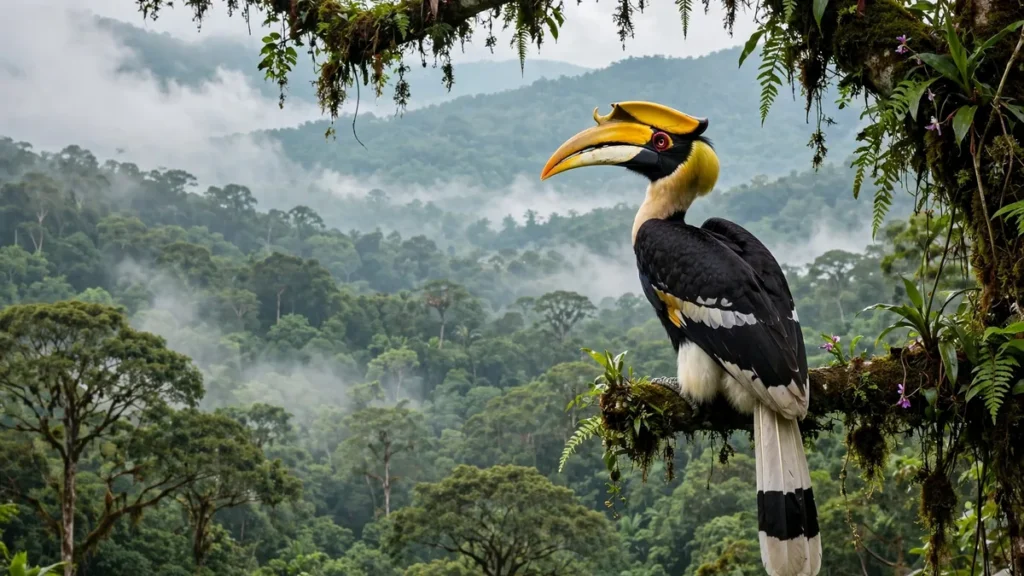
The great hornbill species is a single bird, Buceros bicornis, one of the most spectacular birds of the Asian rainforest, with a huge yellow bill topped by a tall hollow casque and a voice that carries for nearly a kilometre through the trees. If you are asking how many great hornbill species there are, the answer is one: there is a single great hornbill species, Buceros bicornis, and it lives in the old-growth forests of India, Bhutan, Nepal and Southeast Asia as far as Sumatra.
A great hornbill is hard to miss. It flies through the canopy with slow, heavy wingbeats that make a loud whooshing sound, lands on a high branch, and tosses figs into the air before swallowing them whole. Its black-and-white plumage is stained yellow on the head and neck by preen oil, and the male’s red eyes and the female’s pale blue-white eyes tell the two apart.
Key takeaways
- There is one great hornbill species, Buceros bicornis, one of about 60 hornbill species in the family Bucerotidae.
- Great hornbills are about 95 to 130 centimetres long, weigh roughly 2 to 4 kilograms, and have a wingspan of about 152 centimetres.
- They eat mostly fruit, especially figs, and also take small mammals, birds, reptiles and insects.
- During breeding the female seals herself inside a tree cavity, leaving only a narrow slit through which the male passes food.
- Great hornbills are listed as Vulnerable, threatened by the loss of old-growth forest and by hunting for their casque, meat and feathers.
What makes a great hornbill a great hornbill
A great hornbill is built around its bill. The bill is huge and yellow, curved like a banana, and topped by a tall, hollow casque. The casque is light, not solid, and it grows slowly, taking about five years to reach its full size. The hornbill handles the bill with surprising delicacy, plucking figs from a branch and poking into bark for insects and small lizards.
The rest of the bird is just as striking. The body is black, the wings are black with a white trailing edge, the belly is white, and the long white tail carries a broad black band. The head, neck and upper breast are creamy white, stained yellow by the oil the bird spreads through its feathers while preening. Males have red eyes and black skin around the eye, while females have bluish-white eyes and pinkish skin, and males are slightly larger. Like crowned eagles, great hornbills spend almost their whole lives among the tallest trees.
The great hornbill species and their relatives
There is one great hornbill species, Buceros bicornis, in the family Bucerotidae, the hornbills, a family of about 60 species found across Africa and Asia. All hornbills share a large bill with a casque on top, loud voices, and a habit of nesting in tree cavities. The great hornbill is one of the largest of them all.
Its closest relatives are the other large Asian hornbills, above all the rhinoceros hornbill of Borneo, Sumatra and the Malay Peninsula. The wreathed hornbill and the rufous-necked hornbill of the Himalayan foothills are close cousins, and the smaller oriental pied hornbill shares the same forests. Further afield, the family includes the southern ground hornbill of the African savanna, which walks on the ground, and the helmeted hornbill of Southeast Asia, which is now Critically Endangered.

| Type | Animal | Where it lives | Best-known food | Length or Weight |
|---|---|---|---|---|
| Family | Hornbills (family Bucerotidae) | Forests of Africa and Asia | Fruit, small animals and insects | About 40 to 130 cm long |
| Species | Great hornbill (Buceros bicornis) | India, Nepal, Bhutan and Southeast Asia to Sumatra | Figs and other fruit, small mammals and reptiles | About 95 to 130 cm long |
| Species | Rhinoceros hornbill (Buceros rhinoceros) | Borneo, Sumatra and the Malay Peninsula | Figs and other fruit | About 80 to 90 cm long |
| Species | Wreathed hornbill (Rhyticeros undulatus) | North-east India and Southeast Asia | Fruit, especially figs | About 75 to 100 cm long |
| Species | Rufous-necked hornbill (Aceros nipalensis) | Himalayan foothills and northern Southeast Asia | Fruit, small animals and insects | About 90 to 120 cm long |
| Species | Oriental pied hornbill (Anthracoceros albirostris) | India and Southeast Asia | Fruit, insects and small animals | About 55 to 60 cm long |
| Relative | Southern ground hornbill (Bucorvus leadbeateri) | Savanna of sub-Saharan Africa | Small mammals, reptiles and insects | About 90 to 130 cm long |
How great hornbills live
Great hornbills eat mostly fruit, and figs are the most important food of all. Figs fruit at different times through the year, so a hornbill can find them in almost every season, and it swallows them whole, later passing the seeds out in its droppings far from the parent tree. It also eats fat-rich fruits of the laurel and nutmeg families, and about a third of its diet is animal food, caught by hopping along branches and poking into bark.
Great hornbills are usually seen in pairs or small family groups, though larger numbers gather at a fruiting fig tree or at a communal roost. They are monogamous, forming pair bonds that last for years, and during the breeding season, from January to April, they duet with loud calls of kok that can be heard more than 800 metres away.
The breeding behaviour of the great hornbill is one of the most remarkable of any bird. The pair chooses a natural cavity in a tall, old tree. The female climbs inside and seals the entrance with a plaster made mainly of her own droppings, leaving only a narrow vertical slit. She stays sealed inside for months, laying one or two eggs and incubating them for 38 to 40 days, while the male brings her all her food through the slit, visiting about five times a day. The female leaves once the chicks are half grown, and the chicks reseal the nest, fledging at about 72 to 96 days old.
Where great hornbills live
Great hornbills live in the forests of the Indian subcontinent and Southeast Asia, from the Western Ghats and the Himalayan foothills of India, Nepal and Bhutan, through Myanmar, Thailand, Laos, Cambodia and Vietnam, to the Malay Peninsula and the island of Sumatra. They are not found in Borneo. They prefer dense, old-growth evergreen and moist deciduous forest in hilly country, usually between 600 and 2,000 metres above sea level, and they need large stretches of unlogged forest: in Thailand, a male’s home range was about 3.7 square kilometres in the breeding season and 14.7 outside it.
Great hornbills are listed as Vulnerable on the IUCN Red List, a status they have held since 2018, and they are listed on CITES Appendix I, which bans international trade in the birds. Their numbers have fallen by an estimated 30 to 40 percent over the last 50 years, mainly because old-growth forest has been logged and cleared, and because they are hunted for their meat and their casques and tail feathers, which are used as ornaments. Like owls, great hornbills need large, quiet, undisturbed forest to raise their young.
Best seasons for great hornbill watching
The best time to look for great hornbills is the dry season, from November to April, when the birds are most vocal and gather at fruiting fig trees. Early morning is the best hour, when pairs fly between roosting and feeding trees. In India the Western Ghats and the forests of Arunachal Pradesh are among the best places to see them, and in Thailand Khao Yai National Park is famous for its hornbills.
Staying safe around great hornbills
A great hornbill is a wild bird with a huge, powerful bill, and it can bite hard if it feels cornered, so never try to handle one and never approach a nest tree closely. Keep well away from a nest cavity, because a disturbed male may abandon his feeding visits and the sealed-in female and chicks will go hungry. If you hear a loud kok call repeated from the canopy, stand still and watch from a distance.
Great hornbill watching checklist
A little preparation turns a morning in a rainforest into a real chance of seeing a great hornbill, so pack for heat, humidity and long quiet hours under tall trees.
- Binoculars, because great hornbills feed high in the canopy and are best watched from far below.
- A visit to an old-growth forest reserve in the dry season, from November to April, when the birds are most vocal.
- An early start, because hornbills are most active in the first hours after dawn.
- A guide who knows the local fig trees, since fruiting figs are where hornbills gather.
- Light, breathable clothing and insect repellent, for hot, humid forest trails.
- Patience and silence, because hornbills are shy birds and a noisy group will keep them in the canopy.
- A field guide to the birds of India and Southeast Asia, for telling a great hornbill from a wreathed or rufous-necked hornbill.
Frequently asked questions
How many great hornbill species are there?
There is one great hornbill species, Buceros bicornis. It is one of about 60 hornbill species in the family Bucerotidae, and its closest relatives are the rhinoceros hornbill and the other large Asian hornbills.
What does a great hornbill eat?
Great hornbills eat mostly fruit, especially figs, along with fat-rich fruits of the laurel and nutmeg families. They also eat small mammals, birds, reptiles and insects, caught by hopping along branches and poking into bark.
Why does the female great hornbill seal herself into a tree?
The female seals herself inside a tree cavity with a plaster made mainly of droppings, leaving only a narrow slit, to protect her eggs and chicks from predators. The male passes all her food through the slit until she breaks out, and the chicks then seal the nest again behind her.
How big is a great hornbill?
Great hornbills are about 95 to 130 centimetres long, weigh roughly 2 to 4 kilograms, and have a wingspan of about 152 centimetres. Males are slightly larger than females, and the casque takes about five years to reach its full size.
How is this guide different from the great egret species guide?
This guide covers the great hornbill, a single large forest bird of India and Southeast Asia that eats figs and seals its mate inside a tree cavity to nest, while our great egret species guide covers the great egret, a tall white wading bird of wetlands around the world that hunts fish and frogs with its sharp yellow bill. Hornbills fly through the high forest canopy, and egrets wade through marshes and rice fields.
Are great hornbills endangered?
Great hornbills are listed as Vulnerable on the IUCN Red List, not yet Endangered, but their numbers have fallen by 30 to 40 percent over the last 50 years. The main threats are the loss of old-growth forest and hunting for their casque, meat and feathers, and they are protected by a ban on international trade under CITES Appendix I.
Conclusion
The great hornbill species shows how completely one bird can belong to the old forest: a single species, Buceros bicornis, with a bill built for figs, a voice that carries across the canopy, and a nesting habit that depends on the tallest, oldest trees in the forest.
If you go looking for one, go to a fruiting fig tree at dawn in the dry season, go quietly, and go with patience. Watch a great hornbill toss a fig into the air and hear its wings whoosh overhead, and you will understand why keeping the old forest standing matters most.