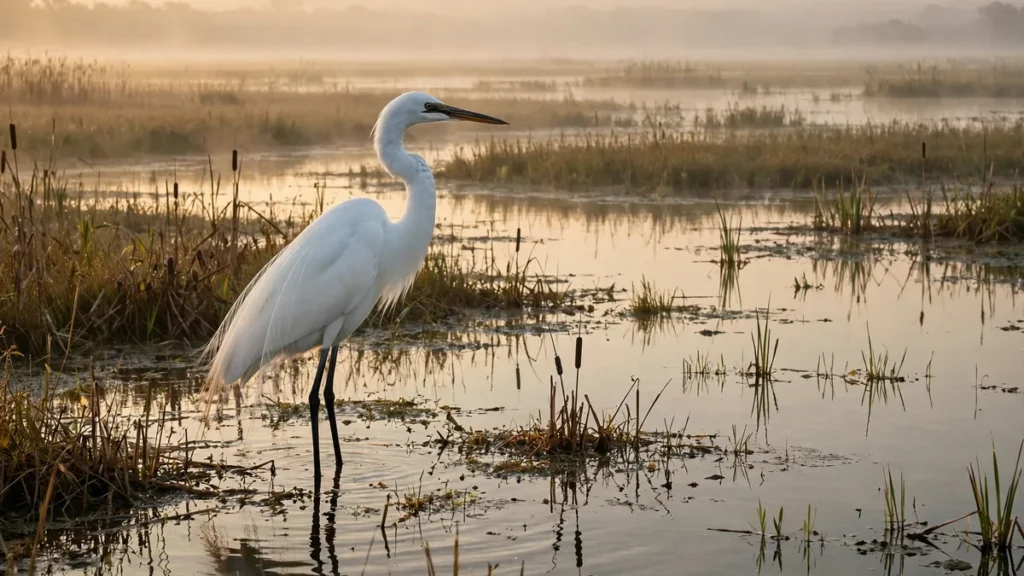
The great egret species is a single bird, Ardea alba, a tall, snow-white heron with a long S-curved neck, a dagger-like yellow bill and long black legs, found in wetlands on every continent except Antarctica. If you are asking how many great egret species there are, the answer is one: there is a single great egret species, Ardea alba, one of the largest white herons in the world, living in marshes, ponds, tidal flats and riverbanks from the Americas to Europe, Africa, Asia and Australia.
The great egret is a patient hunter. It stands motionless in shallow water, neck coiled like a spring, then strikes in a blur, spearing a fish and swallowing it whole. Its white plumes once nearly destroyed it: in the late nineteenth century, hunters killed egrets by the thousand for the feathers that decorated women’s hats, until the slaughter helped to start the modern bird conservation movement.
Key takeaways
- There is one great egret species, Ardea alba, a member of the heron family Ardeidae found on every continent except Antarctica.
- Great egrets are about 80 to 104 centimetres long, with a wingspan of about 131 to 170 centimetres and a weight of roughly 700 to 1,500 grams.
- Great egrets eat fish, frogs, small mammals, reptiles, crayfish and insects, hunting by standing still and spearing prey with the bill.
- They nest in colonies in trees near water, laying three to four pale blue-green eggs that hatch after about 23 to 27 days.
- Great egrets are listed as Least Concern, after plume hunting in the nineteenth century nearly drove them to extinction.
What makes a great egret a great egret
A great egret is all white, from its bill to its tail, with a long, flexible neck that folds into an S-shape when the bird is resting or flying and straightens like a spear when it hunts. Its bill is long, pointed and yellow, its legs and feet are long and black, and the patch of bare skin between the eye and the bill turns a brighter green in the breeding season. In breeding plumage both sexes grow long, delicate plumes called aigrettes that trail from the back.
Size is the simplest way to tell a great egret from the smaller white herons it shares the marsh with. It stands up to a metre tall, about the size of a grey heron, and it is the largest white egret anywhere in its range, larger than the little egret of Europe and Asia and larger than the snowy egret of the Americas. It is not normally a noisy bird, but it gives a low, hoarse croak when disturbed, and at breeding colonies it often calls with a loud croaking call.
The great egret species and their relatives
There is one great egret species, Ardea alba, and it belongs to the heron family Ardeidae, the long-legged wading birds that include herons, egrets and bitterns. Unlike most of the smaller egrets, which belong to the genus Egretta, the great egret is placed in the genus Ardea alongside the great herons, a grouping that reflects its size and its long, heavy bill. Four subspecies are recognised, in Europe and the Palearctic, the Americas, Africa, and Asia and Australasia.
The great egret’s closest relatives are the other large herons and the smaller white egrets of the wetlands. The grey heron is its tall grey European counterpart; the little egret is a smaller white heron with black legs and yellow feet; the snowy egret is the small American white heron with a black bill and yellow feet; and the cattle egret follows grazing animals and picks insects from the grass. Great egrets hunt in both fresh and salt water, waiting at the water’s edge and striking from above, while cormorants dive and swim after fish.
| Type | Animal | Where it lives | Best-known food | Length or Weight |
|---|---|---|---|---|
| Family | Herons (family Ardeidae) | Wetlands worldwide | Fish, frogs and small animals | About 80 to 104 cm long |
| Species | Great egret (Ardea alba) | Wetlands worldwide except Antarctica | Fish, frogs, mice and crayfish | About 80 to 104 cm long |
| Species | Little egret (Egretta garzetta) | Europe, Africa, Asia and Australia | Small fish and aquatic insects | About 55 to 65 cm long |
| Species | Snowy egret (Egretta thula) | Americas, from the United States to Chile | Small fish, shrimp and insects | About 56 to 66 cm long |
| Species | Cattle egret (Bubulcus ibis) | Grasslands and fields worldwide | Insects, frogs and small animals | About 46 to 56 cm long |
| Relative | Grey heron (Ardea cinerea) | Europe, Asia and Africa | Fish, frogs and small mammals | About 90 to 98 cm long |
How great egrets live
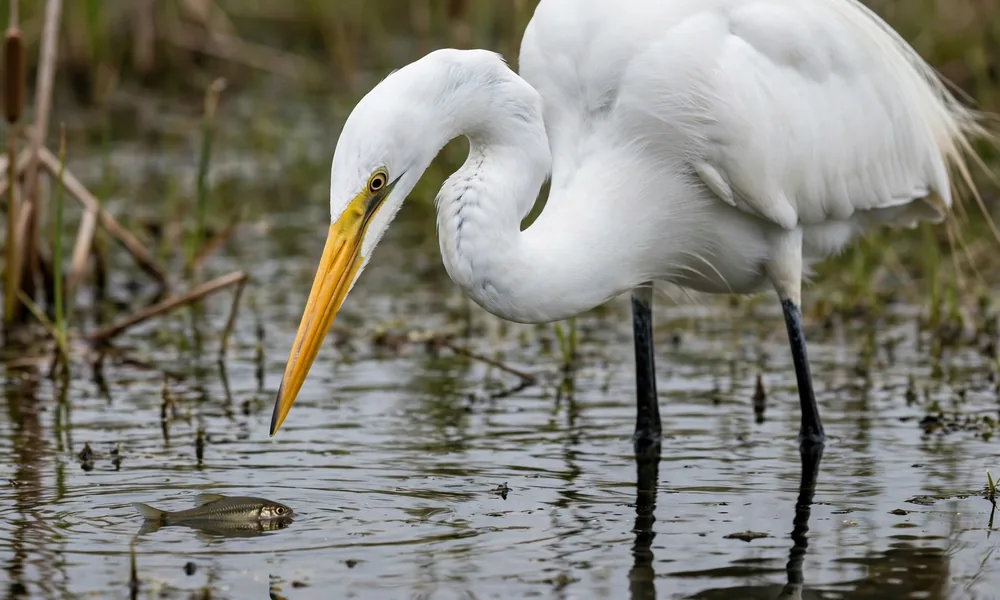
Great egrets feed in shallow water, where they walk slowly with the neck extended, or stand perfectly still for long periods, waiting for an animal to come within range of the long neck and blade-like bill. The strike is a quick thrust of the sharp bill, and the prey is swallowed whole. Fish are the staple food, but great egrets use the same technique to take frogs and other amphibians, small reptiles such as snakes, mice and other small mammals, crayfish, snails and insects such as crickets and grasshoppers.
Breeding takes place in colonies, often in trees standing in or near water, alongside other herons and egrets. The male and female are monogamous through the breeding season, and together they build a nest of sticks that can measure about a metre across. The female lays one to six eggs, usually three or four, pale blue-green in colour, and both parents incubate them for about 23 to 27 days. The chicks are fed by regurgitation by both parents, and they are able to fly within six to seven weeks.
Outside the breeding season, great egrets are partly migratory: birds in the colder north move south for the winter, while birds in warm regions stay put all year. They roost in trees at night, often in groups, and gather at favoured feeding grounds by day. A great egret can live for about 15 years in the wild.
Where great egrets live
Great egrets live in wetlands across most of the tropical and warmer temperate regions of the world. They are found throughout the Americas, from Canada to Argentina, across Africa, Europe and Asia, and in Australia and New Zealand. They live wherever there is shallow water and food: marshes, lakes, ponds, rivers, tidal flats, estuaries and flooded fields.
The bird’s history is a conservation success story. In the late nineteenth century, the long breeding plumes of the great egret and the snowy egret were in high demand to decorate women’s hats, and hunters shot the birds at their colonies, leaving chicks to starve. The slaughter helped to found the bird protection movement: the National Audubon Society in the United States took the great egret as its symbol, and laws such as the Migratory Bird Treaty Act of 1918 gave the birds legal protection. Since then the great egret has recovered strongly, and it is now a common sight in wetlands that were empty of egrets a century ago.
Great egrets are listed as Least Concern, because they are widespread, adaptable and still expanding their range. They are not free of trouble, though: wetland drainage, pollution and disturbance at breeding colonies remain the main threats, and a colony that is disturbed repeatedly may be abandoned. Like common loons, great egrets need quiet water and undisturbed nesting places, and they do well wherever wetlands are protected and left alone.
Best seasons for great egret watching
The best time to look for great egrets is spring and summer, from April to August in the northern hemisphere, when the birds are in breeding plumage with their long aigrette plumes and green lores, and when the colonies are busy with nest building and feeding chicks. Dawn and late afternoon are the best hours, when the birds hunt in the shallows.
Staying safe around great egrets
A great egret is a wild bird with a long, sharp bill that it uses as a spear, and it can strike quickly if it feels cornered, so never approach one closely and never try to handle it. Keep your distance from nesting colonies, especially in the breeding season, and use binoculars rather than walking in for a closer look, because a disturbed colony may abandon its nests. Never feed an egret, since human food harms wild birds and teaches them to approach people.
Great egret watching checklist
A great egret is one of the easiest large birds to find, since it is big, white and fond of open water.
- Binoculars, for watching the slow stalk and the sudden strike without getting close.
- A visit to a marsh, estuary or lake edge in April to August, when the birds wear breeding plumes.
- A dawn or late-afternoon visit, when egrets hunt hardest and the light is at its best.
- Waterproof footwear, for muddy paths and wet ground at the water’s edge.
- A field guide to herons and egrets, for telling a great egret from a little egret or a grey heron.
- Patience and stillness, because an egret that is hunting will freeze for minutes at a time.
- A camera with a zoom lens, for the white plumage against dark water without disturbing the bird.
Frequently asked questions
How many great egret species are there?
There is one great egret species, Ardea alba. Four subspecies are recognised, in Europe and the Palearctic, the Americas, Africa, and Asia and Australasia, but they are all the same species, also known as the great white egret.
What does a great egret eat?
Great egrets eat fish above all, along with frogs and other amphibians, small mammals such as mice, small reptiles such as snakes, crayfish, snails and insects. They hunt by standing still or walking slowly in shallow water, then spearing prey with the long, sharp bill and swallowing it whole.
Why were great egrets hunted for their feathers?
In the late nineteenth century, the great egret’s long breeding plumes, called aigrettes, were in high demand to decorate women’s hats, and hunters killed the birds at their colonies for the feathers. The slaughter helped to start the bird conservation movement, including the National Audubon Society, which took the great egret as its symbol.
How big is a great egret?
A great egret is about 80 to 104 centimetres long, with a wingspan of about 131 to 170 centimetres, and it weighs roughly 700 to 1,500 grams, averaging about 1,000 grams. It stands up to a metre tall, making it the largest white egret anywhere in its range.
How is this guide different from the gentoo penguin species guide?
This guide covers the great egret, a single tall white heron that wades in warm wetlands worldwide and spears fish with a yellow bill, while our gentoo penguin species guide covers the gentoo penguin, a flightless seabird of the far south that swims at about 36 kilometres per hour and builds nests from pebbles on sub-Antarctic beaches. Egrets hunt in shallow fresh water, and gentoos hunt in the freezing Southern Ocean.
Are great egrets endangered?
No. Great egrets are listed as Least Concern, because they are widespread, adaptable and still expanding their range. Their main needs now are protected wetlands and undisturbed breeding colonies.
Conclusion
The great egret species shows how a single bird can span the world: one species, Ardea alba, standing white and still in wetlands on every continent except Antarctica, from a marsh in Florida to a reedbed in the Danube Delta.
If you go looking for one, go to the water’s edge at dawn in spring, go quietly, and watch the long neck coil and strike. The egret survived the feather trade, and keeping its wetlands wet and quiet is what will keep it there.