The cane toad species is the toxic invader that conquered Australia, a big, warty toad from Central and South America that was brought to Queensland in 1935 to eat cane beetles and instead ate almost everything else. If you are asking what a cane toad is, the short answer is Rhinella marina, formerly Bufo marinus, a large terrestrial true toad with dry, warty skin, bony ridges over the eyes and a pair of large parotoid glands behind each eye that secrete a milky poison called bufotoxin, and it is the largest toad in the world, with adults usually 10 to 15 centimetres long and the biggest reaching 24 centimetres. It failed at the job it was brought in to do, because the beetles feed at the top of the cane stalks and the toad hunts at ground level, but it succeeded at something nobody wanted, spreading across more than a million square kilometres of Australia from just 102 founders.
Most people meet a cane toad the same way Australians do, on a warm night in Queensland, when a heavy shape hops across the lawn under the porch light and stops, warty and unhurried, with its golden eyes fixed on the insects gathering in the light. The toad sits, waits, and snaps up whatever comes within reach of its tongue, and it does so in a country where almost nothing can safely eat it, because the poison in its skin kills the dogs, the snakes and the native predators that try. That is the heart of this guide: how a single species of toad became the most famous invasive animal in Australia, how it lives, hunts and breeds in the warm, wet country it calls home, and why it is both a marvel of adaptability and a disaster for the wildlife around it.
Key takeaways
- The cane toad species is Rhinella marina, formerly Bufo marinus, a large terrestrial true toad in the family Bufonidae, native to Central and South America.
- Adults are usually 10 to 15 centimetres long, the largest reach 24 centimetres, and the heaviest reliably recorded specimen weighed 2.65 kilograms.
- Cane toads were introduced to Australia in 1935, when 102 toads were brought from Hawaii to Queensland, and they now number more than 200 million.
- The toad is toxic at every stage of life, from the eggs and tadpoles to the adult, through the milky bufotoxin secreted by the parotoid glands behind its eyes.
- They are listed as Least Concern, are prolific breeders that lay 8,000 to 30,000 eggs at a time, and are mostly seen by night in Queensland, the Northern Territory and New South Wales.
The cane toad species and their relatives
Cane toads belong to the family Bufonidae, the true toads, a large family of land-living amphibians found across the Americas, Europe, Africa and Asia, all sharing the same basic plan: a stout body, short legs made for walking and short hops, dry, warty skin, and poison glands that make them taste bad to predators. The family as a whole spans about 3 cm to 24 cm long, from the tiny oak toad of North America to the cane toad itself, the largest of them all. National Geographic’s profile of the cane toad gives the same broad picture, a big, warty, toxic toad of the American tropics, and this guide builds on that picture with the detail of how the animal actually lives. The genus is Rhinella, a group of large South American toads, and the cane toad is its most famous member, and its most travelled.
The cane toad, Rhinella marina, is the lead species of this guide, and a good ambassador for the whole family, though a troublesome one. It is a large, heavy-bodied toad with dry, warty skin in shades of yellow, olive, grey, red or brown, often marked with darker blotches, and a cream-coloured underside that may carry darker spots. It is native to the Americas, from southern Texas through Central America to southern Peru and the Amazon, and to Trinidad and Tobago, thriving in grasslands and forests of tropical to semi-arid regions. Adults are usually 10 to 15 centimetres from snout to vent, females are significantly longer than males, and the largest reach 24 centimetres, with an average adult weight of about 1.3 kilograms. The genus Rhinella spans about 10 cm to 24 cm long, and the cane toad sits at the top of that range, the biggest toad in its genus and the biggest toad in the world.
| Type | Animal | Where it lives | Best-known food | Length or Weight |
|---|---|---|---|---|
| Family | True toads (Bufonidae) | Land across the Americas, Europe, Africa and Asia | Insects, spiders, worms and other small invertebrates | About 3 cm to 24 cm long |
| Genus | Giant toads (Rhinella) | Central and South America | Insects, spiders, snails and small vertebrates | About 10 cm to 24 cm long |
| Species | Cane toad (Rhinella marina) | Central and South America, introduced to Australia and many Pacific islands | Beetles, ants and other insects | About 10 cm to 24 cm long |
| Species | Mesoamerican cane toad (Rhinella horribilis) | West of the Andes, through Central America to southern Texas | Insects, spiders and other small invertebrates | About 10 cm to 24 cm long |
| Species | American toad (Anaxyrus americanus) | North America | Crickets, ants, spiders, slugs and earthworms | About 5 cm to 9 cm long |
| Species | Common toad (Bufo bufo) | Most of Europe, western North Asia and parts of north-western Africa | Invertebrates and, occasionally, small mice | About 8 cm to 15 cm long |
The closest relative of the cane toad, and the one it was confused with until very recently, is the Mesoamerican cane toad, Rhinella horribilis, the giant toad of the western side of the Andes. Until 2016 both giant toads were called Rhinella marina, and a study of their DNA and skull shapes split them into an eastern species, the cane toad, and a western one, the Mesoamerican cane toad, from the west of the Andes through Central America to southern Texas. They look identical and can be told apart only by DNA or an X-ray of the skull, and the Mesoamerican cane toad is about 10 cm to 24 cm long, the same size as its eastern twin. Within the family, the species sort themselves by the land they live on. The American toad, Anaxyrus americanus, is the toad of North American gardens, about 5 cm to 9 cm long, with kidney-shaped poison glands behind each eye, and the common toad, Bufo bufo, is the toad of Europe, about 8 cm to 15 cm long, stocky and brown, and Britain’s largest and heaviest amphibian. Like the American bullfrog, the cane toad is a big, loud amphibian that eats almost anything it can fit in its mouth, but the bullfrog is a frog of ponds and lakes that hunts in the water, while the cane toad is a toad of dry land that hunts on the ground at night.
What a cane toad looks like
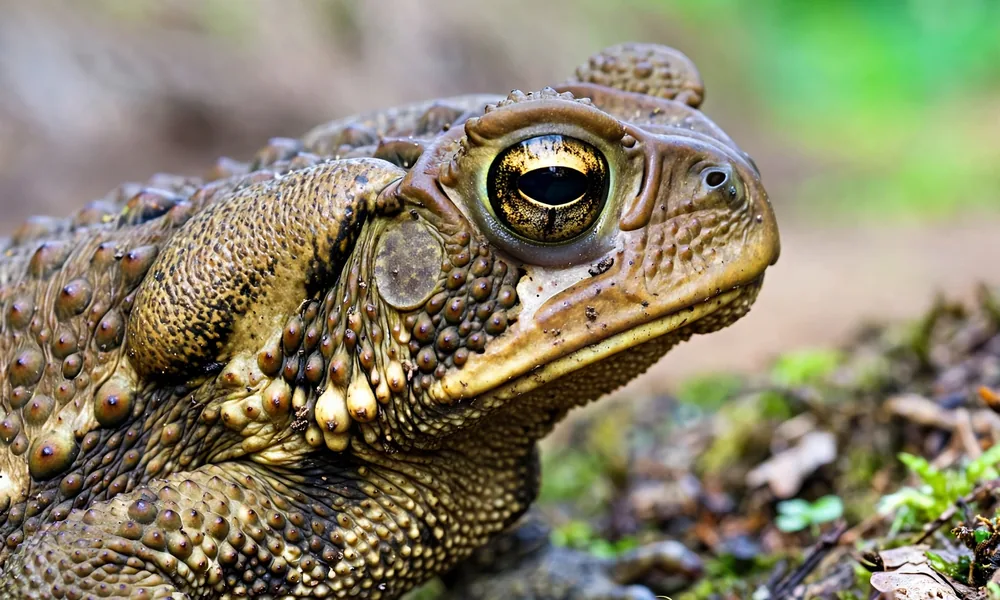
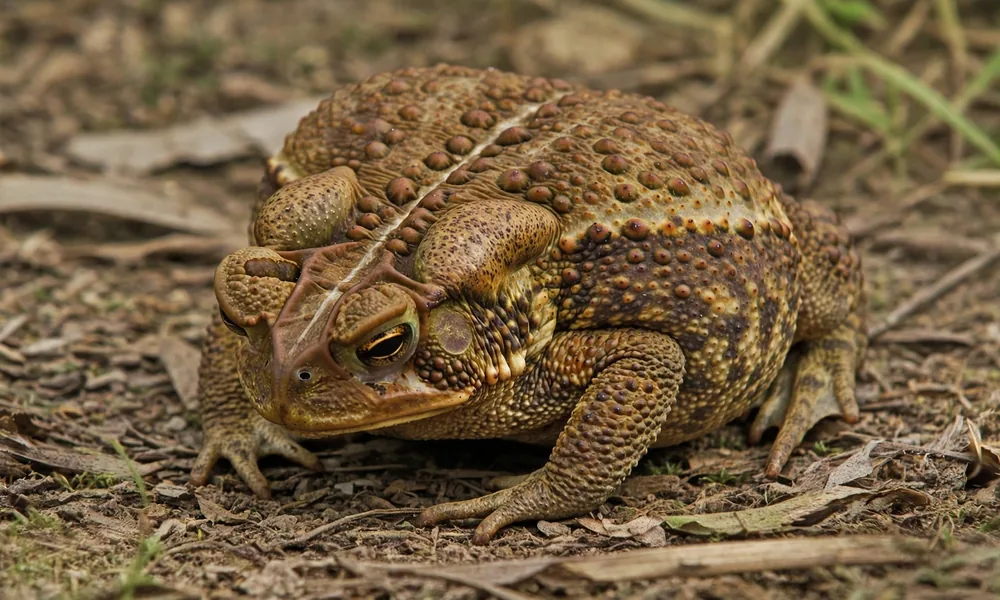
A cane toad is a big, heavy toad, built low and broad like an animal that has decided to walk rather than jump. Adults are usually 10 to 15 centimetres from snout to vent, and a big female is a toad the size of a dinner plate, heavy in the hand and warty all over, with an average adult weight of about 1.3 kilograms. The body is stout and the legs are short and sturdy, suited to walking and short hops rather than the long leaps of many frogs, and the toes are not webbed, which is one more sign that this is an animal of dry land. The skin is dry and warty, in shades of yellow, red, olive, grey and brown, and the underside is cream-coloured and may feature darker blotches, while juveniles have smoother, darker skin and tend to be more reddish in colour.
The head is broad and flat, and it carries the two features that give the toad its look. The first is the bony ridge that runs from over the eyes to the nose, a raised crest that helps to tell the cane toad from the native frogs of Australia, which have no such ridge. The second is the pair of large parotoid glands, one behind each eye, running down the side of the neck and shoulder, and these glands produce the toad’s defensive toxin, a milky secretion loaded with bufadienolides, chemicals that attack the heart. The eyes are gold, with horizontal pupils, and they sit high on the head, watching the ground ahead for movement, and the mouth is wide, made for taking in prey whole.

The size of a cane toad depends on where it lives, and the range is wide. Most adults are 10 to 15 centimetres long, and the biggest reach 24 centimetres from snout to vent, with larger toads tending to be found in areas of lower population density, where there is more food to go around. The heaviest reliably recorded specimen was Prinsen, a pet toad in Sweden listed by the Guinness Book of Records, which weighed 2.65 kilograms and measured 38 centimetres from snout to vent, or 54 centimetres when fully extended. A wild toad found in Conway National Park in Queensland in 2023, nicknamed Toadzilla, was reported at 2.7 kilograms and 25 centimetres. Like the axolotl, the cane toad is an amphibian that has become famous far beyond its home range, but the axolotl is a small, aquatic salamander with feathery external gills that lives only in two lakes near Mexico City, while the cane toad is a big, land-living toad that now lives on four continents.
Where cane toads live
Cane toads live in the warm parts of the world, and they are animals of grassland, forest edge and farmland. Their native range runs from southern Texas through Mexico and Central America to southern Peru and the Amazon, and to Trinidad and Tobago, and they thrive in grasslands and forests of tropical to semi-arid regions. They favour ground that is warm and damp, with somewhere to shelter by day and somewhere to breed by night, and they are rarely found in cold country, because they need a minimum temperature of about 10 to 15 degrees Celsius to stay active.

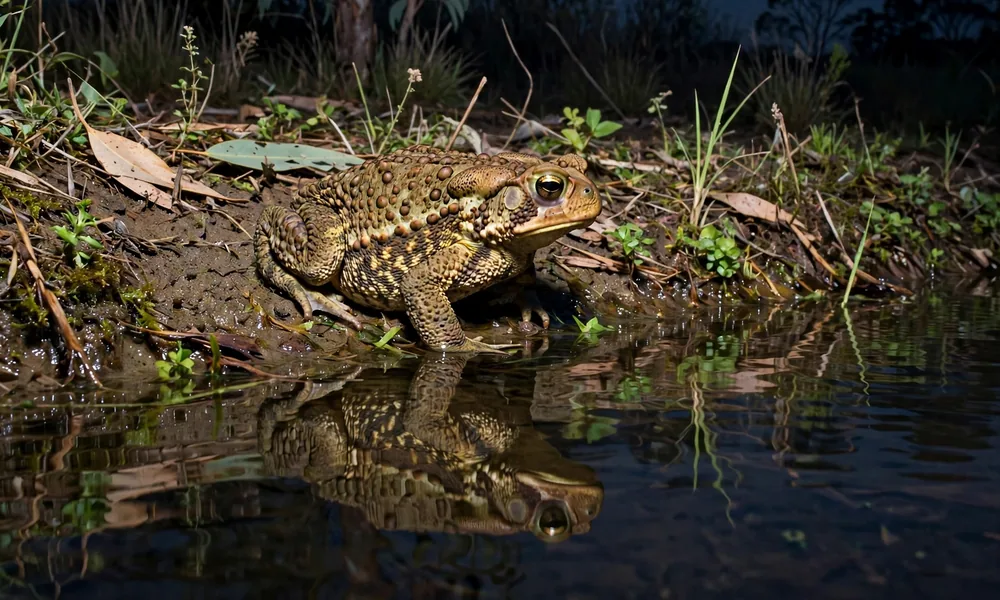
The habitat they choose in Australia is the edge of the water and the edge of the farm, and they are rarely found far from either. Most cane toads live in the low country of Queensland, the Northern Territory, New South Wales and Western Australia, in the cane fields, the cattle country, the suburbs and the bush, wherever there is a dam, a ditch or a puddle to breed in and a porch light to hunt under. They favour places with plenty of shelter, under logs, in burrows, in leaf litter and under debris, which give them both a resting place by day and a hunting ground by night, and they are less common in dense forest, where there is little open ground to hunt on. A cane toad spends much of its life within a small patch of country, though the front of the invasion moves on, at up to 60 kilometres a year in the west.
The cane toad has travelled far beyond its native range, and it has done so because people carried it. It was introduced to Hawaii in 1932, to Puerto Rico and the Philippines in the 1930s, and to Australia in June 1935, when 102 toads were collected in Hawaii and brought to Gordonvale in Queensland, of which 101 survived the trip. Their young, 2,400 toadlets, were released around Gordonvale on 19 August 1935, and by March 1937 some 62,000 toadlets had been bred in captivity and released around Cairns, Gordonvale and Innisfail. From those beginnings the toads spread across Queensland, into the Northern Territory and New South Wales, and by 2011 they were estimated to number more than 200 million, covering about 1.2 million square kilometres.
What cane toads eat
Cane toads are hunters, and their diet is written on the ground itself. The everyday food is the insect, and a cane toad will eat almost any creature it can fit in its mouth, from beetles, ants, termites and crickets to spiders, snails, small frogs, lizards, and even small mammals and birds it can catch. They also eat pet food, human refuse and plants, and a big cane toad will take a small snake without a second thought. A garden full of cane toads keeps the numbers of insects in check, which is one reason people once welcomed them.
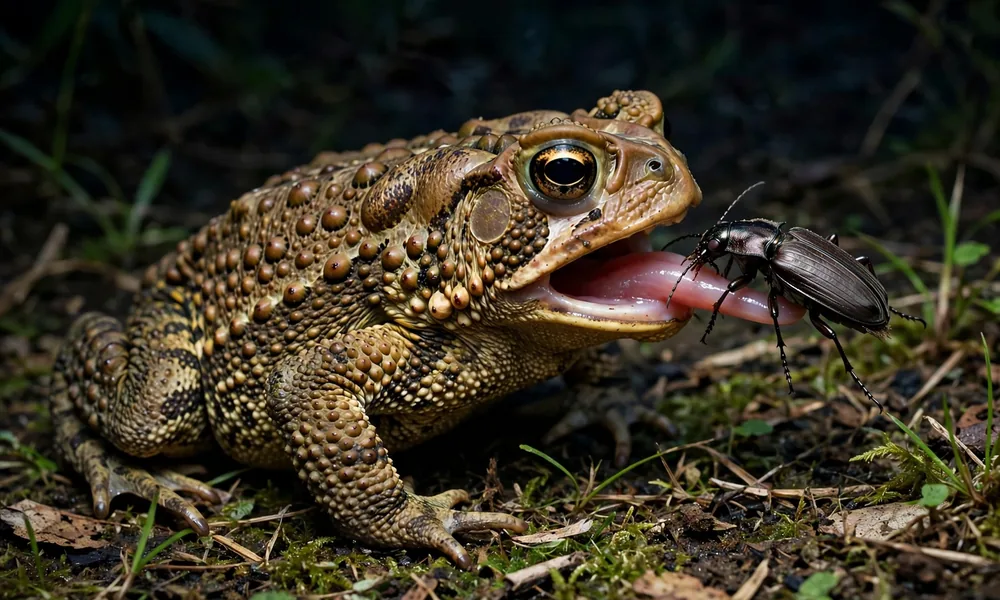
What sets the cane toad apart is how it eats. Unlike most amphibians, which identify prey by movement alone, cane toads can also locate food using their sense of smell, and unlike most frogs and toads they readily eat dead matter, scavenging roadkill and carrion and picking up scraps around houses. They hunt mostly by sitting still and ambushing whatever passes, snapping up prey with a quick flick of a sticky tongue, and they do so at night, when the insects are drawn to the lights and the ground is damp. Tadpoles eat algae and detritus in the water, and the young toadlets eat small insects and grow fast on that rich food, reaching adult size within a year or two. A single toad may eat several dozen insects in a night, and a suburb full of cane toads can keep the numbers of cockroaches and beetles in check.
How cane toads behave
Cane toads are night animals, and their day is a quiet round of sheltering, waking and hunting on the ground. They wake at dusk, leave the burrow or the log where they spent the day, and move out onto the lawn and the road to feed, spending the night working the ground in a slow, unhurried way. They are not strong jumpers over distance, and they do not need to be: their life is lived within a few hundred metres of ground. When a predator approaches, a cane toad will often sit still and rely on its warty skin and its poison to protect it, and if that fails it will inflate its body, lower its head and raise its parotoid glands.
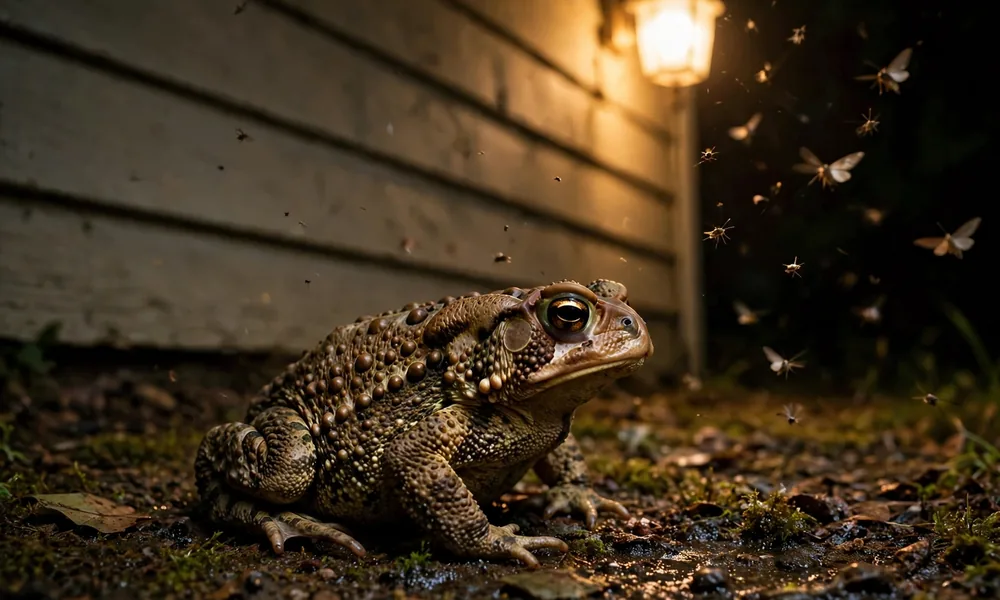
The most famous behaviour in the cane toad is the way it defends itself. When threatened, the toad secretes a milky fluid called bufotoxin through its skin and from its parotoid glands, and the poison contains several different chemicals, such as bufagin, which affects the heart, and bufotenine, a hallucinogen. The toad is toxic through all stages of its life cycle, as even the eggs and tadpoles contain bufotoxin, and the skin of a dead toad stays toxic for some time after death. Cane toads can survive losing about half their body water, but they act to conserve water by being active at night and resting in sheltered places during the day.
Breeding and life cycle
Cane toads breed almost any time of year in warm, wet conditions, and the timing is set by the rain rather than the calendar. The males gather at the edges of ponds, ditches, canals and slow streams and call with a long, low trill to attract females, and a male grips a female in the amplexus position while she releases her eggs in long, jelly-like strings and he fertilises them. A female may breed more than once in a season, and she does so in water that is often no deeper than a puddle, which is one reason the species is so hard to stop: almost any standing water will do.
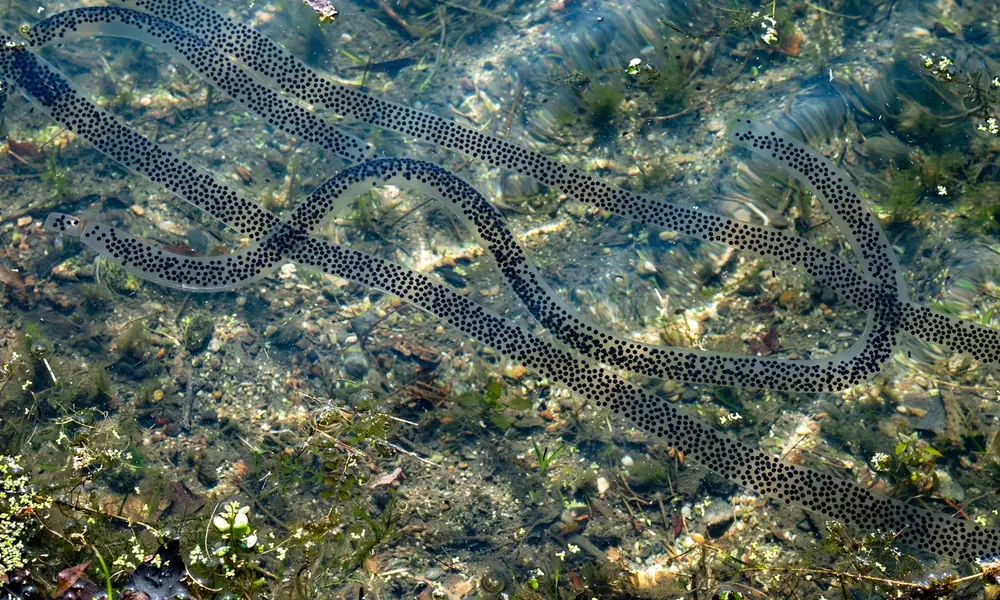
The female lays between 8,000 and 30,000 eggs at a time, in long strings in fresh water, and a single female can lay up to about 36,000 eggs in one clutch, far more than most amphibians produce. The eggs hatch into small black tadpoles, 10 to 25 millimetres long, which are themselves toxic. When they emerge, the toadlets are typically only 10 to 11 millimetres long, and they grow rapidly, at about 0.65 millimetres a day at first. Only an estimated 0.5 percent of cane toads reach adulthood, in part because they lose the toxicity that protected them as eggs and tadpoles before they have fully developed the parotoid glands that produce bufotoxin, and in part because the tadpoles eat each other, but with 30,000 eggs at a time, even half a percent is enough to fill a continent.
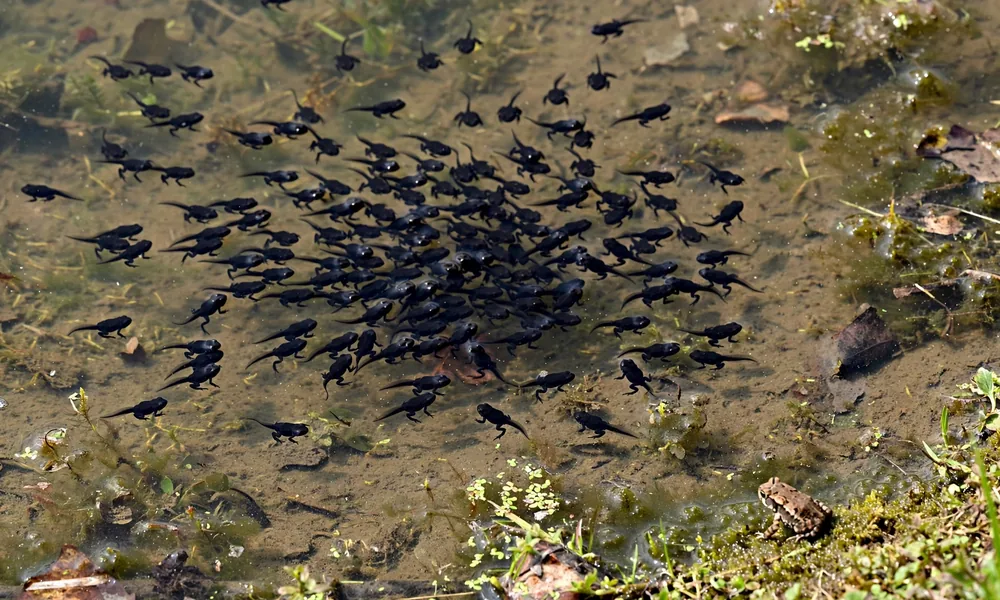
Growth is fast, and a young cane toad reaches breeding size within a year or two, feeding on small insects and growing on the rich food of the wet season. The lifespan in the wild is 10 to 15 years, though some accounts give 5 to 10 years as the average, and toads can live considerably longer in captivity, with one specimen reportedly surviving for 35 years. The young are on their own from the day they leave the water, able to feed and hide within hours, but most of them will never reach adulthood, eaten by fish and birds in their first weeks.
Conservation status
The cane toad is listed as Least Concern by the International Union for Conservation of Nature, and the reasoning is straightforward: it has a huge range, it breeds in enormous numbers, and its population is stable or increasing across that whole range. That broad picture hides a more worrying local one, because the cane toad is doing very well for itself and very badly for the wildlife around it. A toad that breeds in any puddle and eats almost anything cannot be stopped by protecting a single pond, and a country that loses its native predators to the toad’s poison loses them within a generation or two.
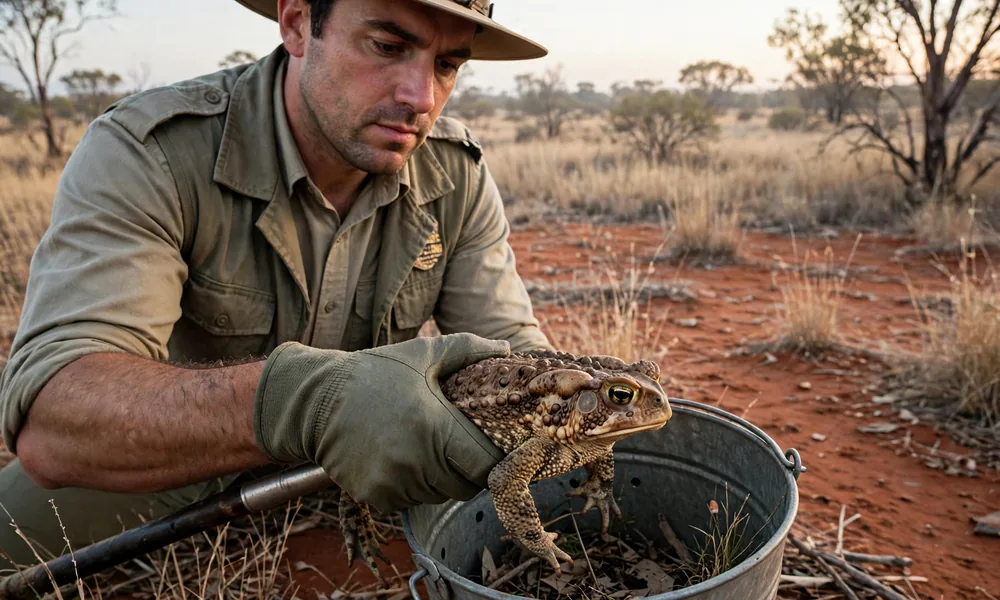
The main pressure the cane toad puts on other animals is its poison. Native predators that have never met a toxic toad before, from the northern quoll to the freshwater crocodile, eat a cane toad and die, and whole populations have crashed in the years after the toads arrive. The toad also eats native frogs, lizards and small mammals, and it competes with native frogs for food and breeding sites. The most useful control work is practical: trapping the toads by hand, fencing the waterholes where native animals drink, and teaching native predators to avoid the toads, by feeding them small, non-lethal toads that make them sick and teach them to leave the big ones alone.
Best seasons for cane toad watching
The best time to look for a cane toad is the wet season, when the rain has filled the dams and the toads are breeding in numbers you can hear from the road. In Queensland that usually means the months from about November to April, when the rain falls most days and the nights are warm, and in the Northern Territory the season runs with the monsoon, from about December to March. Cane toads are present in the country all year round, but a warm, wet night in the wet season will show you far more toads than a cool night in the dry season, when the toads are sheltering under logs and out of sight.
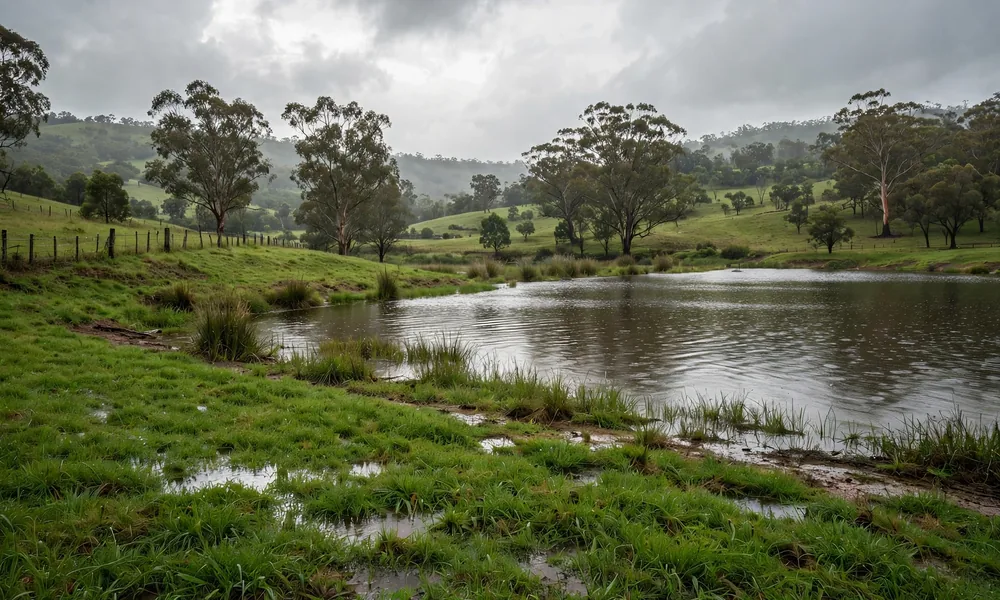
The best hours are the night, when the cane toads are out feeding. From about seven o’clock until midnight, the toads are out on the lawns, the roads and the edges of the dams, sitting under the porch lights and moving from puddle to puddle, and they are at their most approachable then, though approachable means watching from a few metres away, not picking them up. A slow walk around a farm dam with a torch, watching for a warty shape sitting in the grass, is all you need, and the toads will often sit close enough to see the parotoid glands and the golden eyes clearly, if you move gently and keep your distance.
Staying safe around cane toads
A cane toad is dangerous to pets and to native wildlife, and it can be dangerous to people who handle it carelessly, so the safety rules matter more here than they do for most amphibians. The toad’s bufotoxin is a poison, not a venom, which means it hurts you if you eat it or get it in your eyes or mouth, not if it bites you, and the toad will not chase or threaten a person. Never pick up a cane toad with bare hands, never let a dog mouth one, and never touch your eyes or mouth after handling one. If a dog does mouth a toad, wipe its mouth out with a wet cloth and get the dog to a vet at once, because the poison acts on the heart and there is no time to wait.
There are a few practical points for the night itself. Go with a companion, stay on the paths where you can, and keep an eye on the weather, which can change fast in the wet season, with rain and flooding rising in minutes. Wear gloves when you are handling a trap, and wear shoes that grip, because the ground around a dam is slippery after rain. If you find a cane toad, look at it where it is, take a photograph if you like, and do not release it somewhere new: in Australia it is illegal to move a cane toad to a place it has not yet reached, so leave it where you found it, or report it to the local rangers if you are in a toad-free area.
Cane toad watching checklist
A little preparation turns a warm night in Queensland into a real chance of seeing cane toads at their best, out in numbers under the lights and around the dams.
- A visit in the wet season, when the rain has filled the dams and the toads are breeding in numbers you can hear from the road.
- A night walk, when the cane toads are out feeding and the light from a torch is good for seeing them.
- A farm dam or a cane field edge, with grass, logs and shelter, where the toads hunt by night and breed by day.
- A slow walk around the dam, watching for a warty shape sitting in the grass or under a porch light.
- A torch and gloves, so you can see the toad clearly and handle a trap safely without touching the poison glands.
- A companion and a phone, so that a night in the bush stays safe from start to finish.
- Respect for the toad and the bush, keeping your distance, never moving a toad to new ground, and leaving the dam as you found it.
Frequently asked questions
How big do cane toads get?
Most cane toads measure between 10 and 15 centimetres from snout to vent, and a good toad weighs about 1.3 kilograms. The largest reach 24 centimetres. The heaviest reliably recorded specimen was Prinsen, a pet toad in Sweden, which weighed 2.65 kilograms and measured 38 centimetres from snout to vent, or 54 centimetres when fully extended, and a wild toad found in Queensland in 2023, nicknamed Toadzilla, was reported at 2.7 kilograms and 25 centimetres. Females grow larger than males, and the biggest cane toads in any district are almost always female.
What do cane toads eat?
A cane toad eats beetles, ants, termites, crickets, spiders, snails, small frogs, lizards and small mammals and birds it can fit in its mouth, and it also eats pet food, human refuse and plants. It is an opportunistic omnivore that hunts by sitting still and ambushing whatever passes, snapping up prey with a quick flick of a sticky tongue, and unlike most amphibians it readily eats dead matter. Tadpoles eat algae and detritus in the water, and young toadlets eat small insects.
Why were cane toads brought to Australia?
Cane toads were brought to Australia in 1935 to control the cane beetles that were damaging the sugarcane crop, after the toads had apparently succeeded at eating the beetles in Puerto Rico and Hawaii. The plan failed, because the beetles feed at the top of the cane stalks and the adult toads are poor jumpers that hunt at ground level, so the toads never reached their target. Instead they spread across the country, breeding in dams, ditches and puddles, each female producing tens of thousands of eggs a year, and from 102 founders they have grown to an estimated 200 million.
Are cane toads dangerous?
Yes, cane toads are dangerous to pets and to native wildlife, and they can be dangerous to people who handle them carelessly. They secrete a milky poison called bufotoxin from the parotoid glands behind their eyes, and the poison contains chemicals that affect the heart, so a dog that mouths a toad can die within minutes, and a native predator that eats one often dies too. Their whole defence is built on being toxic at every stage of life, from the eggs and tadpoles to the adult, and their first response to a threat is to sit still, inflate the body and offer the poison glands to whatever tries to bite. The safety rule is simple: look, do not touch, and keep dogs away.
Can you keep a cane toad in an aquarium?
You can, but it is hard, and most people should not try. A cane toad grows to 10 to 15 centimetres, it needs a large tank with clean water and dry land, and it eats live insects and small vertebrates, which makes it expensive and demanding to keep. It is also illegal to keep one in some places without a permit, and in Australia it is illegal to move a cane toad to a place it has not yet reached, so a toad that outgrows its tank must never be released into the wild. A cane toad belongs in its home range, not in a living room.
How is this guide different from the caecilian guide?
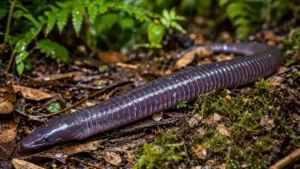
This guide covers the cane toad, a big, warty, land-living toad of 10 to 15 centimetres that hunts insects on the ground at night, defends itself with a milky poison from the parotoid glands behind its eyes, and lays 8,000 to 30,000 eggs at a time in long strings in fresh water, while our caecilian guide covers a limbless burrowing amphibian of 30 to 50 centimetres that lives its whole life in damp tropical soil, finds its food with sensory tentacles and gives birth to live young after a gestation of about 11 months. One is a toad you meet under a porch light on a warm Queensland night; the other is an animal you find by lifting a rotting log on a damp night in a tropical forest.
This guide also goes further than our general frog guide, which covers frogs as a whole, from the tiny tree frogs to the great bullfrogs, in broad strokes. That guide tells you what a frog is; this one tells you what one toad does, night by night, from the sit-and-wait hunting under the porch light to the bufotoxin defence and the 30,000-egg breeding, with the exact sizes, the exact 1935 introduction of 102 toads, and the Queensland dams where you can actually find the animal. If you want the whole family of frogs and toads, read the general guide first, and if you want the cane toad itself, this is the guide to read.
Conclusion
The cane toad species is a reminder that an animal does not need to be fast or frightening to change a continent. A stout, warty body, a pair of poison glands, a tongue that snaps up almost anything and a female that lays 30,000 eggs at a time have made the cane toad the most famous invasive animal in Australia, at home in a cane field in Queensland, a cattle station in the Northern Territory and a suburban garden in New South Wales.
If you go looking for one, go on a warm, wet night in the wet season, go after dark, and walk slowly around a farm dam with a torch and gloves. Find the grass, watch for a warty shape sitting under the light, and keep your dog well away, and you will have met the cane toad that turns a quiet Queensland night into a place of slow, warty wonder.