The Chinese giant salamander species is the largest amphibian on Earth, a fully aquatic animal that can grow to 1.8 metres long and weigh as much as 50 kilograms. If you are asking what a Chinese giant salamander is, the short answer is a giant salamander of the genus Andrias, a mottled, wrinkled creature of the rocky mountain streams of central China that spends its whole life underwater, hunts at night, and breathes largely through the folds of its loose, baggy skin. It is a living fossil, a member of a family that split from all other salamanders more than 170 million years ago, and it is now Critically Endangered, having all but vanished from much of its old range.
Most people will never see one in the wild, and that is part of the story. The Chinese giant salamander hides under boulders in cold, fast water by day and comes out after dark to hunt fish, crabs and frogs, and the animals that remain in the rivers are few, shy and very hard to find. Yet the salamander has been known in China for thousands of years, eaten as a delicacy, used in traditional medicine, and called the infant fish, wawa yu, because of the strange sounds it makes. This guide follows the whole animal: how it looks, where it lives, what it eats, how it breeds, and why saving it has become one of the hardest conservation jobs in the world.
Key takeaways
- The Chinese giant salamander species is Andrias davidianus, the largest amphibian in the world, with adults averaging about 1.3 metres and the biggest animals reaching 1.8 metres and 50 kilograms.
- It is fully aquatic and endemic to the rocky mountain streams and lakes of the Yangtze river basin in central China, where it hides under boulders in cold, clear, fast-flowing water.
- It breathes mainly through its skin, using the loose folds along its flanks to take in oxygen from the water, which is why it needs clean, well-oxygenated streams to survive.
- It is a nocturnal hunter that eats fish, crabs, frogs, worms and snails, catching prey with a sudden sucking snap of its wide mouth, and it can go without food for long stretches.
- It is listed as Critically Endangered, having declined by more than 80 per cent since the 1950s through overcollection for food, habitat loss, pollution and dam building.
The Chinese giant salamander species and their relatives
The Chinese giant salamander belongs to the family Cryptobranchidae, the giant salamanders, a small and ancient family with only a handful of living species, all of them large, fully aquatic and confined to cool, fast-flowing rivers. The family holds two living genera, Andrias in Asia and Cryptobranchus in North America, and the three animals most people know, the Chinese, the Japanese and the American hellbender, are the whole of the family as it was understood for most of the last century. Recent genetic work has split the Chinese animal into several separate lineages, so the family is now understood to hold more species than it once did, but the Chinese giant salamander of this guide, Andrias davidianus, remains the best known and the largest of them all.
The genus is Andrias, a name given to these great salamanders in the nineteenth century, and it holds the Asian giants. The lead species of this guide, the Chinese giant salamander, Andrias davidianus, is endemic to the rocky mountain streams and lakes of the Yangtze river basin in central China, and it grows to 1.8 metres at most, though most adults are far smaller. A typical adult weighs 25 to 30 kilograms and measures about 1.3 metres, which is already longer than most dogs and heavier than most children, and the largest animal documented in recent years, kept at a farm in Zhangjiajie, measured 1.8 metres in 2007.
| Type | Animal | Where it lives | Best-known food | Length or Weight |
|---|---|---|---|---|
| Family | Giant salamanders (Cryptobranchidae) | Rocky mountain streams of China, Japan and eastern North America | Fish, crabs and frogs | Up to 1.8 m long |
| Genus | Giant salamanders (Andrias) | Rocky mountain streams of China and Japan | Fish, crabs and frogs | Up to 1.8 m long |
| Species | Chinese giant salamander (Andrias davidianus) | Rocky mountain streams of central China | Fish, crabs and frogs | Up to 1.8 m long |
| Species | Japanese giant salamander (Andrias japonicus) | Fast rocky streams of Japan | Fish, crabs and insects | Up to 1.5 m long |
| Species | South China giant salamander (Andrias sligoi) | Pearl River basin of southern China | Fish and crabs | Up to 1.8 m long |
| Species | American hellbender (Cryptobranchus alleganiensis) | Clean fast rivers of eastern North America | Crayfish and small fish | Up to 74 cm long |
The closest relative of the Chinese giant salamander is the Japanese giant salamander, Andrias japonicus, a fish of the fast rocky streams of Japan that grows to 1.5 metres and weighs up to 25 kilograms. It looks much the same, a great mottled animal with a broad flat head and tiny eyes, but it carries large single tubercles, wart-like bumps, scattered over its head and throat, where the Chinese animal has smaller, more numerous ones. The Japanese species is listed as Vulnerable, a less desperate position than its Chinese cousin, though it faces many of the same pressures.
Within the family, the giant salamanders sort themselves by the continent they live on and the size they reach. The South China giant salamander, Andrias sligoi, lives in the Pearl River basin of southern China, and the largest museum specimen on record, at 1.8 metres, belongs to this species, which was only recognised as separate from the Chinese giant salamander in 2019. The American hellbender, Cryptobranchus alleganiensis, is the only giant salamander of North America, a smaller animal of the clean, fast rivers of the eastern United States that grows to 74 centimetres and weighs up to 5.1 kilograms. Like the axolotl, the Chinese giant salamander is a salamander that keeps its larval features into adult life, but the axolotl is a small, soft-bodied animal of a few Mexican lakes that rarely grows beyond 30 centimetres, while the Chinese giant salamander is a river predator longer than a person is tall.
What a Chinese giant salamander looks like
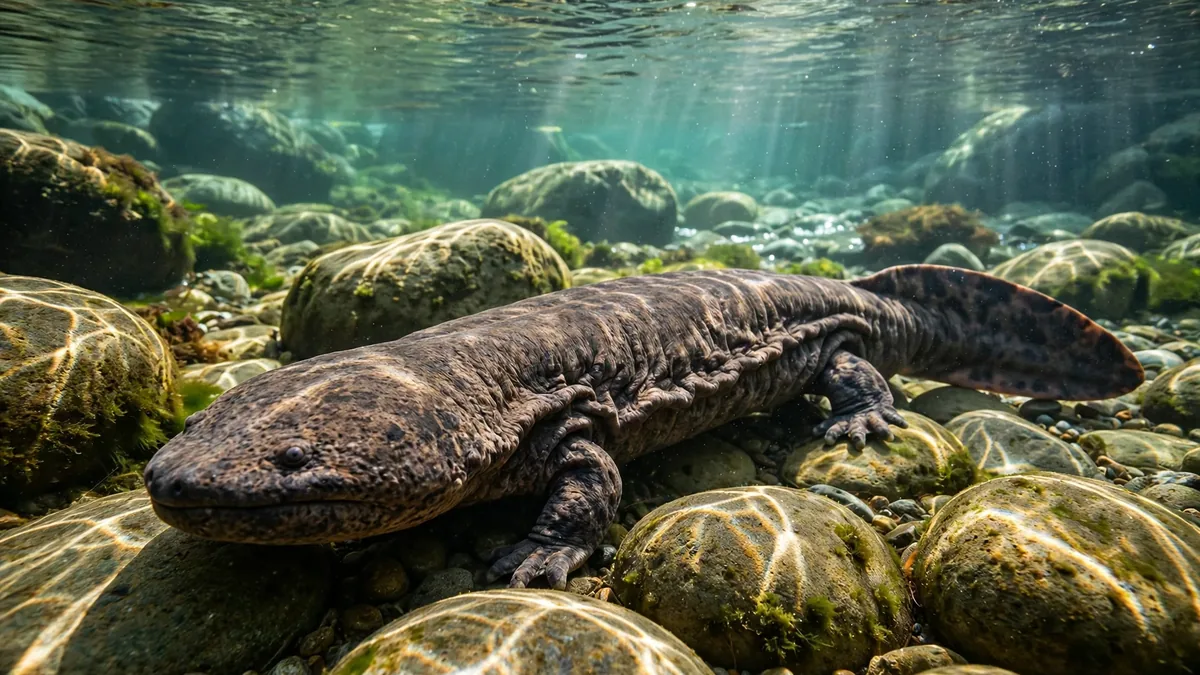
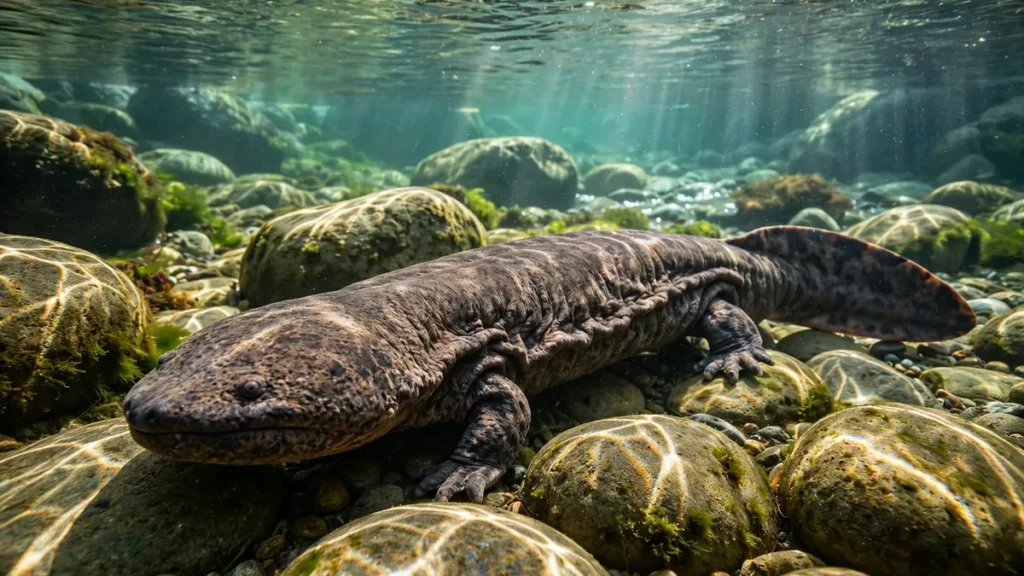
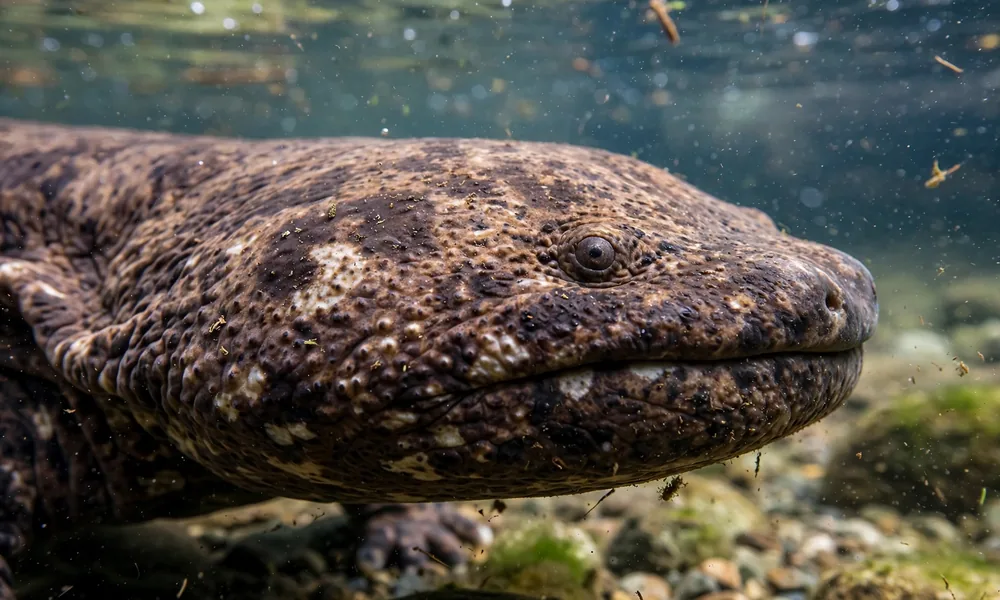
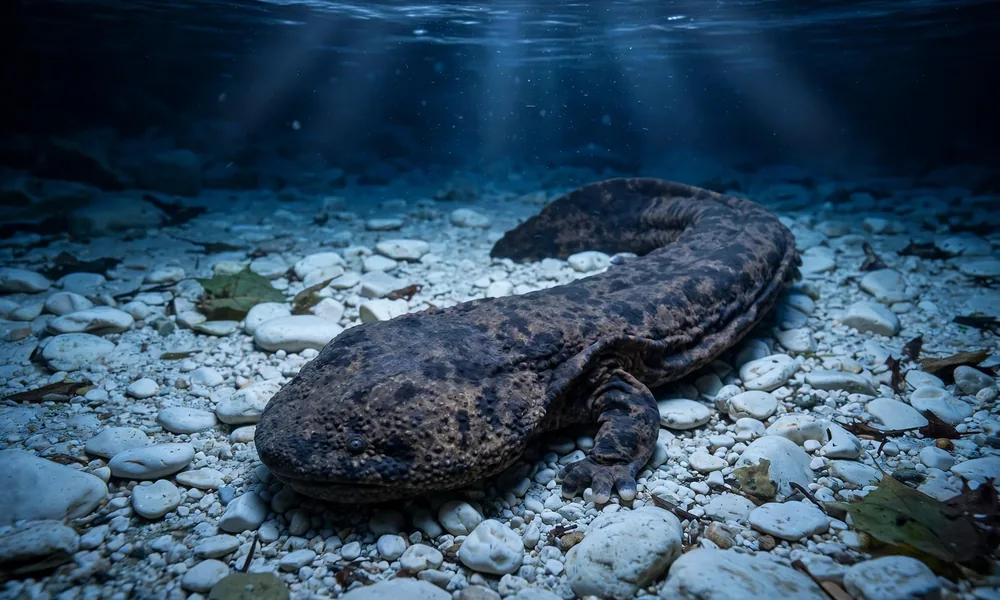
A Chinese giant salamander looks like an animal that time forgot, and in a sense it is. The body is long and heavy, flattened from above, with a broad flat head that takes up a good share of its length, four short, stubby legs, and a long tail flattened from side to side like a paddle. The skin is loose and baggy, hanging in folds along the flanks and the tail, and it is mottled in dark brown, grey and black, sometimes with paler blotches, a pattern that breaks the animal up against the stones of a riverbed. The eyes are tiny and lidless, set wide apart on top of the head, and they see very little.
The head is the most distinctive part of the animal, and it is built for a life spent waiting in the dark. The mouth is very wide, stretching almost the full width of the head, and it opens with a sudden snap that sucks water and prey in together. The teeth are small and numerous, set in rows along the jaws, and they are made for gripping rather than chewing, because the salamander swallows its food whole. The nostrils sit at the tip of the blunt snout, and the whole head is covered in small sensory bumps that pick up the movement of prey in the water, which matters far more than eyesight in a dark river.
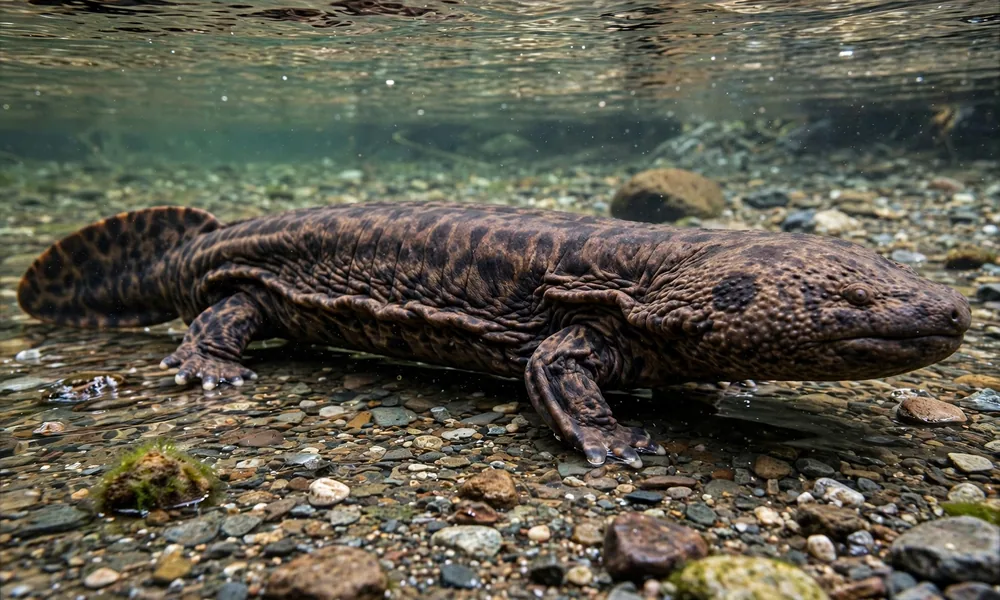
The skin is the animal’s real lung, and it is the reason the salamander looks the way it does. The loose folds along the sides of the body are rich in blood vessels, and they give the skin a huge surface area for taking oxygen straight out of the water. The animal has no working gills as an adult, though the young keep feathery external gills for their first few years, and it has no eyelids either, so the eyes stay open underwater all its life. The skin is slimy to the touch, and it is covered in a mucus that protects it from infection and helps it slip through narrow gaps between stones.
The size of a Chinese giant salamander depends on its age and its river, and the range is wide, because the animals keep growing all their lives. A typical adult is about 1.3 metres long and weighs 25 to 30 kilograms, and a good animal in a rich river will be longer than that. The biggest animals on record reach 1.8 metres and 50 kilograms, and a study of the family gives 59 kilograms as the greatest weight reported for the species. Males and females are much the same size, and the sexes are hard to tell apart outside the breeding season, when the male’s cloaca, the vent at the base of the tail, swells. The young hatch at about 3 centimetres long, and they reach 40 to 50 centimetres by the time they are old enough to breed, at five or six years of age.
Compared with other salamanders, the Chinese giant salamander is easy to tell apart once you know what to look for. No other salamander comes close to its size, and no other combines a broad flat head, tiny lidless eyes, loose wrinkled skin folds and a fully aquatic life in fast mountain water. The Japanese giant salamander is the animal most often confused with it in a photograph, and the two can be separated by the tubercles on the head and throat, large and scattered in the Japanese animal, smaller and more numerous in the Chinese one, and by the range, since the two do not meet in the wild.
Where Chinese giant salamanders live
Chinese giant salamanders live in the rocky mountain streams and lakes of the Yangtze river basin in central China, and they are animals of cold, clear, fast-flowing water. Their range once covered much of central and southern China, from the hills of Sichuan and Shaanxi east through Hubei and Hunan, but the animals are now gone from many of the rivers where they were once common, and the surviving populations are small, scattered and hard to find. A survey of 97 sites in 16 provinces, carried out over four years by researchers from the Zoological Society of London and the Kunming Institute of Zoology, found wild salamanders at almost none of them, and the species is now thought to be functionally extinct across much of the area it was surveyed in.
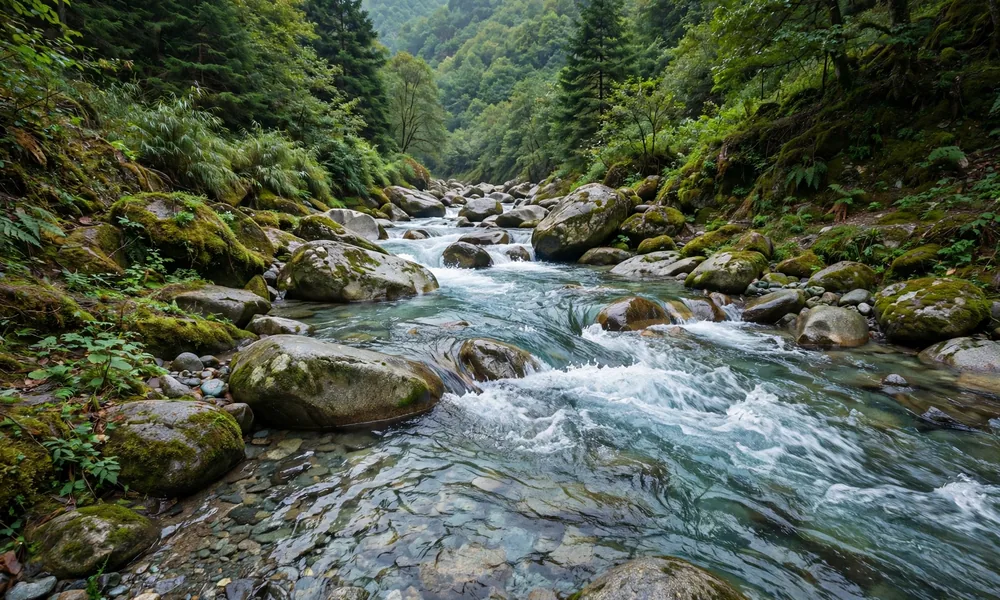
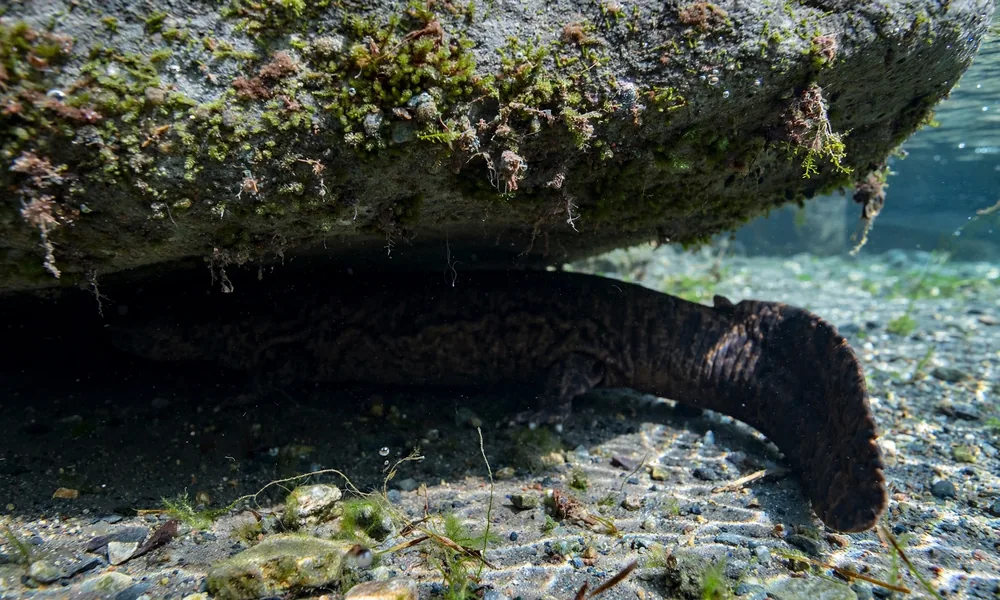
The habitat they choose is the stream itself, and they are rarely found far from the water. Most giant salamanders spend the day hidden in underwater hollows, under large boulders, in rock crevices or in burrows dug into the riverbank, and they come out at night to hunt in the pools and runs nearby. They favour water that is cold and rich in oxygen, and they are rarely found where the water is warm, muddy or polluted, which sets a hard limit on where they can live. The streams they prefer run through forested hills, with plenty of cover, and the animals are usually found at altitudes where the water stays cool all year round.
What Chinese giant salamanders eat
Chinese giant salamanders are hunters, and their diet is written on the river itself. The everyday food is fish, and a giant salamander will eat almost any fish it can fit in its mouth, from small minnows to larger river fish. They also eat crabs, frogs, worms, snails, insects and crayfish, and a salamander that has fed well may not need to eat again for days or even weeks. They are the top predators of their streams, and nothing in the water eats an adult giant salamander.
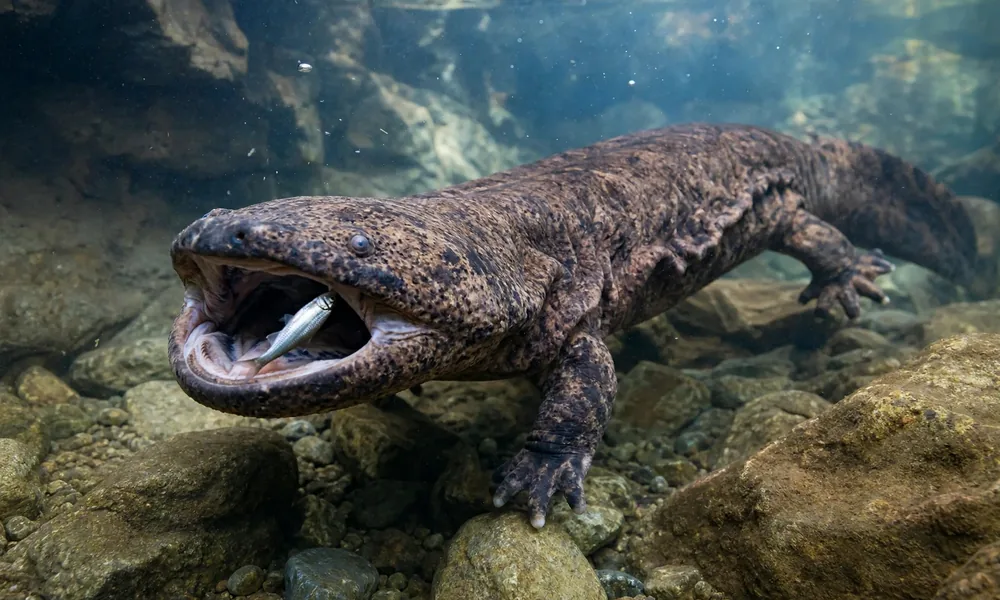
What sets the giant salamander apart is how it hunts. It does not chase its prey, and it does not hunt in a pack. It lies almost motionless on the stream bed, often with only its head poking out from under a boulder, and it waits for something to swim within reach. When a fish comes close, the salamander opens its huge mouth in a fraction of a second, and the sudden rush of water sucks the prey in whole, and the whole strike is over before the fish has time to turn. Like the frog, the giant salamander is an amphibian that eats other animals for a living, but the frog is a small, leaping hunter of the pond edge that snaps at insects with its tongue, while the giant salamander is a river predator that waits in one place and lets the water do the work.
Feeding follows the rhythm of the day and the night, and it is busiest after dark. Giant salamanders feed most actively at night, when they leave their shelters and move slowly through the pools, and they rest in the day, holding in the deep water where the food is thin. They are famous for being able to fast for a very long time, and animals in captivity have gone for months without eating.
How Chinese giant salamanders behave
Chinese giant salamanders are night animals, and their day is a quiet round of hiding, waiting and hunting in the dark. They spend the daylight hours tucked away under a boulder or in a burrow, saving energy, and they come out at dusk to hunt in the pools, and they spend the night moving slowly through the water, never rushing, never chasing far. They are not strong swimmers over distance, and they do not need to be: their life is lived within a few dozen metres of stream, up and down, and the whole river is their hunting ground. When a larger animal passes, a giant salamander will often freeze and sink into the shadows, and if that fails it will dart under the nearest rock and wait.
The most famous behaviour in the giant salamander is its voice. The animal is known in China as the infant fish, wawa yu, because it can make sounds that people have compared to a crying human baby. The salamander also has poor eyesight, and it finds its way and its food by the sensory bumps on its head and body, which pick up the slightest movement of the water, and by smell, which is keen enough to find a dead fish in the dark.
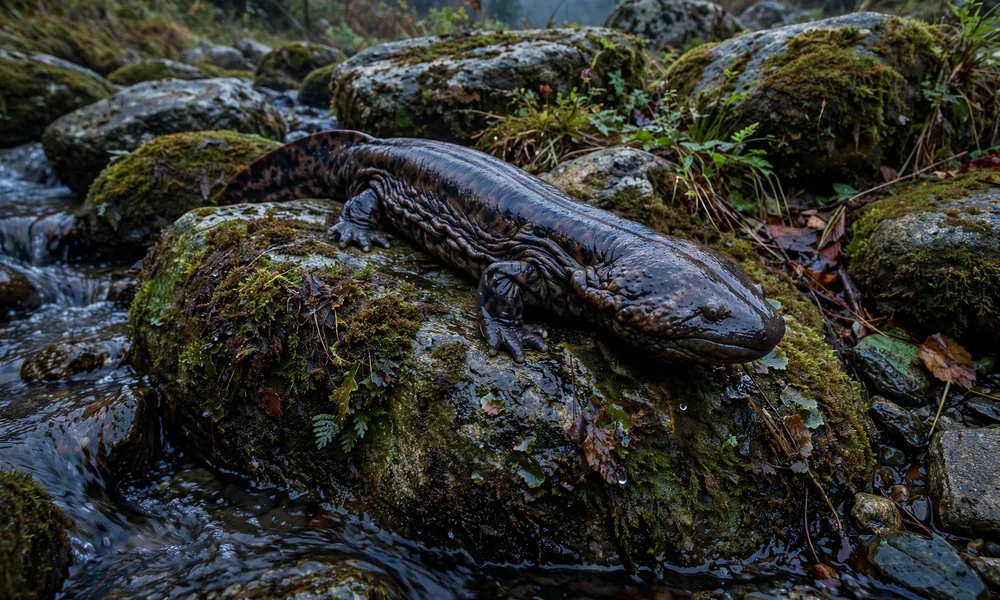
When a giant salamander is threatened, its first response is to freeze and hide, relying on its mottled skin and its stillness to vanish against the stones, and if that fails it will dart under the nearest boulder and stay there until the danger passes. Giant salamanders have no venom and no bite that matters to a person, though a large animal can give a sharp nip if it is picked up, and a salamander brought out of the water will rarely live long, because its skin dries out and it cannot breathe properly in air. The salamander is a prey item itself only when it is young, and it is eaten by fish, birds and snakes in its first years, while an adult has no natural enemies in the river.
Breeding and life cycle
Chinese giant salamanders breed once a year, and the timing is set by the temperature of the water. The breeding cycle begins when the water reaches 20 degrees Celsius, and mating takes place between July and September, when the males have prepared their dens and the females are ready to lay. The adults are widely spread through the river, and finding a mate in the dark is a real problem, which is why the males dig and defend a den, a hollow under a rock or in the riverbank, and wait there for a female to come to them. A male will clear sand and gravel out of his den to make it bigger and deeper, and he will defend it against other males.
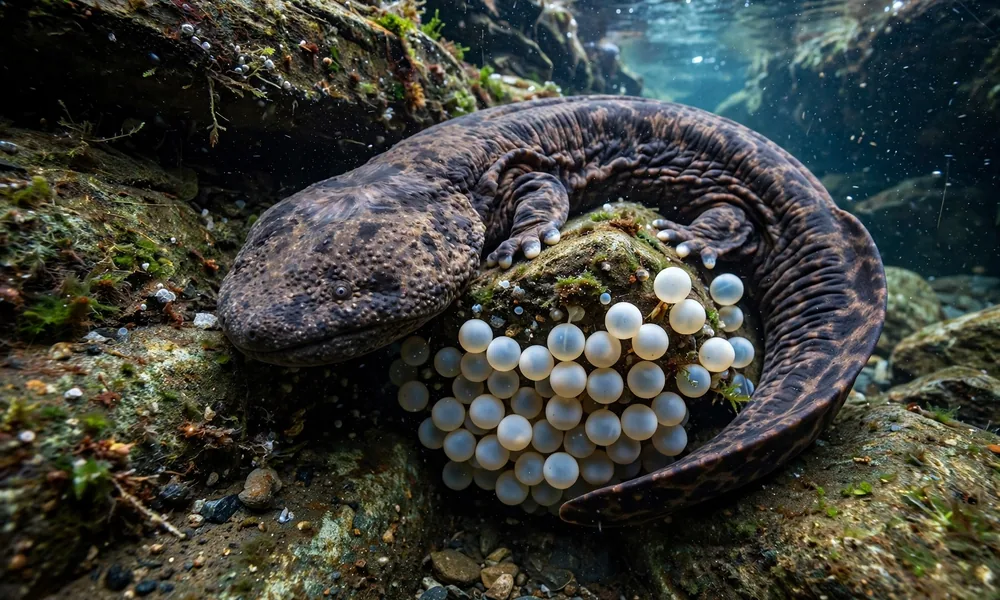
The female lays her eggs in the male’s den, in a string of 400 to 500 eggs, and the male fertilises them as they are laid, releasing his milt over the egg mass. The eggs are small when they are laid, about 7 to 8 millimetres across, but they swell to about twice that size as they absorb water, and they hatch after 50 to 60 days. The male stays with the eggs the whole time, guarding them from predators, fanning them with his tail to keep the water moving over them, and eating any eggs that are unfertilised or rotting. Several females may lay in the same den, and a dominant male may guard the eggs of more than one female at once.
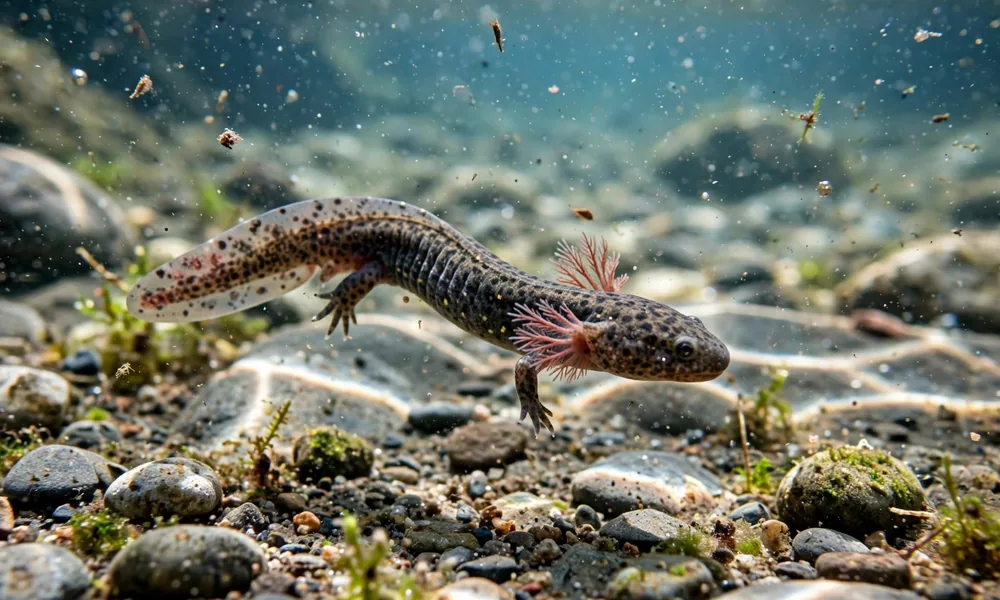
Growth is slow and little understood, and a young giant salamander can take a long time to become an adult. The larvae hatch at about 3 centimetres long, and they look nothing like the adult at all, small and dark with feathery external gills that they keep until they are about 20 centimetres long, at around three years of age. The young are independent from the day they hatch, able to feed and hide within hours, but most of them will never reach adulthood, eaten by fish and other predators in their first weeks. Maturity comes at five to six years of age, at a length of 40 to 50 centimetres, and the animals then keep growing for the rest of their lives. How long a giant salamander lives is not known for certain, but captive animals have lived for at least 60 years, and undocumented claims of 200-year-old animals are considered unreliable.
Conservation status
The Chinese giant salamander is listed as Critically Endangered by the International Union for Conservation of Nature, and the reasoning is straightforward: it has declined by more than 80 per cent since the 1950s, and wild animals are now extremely hard to find anywhere in China. That broad picture hides a more uncertain local one, because the salamander is tied to the fate of the rivers it lives in. An animal that breathes through its skin and needs cold, clean, fast-flowing water cannot live where the river is dammed, polluted or emptied of fish, and a river that loses its giant salamanders loses its top predator soon after.
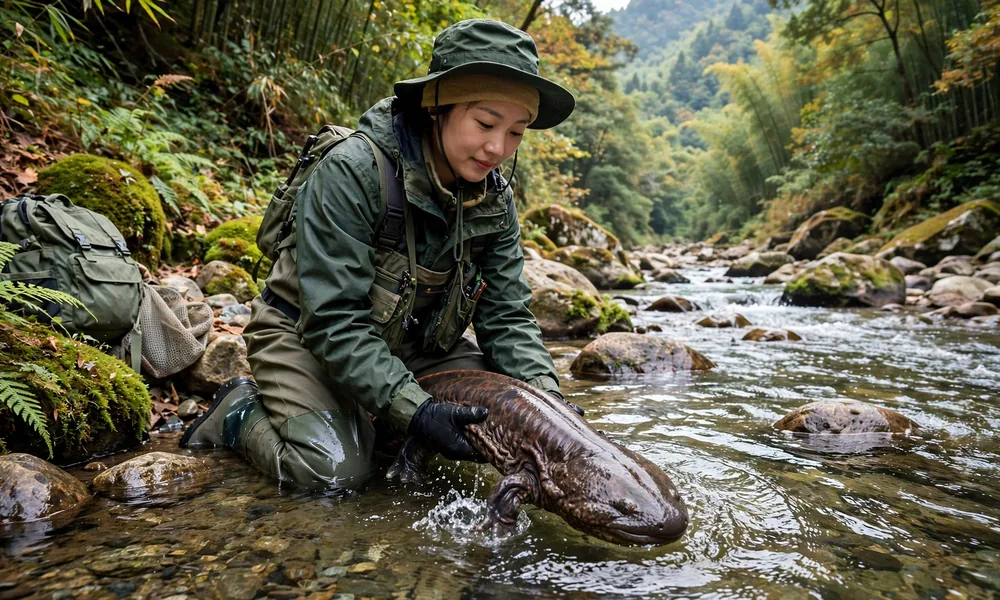
The main pressure is overcollection. For decades the salamander has been hunted for the luxury food market, where it is eaten as a delicacy, and for traditional medicine, and the animals were taken from the rivers in such numbers that the wild populations collapsed. A four-year survey of 97 sites in 16 provinces found that wild populations were critically depleted or gone at every site, and illegal poaching was still widespread even where the animals were protected by law. The farming industry, which now breeds the animals in their thousands, was meant to take the pressure off the wild animals, but it has also driven demand, and farmed animals have escaped or been released into rivers where they do not belong.
The most useful conservation work is practical, and it is the same work that helps the whole river. Protecting the mountain streams from dam building, mining and pollution keeps the cold, clean water the salamander needs, and stopping the trade in wild-caught animals gives the survivors a chance to breed. Captive breeding programmes are now working to keep the separate genetic lineages apart, because the Chinese giant salamander turns out to be several distinct species, and releasing the wrong lineage into a river could wipe out the local one. There are no easy answers, and none of the work will matter unless the rivers themselves are protected.
Best seasons for Chinese giant salamander watching
The best time to look for a Chinese giant salamander is the late summer, when the breeding season is under way and the animals are at their most active, though no season will show you one from the bank. Giant salamanders are present in the rivers all year round, so there is no wrong season in the strict sense, but a visit in August or September, when the water is warm enough for breeding and the males are guarding their dens, is the time when the animals are most likely to be found. In the winter the animals are inactive, holding deep in their shelters, and they are hardest to find then.
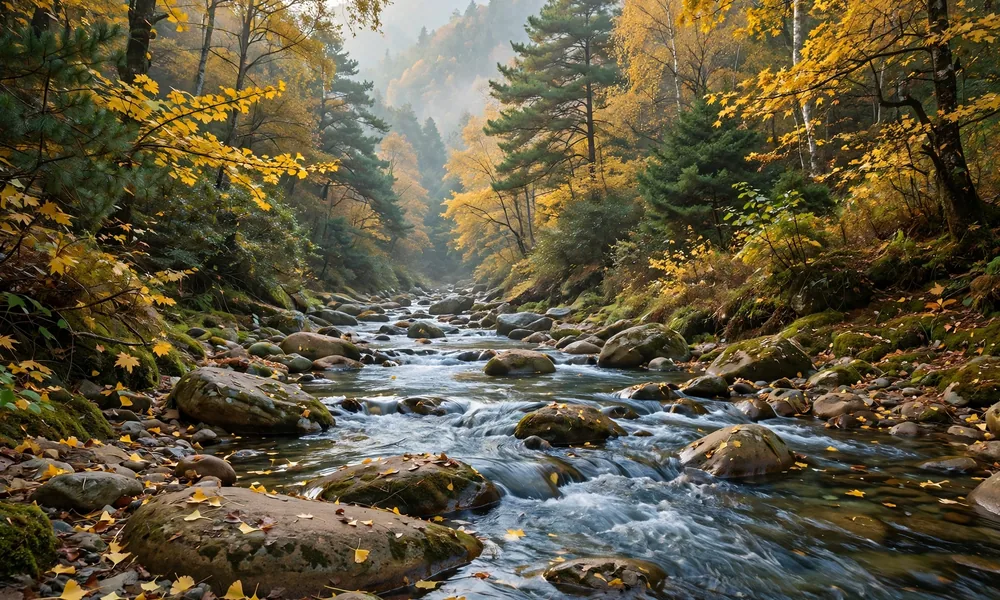
The best hours are the night, when the salamanders are out hunting in the pools and the torchlight can find them on the stream bed. From about dusk until midnight, the animals are at their most active, moving slowly through the shallow water, and they are at their easiest to see then, if you move gently and keep your light low. A slow walk along a mountain stream with a red torch, watching for a great mottled shape on the stones, is all you need, and the salamander will often hold still long enough to see the broad head and the wrinkled skin clearly, if you keep your distance and stay quiet.
Staying safe around Chinese giant salamanders
A Chinese giant salamander is not dangerous to people, and there is no safety warning that belongs to the animal itself. It has no venom, it does not bite unless it is picked up, and it will not chase or threaten a swimmer, because it lives in a mountain stream and it will never meet one. The safety rules for watching giant salamanders are the rules of the river and the hills: watch the water, watch the weather, and respect the animal that you came to see. Never wade in a fast stream alone, never handle a salamander with dry hands, and never keep one out of the water longer than you must, because an animal that breathes through its skin will dry out and die quickly in air.
There are a few practical points for the water itself. Work with a buddy, stay within your depth, and keep an eye on the weather, which can change fast in the mountains and turn a clear stream into a flood in an hour. Wear sturdy boots with a good grip on wet rock, and keep clear of deep pools and slippery boulders. A giant salamander will not hurt you, but the river can, and the sensible approach is to enjoy the animal and respect the cold water it lives in.
Chinese giant salamander watching checklist
A little preparation turns a night beside a mountain stream into a real chance of seeing a giant salamander at its best, lying on the stones with its broad head in the torchlight.
- A mountain stream in central China in late summer, when the breeding season is under way and the animals are at their most active.
- A night walk, when the salamanders are out hunting in the pools and the torchlight can find them on the stream bed.
- Cold, clear, fast-flowing water over boulders, where the salamander can breathe through its skin and find its food.
- A red torch, so you can see the animal without blinding it or driving it back under its rock.
- Sturdy boots with a good grip, so that wet rock and a fast current stay safe from start to finish.
- A buddy and a charged phone, so that a night in the hills stays safe if the weather turns.
- Respect for the animal and the river, keeping your distance, keeping the salamander in the water, and leaving the stream as you found it.
Frequently asked questions
How big do Chinese giant salamanders get?
Most Chinese giant salamanders measure about 1.3 metres from snout to tail, and a good adult weighs 25 to 30 kilograms. The largest animals on record reach 1.8 metres and 50 kilograms, and the longest recently documented animal, kept at a farm in Zhangjiajie, measured 1.8 metres in 2007.
What do Chinese giant salamanders eat?
A Chinese giant salamander eats fish, crabs, frogs, worms, snails, insects and crayfish, which it takes in the dark with a sudden sucking snap of its wide mouth. The everyday food is fish, and a salamander that has fed well may not need to eat again for days or even weeks. Young salamanders eat smaller prey, and they grow slowly on that thin food, taking five or six years to reach the size of an adult.
Why do Chinese giant salamanders have wrinkled skin?
Chinese giant salamanders have wrinkled skin for a simple reason, and it is about breathing in the water. The loose folds along the sides of the body are rich in blood vessels, and they give the skin a huge surface area for taking oxygen straight out of the water, which is how the adult breathes, since it has no working gills. The folds also help the animal blend in with the stones of the riverbed, and they let it slip through narrow gaps between boulders.
Are Chinese giant salamanders dangerous?
No, Chinese giant salamanders are not dangerous to people. They have no venom, they do not bite unless they are picked up, and they will not chase or threaten a swimmer, because they live in mountain streams and they will never meet one. Their whole defence is built on being hard to see, hard to find and hard to catch, and their first response to a threat is to freeze and hide under the nearest boulder. The safety rules for watching them are the rules of the river itself: watch the water, watch the weather, and wear sturdy boots on wet rock.
Can you keep a Chinese giant salamander as a pet?
You should not, and in most places you cannot, because the Chinese giant salamander is a protected species and it needs cold, clean, fast-flowing water, live fish to eat, and a tank bigger than most rooms. It is also impossible to keep one without a specialist licence and a great deal of space, and a salamander that outgrows its tank must never be released into waters where it does not belong. A giant salamander belongs in a mountain stream, not in a living room.
How is this guide different from the cane toad guide?
This guide covers the Chinese giant salamander, a fully aquatic river giant of up to 1.8 metres that breathes through its wrinkled skin, hunts fish at night in the mountain streams of China and is Critically Endangered, while our cane toad guide covers a land-living toad of up to 24 centimetres that hops across the dry ground of Central and South America, eats insects and small animals, and has spread across Australia as an introduced pest. One is a shy, water-bound giant you may never see in the wild; the other is a bold, warty toad you can hardly avoid where it has been introduced.
Conclusion
The Chinese giant salamander species is a reminder that an animal does not need to be fast or fierce to be unforgettable. A broad flat head, tiny lidless eyes, loose wrinkled skin that breathes for it, and a body longer than a person is tall have made the Chinese giant salamander the most famous amphibian on Earth, at home in the cold, clear mountain streams of central China for more than 170 million years.
If you go looking for one, go to a mountain stream in late summer, go at night, and walk slowly along the bank with a red torch and a quiet step. Find the cold, clear water, watch for a great mottled shape on the stones, and wait for it to move, and you will have met the giant salamander that turns a dark, empty stretch of river into a place of sudden, ancient wonder.