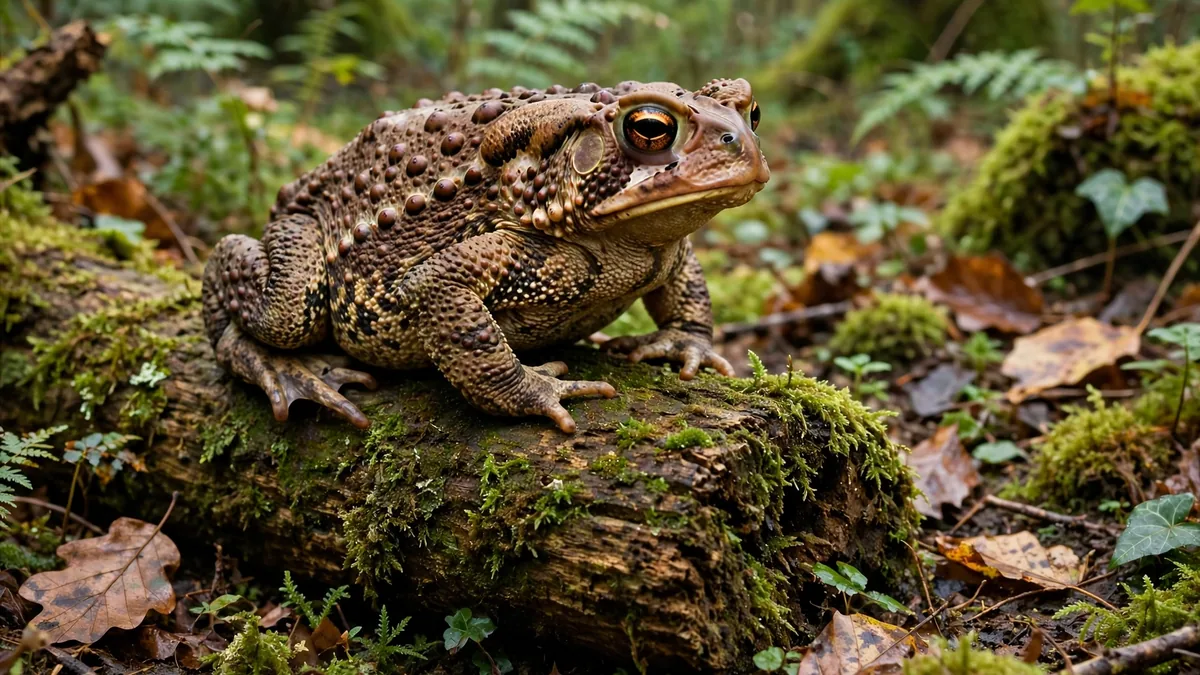
The common toad species is Europe’s largest and heaviest amphibian, a warty, copper-eyed animal that spends its nights hunting slugs and beetles in gardens and woodland, and its springs breeding in the pond where it was born. If you are asking what a common toad is, the short answer is a true toad of the genus Bufo, Bufo bufo, a dry-skinned, short-legged creature that walks and hops rather than leaps, grows to about 18 centimetres long, and carries poison glands behind its eyes that make it taste so foul that most predators leave it alone. It is one of the most familiar wild animals in Britain and Europe, and it is also one of the most overlooked, a creature that can live in the same garden for a decade without ever being seen.
Most people meet a common toad by accident, on a damp evening in spring, when the animals are on the move to their breeding ponds and crossing roads in their hundreds. The toad is not a pretty animal by most measures, and it does not try to be, but it is a useful one, eating the slugs and insects that gardeners curse, and it is a long-lived one, with wild animals reaching ten to twelve years and captive animals living for fifty. This guide follows the whole animal: how it looks, where it lives, what it eats, how it breeds, and why the journey to its pond has become the most dangerous part of its life.
Key takeaways
- The common toad species is Bufo bufo, also called the European toad, the largest and heaviest amphibian in Britain, with females growing to about 18 centimetres long.
- It lives across most of Europe, north-west Africa and western Asia, but it is absent from Ireland, Iceland and some Mediterranean islands, and it favours damp woodland, gardens and farmland.
- It is a nocturnal hunter that eats insects, slugs, worms and spiders, catching them with a flick of its long sticky tongue, and larger toads sometimes take slow worms, small grass snakes and harvest mice.
- It defends itself with bufotoxin, a foul-tasting poison secreted from the large parotoid glands behind its eyes, and by inflating its body and raising its hindquarters to look bigger.
- It is listed as Least Concern, but it is declining in parts of Europe, and thousands of toads are killed on roads every spring on their way to their breeding ponds.
The common toad species and their relatives
The common toad belongs to the family Bufonidae, the true toads, a large family of warty, short-legged amphibians found on every continent except Australia and Antarctica. The family holds hundreds of species, all of them built on the same plan: dry, warty skin, short hind legs, a broad head with a wide mouth, and a pair of poison glands behind the eyes. The common toad is the type species of the whole family, which means it is the animal against which all the other true toads are measured, and it is also the type species of its genus, Bufo. The family sits in the order Anura, alongside the frogs, and it is one of the great families of the amphibians, with species in almost every land habitat on Earth.
The genus is Bufo, a name that has held the true toads since the eighteenth century, though many of the species once placed in it have since been moved to other genera. The lead species of this guide, the common toad, Bufo bufo, was first described by Carl Linnaeus in 1758, and it is the toad that defines the whole genus in most people’s minds. It lives across most of Europe, north-west Africa and western Asia, and it grows to 18 centimetres at most, though most adults are far smaller. A typical adult is 10 to 15 centimetres long, and a good female in the south of the range, where the animals grow largest, will be longer than that.
| Type | Animal | Where it lives | Best-known food | Length or Weight |
|---|---|---|---|---|
| Family | True toads (Bufonidae) | Europe, Asia, Africa and the Americas | Insects, slugs and worms | Up to 24 cm long |
| Genus | True toads (Bufo) | Europe and Asia | Insects, slugs and worms | Up to 18 cm long |
| Species | Common toad (Bufo bufo) | Europe and western Asia | Insects, slugs and worms | Up to 18 cm long |
| Species | Natterjack toad (Epidalea calamita) | Sandy heaths of western Europe | Insects and spiders | Up to 8 cm long |
| Species | European green toad (Bufotes viridis) | Steppes and towns of mainland Europe | Insects and spiders | Up to 10 cm long |
| Species | Cane toad (Rhinella marina) | Central and South America, introduced to Australia | Insects and small animals | Up to 24 cm long |
The closest relative of the common toad in size and fame is the natterjack toad, Epidalea calamita, a toad of the sandy heaths and dunes of western Europe that grows to 8 centimetres. It is smaller than the common toad, and it is easy to tell apart, with a yellow stripe down the middle of its back, parallel parotoid glands, and a habit of running rather than hopping, because its hind legs are about the same length as its forelegs. The natterjack is a noisy animal, and the male’s call, a loud rasping croak, can be heard a kilometre away on a still night.
Within the family, the toads sort themselves by the ground they live on and the size they reach. The European green toad, Bufotes viridis, is a toad of the steppes and towns of mainland Europe that grows to 10 centimetres, a slimmer, longer-legged animal than the common toad, with green blotches on a pale back and a talent for surviving droughts and heat that the common toad does not share. The cane toad, Rhinella marina, is the largest toad in the family, a great animal of Central and South America that grows to 24 centimetres, and it has been introduced to Australia and the Caribbean, where it has become one of the world’s most famous pests. Like the frog, the common toad is an amphibian that begins its life as a tadpole in the water, but the frog is a smooth-skinned, long-legged animal that leaps and lives close to the water, while the common toad is a dry-skinned, short-legged animal that walks and lives most of its life on dry land.
What a common toad looks like
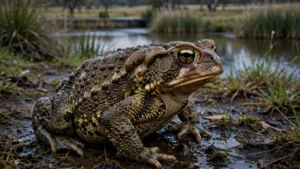
A common toad looks like an animal that was built for the ground, and in a sense it is. The body is broad and squat, with a wide head, short legs and a back covered in warts, and it is coloured in browns, olives and greys, sometimes with a reddish tinge, a pattern that changes with the soil it lives on. The skin is dry to the touch, unlike a frog’s, and it is thick and tough, which helps the animal keep its water in on dry land. The belly is a dirty white, spotted with grey and black, and the whole animal looks as if it had been made out of the leaf litter it lives in.
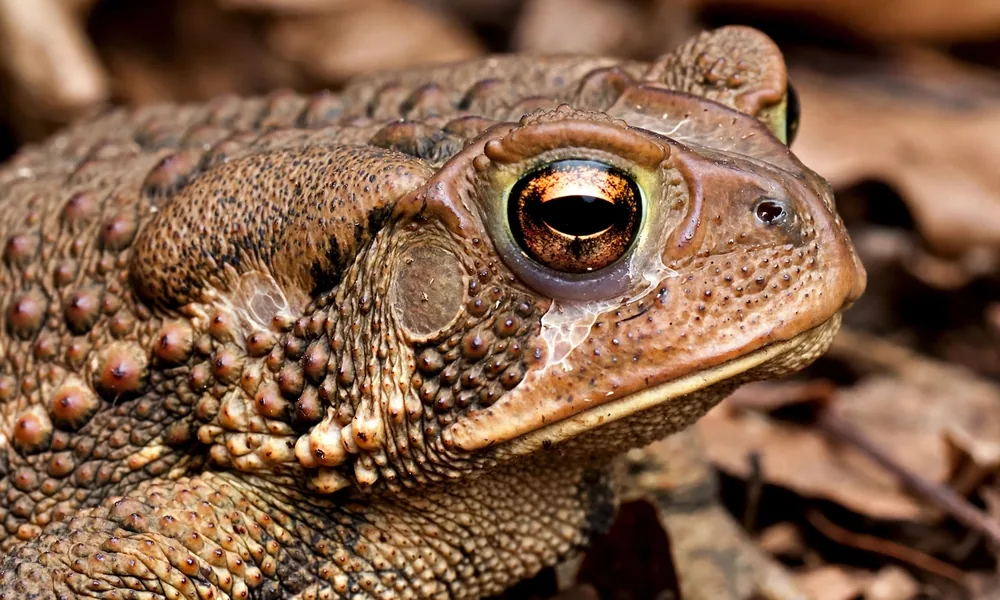
The head is the most distinctive part of the animal, and it is built for a life spent hunting on the ground. The eyes are large and bulging, with yellow or copper-coloured irises and horizontal slit-shaped pupils, and they sit high on the head, where they can watch for movement while the rest of the animal stays low. The mouth is wide, with no teeth, and the tongue is long and sticky, and it can be flicked out in a fraction of a second to catch an insect and pull it back in. Just behind each eye sits a parotoid gland, a bulging, kidney-shaped gland that runs at an oblique angle, and it is the toad’s main weapon, full of a foul-tasting poison called bufotoxin.

The skin is the animal’s real armour, and it is the reason the toad looks the way it does. The warts are not warts at all, but glands, and each one can secrete a little of the same foul substance that the parotoid glands hold, so that the whole animal tastes bad to anything that tries to eat it. The toad sheds its skin regularly, and it often eats the skin it has shed, which is a neat way of getting back the nutrients in it. The colour of the toad varies with the colour of the soil, and a toad on grey soil will be grey, while a toad on brown soil will be brown, which is why the same species can look so different from one garden to the next.
The size of a common toad depends on its sex and its place, and the range is wide, because the females grow much larger than the males. A typical adult is 10 to 15 centimetres long, and a good female can reach 18 centimetres, while the males are usually smaller, at 8 to 10 centimetres, and slimmer. The young leave the pond at about 1.5 centimetres long, and they reach maturity at three to seven years of age, which is slow for an animal of this size.
Compared with other toads, the common toad is easy to tell apart once you know what to look for. No other European toad is as large or as heavily built, and no other combines a broad head, oblique parotoid glands and a habit of walking rather than hopping. The natterjack toad is the animal most often confused with it in a photograph, and the two can be separated by the yellow stripe down the natterjack’s back, by the parallel glands behind its eyes, and by the size, since the natterjack rarely grows beyond 8 centimetres. The common frog is the animal most often confused with the toad by people who do not know the difference, and it has smooth, moist skin, long hind legs and a pointed snout, so the two are easy to separate once you have seen them side by side.
Where common toads live
Common toads live across most of Europe, from Britain and Ireland’s near neighbour across the Channel to the far east of Russia, and south into north-west Africa and west into Asia, and they are animals of damp, shady ground. Their range covers almost the whole of mainland Britain, mainly England, Scotland and Wales, but they are absent from Ireland, Iceland and some Mediterranean islands, including Corsica, Sardinia, Crete and the Balearic Islands, and they are scarce in the far north of Scandinavia. They are one of the most widely spread amphibians in the world.
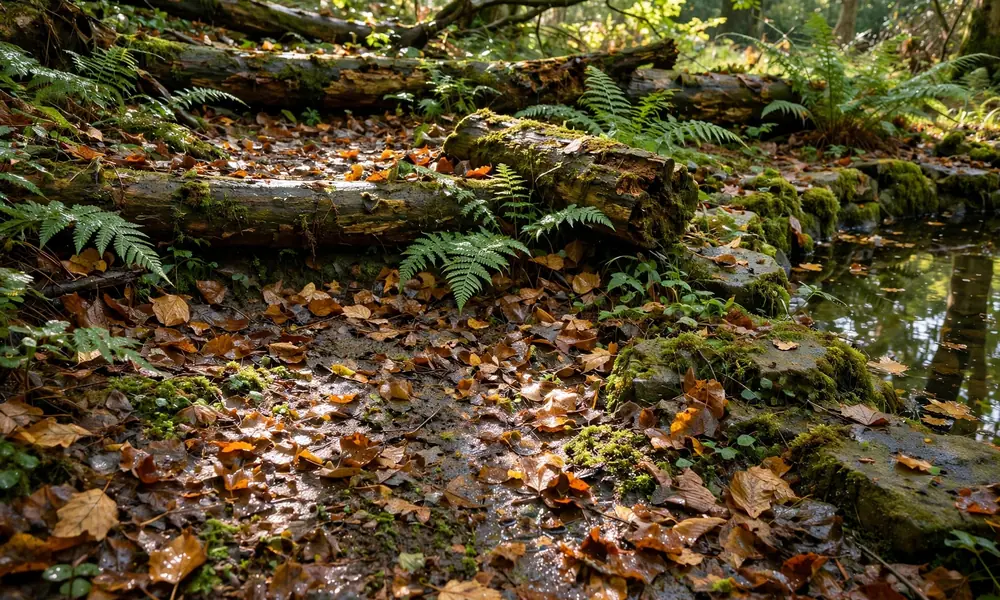
The habitat they choose is the damp ground itself, and they are rarely found far from cover. Most common toads spend the day hidden under a log, a stone or a pile of leaves, in a burrow of their own digging, or in a cool, dark corner of a garden shed, and they come out at night to hunt in the grass and the leaf litter nearby. They favour woodland, scrub, gardens, parks and farmland, and they are happy in places that frogs would find too dry, because their thick skin loses water slowly. A toad is a creature of habit, and it will often return to the same shelter night after night, in the same place at the same time, for years.
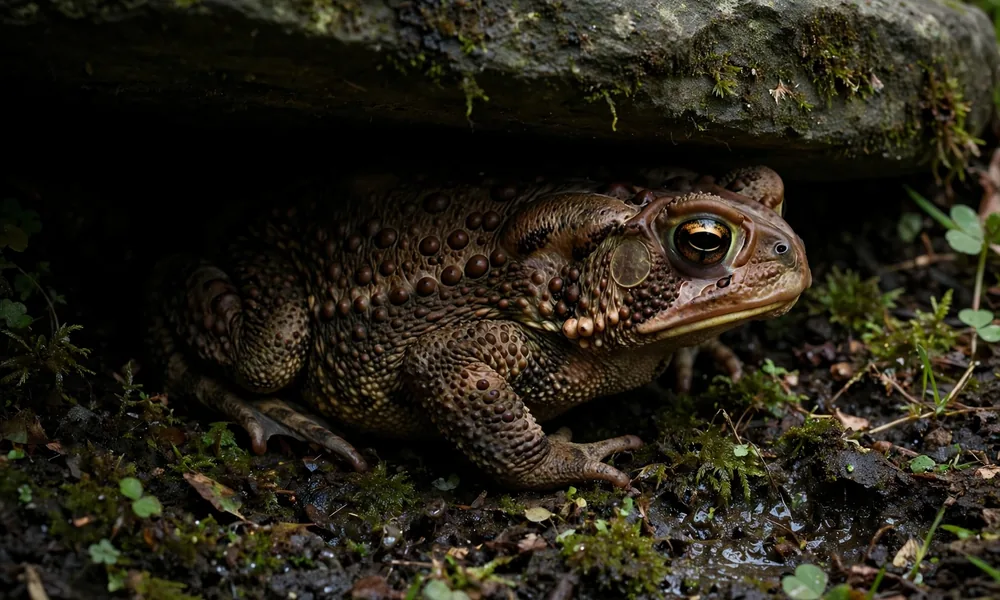
The toad’s life is split between the land and the water, and the balance changes with the season. For most of the year the toad lives on dry land, away from the pond, hunting in the grass and sleeping under cover, and it only returns to the water in spring, to breed. In winter it hibernates, usually from October onwards, under a deep layer of leaf litter, in a log pile, in a burrow or in a drainpipe, and sometimes in the mud at the bottom of a pond. The animals are faithful to their home ground, and a toad that has lived in a garden for years will know every log and stone in it.
What common toads eat
Common toads are hunters, and their diet is written on the garden itself. The everyday food is invertebrates, and a common toad will eat almost any small animal it can fit in its mouth, from beetles and flies to caterpillars and woodlice. They also eat slugs, earthworms, spiders and larvae, which they catch with a flick of their long, sticky tongue, and a toad that has fed well may not need to eat again for a day or two. They are a welcome visitor to any garden, because they eat the slugs and insects that damage plants, and a single toad can clear a vegetable bed of slugs in a night.

What sets the common toad apart is how it hunts. It does not chase its prey, and it does not hunt in a pack. It sits almost motionless in the grass, often in the same spot night after night, and it waits for something to move within reach. When a beetle or a slug comes close, the toad flicks its tongue out in a fraction of a second, and the prey sticks to it and is pulled back into the mouth, and the whole strike is over before the prey has time to turn. Like the axolotl, the common toad is an amphibian that eats other animals for a living, but the axolotl is a small, soft-bodied animal of a few Mexican lakes that snaps at tiny water creatures, while the common toad is a land hunter that sits in the grass and lets the slugs come to it.
Feeding follows the rhythm of the day and the night, and it is busiest after dark and in wet weather. Common toads feed most actively at night, when they leave their shelters and move slowly through the grass, and they rest in the day, holding under a log or a stone where the air is damp. Larger toads will also take bigger prey, and a big female has been known to eat slow worms, small grass snakes and harvest mice, swallowing them alive. A toad that has taken a large meal may not feed again for days, and that is the whole point of the wide mouth and the slow, patient way of life.
How common toads behave
Common toads are night animals, and their day is a quiet round of hiding, waiting and hunting in the dark. They spend the daylight hours tucked away under a log or a stone, saving water and energy, and they come out at dusk to hunt in the grass, and they spend the night moving slowly through the garden, never rushing, never chasing far. They are not strong jumpers, and they do not need to be: their life is lived within a few dozen metres of ground, up and down the garden, and the whole patch is their hunting ground. When a larger animal passes, a common toad will often freeze and sink into the leaf litter, and if that fails it will puff itself up and wait.
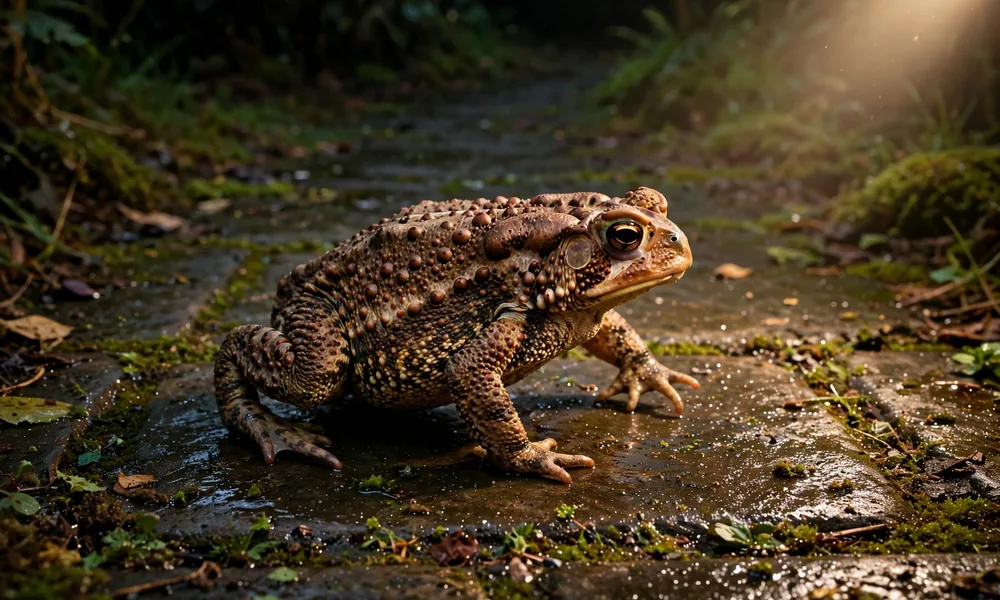
The most famous behaviour in the common toad is its defence, and it is a good one. When a toad is threatened, it lowers its head, raises its hindquarters, and inflates its body with air, which makes it look much larger than it is and much harder to swallow. At the same time it releases bufotoxin from its parotoid glands, a foul-tasting poison that is enough to deter most predators, though grass snakes and hedgehogs are immune to it. The toad also has a trick that surprises people who pick it up: it can make a low, croaking call, and it will often empty its bladder, which is a neat way of telling a predator to put it down.
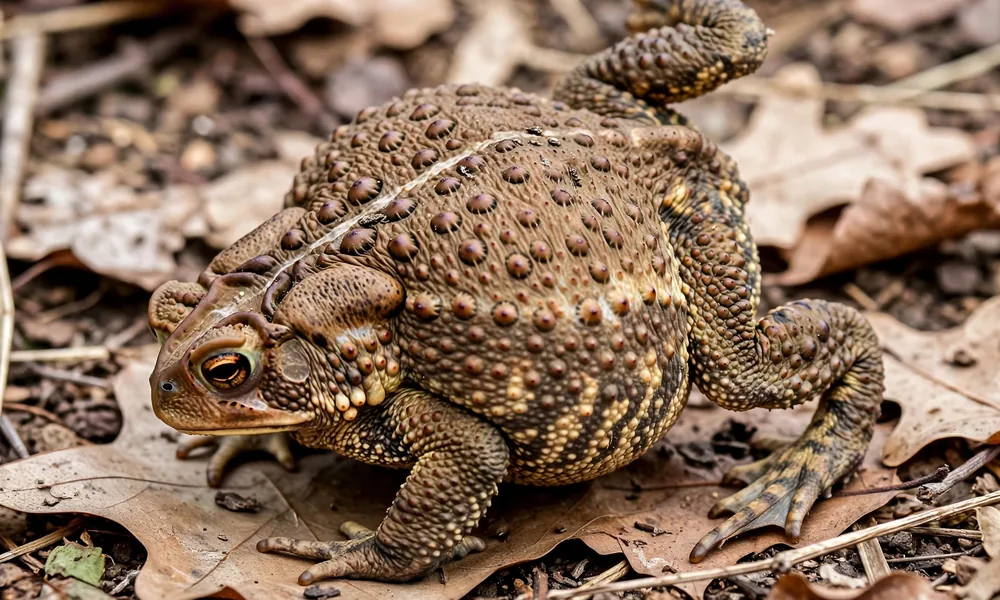
When a common toad is threatened, its first response is to freeze and hide, relying on its brown skin and its stillness to vanish against the leaf litter, and if that fails it will inflate itself and wait for the predator to lose interest. Common toads have no venom that matters to a person, though the bufotoxin in their skin can irritate the eyes and the mouth, and a dog that picks one up will soon drop it, drooling and shaking its head.
Breeding and life cycle
Common toads breed once a year, and the timing is set by the coming of spring. The breeding season begins when the toads come out of hibernation, usually in March or April in Britain, and the animals make their way to the pond where they were born, sometimes travelling a kilometre or more to get there. The adults are widely spread through the countryside, and finding a mate in the dark is a real problem, which is why the males gather at the pond first and wait there, calling softly, and the females arrive later, often with a male already clinging to their back.
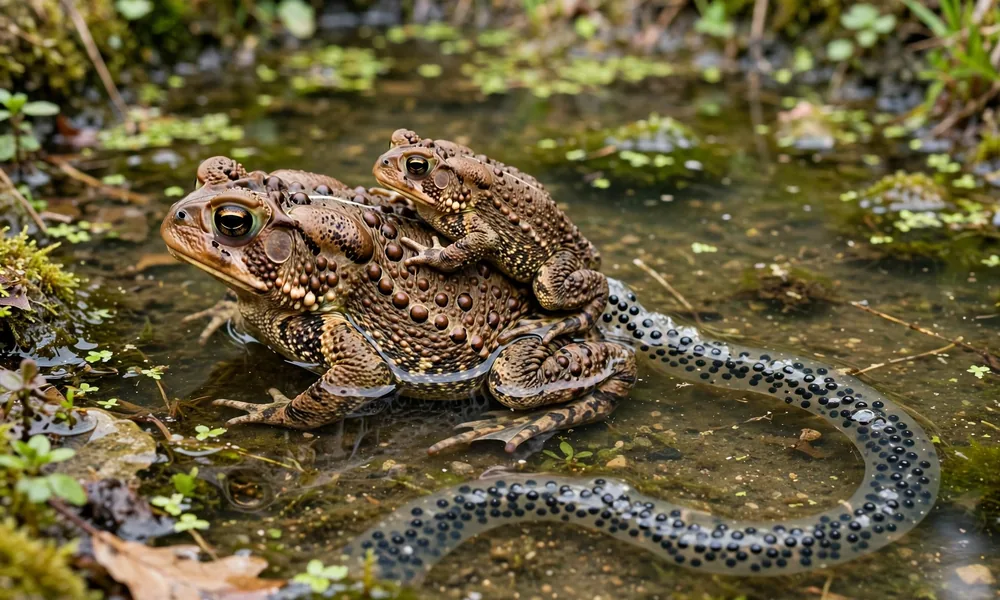
The female lays her eggs in the pond, in long double strings of 3,000 to 6,000 small black eggs, and the male fertilises them as they are laid, releasing his sperm over the egg strings. The strings are 3 to 4.5 metres long, and they get tangled in the stems of water plants as the pair wander through the shallows, with the male clinging to the female’s back in amplexus, sometimes for several days. The eggs hatch after two to three weeks, and the small black tadpoles cling to the remains of the egg strings at first, feeding on the jelly, before they swim free and begin to eat algae and tiny water creatures.
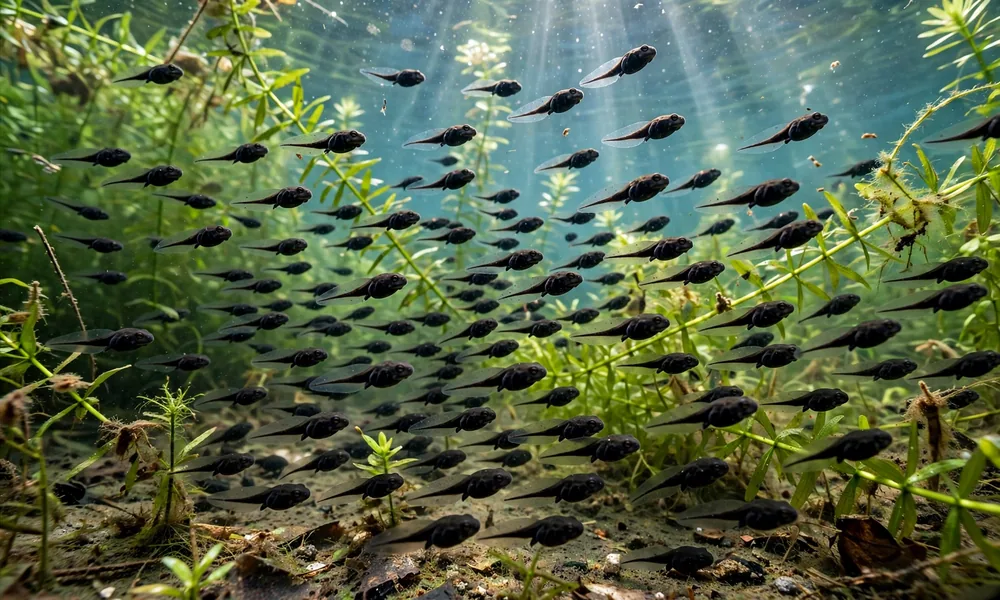
Growth is slow and little understood, and a young common toad can take a long time to become an adult. The tadpoles grow legs over about twelve weeks, and they leave the pond as tiny toadlets, about 1.5 centimetres long, in the middle of summer. The young are independent from the day they leave the water, able to feed and hide within hours, but most of them will never reach adulthood, eaten by birds, fish and other predators in their first weeks. Maturity comes at three to seven years of age, and the animals then keep growing slowly for the rest of their lives. How long a common toad lives is not known for certain, but wild animals live for ten to twelve years, and captive animals have lived for fifty.
Conservation status
The common toad is listed as Least Concern by the International Union for Conservation of Nature, and the reasoning is straightforward: it has a huge range, it is found across most of Europe, and it is not especially threatened by habitat loss, because it can live in gardens, parks and farmland as well as in wild woodland. That broad picture hides a more uncertain local one, because the toad is tied to the fate of the ponds it breeds in and the roads it must cross to reach them. An animal that returns to the same pond every spring cannot breed where the pond has been filled in, and a toad that must cross a busy road to get there may not live to lay its eggs.

The main pressure is the road. Every spring, thousands of toads are killed on the roads as they make their way to their breeding ponds, and in Britain alone the toll is measured in tonnes of toads every year. The animals cross at night, when the traffic is lighter but still deadly, and they move slowly, which makes them easy to hit. Tunnels under the road are an effective way of cutting the toll, and toad patrols, where volunteers carry the animals across in buckets, save thousands more every spring. Habitat loss is a second pressure, and a garden that loses its log pile or its pond loses its toads soon after.
Best seasons for common toad watching
The best time to look for a common toad is the spring, when the breeding migration is under way and the animals are on the move in their hundreds, though no season will show you one from the road. Common toads are present in the garden all year round, so there is no wrong season in the strict sense, but a visit to a breeding pond in March or April, when the males are calling and the females are laying their eggs, is the time when the animals are most likely to be found. In the winter the animals are in hibernation, holding deep under leaf litter and log piles, and they are hardest to find then.

The best hours are the night, when the toads are out hunting in the grass and the torchlight can find them on the garden path. From about dusk until midnight, the animals are at their most active, moving slowly through the damp grass, and they are at their easiest to see then, if you move gently and keep your light low. A slow walk around a garden with a torch, watching for a squat brown shape on the path, is all you need, and the toad will often hold still long enough to see the copper eye and the warty skin clearly, if you keep your distance and stay quiet.
Staying safe around common toads
A common toad is not dangerous to people, and there is no safety warning that belongs to the animal itself. It has no venom, it does not bite, and it will not chase or threaten a walker, because it lives in a garden and it will never meet one. The safety rules for watching common toads are the rules of the garden and the road: watch the traffic, watch where you put your feet, and respect the animal that you came to see. Never pick a toad up with dry hands, never handle one and then touch your eyes or your mouth, and never keep one out of its shelter longer than you must, because an animal that loses water through its skin will dry out quickly.
There are a few practical points for the pond itself. Work with a buddy, stay on the bank, and keep an eye on children and dogs near the water, which can be deeper than it looks. Wash your hands after handling a toad, and keep dogs from picking them up, because the bufotoxin will make a dog drool and shake its head, and a small dog can be made quite ill. A common toad will not hurt you, but the road can, and the sensible approach is to enjoy the animal and respect the damp ground it lives on.
Common toad watching checklist
A little preparation turns a night in the garden into a real chance of seeing a common toad at its best, sitting on the path with its copper eye in the torchlight.
- A garden or woodland pond in spring, when the breeding migration is under way and the toads are on the move.
- A night walk, when the toads are out hunting in the grass and the torchlight can find them on the path.
- Damp ground with logs, stones and leaf litter, where the toad can hide by day and hunt by night.
- A torch with a red filter, so you can see the animal without blinding it or driving it back under its log.
- Sturdy shoes with a good grip, so that wet grass and a muddy bank stay safe from start to finish.
- A buddy and a charged phone, so that a night in the garden stays safe if the weather turns.
- Respect for the animal and the garden, keeping your distance, keeping the toad in its shelter, and leaving the pond as you found it.
Frequently asked questions
How big do common toads get?
Most common toads measure 10 to 15 centimetres from snout to tail, and a good female can reach 18 centimetres, while the males are usually smaller, at 8 to 10 centimetres. The females are browner and the males are greyer, and the toads of the south grow larger than the toads of the north. The young leave the pond at about 1.5 centimetres long and reach maturity at three to seven years of age, so no common toad is ever a big animal, whatever its warts may suggest.
What do common toads eat?
A common toad eats insects, slugs, earthworms, spiders, beetles, flies, caterpillars and woodlice, which it takes in the dark with a flick of its long sticky tongue. The everyday food is the slug and the beetle, and a toad that has fed well may not need to eat again for a day or two. Larger toads will also take slow worms, small grass snakes and harvest mice, swallowing them alive.
Why do common toads have warts?
Common toads have warts for a simple reason, and it is about defence. The warts are glands, and each one can secrete a little of the same foul substance that the parotoid glands behind the eyes hold, so that the whole animal tastes bad to anything that tries to eat it. The warts also help the toad blend in with the leaf litter, and they are part of the thick, dry skin that lets the toad live on dry land, where a frog would dry out.
Are common toads dangerous?
No, common toads are not dangerous to people. They have no venom, they do not bite, and they will not chase or threaten a walker, because they live in gardens and woodland and they will never meet one. Their whole defence is built on being hard to see, hard to swallow and foul to taste, and their first response to a threat is to freeze and hide in the leaf litter. The safety rules for watching them are the rules of the garden itself: wash your hands after handling one, keep dogs away, and watch the traffic on the road.
Can you keep a common toad as a pet?
You can, but only with care, and most people should not try. A common toad needs a damp, shady enclosure with logs and leaf litter, it needs live insects and slugs to eat, and it can live for decades, so it is a long commitment. It is also illegal to take one from the wild in some places without a licence, and a toad that outgrows its enclosure must never be released into waters where it does not belong. A common toad belongs in a garden, not in a living room.
How is this guide different from the Chinese giant salamander guide?
This guide covers the common toad, a land-living toad of up to 18 centimetres that walks the gardens and woodland of Europe, hunts slugs at night with a flick of its tongue and breeds in a pond each spring, while our Chinese giant salamander guide covers a fully aquatic river giant of up to 1.8 metres that breathes through its wrinkled skin, hunts fish in the mountain streams of China and is Critically Endangered. One is a familiar garden animal you can meet on a damp evening; the other is a shy, water-bound giant you may never see in the wild.
Conclusion
The common toad species is a reminder that an animal does not need to be rare or beautiful to be unforgettable. A broad squat body, copper eyes, dry warty skin and a pair of poison glands behind the ears have made the common toad the most familiar amphibian in Europe, at home in the gardens and woodland of the continent for thousands of years.
If you go looking for one, go to a garden pond in spring, go at night, and walk slowly along the path with a torch and a quiet step. Find the damp ground, watch for a squat brown shape on the leaves, and wait for it to move, and you will have met the common toad that turns a dark, ordinary stretch of garden into a place of sudden, quiet wonder.