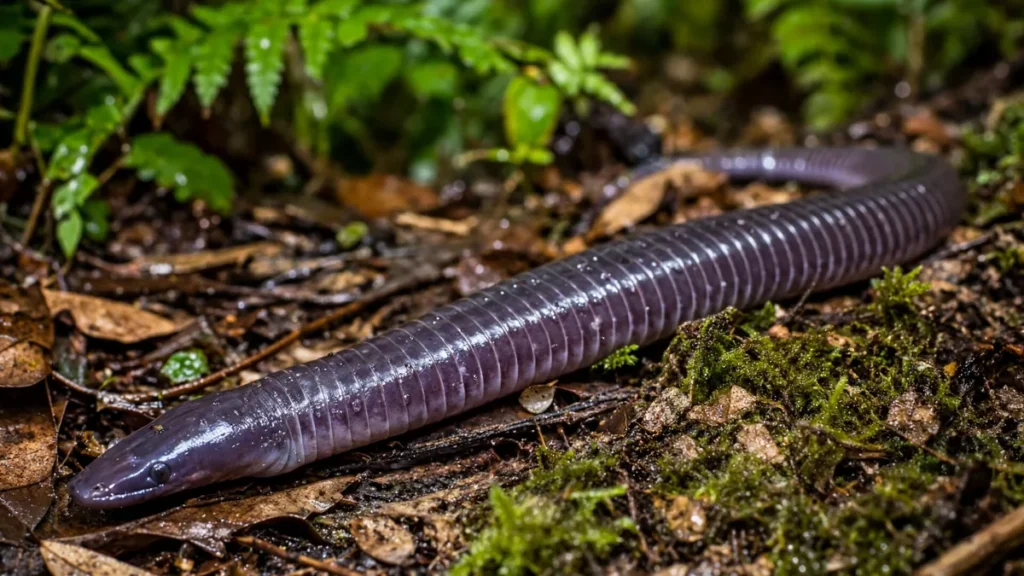
The caecilian species are the limbless burrowing amphibians of the tropics, worm-shaped animals that spend almost their whole lives hidden in damp soil or in streambeds, and they are some of the least familiar amphibians on Earth. If you are asking what a caecilian is, the short answer is a member of the order Gymnophiona, a group of more than 220 living species in 10 families that live in the tropics of Central and South America, Africa and southern Asia, with no legs at all, tiny eyes that are often covered by skin, and a pair of sensory tentacles on the head that they use to smell and feel their way through the dark. They are not worms, and they are not snakes, though they look like both at first glance, and they are amphibians in the same broad family as frogs and salamanders, with moist skin, a life tied to water and damp ground, and a breeding biology that is unlike anything else in the amphibian world.
Most people never meet a caecilian at all, and that is the whole point of the animal. It lives where we do not look, a few centimetres under the leaf litter of a tropical forest or in the loose soil of a plantation, and it comes to the surface only on damp nights, often after light rain, when the ground is soft and the worms it hunts are close to the surface. The lead species of this guide is the Mexican burrowing caecilian, Dermophis mexicanus, a grey-purple burrower of Mexico and Central America that grows to 30 to 50 centimetres and gives birth to live young after a gestation of about 11 months, and this guide follows it and its relatives through how they look, where they live, what they eat, how they behave, and why so many of them are still so poorly known.
Key takeaways
- The caecilian species belong to the order Gymnophiona, one of the three living amphibian orders, with more than 220 living species in 10 families.
- The Mexican burrowing caecilian, Dermophis mexicanus, is the lead species of this guide, and adults grow to about 30 cm to 50 cm long.
- Caecilians are limbless, with tiny skin-covered eyes and a pair of chemosensory tentacles between the eyes and the nostrils that they use to find food underground.
- Most caecilians are burrowers of damp tropical soil, but the aquatic typhlonectids live in rivers and marshes, and the largest caecilian, Caecilia thompsoni, reaches 1.5 metres.
- The Mexican burrowing caecilian is listed as Least Concern, yet many caecilians are threatened by habitat loss, and some, like the Taita African caecilian, are Endangered.
The caecilian species and their relatives
Caecilians belong to the order Gymnophiona, one of the three living orders of amphibians, alongside the frogs and toads of the order Anura and the salamanders of the order Urodela, and the name comes from the Latin word caecus, meaning blind, a nod to the tiny eyes that are often covered by skin and can do little more than tell light from dark. The order holds more than 220 living species in 10 families, all sharing the same basic plan: a long, limbless body, a bullet-shaped head for pushing through soil, skin marked with ring-like grooves called annuli, and a pair of sensory tentacles on the head. National Geographic’s profile of caecilians gives the same broad picture, a limbless burrowing amphibian of the tropics, and this guide builds on that picture with the detail of how the animal actually lives. The family as a whole spans about 20 cm to 50 cm long, with most of its members burrowing in moist tropical soil, though a few giants stretch far beyond that range.
The Mexican burrowing caecilian, Dermophis mexicanus, is the lead species of this guide, and a good ambassador for the whole order. It is a member of the family Dermophiidae, living in Mexico, Guatemala, El Salvador, Honduras and Nicaragua, mostly on the Atlantic side but also in some isolated parts of the Pacific slope, burrowing under leaf litter and plant debris in damp, loose soil, often in banana and coffee plantations. It grows to a total length of 30 to 50 centimetres, and in general appearance it resembles a large earthworm, with around a hundred annular folds in the skin, a pointed snout, and two vestigial eyes covered with skin, with a pair of protrusible tentacles between the eyes and the nostrils. The genus Dermophis spans about 30 cm to 50 cm long, and the Mexican burrowing caecilian sits squarely in the middle of that range, a mid-sized burrower that is common enough to be studied and strange enough to stand for the whole order.
| Type | Animal | Where it lives | Best-known food | Length or Weight |
|---|---|---|---|---|
| Family | Caecilians (Dermophiidae) | Moist tropical soils of Central and South America and Africa | Earthworms, termites and other soil invertebrates | About 20 cm to 50 cm long |
| Genus | Burrowing caecilians (Dermophis) | Mexico and Central America | Earthworms, termites and other soil invertebrates | About 30 cm to 50 cm long |
| Species | Mexican burrowing caecilian (Dermophis mexicanus) | Mexico and Central America | Earthworms, termites, crickets, slugs and snails | About 30 cm to 50 cm long |
| Species | Taita African caecilian (Boulengerula taitana) | Taita Hills of Kenya | Termites, earthworms and dipteran larvae | About 24 cm to 42 cm long |
| Species | Rio Cauca caecilian (Typhlonectes natans) | Rivers of Colombia and Venezuela | Fishes, eels and aquatic invertebrates | About 45 cm to 55 cm long |
| Species | Ceylon caecilian (Ichthyophis glutinosus) | Sri Lanka | Earthworms and other soil invertebrates | About 23 cm to 40 cm long |
The closest relatives of the Mexican burrowing caecilian are the other members of its genus, including the Oaxacan caecilian of south-western Mexico, a blue-black burrower of much the same size and habits. Beyond the genus, the African branch is best known through the Taita African caecilian, Boulengerula taitana, a species endemic to the Taita Hills of south-eastern Kenya that is about 24 cm to 42 cm long, with males reaching 42 centimetres and females a little shorter. Like the frog in our general guide, the caecilian is an amphibian that lives its life tied to damp ground and fresh water, but most frogs are animals of the surface, with long legs for jumping and big eyes for hunting by sight, while the caecilian is an animal of the soil, with no legs at all and eyes that barely work, and it is the tentacle, not the eye, that finds its food.
Within the order, the species sort themselves by the ground and the water they live in. The Mexican burrowing caecilian is the terrestrial burrower of Mexico and Central America. The Taita African caecilian is the African burrower, living a couple of centimetres under the soil beneath rotting logs in the forests and farmlands of the Taita Hills, at altitudes between about 1,230 and 1,859 metres. The Rio Cauca caecilian, Typhlonectes natans, is the aquatic one, a dark grey-black animal of the rivers and marshes of Colombia and Venezuela that grows to about 45 cm to 55 cm long and is almost helpless out of water, sold in the aquarium trade under the misleading name of rubber eel, though it is no eel at all. The Ceylon caecilian, Ichthyophis glutinosus, is the Asian burrower, endemic to south-western and central Sri Lanka, growing to about 23 cm to 40 cm long, with a yellow stripe along each side and a mother that coils around her eggs until they hatch into larvae about 7 to 11 centimetres long.
What a caecilian looks like
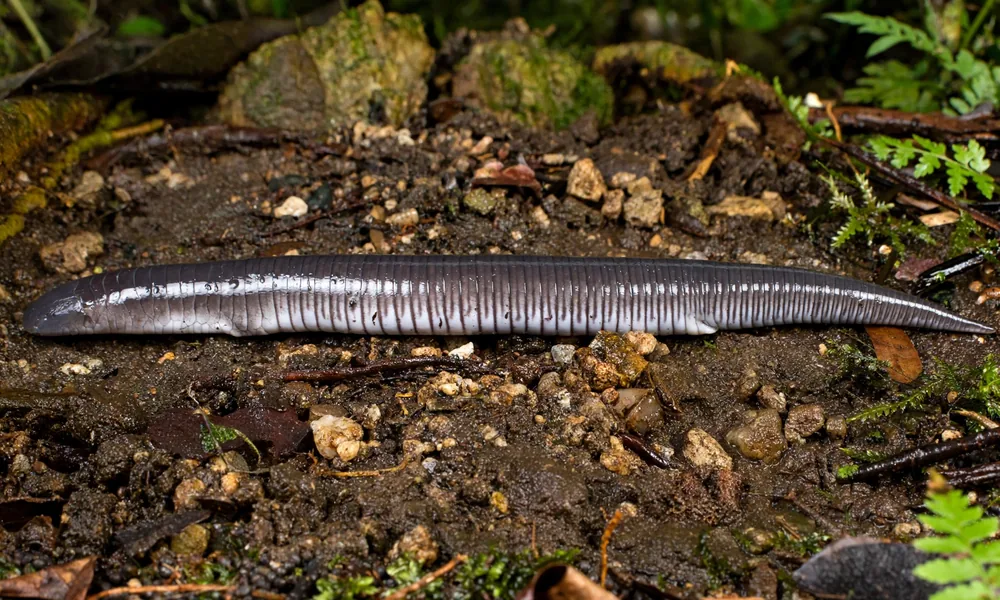
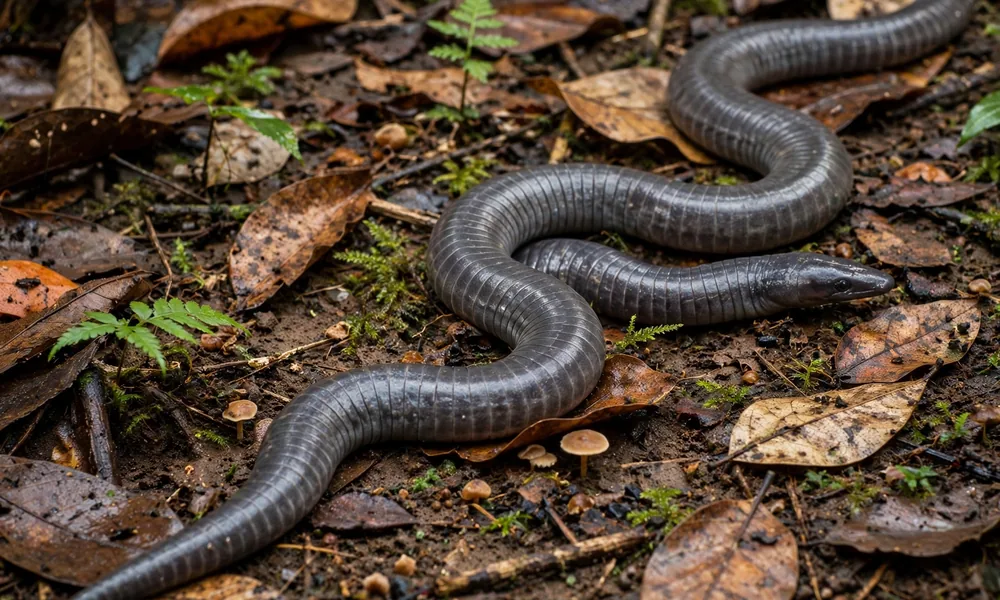
A caecilian looks like a worm that has been built to a much grander scale, and once you have seen one you will never mistake it for a snake, though plenty of people do at first glance. The body is long and cylindrical, smooth and slimy, marked all along its length by ring-like grooves called annuli, which divide the skin into segments and give the animal its earthworm look, and in some species there are small scales hidden underneath the skin, a reminder that the caecilian is a vertebrate with a backbone, not a soft-bodied worm at all. The colour is usually dark and plain, grey, brown, purple-grey or black above and paler below, and the Mexican burrowing caecilian is dark grey on the back with a pale belly, a colour scheme that disappears into damp soil in an instant.
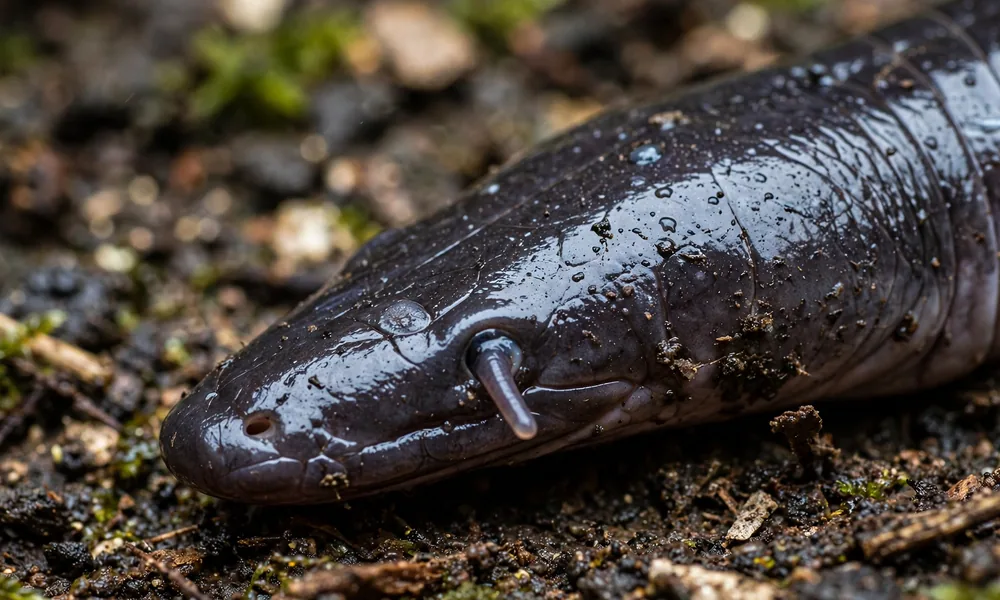
The head is the most distinctive part of the animal, and it is built for a life underground. It is pointed and bullet-shaped, with a heavily boned skull and skin that sticks tight to the bone, so that the whole head works like a chisel, pushing through the soil while the body follows behind in waves. The mouth is small and set underneath the snout, and it holds rows of sharp, recurved teeth that grip an earthworm while the animal swallows it whole. The eyes are tiny and vestigial, covered by a layer of skin, and in some species they are hidden altogether beneath the bones of the skull, so that the animal can probably do no more than tell light from dark.
What sets the caecilian apart is the tentacle, a feature that no worm and no snake possesses. Between the eye and the nostril on each side of the head sits a short, protrusible tentacle, a chemosensory organ that the animal can push out and draw back in, carrying chemical signals from the soil to the vomeronasal organ in the roof of the mouth. The tentacle is how a caecilian smells its way through the dark, finding an earthworm without ever seeing it. The body has no legs, no trace of a limb girdle in most species, and no tail to speak of, with the cloaca sitting near the very end of the body.
The size of a caecilian depends on the species, and the range is wide. Most species are less than 30 centimetres long, but the Mexican burrowing caecilian grows to about 30 cm to 50 cm long, and the largest known caecilian, Caecilia thompsoni of Colombia, reaches 1.5 metres, a snake-sized animal that is still, in every important way, an amphibian. Like the axolotl, the caecilian is an amphibian that keeps a secretive, almost alien look into adult life, but the axolotl is an aquatic salamander with feathery external gills and four small legs, while the caecilian has no legs and no external gills at all, and it is the burrow, not the pond, that shapes its whole body.
Where caecilians live
Caecilians live in the tropics, and they are animals of damp ground and warm water. Their range runs through Central and South America, Africa and southern Asia, and they are found in Indonesia, Sri Lanka, the Philippines and the Seychelles, wherever the soil stays moist and warm through the year. They favour loose, rich ground under leaf litter and rotting logs, and the soft mud at the edge of streams, and they are rarely found in dry ground, where the skin they breathe through would dry out and kill them.

The habitat they choose is the soil itself, and they are rarely found far from it. Most caecilians live a few centimetres under the surface, in burrows they dig themselves, pushing through the ground with the head and anchoring the back end while the front end drives forward, a movement that works like a concertina, squeezing and lengthening the body in waves. They favour places with plenty of cover, which give them both hunting ground and a place to hide from the snakes and birds above, and they are less common in open ground, where there is little to eat and nowhere to hide.
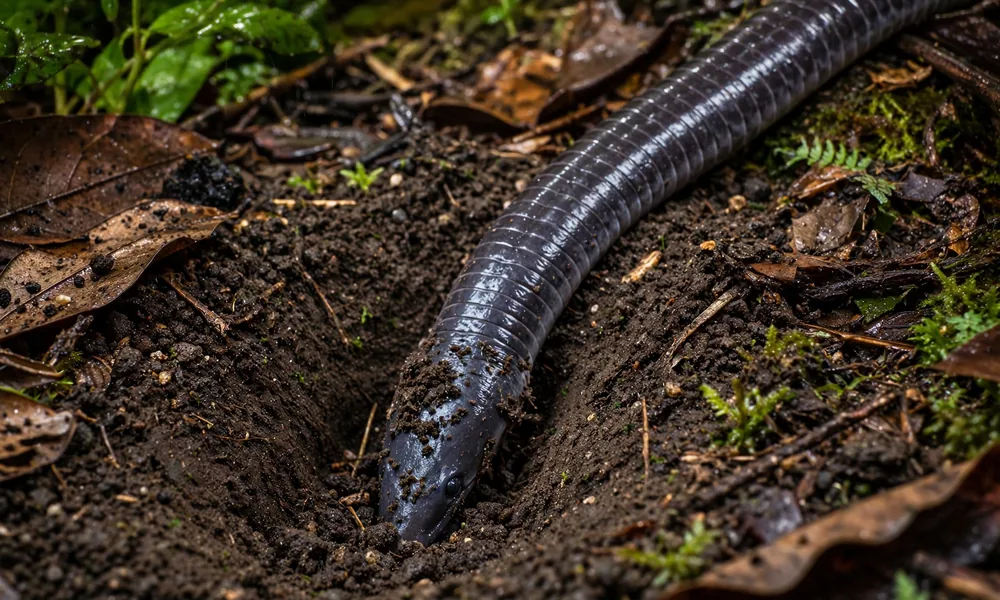
Caecilians are animals of the top few centimetres of soil, and most of them stay within a hand’s breadth of the surface, where the earthworms are thickest and the ground is softest. In the dry season they may go deeper, following the moisture down as the top soil dries, and in the wet season they rise again, sometimes coming right to the surface on damp nights. The Mexican burrowing caecilian lives from sea level to about 1,500 metres, and it has shown some adaptability to secondary habitats such as coffee plantations, though it still needs cover, and a plantation that loses its leaf litter loses its caecilians within a season or two.
What caecilians eat
Caecilians are hunters, and their diet is written on the soil itself. The everyday food is the earthworm, and a caecilian will eat almost any soft-bodied creature it can find in its burrow, from earthworms and termites to crickets, slugs and snails, and a big caecilian will take a small lizard or a baby mouse without a second thought. The Mexican burrowing caecilian preys on invertebrates, including earthworms, termites, crickets, slugs and snails, and it emerges onto the ground surface on nights with light rainfall to catch small prey within its reach.

What sets the caecilian apart is how it hunts. It does not chase its prey across open ground, and it does not hunt in a pack. It is a sit-and-wait predator, lying motionless in its burrow and waiting for a worm to come within reach, and when the moment comes it seizes the prey with its recurved teeth and then spins rapidly around its own long axis inside the burrow, using the shear against the tunnel wall to twist a large earthworm apart into swallowable segments. The aquatic caecilians hunt differently, and the typhlonectids prey on fishes, eels and aquatic invertebrates, swimming in an eel-like fashion through the water.
How caecilians behave
Caecilians are night animals, and their day is a quiet round of burrowing, resting and hunting in the dark. They wake at dusk, leave the deepest part of the burrow where they spent the day, and move through the top soil to feed, spending the night working the ground in a slow, unhurried way. They are not strong movers over distance, and they do not need to be: their life is lived within a few metres of soil. When a snake passes overhead, a caecilian will often lie flat in its burrow and stay still, relying on its dark back to blend into the soil, and if that fails it will push itself deeper and wait.

The most famous behaviour in the caecilian is the way it moves through solid ground. It does not dig with its legs, because it has none. Instead it uses a two-part system of muscles, with the vertebral column acting like a piston inside the outer layer of the body wall, which is closely attached to the skin. By contracting the outer layer of muscles it squeezes the body and generates a strong force that lengthens it, anchoring the back end and forcing the head forwards, then pulling the rest of the body up in waves. In water or very loose mud, caecilians instead swim in an eel-like fashion, and the aquatic typhlonectids have a fleshy fin along the rear of the body that helps them swim.
Breeding and life cycle
Caecilians breed in the wet season, when the soil is soft and the food is plentiful, and the timing is set by the rain rather than the calendar. All caecilians are believed to have internal fertilisation, which is unusual among amphibians, achieved by means of the phallodeum, a copulatory organ in males that is a modified part of the cloacal wall, which the male everts into the female’s cloaca to transfer sperm. A female may mate only once in a season, and she carries the young for a long time afterwards, which is one reason caecilian populations are slow to recover when their numbers fall.

The Mexican burrowing caecilian is viviparous, which means the young develop inside the mother and are born live, and the story of how they feed inside her is one of the strangest in the amphibian world. Up to 16 developing young subsist on the yolks of their eggs for the first three months, and then they develop rasping teeth and feed on maternal glandular secretions, scraping the inside of the oviduct to stimulate their production. When the young emerge, after 11 months of gestation, they are 10 to 15 centimetres long, and they then shed their larval teeth and rapidly grow a set of adult ones. The litter is usually 3 to 16 young, born when the rainy season begins in May or June, and the newborns are already well developed, able to burrow and feed within hours of birth.

Not all caecilians give birth to live young, and the order holds every kind of breeding in between. About half of caecilian species lay eggs that are guarded by the female, which coils around them until they hatch, and the clutches may hold up to 54 eggs. In the families Ichthyophiidae and Rhinatrematidae the eggs are laid in burrows in mud close to water, and upon hatching the larvae leave the burrows for ponds and streams, while in other species the eggs hatch on land as small adults, with no larval stage at all. The Rio Cauca caecilian gives birth to 3 to 7 live, fully developed young, which after only one year reach almost half the size of an adult. A young Mexican burrowing caecilian reaches breeding size in its second or third year, and the lifespan in the wild is about 13 years, though much about most species is still unknown, because so few have ever been followed for a whole lifetime.
Conservation status
The Mexican burrowing caecilian is listed as Least Concern by the International Union for Conservation of Nature, and the reasoning is straightforward: it has a wide range across Mexico and Central America, it lives in a variety of habitats including plantations, and there is no evidence of a rapid decline across that whole range. That broad picture hides a more worrying local one, because the caecilian is tied to the fate of the soil it lives in, and a burrower that lives in the top few centimetres of ground cannot live where that ground has been cleared, compacted or poisoned. A forest that loses its leaf litter loses its caecilians within a season or two.
The main pressure is the loss of habitat. When a tropical forest is cleared for farming or building, or a wetland is drained, the caecilian loses the damp soil where it burrows and the leaf litter where it hunts. People are a second pressure, and a caecilian dug up by a farmer is often killed on sight, because it looks like a snake or a giant worm, and the farmer does not know it is a harmless amphibian that eats the pests in the soil. Pollution is a third pressure, and a soil soaked in pesticide loses the earthworms the caecilian feeds on, and the caecilian with them, because the animal breathes through its skin and takes in whatever is in the ground.
Some caecilians are in far worse shape than the Mexican burrowing caecilian. The Taita African caecilian is listed as Endangered, because it lives only in the Taita Hills of Kenya, where as much as 98 percent of the natural forest has already been lost and only a few square kilometres remain. The Ceylon caecilian is listed as Vulnerable, because it is endemic to Sri Lanka and its wet-zone forests are shrinking, and many other caecilians have never been assessed at all, because they are so rarely seen that nobody knows how many are left. The most useful conservation work is practical: protecting the damp forest and the leaf litter, keeping the soil free of heavy pesticide use, and leaving a caecilian alone when you find one, so it can go back to its burrow and carry on eating the worms.
Best seasons for caecilian watching
The best time to look for a caecilian is the wet season, when the rain has softened the ground and the animals are close to the surface, feeding hard and, in the case of the Mexican burrowing caecilian, giving birth to their young. In Mexico and Central America that usually means the months from about May to October, when the rain falls most days and the soil stays damp, and in Sri Lanka the season runs with the monsoon, from about May to September in the south-west and from October to January in the north-east. Caecilians are present in the soil all year round, so there is no wrong season in the strict sense, but a damp night in the wet season will show you far more animals than a dry day in the dry season, when the caecilians are deep in the ground and out of reach.

The best hours are the dusk and the early night, when the caecilians come to the surface to feed. From about six o’clock until nine in the evening, and again after a shower of rain, the animals are out on the leaf litter, moving slowly between the fallen leaves, and they are at their most approachable then, though approachable means watching from a short distance away, not picking them up. A slow walk through a damp forest with a torch, lifting a rotting log gently and putting it back exactly as you found it, is all you need, and the animals will often lie close enough to see the ringed skin and the tentacles clearly, if you move gently and keep your hands wet.
Staying safe around caecilians
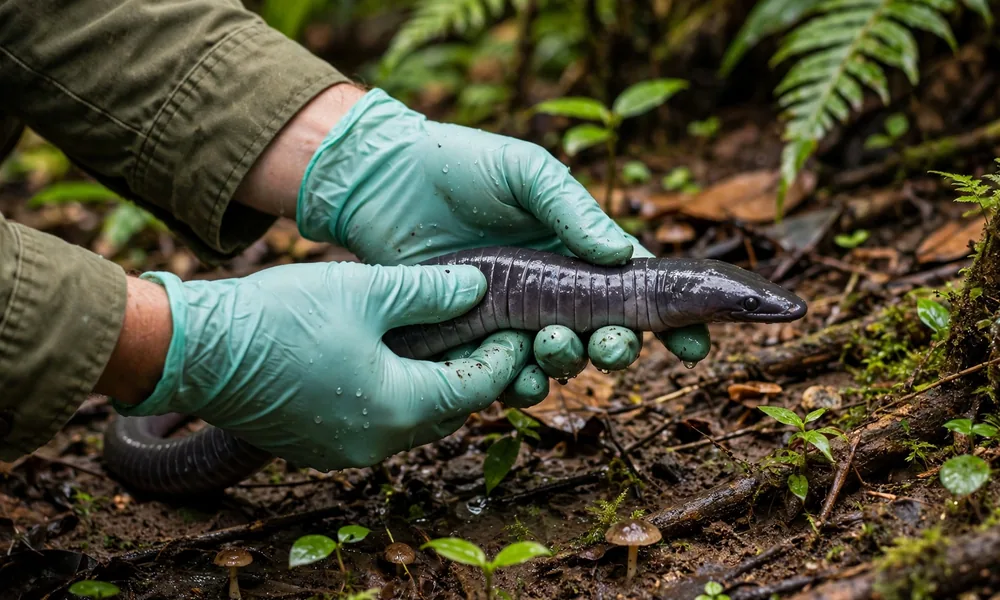
A caecilian is not dangerous to people, and there is no safety warning that belongs to the animal itself. It has no venom, it does not bite in any way that matters, and it will not chase or threaten a person. The safety rules for watching caecilians are the rules of the forest floor: watch where you put your hands, watch the weather, and respect the animal that you came to see. Never dig up a burrow with your bare hands, never lift a rotting log without checking what is underneath it first, and never handle a caecilian with dry hands, because a dry hand strips the slime that protects its skin.
There are a few practical points for the forest itself. Go with a guide who knows the ground, stay on the paths where you can, and keep an eye on the weather, which can change fast in a tropical forest, with rain and mud rising in minutes. Wear gloves when you are lifting logs, and wear shoes that grip, because the forest floor is slippery after rain. If you find a caecilian, look at it where it is, take a photograph if you like, and put the log back exactly as you found it.
Caecilian watching checklist
A little preparation turns a damp evening in the forest into a real chance of seeing caecilians at their best, close to the surface in soft, wet soil.
- A visit in the wet season, when the rain has softened the ground and the caecilians are close to the surface.
- A dusk or early-night walk, when the caecilians come out to feed and the light is good.
- A damp tropical forest with leaf litter, rotting logs and loose, dark soil, where the animals burrow and hunt.
- A slow walk through the leaf litter, lifting a rotting log gently and putting it back exactly as you found it.
- A torch and wet hands, so you can see the animal clearly without stripping the slime that protects its skin.
- A guide who knows the ground, so that a night in the forest stays safe from start to finish.
- Respect for the animal and the soil, keeping your distance, never digging up a burrow, and leaving the forest floor as you found it.
Frequently asked questions
How big do caecilians get?
Most caecilians measure less than 30 centimetres from snout to tail, and many are no longer than a large earthworm. The Mexican burrowing caecilian grows to about 30 cm to 50 cm long, the Rio Cauca caecilian grows to about 45 cm to 55 cm long, and the largest known caecilian, Caecilia thompsoni of Colombia, reaches 1.5 metres, a snake-sized animal that is still, in every important way, an amphibian.
What do caecilians eat?
A caecilian eats earthworms, termites, crickets, slugs, snails and other soft-bodied soil invertebrates, which it takes in its burrow with its recurved teeth. The everyday food is the earthworm, and a big caecilian will take a small lizard or a baby mouse without a second thought. The aquatic caecilians eat fishes, eels and aquatic invertebrates, and young caecilians eat small worms and insect larvae, growing fast on that rich food until they reach adult size within a year or two.
Are caecilians worms or snakes?
Neither, though they look like both at first glance. A caecilian is an amphibian, in the same broad family as frogs and salamanders, with a backbone, moist skin that it breathes through, and a breeding biology that no worm or snake shares. A worm has no backbone and no tentacles, and a snake has scales and a forked tongue, while a caecilian has ringed skin, a bullet-shaped head, tiny skin-covered eyes and a pair of sensory tentacles that it uses to find food underground.
Are caecilians dangerous?
No, caecilians are not dangerous to people. They have no venom, they do not bite in any way that matters, and they will not chase or threaten a person. Their whole defence is built on being hard to find, hard to hold and hard to swallow, and their first response to a threat is to burrow deeper or to secrete a slimy mucus that makes them taste bad. The safety rules for watching them are the rules of the forest floor itself: watch where you put your hands, wear gloves when you lift logs, and handle any animal you find gently, with wet hands.
Can you keep a caecilian in an aquarium?
You can, but it is hard, and most people should not try. A caecilian needs a tank with deep, damp soil or, for the aquatic species, clean, well-oxygenated water, and it eats live earthworms and other invertebrates, which makes it expensive and demanding to keep. It is also illegal to keep one in some places without a permit, and a caecilian that outgrows its tank must never be released into soil where it does not belong. A caecilian belongs in the forest floor, not in a living room.
How is this guide different from the American bullfrog guide?
This guide covers the caecilian, a limbless burrowing amphibian of 30 to 50 centimetres that lives its whole life in damp tropical soil, finds its food with sensory tentacles and gives birth to live young after a gestation of about 11 months, while our American bullfrog guide covers a big, legged frog of up to 20 centimetres that sits at the edge of a pond, hunts by sight and sound, and lays thousands of eggs in the water each spring. One is an animal you find by lifting a rotting log on a damp night; the other is an animal you hear calling from a pond at dusk.
Conclusion
The caecilian species are a reminder that an amphibian does not need legs, or big eyes, or a loud call to be unforgettable. A long, ringed body, a bullet-shaped head, a pair of sensory tentacles and a life spent in the dark of the soil have made the caecilian the most secretive amphibian of the tropics, at home in the leaf litter of Mexico, the forests of Kenya and the wet zone of Sri Lanka alike.
If you go looking for one, go on a damp night in the wet season, go at dusk, and walk slowly through a tropical forest with a torch and wet hands. Find the leaf litter, lift a rotting log gently, and look for a dark, ringed shape moving through the soil, and you will have met the caecilian that turns a quiet forest floor into a place of slow, hidden wonder.