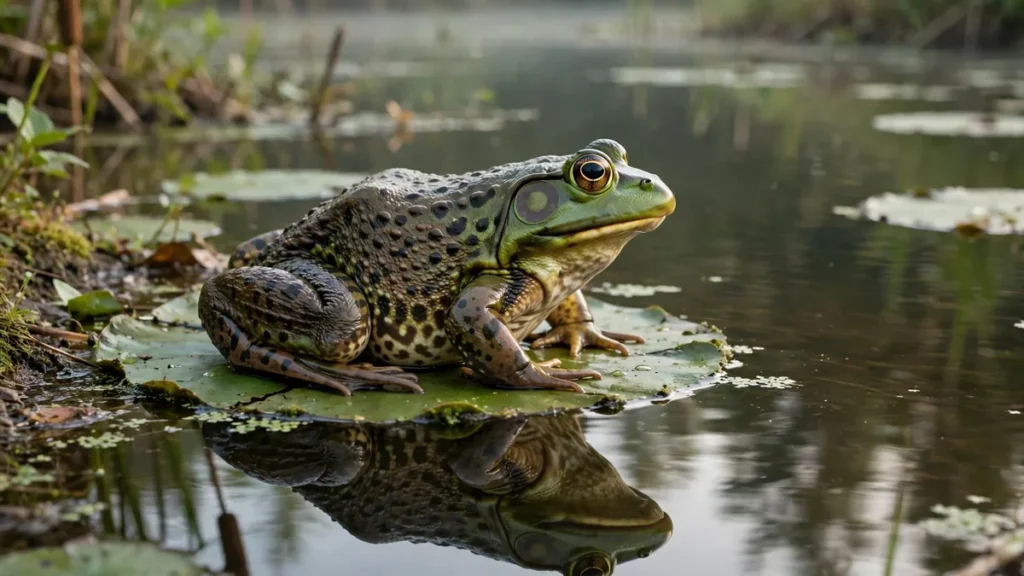
The American bullfrog species is North America’s largest frog, a heavy, green-brown animal with a voice like a bull and an appetite to match, that sits at the edge of a pond and eats almost anything it can fit in its mouth. If you are asking what an American bullfrog is, the short answer is Lithobates catesbeianus, formerly Rana catesbeiana, a true frog that grows to about 20 centimetres and 500 grams, lives in the warm, still water of ponds, lakes and slow rivers, and is known above all for the male’s deep, rolling call, often written as jug-o-rum, that carries across a summer pond for a kilometre or more. It is native to eastern North America, and it has spread far beyond its home, to the western United States, Europe, South America and Asia, where it is one of the most damaging invaders in the frog world.
Most people meet a bullfrog the same way I did, on a warm evening beside a farm pond, when a low, booming call rolled across the water and the whole pond seemed to answer it, and then a pair of eyes and a broad green head rose slowly above the surface at the water’s edge. There was nothing hurried about the animal at all. It sat there in the shallows, perfectly still, waiting for something to come within reach of its tongue, and it stayed there long after the light had gone. That is the heart of this guide: how a single species of frog became the biggest frog on a whole continent, how it lives, hunts and breeds in the warm, still water it calls home, and why a frog that is common and welcome in its own ponds has become a problem everywhere else it has been taken.
Key takeaways
- The American bullfrog species is Lithobates catesbeianus, a member of the true frog family Ranidae, native to eastern North America.
- It is the largest frog in North America, growing to about 20 centimetres and 500 grams, with females larger than males.
- The male’s deep jug-o-rum call can be heard for more than a kilometre, and males defend stretches of shoreline of 3 to 25 metres.
- Bullfrogs eat almost anything they can fit in their mouths, from insects and fish to other frogs, snakes, small birds and even other bullfrogs.
- They are listed as Least Concern, are long-lived for a frog at 7 to 9 years in the wild, and are invasive in the western United States, Europe, South America and Asia.
The American bullfrog species and their relatives
American bullfrogs belong to the family Ranidae, the true frogs, a large family with hundreds of species found on every continent except Antarctica, and every one of them shares the same smooth, moist skin, the same long hind legs built for leaping and swimming, the same webbed hind feet and the same life in and around fresh water. They range in size from small frogs of about 4 centimetres to the American bullfrog itself at about 20 centimetres, so the family as a whole spans about 4 cm to 20 cm long, and the bullfrog sits at the very top of that range as the largest true frog in North America. National Geographic’s profile of the American bullfrog gives the same broad picture, a big, loud, aquatic frog of eastern North America, and this guide builds on that picture with the detail of how the animal actually lives.
The American bullfrog, Lithobates catesbeianus, is the lead species of this guide, and it is a good ambassador for the whole family. It is a heavy-bodied frog with an olive-green to brown back, often with dark spots, a pale belly, a broad, flat head and powerful hind legs, and it is found in ponds, lakes, swamps and slow rivers from Nova Scotia to central Florida, and west across the Great Plains to the Rockies. It grows to about 20 centimetres and 500 grams, with the largest animals reaching 800 grams, and it is the frog that people mean when they talk about the big frog in the pond, an animal with a reputation for appetite that has followed it from the ponds of the eastern United States to the rice fields of Asia. If you have sat beside a warm pond on a summer evening, there is a fair chance the deep call rolling across the water was a bullfrog, or one of its close cousins in the same genus.
| Type | Animal | Where it lives | Best-known food | Length or Weight |
|---|---|---|---|---|
| Family | True frogs (Ranidae) | Fresh water on every continent except Antarctica | Insects, fish and small vertebrates | About 4 cm to 20 cm long |
| Genus | True frogs (Lithobates) | North and Central America | Insects, fish and small vertebrates | About 4 cm to 20 cm long |
| Species | American bullfrog (Lithobates catesbeianus) | Eastern North America | Insects, fish, frogs and birds | Up to 20 cm long |
| Species | Green frog (Lithobates clamitans) | Eastern North America | Insects and small fish | About 5 cm to 11 cm long |
| Species | Northern leopard frog (Lithobates pipiens) | Northern North America | Insects and spiders | About 5 cm to 9 cm long |
| Species | Wood frog (Lithobates sylvaticus) | Forests of northern North America | Insects | About 4 cm to 6 cm long |
The closest relative of the American bullfrog, and the one it is most often confused with, is the green frog, Lithobates clamitans, the common frog of the ponds and streams of eastern North America. Like the bullfrog, the green frog is a member of the genus Lithobates, but it is a smaller frog, about 5 cm to 11 cm long, and it has a pair of ridges, the dorsolateral folds, running down its back that stop before the groin, which the bullfrog lacks entirely. The genus as a whole spans about 4 cm to 20 cm long, and the bullfrog sits at the very top of it, with adults two or three times the length of the smallest members. Like the frog in our general guide, the bullfrog is an amphibian that lives half in the water and half on land, but most frogs are small, quick animals that hop away at the first sign of trouble, while the bullfrog is a large, heavy animal that sits its ground and waits for its food to come to it.
What an American bullfrog looks like
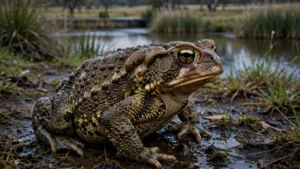
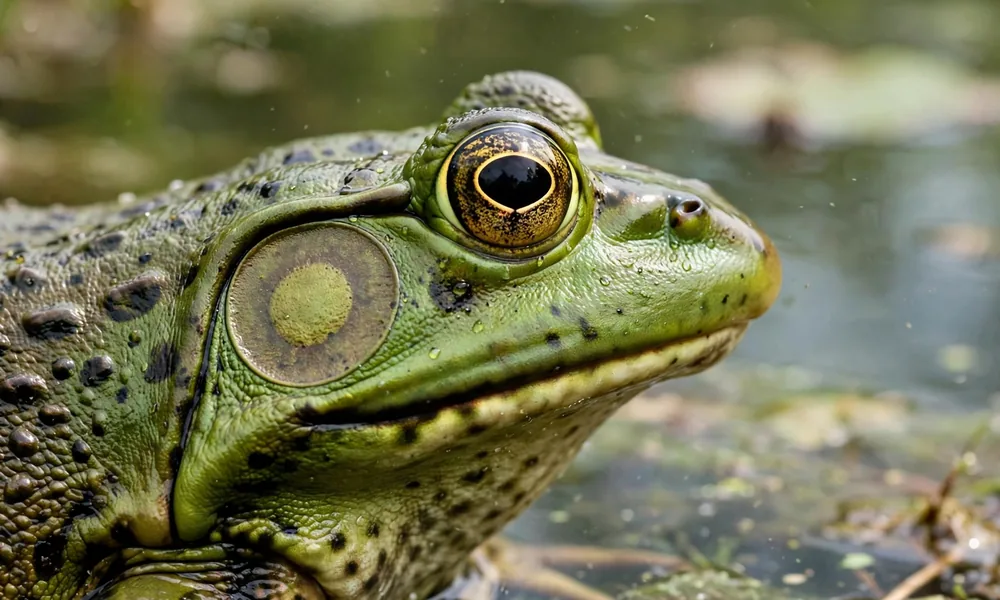
An American bullfrog is a large, heavy-bodied frog, built low and broad like a frog that has decided to live in the water and stay there. Adults commonly measure between 9 and 15 centimetres from snout to vent, and a big animal weighs up to about 500 grams, though a frog of 700 or 800 grams is a fine sight, and the largest reliably measured reached about 20 centimetres. The body is broad and flat, and it is thickest just behind the head, and it tapers to powerful hind legs that make up most of the animal’s weight. The back is olive-green to brown, often with dark spots or blotches, fading to a pale, almost cream belly, and the skin looks smooth and moist, with no warts or rough patches, though the young carry dark spots that fade as they grow.
The head is broad and flat, and the face is the feature that gives the animal its look. It is wide and slightly upturned, with the eyes set high on the head so the frog can sit in the water with only its eyes and nostrils showing, and behind each eye sits the tympanum, the round external eardrum, which in a male is much larger than the eye and in a female is about the same size as the eye. The mouth is wide, and it opens to take in prey as large as a small bird, and the teeth are tiny and useful only for gripping. The hind feet are fully webbed, which makes the frog a strong swimmer, and the front toes are not webbed at all. The fold of skin that runs from behind the eye and around the tympanum is the other giveaway: unlike its cousins, the bullfrog has no dorsolateral folds running down its back, and that smooth back is one of the easiest ways to tell it from a green frog.
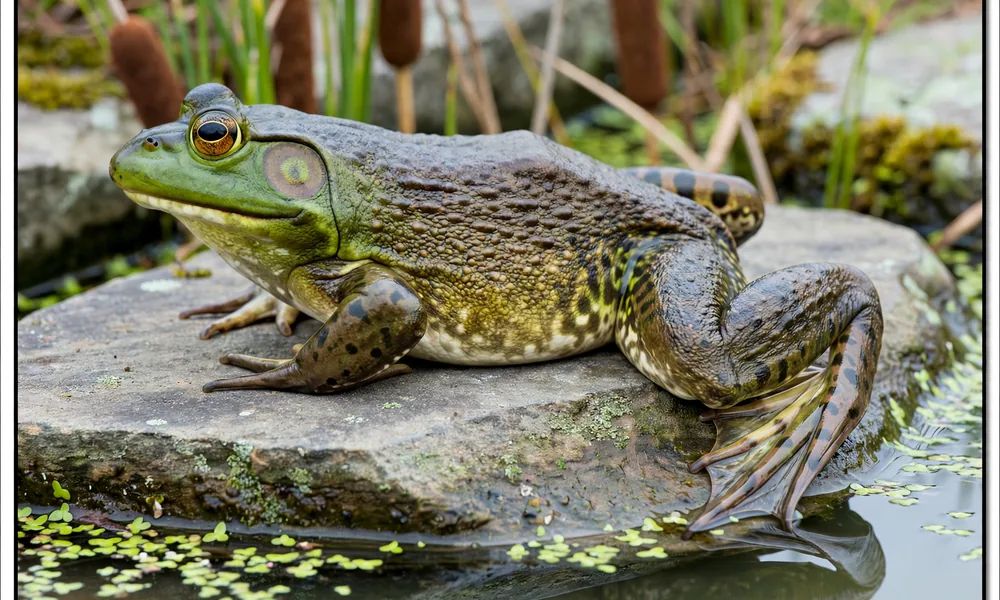
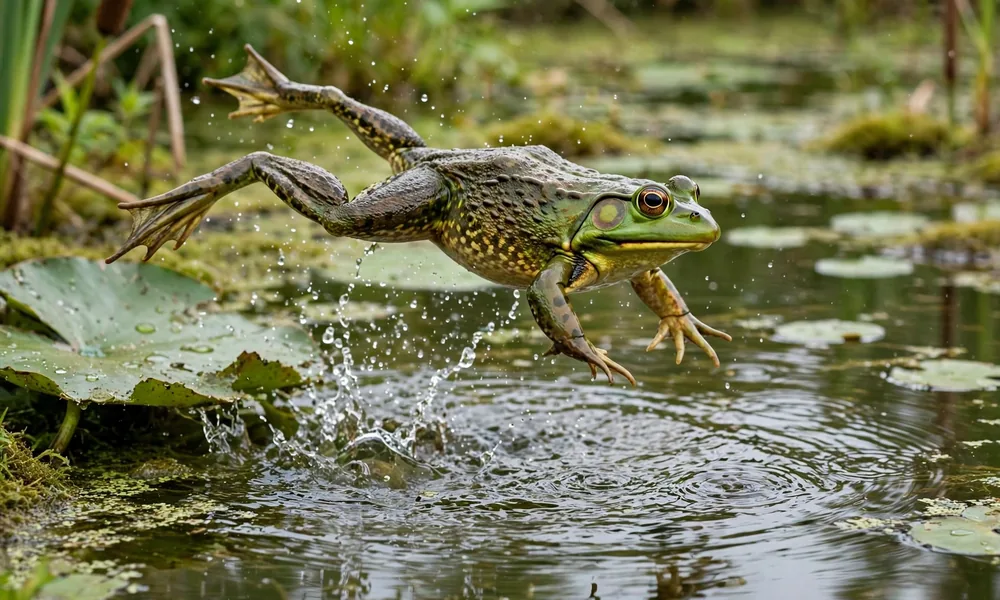
The size of a bullfrog depends on the sex, and the range is wide. Females grow larger than males, and the biggest bullfrogs in any pond are almost always female, heavy with eggs, and the males are smaller but louder, with a larger tympanum and a yellow throat in the breeding season. A bullfrog of 15 centimetres is a fine sight, and a bullfrog of 20 centimetres is a frog the size of a small papaya, heavy in the hand, and it is still the largest frog most people in North America will ever meet. A bullfrog can leap up to about 1.8 metres in a single bound, which is nine times its own body length, and it is a leap that takes it from the bank to the safety of the water in a single flash.
Where American bullfrogs live
American bullfrogs live in the warm, still waters of eastern North America, and they are at home in ponds, lakes, swamps, marshes and slow rivers. Their native range runs from Nova Scotia in the north, south through the eastern United States to central Florida, and west across the Great Plains to the Rockies, with the centre of abundance in the warm, shallow ponds of the south-eastern United States. They favour water that is warm, still and shallow, with plenty of aquatic vegetation, and they are rarely found in fast-flowing water, where other frogs take their place. Wherever there is warm water, a pond and something to eat, there is a good chance a bullfrog is nearby.
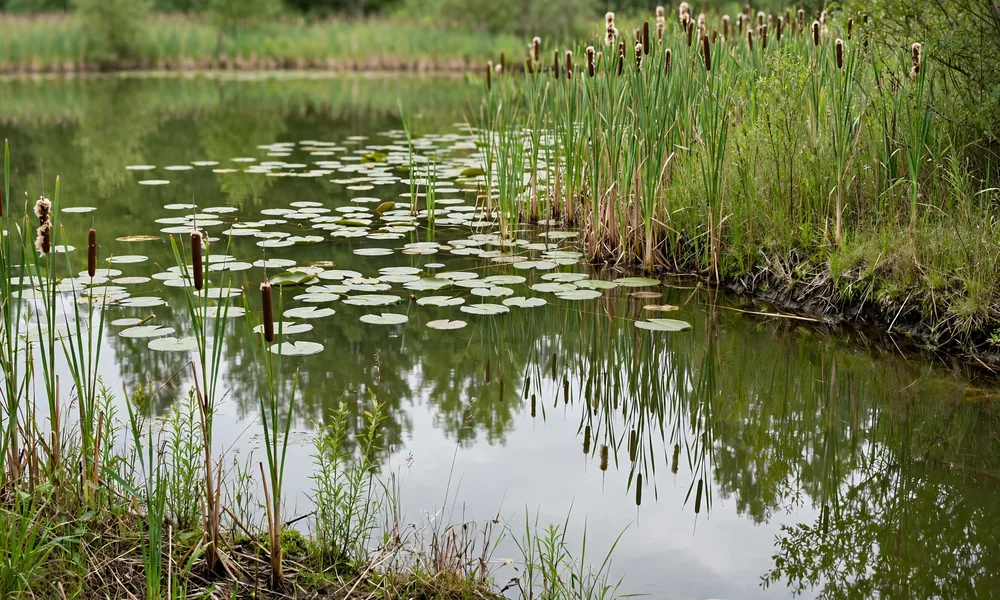
The habitat they choose is the edge of the water, and they are rarely found far from it. Most bullfrogs live in water that is only a metre or two deep, along the pond margins, in the marshes and around the lake shores, where the food is richest and the shelter is thickest. They favour places with plenty of lily pads, reeds and cattails, which give them both a hunting perch and a place to hide from the herons that hunt them from above, and they are less common in open water, where there is little to eat and nowhere to hide. A bullfrog spends much of its life within a small stretch of shoreline, sometimes no larger than a few dozen metres, and it knows every lily pad and every reed bed in that stretch the way you know the rooms of your own house.

The bullfrog has travelled far beyond its native range, and it has done so because people took it there. Bullfrogs were introduced to the western United States in the early 1900s, for frog-leg farming, and they escaped and established themselves in irrigation ditches, stock ponds and slow rivers across California, Oregon, Washington and Arizona. They have also been introduced, by accident or on purpose, into southern Europe, South America, China, Japan and south-east Asia, and in these places they are invasive, eating native frogs and fish that have no defence against them, and spreading disease. In the western United States they are now one of the most damaging invaders in the frog world, and several states list them as prohibited or regulated, because a pond that gains bullfrogs loses its native frogs within a few years.
What American bullfrogs eat
American bullfrogs are hunters, and their diet is written on the pond itself. The everyday food is insects, and a bullfrog will eat almost any insect it can catch, from dragonflies and beetles to grasshoppers and moths, and it will also eat crayfish, worms and other small creatures of the pond. They also eat fish, from minnows to young sunfish, and small frogs, including other bullfrogs, and a big bullfrog will take a snake, a small turtle, a mouse or a duckling without a second thought. A single bullfrog may eat several large meals in a week, and a pond full of bullfrogs can keep the numbers of smaller frogs in check, which is one reason they sit near the top of the food chain in so many ponds.
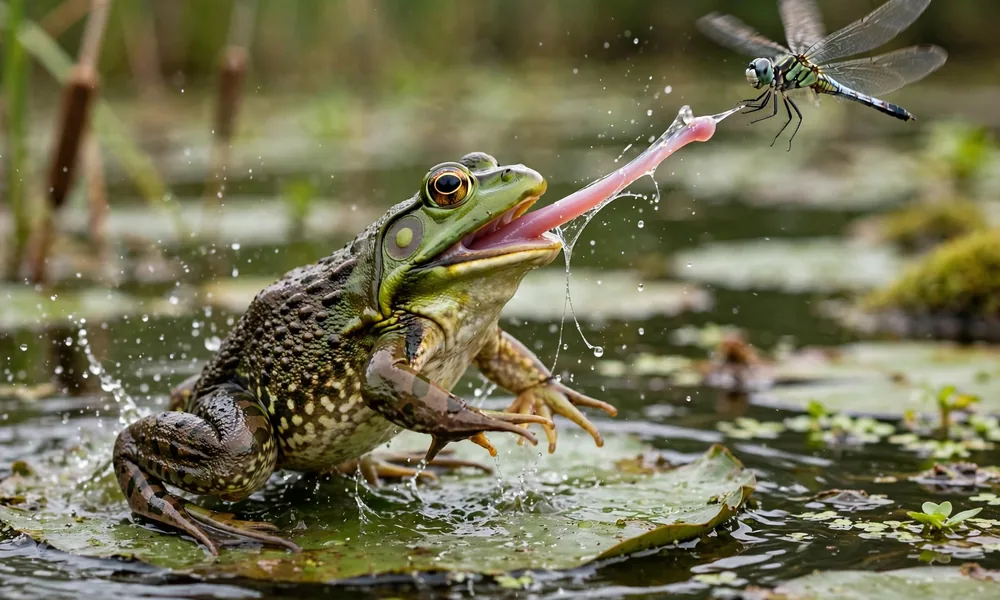
What sets the bullfrog apart is how it hunts. It does not chase its prey across the pond, and it does not hunt in a pack. It sits and waits, perfectly still at the water’s edge, watching for something to come within reach, and when the moment comes it flicks out its long, sticky tongue, grabs the prey and pulls it back into its mouth, and the whole strike takes a fraction of a second. The tongue is attached at the front of the mouth, so it can be flipped out and back in a single motion, and the eyes are pressed down into the head to help push the food down the throat. A bullfrog can even eat prey larger than its own head, because its mouth is so wide, and it will try to swallow anything that moves and fits, which is why ducklings and small birds sometimes end up in a bullfrog’s stomach.
How American bullfrogs behave
American bullfrogs are warm-weather animals, and their day is a quiet round of sitting, waiting and hunting at the pond’s edge. They wake in the morning, leave the mud where they spent the night, and move to a sunny spot at the water’s edge to warm up, and they spend the day sitting in the shallows in a slow, unhurried way, never rushing, never chasing far. They are not strong travellers over land, and they do not need to be: their life is lived within a few dozen metres of pond, and speed matters less than patience and a good hiding place. When a heron passes overhead, a bullfrog will often sink below the surface and stay still, relying on its green back to blend into the pond weed, and if that fails it will dart into the deepest water and wait.

The most famous behaviour in the bullfrog is the call. The male’s call is a low, resonant jug-o-rum, a sound often described as the bellowing of a bull, and it can be heard for more than a kilometre across still water on a warm night. The males call to attract females and to warn other males away from their territory, and each male defends a stretch of shoreline of 3 to 25 metres, wrestling with rivals that come too close, jumping on them and chasing them away. The call is made with the mouth closed, using the large vocal sacs under the throat, and a chorus of bullfrogs on a summer night is one of the loudest sounds in the pond, a rolling, booming chorus that goes on for hours. The females also make a call, a shorter, sharper sound, when they are grabbed by a male they do not want.
Breeding and life cycle
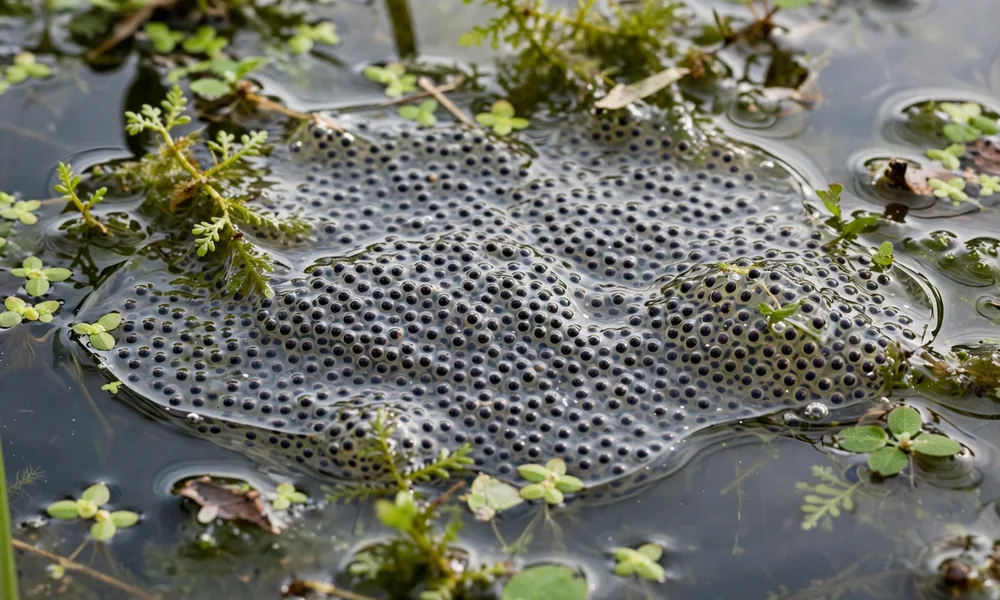
American bullfrogs breed in late spring and summer, when the water is warmest, and the timing is set by the temperature rather than the calendar. The breeding season runs from May to July in the north, and from February to October in the south, and the males gather in the shallow water at the pond’s edge, calling to attract females and defending their stretches of shoreline. A female may mate with more than one male, and she lays her eggs in a floating film on the surface of the water, often among the water plants, where the eggs are fertilised outside her body. A female can lay up to 20,000 eggs in a single clutch, though a typical clutch holds 10,000 to 12,000 eggs, and after the eggs are laid there is no parental care at all: the parents swim away, and the young are on their own from the moment they hatch.
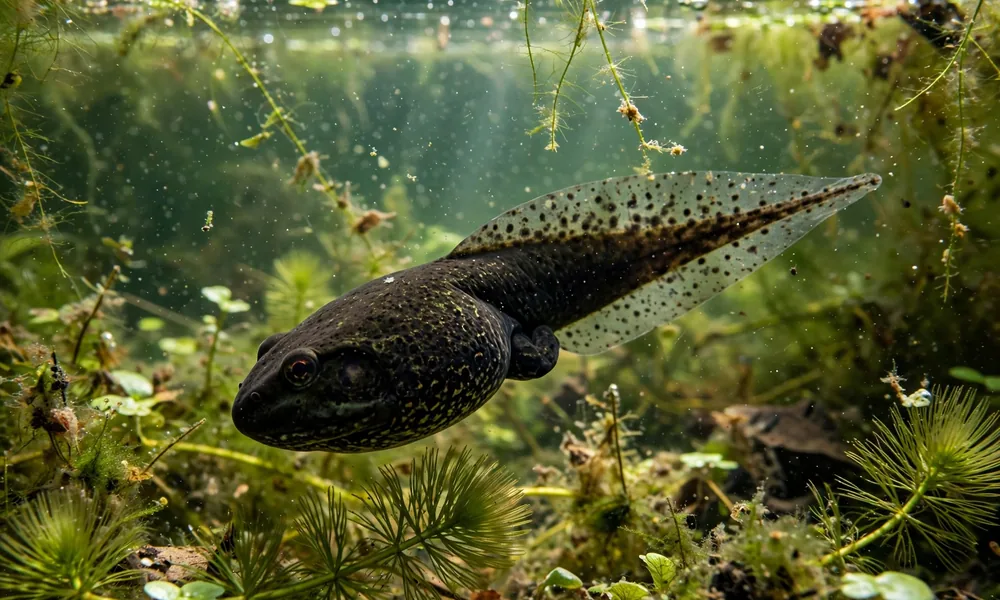
The eggs hatch in about four to five days, and out come spotted tadpoles with gills and a tail, which graze on algae and aquatic plants in the shallow water. The tadpole stage is the longest of any frog in North America: in the warm south it lasts only a few months, in Missouri it takes about 11 to 14 months, including a winter under the ice, and in the cold north it can take one to three years before the change begins. The tadpoles grow large, reaching up to about 15 centimetres long, which is longer than some adult frogs, and they spend their winters in the pond, where the water stays above freezing. The young are on their own from the day they hatch, able to feed and hide within hours, but most of them will never reach adulthood, eaten by fish and birds in their first weeks.
Growth is slow, and a young bullfrog takes years to reach breeding size. The tadpole’s tail disappears as it becomes a froglet, a small frog of 4 to 5 centimetres that climbs out of the water in late summer, and it takes another two to three years to reach adult size. Bullfrogs are ready to breed at about 3 to 5 years old, and the lifespan in the wild is typically 7 to 9 years, with the record for a captive animal standing at 16 years. The slow growth and the long tadpole stage mean that a bullfrog population that loses its breeding ponds takes a long time to replace them, which is why the species is watched so closely by the people who study frogs, even though it is common in its home range.
Conservation status
The American bullfrog is listed as Least Concern by the International Union for Conservation of Nature, and the reasoning is straightforward: it has a huge range, it is common across its home range, and its numbers are large and stable. That broad picture hides a more complicated local one, because the bullfrog is tied to the fate of the ponds it lives on, and it is also a threat to the ponds it has invaded. A frog that breeds in a pond and eats the native frogs cannot live where the pond has been drained, and a pond that gains bullfrogs loses its native frogs within a few years. The assessment was made in 2022, and it lists the species as Least Concern, on evidence of its wide distribution and large populations.

The main pressure in its home range is the loss of habitat. When a pond is drained for building, or a marsh is filled in, the bullfrog loses the water where its young grow up, and the shallow edges where it feeds. Water pollution is a second pressure, and a pond that loses its clean water to pesticides and fertiliser loses the insects the bullfrog feeds on. Disease is a third pressure, and the chytrid fungus, which has killed frogs all over the world, is a threat to bullfrogs too, though they carry it better than many other frogs, and they can spread it to frogs that cannot. Outside its home range, the pressure runs the other way: the bullfrog itself is the threat, eating native frogs, spreading disease and outcompeting the animals that were there first.
Best seasons for American bullfrog watching
The best time to look for an American bullfrog is the late spring and summer, when the water is warm and the frogs are calling at night. In the north that usually means the months from about May to August, when the water is warm and the breeding season is at its height, and in the south the season runs longer, from February to October, with good calling through most of the warm months. Bullfrogs are present in the pond all year round, and they do not migrate, so there is no wrong season in the strict sense, but a warm, damp evening in June will show you far more frogs than a cold day in midwinter, when the frogs are buried in the mud at the bottom of the pond.
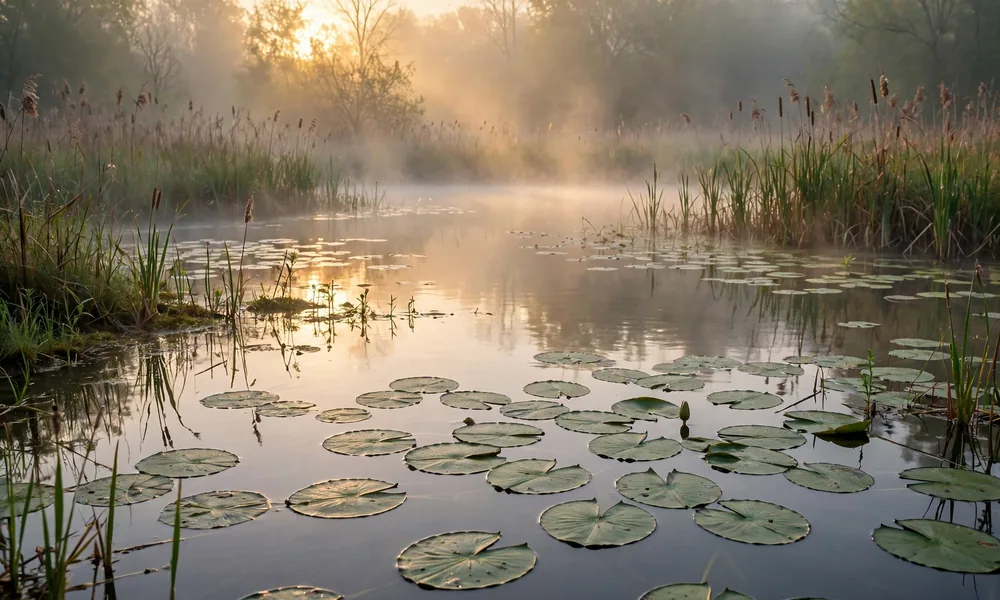
The best hours are the dusk and the night, when the bullfrogs are calling and the light is good for hearing them, and the dawn, when they are still sitting at the water’s edge. From about eight o’clock in the evening until midnight, the males are calling from the shallows, and they are at their most approachable then, though approachable means listening from a few metres away, not touching. A slow walk along the pond’s edge, with a torch to light the water, is all you need, and the frogs will often sit close enough to see the broad green head and the large tympanum clearly, if you move gently and keep your distance.
Staying safe around American bullfrogs
An American bullfrog is not dangerous to people, and there is no safety warning that belongs to the frog itself. It has no venom, it does not bite, and it will not chase or threaten a person. The safety rules for watching bullfrogs are the rules of the pond and the water: watch the water, watch the weather, and respect the frog that you came to see. Never wade into deep water without knowing what is under your feet, never handle a frog with dry hands, because a dry hand strips the mucus that protects its skin, and never take a bullfrog home, because a frog that is released where it does not belong can become an invader.
American bullfrog watching checklist
A little preparation turns an evening beside a pond into a real chance of seeing American bullfrogs at their best, calling in the warm, still water.
- A visit in late spring or summer, when the water is warm and the bullfrogs are calling at night.
- A dusk or night trip, when the males are calling from the shallows and the pond is at its loudest.
- A still pond, lake or slow river with lily pads, reeds and cattails, where the frogs sit and hunt.
- A slow walk along the pond’s edge, watching for a broad green head at the water’s surface or a pair of eyes above the water.
- A torch that lights the water without dazzling the frogs, so you can see into the shallows and spot them.
- A buddy and shoes that grip, so that an evening beside the water stays safe from start to finish.
- Respect for the frog and the pond, keeping your distance, never handling a frog with dry hands, and leaving the pond as you found it.
Frequently asked questions
How big do American bullfrogs get?
Most American bullfrogs measure between 9 and 15 centimetres from snout to vent, and a good frog weighs 300 to 500 grams. A frog of 20 centimetres is a frog the size of a small papaya, and the largest animals have been recorded at 800 grams and 20 centimetres from snout to vent. Females grow larger than males, and the biggest bullfrogs in any pond are almost always female, heavy with eggs, while the males are smaller but louder, with a larger tympanum and a yellow throat in the breeding season.
What do American bullfrogs eat?
An American bullfrog eats insects, crayfish, worms, fish, small frogs, snakes, small turtles, mice and ducklings, and almost anything else it can fit in its mouth. The everyday food is insects, from dragonflies and beetles to grasshoppers and moths, and a big bullfrog will take a snake or a duckling without a second thought. Young bullfrogs eat insects and small invertebrates, and they grow fast on that rich food, reaching adult size in two to three years.
Why do bullfrogs call jug-o-rum?
Bullfrogs call jug-o-rum to attract females and to warn other males away from their territory, and the call is made with the mouth closed, using the large vocal sacs under the throat. The male’s call is a low, resonant sound, often described as the bellowing of a bull, and it can be heard for more than a kilometre across still water on a warm night. Each male defends a stretch of shoreline of 3 to 25 metres, wrestling with rivals that come too close, and a chorus of bullfrogs on a summer night is one of the loudest sounds in the pond.
Are American bullfrogs dangerous?
No, American bullfrogs are not dangerous to people. They have no venom, they do not bite, and they will not chase or threaten a person. Their whole defence is built on being hard to see, hard to catch and hard to hold, and their first response to a threat is to leap into the water and hide in the mud. A bullfrog will eat anything it can fit in its mouth, so a small pet left beside a pond full of bullfrogs is not safe, but a person has nothing to fear from a bullfrog.
Can you keep an American bullfrog as a pet?
You can, but it is hard, and most people should not try. A bullfrog grows to 20 centimetres, it needs a very large tank with clean water and a dry basking area, and it eats insects, fish and mice, which makes it expensive and demanding to keep. It is also illegal to keep one in some places without a permit, and a bullfrog that outgrows its tank must never be released into waters where it does not belong, because a released bullfrog can become an invader. A bullfrog belongs in a pond, not in a living room.
How is this guide different from the moray eel guide?
This guide covers the American bullfrog, a freshwater frog of up to 20 centimetres that sits at the edge of a pond, calls jug-o-rum through the summer night and eats anything it can fit in its mouth, while our moray eel guide covers a saltwater eel of up to about 3 metres that lives in a hole on a coral reef, hunts by smell at night and swallows its prey with a second set of jaws in its throat. One is a frog you listen for on a warm evening beside a pond; the other is an eel you peer for in a crevice on a reef.
This guide also goes further than our general frog guide, which covers frogs as a whole, from the tiny tree frogs to the giant bullfrog, in broad strokes. That guide tells you what a frog is; this one tells you what one frog does, hour by hour, from the jug-o-rum chorus at midnight to the sit-and-wait hunting at the pond’s edge, with the exact sizes, the exact clutch of up to 20,000 eggs, the Least Concern listing and the ponds where you can actually find the animal. If you want the whole family of frogs, read the general guide first, and if you want the American bullfrog itself, this is the guide to read.
Conclusion
The American bullfrog species is a reminder that a frog does not need to be small or shy to be unforgettable. A broad, heavy body, a voice like a bull, a tongue that flicks out in a fraction of a second and a tadpole stage that can last three years have made the bullfrog the biggest frog in North America, at home in a farm pond in Florida, a lake in Ontario and a marsh in Louisiana alike.
If you go looking for one, go on a warm, damp evening in summer, go at dusk or after dark, and walk slowly along a still pond with a torch in your hand. Find the lily pads, listen for the deep jug-o-rum rolling across the water, and watch for a broad green head rising at the water’s edge, and you will have met the bullfrog that turns a quiet pond into a place of deep, booming wonder.