The axolotl species is a single species, Ambystoma mexicanum, a Mexican salamander that never grows up, keeping its feathery gills and its tadpole tail for its whole life, and it can regrow a lost leg, a damaged spine and even parts of its heart. If you are asking how many axolotl species there are, the answer is one: there is only one axolotl species in the world, and every axolotl alive today belongs to it.
The axolotl belongs to the salamander family, Ambystomatidae, and it lives only in the canals of Xochimilco, on the edge of Mexico City, where it once swam in two great lakes. Its wide smile, its pink feathery gills and its soft grey skin make it one of the most recognisable amphibians on Earth.
Key takeaways
- There is only one axolotl species, Ambystoma mexicanum, with only 50 to 1,000 adults left in the wild.
- Axolotls are neotenic, which means they keep their larval gills and fins for their whole lives and almost never metamorphose.
- Axolotls can regrow lost limbs, parts of their spinal cord, their heart and even parts of their brain.
- Wild axolotls live only in the canals of Xochimilco near Mexico City, and nowhere else on Earth.
- Axolotls are listed as Critically Endangered, and pollution and invasive fish are the main threats to their future.
What makes an axolotl an axolotl
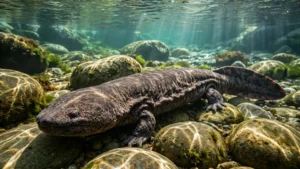
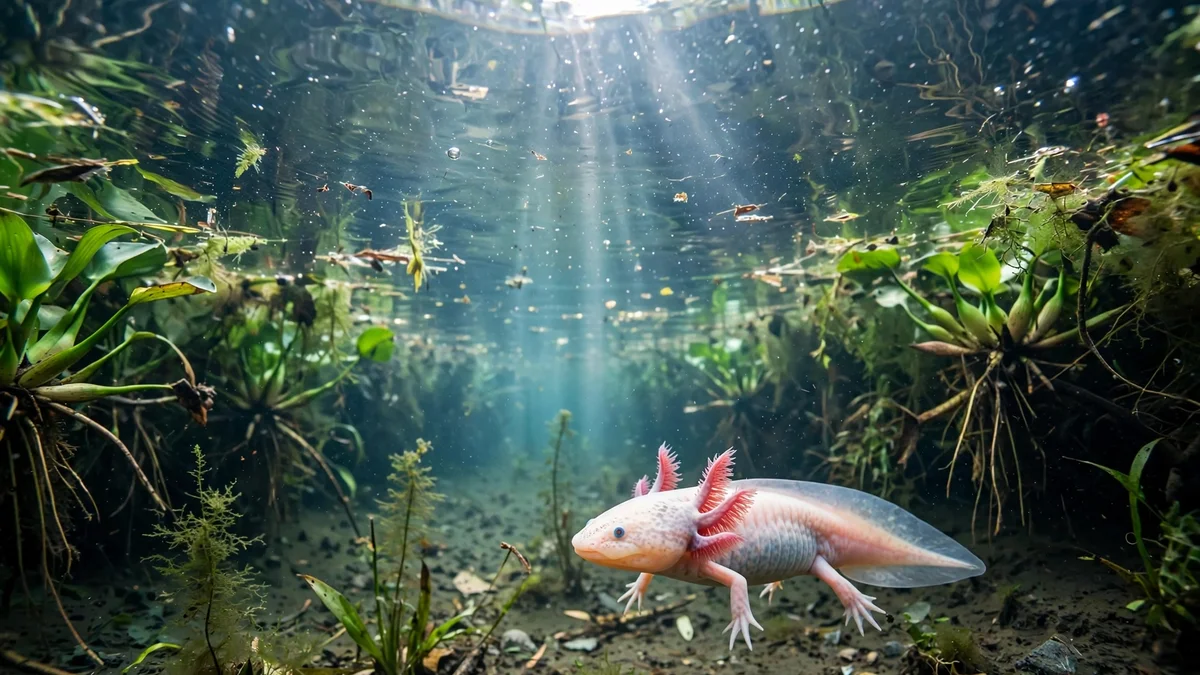
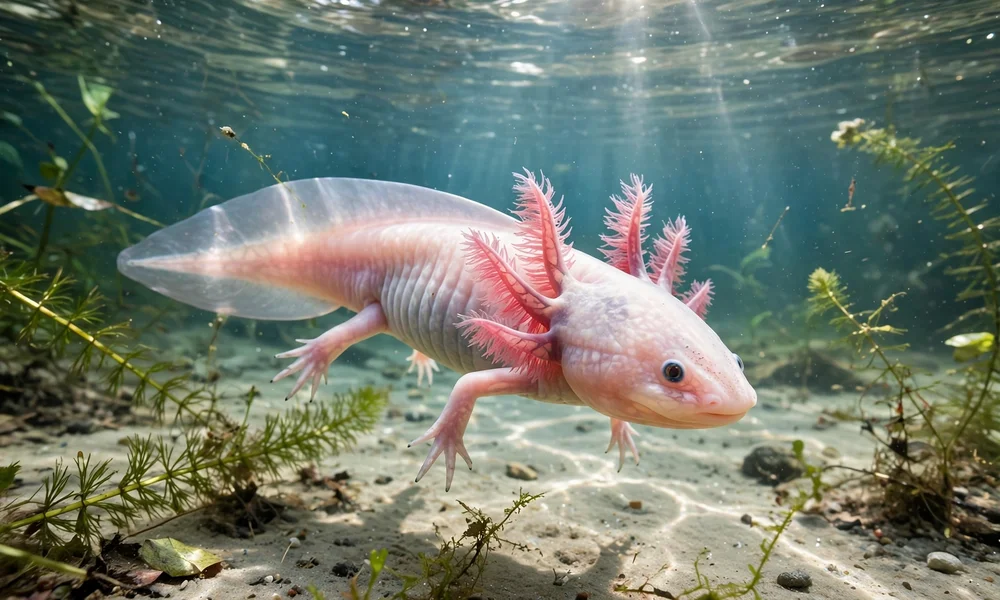
An axolotl is a soft-bodied salamander with a wide flat head, a long tail fin, four short legs and three pairs of feathery external gills that fan out from its head like a crown. An adult measures roughly 15 to 25 centimetres long, and large animals can reach 45 centimetres.
The gills define the axolotl: three feathery branches on each side of its head that let it breathe underwater for its whole life, because the axolotl almost never leaves the water or turns into a land salamander. Its skin is soft and grey-brown in the wild, though captive axolotls are often pink or white, and its wide mouth looks like a permanent smile. Like other frogs and salamanders, it breathes through its skin as well as its gills.
The axolotl species and its relatives
Ambystoma mexicanum is the only axolotl species, and it is not split into formally recognised subspecies. Wild axolotls in the canals of Xochimilco form one connected population, because the canals join into a single maze of waterways, though the animals are now scarce and hard to find.
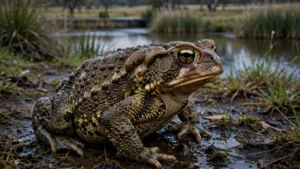
The tiger salamander is the axolotl’s closest relative in North America, and the two belong to the same genus, but the tiger salamander metamorphoses into a land animal with lungs and a yellow-spotted back, while the axolotl stays in the water for life. The California newt is another western salamander that returns to water only to breed, and the red-eyed tree frog, the American bullfrog and the cane toad are frogs and toads that share the axolotl’s ponds and canals. The common frog is a familiar European amphibian that also begins life as a tadpole and changes into a land animal.
| Type | Animal | Where it lives | Best-known food | Length or Weight |
|---|---|---|---|---|
| Species | Axolotl (Ambystoma mexicanum) | Canals of Xochimilco, Mexico | Worms, larvae and small fish | 15 to 25 cm |
| Close relative | Tiger salamander | North America | Worms, insects and mice | 15 to 30 cm |
| Close relative | California newt | California, United States | Worms, snails and insects | 13 to 20 cm |
| Close relative | Red-eyed tree frog | Central America | Moths, crickets and flies | 5 to 7 cm |
| Close relative | American bullfrog | North America | Insects, fish and small frogs | 9 to 15 cm |
| Close relative | Cane toad | Central and South America | Insects and small animals | 10 to 15 cm |
| Close relative | Common frog | Europe and Asia | Flies, slugs and worms | 6 to 9 cm |
How axolotls live
Axolotls are creatures of still, murky water. An axolotl lives alone on the bottom of a canal, hiding among the reeds and the water plants by day and hunting at night, and the animals come together only to breed in spring. Like other North American animals, it follows the seasons, breeding when the water warms and the days lengthen.
Worms make up most of the diet, along with insect larvae, small crustaceans and small fish, and the axolotl hunts by smell, snapping up its prey with a sudden sucking gulp. Its most famous power is regeneration: a lost leg grows back in weeks, and it can regrow parts of its spinal cord, its heart and even parts of its brain, which is why scientists study it in laboratories all over the world.
Breeding happens in spring, and the male drops a packet of sperm on the canal bottom, which the female picks up and uses to fertilise her eggs. She lays 100 to 1,000 eggs one by one on water plants, and the eggs hatch in about two weeks into tiny tadpoles with gills. Axolotls live for around 10 to 15 years in the wild, and longer in captivity.
Where axolotls live
The axolotl lives only in the canals of Xochimilco, a maze of waterways on the southern edge of Mexico City, and nowhere else on Earth. It once lived in two great lakes, Lake Xochimilco and Lake Chalco, but Chalco was drained to build the city, and much of Xochimilco has disappeared too. It is one of the most narrowly distributed animals in the world, confined to a few square kilometres of canal water.
Clean water is the key requirement. An axolotl needs cool, well-oxygenated water with plenty of plants to hide in and lay eggs on, so it lives in the old chinampa canals, the floating gardens built by the Aztecs, where the water is shaded and rich in food. It depends on the canals staying clean, like the fish and the herons that share its water, and when the water is polluted the axolotls sicken and vanish. Surveys found about 6,000 axolotls per square kilometre in 1998, but only about 35 per square kilometre in 2014.
The species is listed as Critically Endangered, and its numbers are falling. The main pressures are pollution from the city, invasive fish such as tilapia and carp that eat the axolotl’s eggs and young, and the loss of the canals to building. A new census began in 2024, but the best estimate is still only 50 to 1,000 adult axolotls left in the wild, though up to a million live in laboratories and homes around the world.
Best seasons for axolotl watching
There is no simple watching season, because wild axolotls are rare, shy and hard to find even for experienced guides, and they live in murky water where they are almost invisible. The best chance comes in spring, from about March to May, when the water warms and the animals are breeding, and local guides take small boats through the canals of Xochimilco.
The spring has its own rewards: the canals are at their greenest and the guides know where the axolotls hide, though no trip can promise a sighting. Good places to try include the chinampa canals of Xochimilco and the axolotl sanctuary at the National Autonomous University of Mexico.
Staying safe around axolotls
An axolotl is a wild animal with soft skin and no teeth worth fearing, and it cannot hurt a person, though its skin is easily damaged by handling. Keep your distance, never pick up an axolotl, and never try to touch one, because the oils and heat of a human hand can harm its skin. If you see axolotls from a boat, keep the engine slow and quiet, and let the animals stay hidden if they choose.
Like other wild amphibians, axolotls can carry diseases, and any bite or scratch should be washed at once and checked by a doctor without delay. Admire from a distance, from the deck of a boat, and never take an axolotl from the wild, because wild axolotls are fully protected by Mexican law.
Axolotl watching checklist
A little preparation turns a Xochimilco boat trip into a real chance of seeing an axolotl, so pack for sun, still water and long quiet hours.
- Binoculars with good low-light performance, for picking a grey shape out of the murky water.
- A camera with a zoom lens, because axolotls should always be watched from a boat, never handled.
- Sun cream and a hat, because the best watching is in the bright midday sun.
- Water and snacks for long days, because the best trips spend hours on the canals.
- A booked local guide who knows the canals, the axolotl’s hiding places and the safe routes.
- A plan to be out in spring, when the water warms and the axolotls are breeding.
- Patience and silence, because axolotls are shy animals and a noisy boat will send them away.
Frequently asked questions
How many axolotl species are there?
There is one axolotl species, Ambystoma mexicanum. Wild axolotls in the canals of Xochimilco form one connected population, and the pink and white axolotls in pet shops are the same species, bred in captivity. No second axolotl species is recognised.
Why do axolotls never grow up?
Axolotls never grow up because they are neotenic, which means they keep their larval features, such as their feathery gills and their tail fin, for their whole lives. They almost never metamorphose into land salamanders, because the cold, deep water of Xochimilco suits their gills better than the land does.
Can axolotls really regrow a lost leg?
Yes. Axolotls can regrow a lost leg in a few weeks, and they can regrow parts of their spinal cord, their heart and even parts of their brain. Scientists study this power in the hope of learning how to help injured people heal, and it is one of the reasons the axolotl is kept in laboratories all over the world.
Can you keep an axolotl as a pet?
Yes, in many countries, but only a captive-bred axolotl from a breeder, never one taken from the wild, which is illegal. A pet axolotl needs a cool tank of clean water, a hiding place and live food, and it can live for 15 years or more. Wild axolotls are Critically Endangered and fully protected.
How is this guide different from the monarch butterfly species guide?
This guide covers the single axolotl species, a salamander that never leaves the water of one Mexican canal system, while our monarch butterfly species guide covers the single monarch butterfly species, an insect that migrates up to 4,800 kilometres across North America. The axolotl stays in a few square kilometres of water, and the monarch crosses a continent.
Are axolotls endangered?
Axolotls are listed as Critically Endangered, so they are classed as critically endangered, one step from extinction in the wild. Only 50 to 1,000 adults remain in the wild, though up to a million live in laboratories and homes.
Conclusion
The axolotl species shows how much strangeness one animal can hold: Ambystoma mexicanum, with feathery gills worn for life, a smile that never leaves, the power to regrow a leg or a heart, and a life spent in a maze of canals on the edge of a great city. It is one of the rarest amphibians on Earth, and it has lived in the waters of the Valley of Mexico for thousands of years.
If you go looking for one, go in spring to Xochimilco, go with a local guide, and go with patience. Watch the still water of a chinampa canal and you may glimpse an axolotl’s gills in the green shade, and you will understand why it has earned its place as the water monster of Mexico, and why keeping its canals clean matters most.