The monarch butterfly species is a single species, Danaus plexippus, an orange and black butterfly that migrates up to 4,800 kilometres across North America, a journey no single butterfly ever completes, because it takes four generations to make the round trip. If you are asking how many monarch butterfly species there are, the answer is one: there is only one monarch butterfly species in the world, and every monarch alive today belongs to it.
The monarch butterfly belongs to the brush-footed butterfly family, Nymphalidae, and it is the only insect on Earth that makes a multi-generational migration across a whole continent. Its orange wings with black veins, its milkweed caterpillars and its winter clusters in the fir forests of Mexico make it one of the most recognisable insects on Earth.
Key takeaways
- There is only one monarch butterfly species, Danaus plexippus, and its migratory subspecies is listed as Endangered.
- Monarch butterflies migrate up to 4,800 kilometres, from Canada and the United States to Mexico, over four generations.
- Monarch caterpillars eat only milkweed, and the milkweed’s toxins make the butterfly poisonous to birds.
- The eastern monarch population has fallen by 84 percent since 1996, and the western population by 99.9 percent since the 1980s.
- Monarchs are listed as Endangered, and the loss of milkweed and winter forest is the main threat to their future.
What makes a monarch butterfly a monarch butterfly
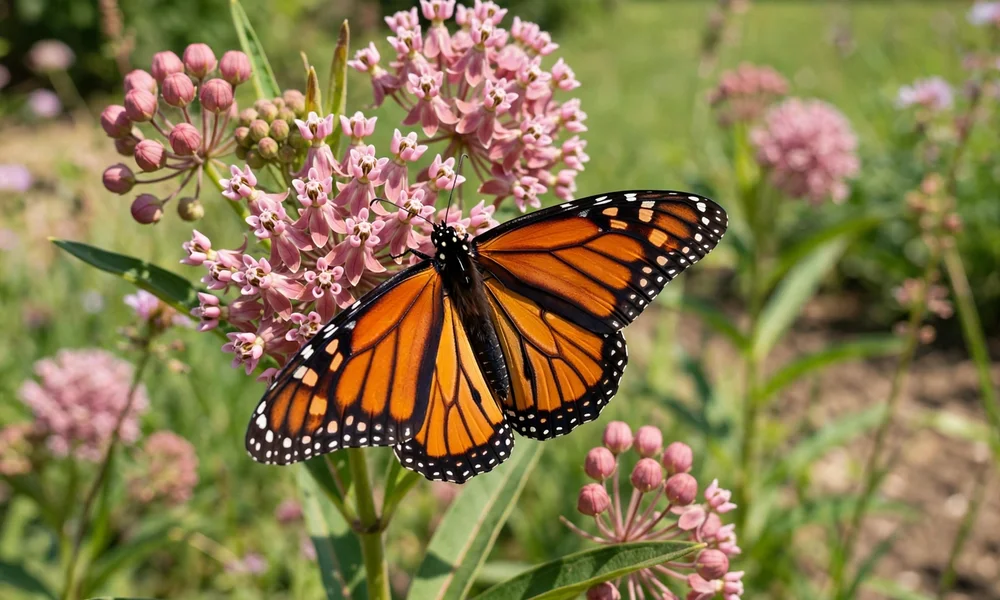
A monarch butterfly is a large orange butterfly with black veins, a thick black border with white spots, and a wingspan of 8.9 to 10.2 centimetres, and it weighs only about half a gramme. The male has a black spot on each hind wing, while the female’s veins are thicker and darker.
The migration defines the monarch butterfly: each autumn the butterflies fly south to overwinter in the oyamel fir forests of central Mexico, or on the California coast for the western population, and in spring their great-grandchildren fly north again. Its caterpillar eats only milkweed, and the plant’s bitter toxins stay in the butterfly’s body, so birds that taste a monarch learn to leave orange butterflies alone. Like other butterflies, it tastes with its feet and smells with its antennae.
The monarch butterfly species and its relatives
Danaus plexippus is the only monarch butterfly species, and it is not split into formally recognised subspecies, though scientists do recognise a migratory North American population and non-migratory populations in the tropics and around the Pacific. The migratory population is the one listed as Endangered, and it is the one that makes the great journey to Mexico.
The viceroy butterfly is the monarch’s most famous lookalike, an orange butterfly that copies the monarch’s colours to avoid being eaten, though it is smaller and has a black line across its hind wings. The painted lady is another orange migrant that flies across whole continents, while the red admiral, the swallowtail and the cabbage white are common garden butterflies of the same family. The blue morpho is a much larger tropical butterfly with brilliant blue wings, and it shares the monarch’s taste for sunny forest clearings.
| Type | Animal | Where it lives | Best-known food | Length or Weight |
|---|---|---|---|---|
| Species | Monarch butterfly (Danaus plexippus) | North America, migrates to Mexico | Milkweed nectar | 8.9 to 10.2 cm wingspan |
| Close relative | Viceroy butterfly | North America | Willow and poplar nectar | 6.3 to 8.6 cm wingspan |
| Close relative | Painted lady | Worldwide | Thistle and aster nectar | 5 to 9 cm wingspan |
| Close relative | Red admiral | Europe and North America | Nettle leaves, fruit | 4.5 to 6.4 cm wingspan |
| Close relative | Swallowtail butterfly | Europe, Asia and America | Umbellifer nectar | 6.5 to 8.6 cm wingspan |
| Close relative | Cabbage white | Europe, Asia and America | Cabbage and mustard plants | 3.5 to 5 cm wingspan |
| Close relative | Blue morpho | Central and South America | Rotting fruit and sap | 12 to 15 cm wingspan |
How monarch butterflies live
Monarch butterflies are creatures of open meadows and gardens. A monarch lives alone, flying from flower to flower in the sun, and the butterflies gather only in the great winter clusters, where millions hang from the fir trees of Mexico. Like other North American animals, it follows the seasons, moving north in spring and south in autumn, and it can fly for hours without stopping.
Milkweed makes up the whole diet of the caterpillar, and the adult drinks nectar from milkweed, thistles, asters and other flowers, using a long tongue that unrolls like a drinking straw. The caterpillar grows through five stages in about two weeks, shedding its striped skin each time, and then it hangs upside down and turns into a green chrysalis with gold spots, emerging as a butterfly after ten to fourteen days. The summer generations live for two to six weeks, but the migrating generation lives for eight to nine months, long enough to reach Mexico and start the journey back.
Breeding happens in spring and summer, and the female lays her eggs one by one on the underside of milkweed leaves, up to 300 eggs in her short life. Each egg hatches in three to five days into a tiny caterpillar that eats its own eggshell and then the leaf, growing a hundred times heavier before it pupates. Monarchs live for around two to six weeks in summer, and eight to nine months in the migratory generation.
Where monarch butterflies live
The monarch butterfly lives across North America in summer, from southern Canada to the southern United States, and it winters in two places: the eastern population in the oyamel fir forests of central Mexico, and the western population in the eucalyptus and pine groves of the California coast. It is most common in the meadows and gardens of the American Midwest, where milkweed grows thickest, and it has spread to other continents, including Australia and Spain, where milkweed was planted.
Milkweed is the key requirement. A monarch needs milkweed to lay its eggs on, so it follows the milkweed as it grows in spring, moving north as the plants sprout, and when the milkweed is sprayed or mown the butterflies have nowhere to breed. It depends on the oyamel fir forests staying cool and humid in winter, like the millions of butterflies that cluster there, and when the forest is logged the winter shelter disappears. The eastern winter colony covered 21 hectares of forest in the mid-1990s, but only 2.21 hectares in the winter of 2023 to 2024.
The migratory monarch is listed as Endangered, and its numbers are falling. The main pressures are the loss of milkweed to herbicides and farming, the logging of the winter forests in Mexico, and climate change, which disrupts the migration. The western population fell from around 10 million in the 1980s to just 1,914 butterflies in 2021, and the eastern population fell by 84 percent between 1996 and 2014. The United States proposed listing the monarch as threatened in 2024.
Best seasons for monarch butterfly watching
There is no closed season, because monarchs are active from spring to autumn, but the best time to look for them depends on where you go. In the United States and Canada the best months are often July to September, when the butterflies are breeding in the meadows and gardens.
The autumn has its own rewards: the migrating butterflies gather in roosts along their route south, and they are easy to watch nectaring on late flowers, though they are travelling and should not be disturbed. Good places to try include the Monarch Butterfly Biosphere Reserve in Mexico and the California coast in winter.
Staying safe around monarch butterflies
A monarch butterfly is a wild insect with no sting and no bite, and it cannot hurt a person, though its body carries milkweed toxins that can upset the stomach if eaten. Keep your distance, never catch a monarch by its wings, and never try to keep one in a jar, because handling damages the tiny scales that let it fly. In monarch country, watch from a path and use your eyes.
Admire from a distance, and never collect a monarch, because a collected butterfly cannot complete its migration.
Monarch butterfly watching checklist
A little preparation turns a summer meadow walk into a real chance of seeing a monarch butterfly, so pack for sun, flowers and long quiet hours.
- Binoculars with close focus, for picking an orange butterfly out of the flowers.
- A camera with a macro lens, because monarchs should always be watched from a short distance, never touched.
- Sun cream and a hat, because the best watching is in the sunny midday hours.
- Water and snacks for long days, because the best sightings come after hours of searching.
- A field guide to butterflies, for telling a monarch from a viceroy at a glance.
- A plan to be out in late summer, when the migrating generation is on the wing.
- Patience and silence, because monarchs are quiet insects and a noisy group will send them away.
Frequently asked questions
How many monarch butterfly species are there?
There is one monarch butterfly species, Danaus plexippus. Scientists recognise a migratory North American population and non-migratory populations in the tropics, but they are all the same species. No second monarch butterfly species is recognised.
Why do monarchs migrate if no butterfly completes the trip?
Monarchs migrate because the journey lets the species use the summer milkweed of the north and the warm winter shelter of Mexico, and the trip is shared across four generations. The autumn butterfly flies south, its children and grandchildren fly north in spring, and only the great-grandchildren reach the north again.
Are monarch butterflies poisonous?
Yes, to birds. Monarch caterpillars eat milkweed, and the plant’s bitter toxins stay in the butterfly’s body, so a bird that eats a monarch vomits and learns to leave orange butterflies alone. The toxins do not harm people unless the butterfly is eaten.
Can you keep a monarch butterfly as a pet?
No. A monarch butterfly is a wild insect that needs milkweed, flowers and the open sky, and it is protected by law in Mexico and in some parts of the United States. Monarchs raised in classrooms should be released where they were found, and they are not pets.
How is this guide different from the emperor penguin species guide?
This guide covers the single monarch butterfly species, an orange insect that migrates up to 4,800 kilometres across North America, while our emperor penguin species guide covers the single emperor penguin species, a flightless bird that breeds on the Antarctic sea ice in winter. The monarch flies on the wind and feeds on flowers, and the emperor penguin swims and dives in the Southern Ocean.
Are monarch butterflies endangered?
The migratory monarch is listed as Endangered, so it is classed as endangered, the only butterfly on this list with that status. The eastern population has fallen by 84 percent since 1996, and the western population by 99.9 percent since the 1980s.
Conclusion
The monarch butterfly species shows how much endurance one insect can hold: Danaus plexippus, with wings that carry it 4,800 kilometres, caterpillars that eat only milkweed, toxins that teach birds to leave it alone, and a life spent crossing a continent in four generations. It is the only insect that migrates across a whole continent, and it has flown the same route for thousands of years.
If you go looking for one, go in late summer to a meadow full of milkweed, or in winter to the fir forests of Mexico, go quietly, and go with patience. Watch a monarch butterfly feeding on a flower and you will understand why it has earned its place as the great traveller of the insect world, and why keeping its milkweed and its winter forest matters most.