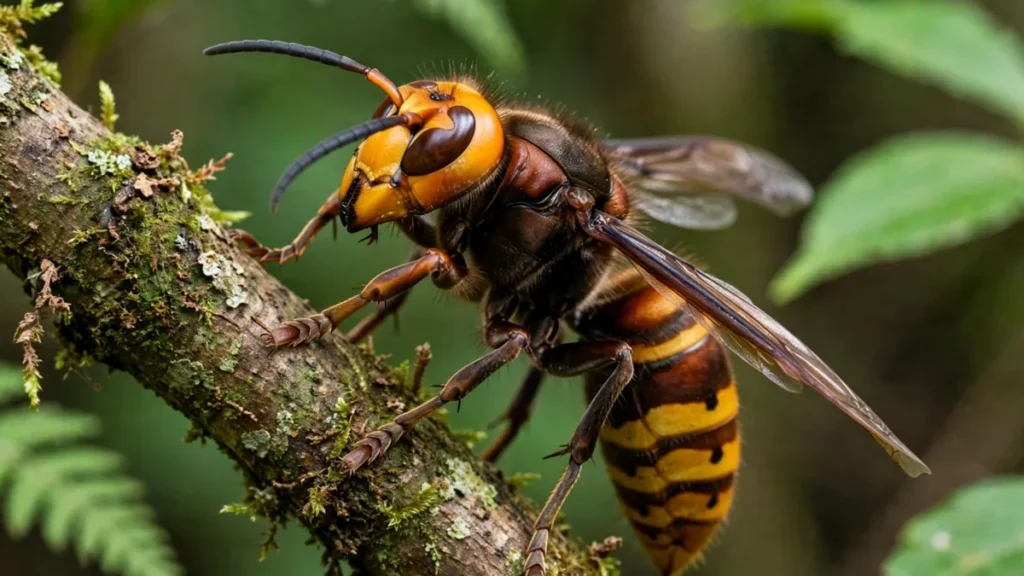
The asian giant hornet species is the largest hornet on Earth, and it is an insect that lives up to its size. The Asian giant hornet, Vespa mandarinia, is a wasp whose queens can reach 5.5 centimetres long, with a wingspan of up to 7.6 centimetres, and it carries a sting about 6 millimetres long and a venom that kills an estimated 30 to 50 people a year in Japan. If you are asking what an Asian giant hornet is, the short answer is a social hunting wasp of the forests of East Asia, a powerful flier that eats tree sap and fruit as an adult and feeds its larvae on the meat of other insects, above all honeybees.
Most people know this hornet by its nickname, the murder hornet, a name given to it by a newspaper in 2020, when the insect turned up in the Pacific Northwest of North America and set off a five-year hunt. The nickname is unfair, because the hornet is not aggressive towards people unless its nest is threatened, but the animal is a fearsome hunter. A single hornet can kill about 40 honeybees in a minute, and a group of 20 to 30 can destroy a whole colony of 30,000 bees in a few hours. This guide follows the whole animal: how it looks, where it lives, what it eats, how it breeds, and why the world’s largest hornet is both a wonder and a danger.
Key takeaways
- The asian giant hornet species is Vespa mandarinia, the world’s largest hornet, with queens reaching 5.5 centimetres long and a wingspan of up to 7.6 centimetres, while workers measure 3.5 to 3.9 centimetres.
- It lives in the temperate and tropical forests of East Asia, from Japan and Korea through China to India, Thailand and the Russian Far East, and it nests underground or in tree cavities.
- It is a social hunter that eats tree sap, nectar and fruit as an adult and feeds its larvae on insects, above all honeybees, which it kills with its great crushing mandibles.
- Its sting is about 6 millimetres long and its venom contains mandaratoxin, a neurotoxin that can be lethal even to people who are not allergic, and it kills an estimated 30 to 50 people a year in Japan.
- It is not considered threatened, but its one population outside Asia, found in Washington State in 2019, was declared eradicated in December 2024 after four nests were destroyed.
The asian giant hornet species and their relatives
The Asian giant hornet belongs to the family Vespidae, the social wasps, a family that holds the hornets, the yellowjackets and the paper wasps, and it is one of the largest and most formidable families of insects on Earth. There are 22 recognised species of true hornet, and every one of them belongs to the genus Vespa, big, social, meat-eating wasps that build papery nests, hunt in the air and defend their colonies with a sting. The hornets are the largest of the social wasps, and the Asian giant hornet is the largest of the hornets. The hornets themselves are mostly Asian, and only one species, the European hornet, is at home in Europe and North America.
The genus is Vespa, a name that has meant hornet since the Romans, and it holds all 22 of the true hornets. The lead species of this guide, the Asian giant hornet, Vespa mandarinia, is the largest of them all, a hornet of the lowland forests of East Asia whose queens reach 5.5 centimetres and whose workers measure 3.5 to 3.9 centimetres. The species was described by the English entomologist Frederick Smith in 1852, and it is known in Japan as the giant sparrow bee. In 2022 the Entomological Society of America gave the hornet a new common name, the northern giant hornet, though most people still call it the Asian giant hornet.

| Type | Animal | Where it lives | Best-known food | Length or Weight |
|---|---|---|---|---|
| Family | Social wasps (Vespidae) | Forests and gardens across the world | Insects, sap and nectar | Up to 5.5 cm long |
| Genus | Hornets (Vespa) | Forests of Asia, Europe and North America | Insects, especially honeybees | Up to 5.5 cm long |
| Species | Asian giant hornet (Vespa mandarinia) | Lowland forests of East Asia | Honeybees and large insects | Up to 5.5 cm long |
| Species | European hornet (Vespa crabro) | Forests of Europe and eastern North America | Insects and tree sap | Up to 3.5 cm long |
| Species | Asian hornet (Vespa velutina) | Asia, and invasive in Europe since 2004 | Honeybees and other insects | Up to 3 cm long |
What an Asian giant hornet looks like
An Asian giant hornet looks like a wasp that has been built on a bigger scale, and the first thing anyone notices is the head. The head is large and solid orange-yellow, with big, dark compound eyes, three small simple eyes on top, dark brown antennae and a set of powerful orange mandibles. The thorax, the middle section of the body, is dark brown or black and covered in a short, velvety fuzz, and the abdomen is banded in dark brown and yellow-orange, with the last segment a bright yellow. The wings are grey-brown and smoky, and when the hornet flies they beat with a slow, deep thrum that you can hear from several metres away.
Size is the hornet’s signature, and it is worth getting the numbers right, because the animal is often described as bigger than it is. A worker measures 3.5 to 3.9 centimetres long, about the length of a paperclip, and a queen can reach 5.5 centimetres, with a wingspan of up to 7.6 centimetres, which is wider than most people’s palms. That makes the Asian giant hornet about four times the length of a honeybee. The sting is about 6 millimetres long, a quarter of an inch, and it is long enough and sharp enough to pierce a standard beekeeper’s suit, which is why the people who hunted the nests in Washington State had to order special reinforced suits. Males are smaller than the queens and look much the same, but they have no sting at all, because the sting is a modified egg-laying tube.
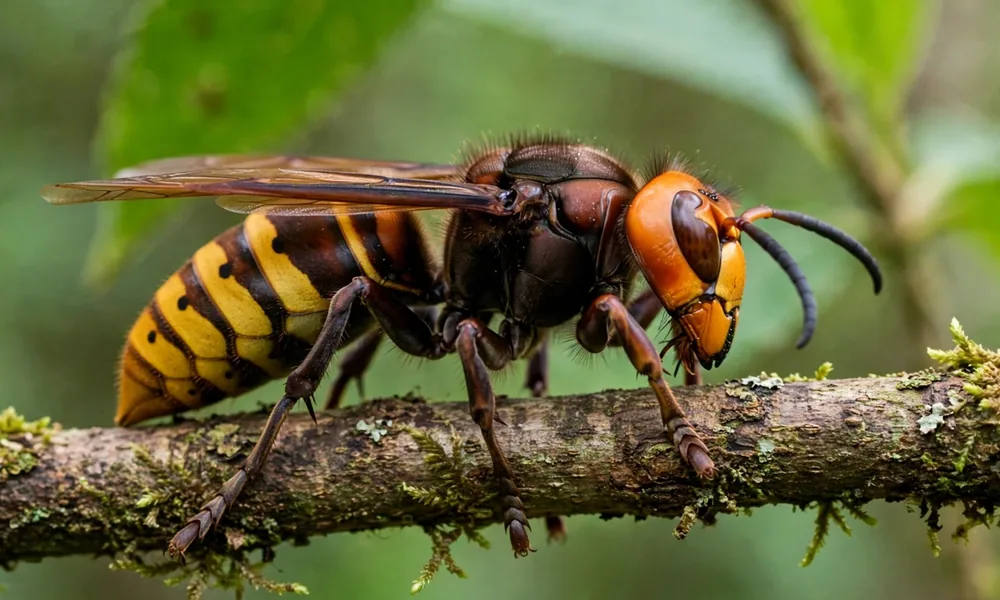
The colours are a warning. The orange head and the yellow bands on a dark body are the classic colours of a stinging insect, and they tell any animal that has learned the lesson to keep away. The hornet’s body is also built for its work. The mandibles are long and curved, and they are used not for stinging but for killing, crushing the heads and thoraxes of bees and other insects and carrying the meat back to the nest. The legs are long and strong. The eyes are large and sharp, and they give the hornet a wide field of view, so it can spot a bee in flight and catch it in the air.
Where Asian giant hornets live
Asian giant hornets live in the temperate and tropical forests of East Asia, and they are most at home in the lowland woods and the foothills of the mountains. Their range runs from the Russian Far East, through Korea and Japan, across China and Taiwan, and south through Vietnam, Laos, Cambodia and Thailand to India, Nepal and Sri Lanka. They are commonest in the mountains of Japan, and they are a familiar sight in the forests of central and southern China. They live in forests and woodland edges, in gardens and orchards, and anywhere there are trees to nest in, sap to drink and insects to hunt.
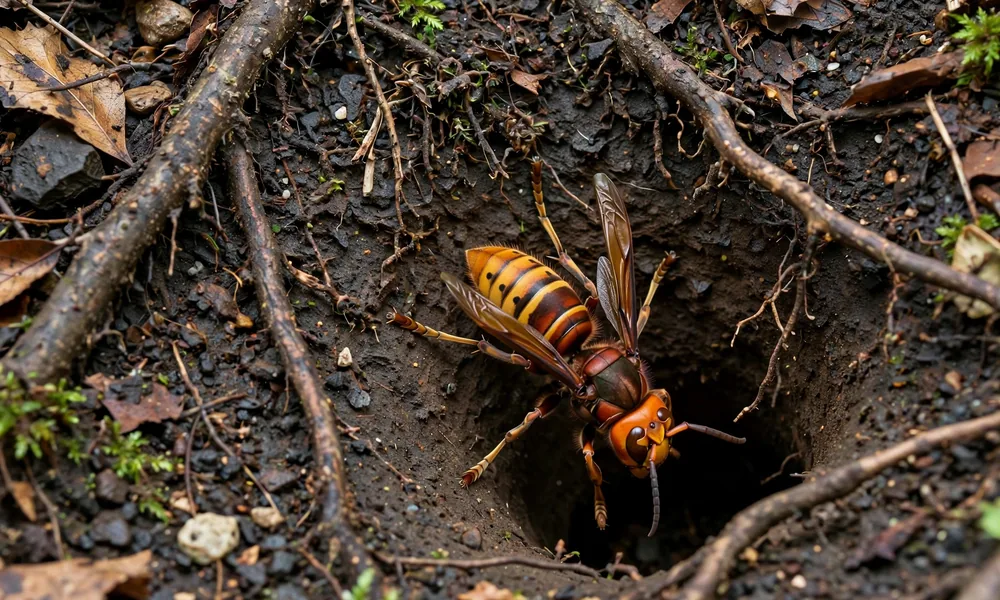
The nest is the centre of the hornet’s life, and it is almost always underground. A queen in the spring will look for an old rodent burrow, a hollow at the base of a tree or a cavity among the roots, and she will build her first papery cells there, chewing wood into a soft pulp and shaping it into a nest that can grow, over the summer, to the size of a basketball. Some nests are built in tree cavities, but most are hidden away, and a walker can pass within a few metres of a nest without knowing it is there. The nest is the reason the hornet is dangerous, because the whole colony will defend it. The hornets are most aggressive in the late summer and autumn, when the colony is at its largest.

The hornet’s range is almost entirely Asian, and the one time it left Asia it made the news around the world. In August 2019 a nest was found and destroyed on Vancouver Island in Canada, and in December 2019 a dead hornet was found in Blaine, Washington, near the Canadian border. Over the next two years, four nests were found and destroyed in Whatcom County, and scientists tracked the hornets back to their nests by tying tiny radio tags to live hornets with dental floss and following them through the forest. The largest nest held close to 1,500 hornets at all stages of life, and it was vacuumed out of a tree in October 2021. No hornets were seen in Washington in 2023 or 2024, and on 18 December 2024 the Washington State Department of Agriculture announced that the northern giant hornet had been eradicated from the state.
Within Asia, the hornet is a normal part of the forest, though beekeepers watch it closely. The hornet prefers lowland forest to high mountains, and it is most active in the warm months, from spring to autumn, when the trees are in leaf and the insects are out. In the winter the colony dies and only the mated queens survive, hiding alone in the soil or in leaf litter, waiting for the spring. A hornet can fly at about 25 miles per hour, and a queen can cover 20 miles in a day, so a colony can hunt across several square kilometres. The hornet is a strong, fast flier, and it is the speed that makes it so deadly to bees, because a bee cannot outrun it.
What Asian giant hornets eat
Asian giant hornets eat two very different diets, and the difference is between the adults and the young. The adults feed mostly on tree sap, nectar, honey and soft fruit. They do not eat meat themselves, or not much of it, because their mouths are not made for chewing solid food. The larvae are the meat eaters. The workers bring them the bodies of insects, above all honeybees, and the larvae chew the meat and digest it, and in return they secrete a rich, amino-acid fluid that the adults drink. It is a trade that holds the colony together, because the adults cannot eat meat and the larvae cannot fly.
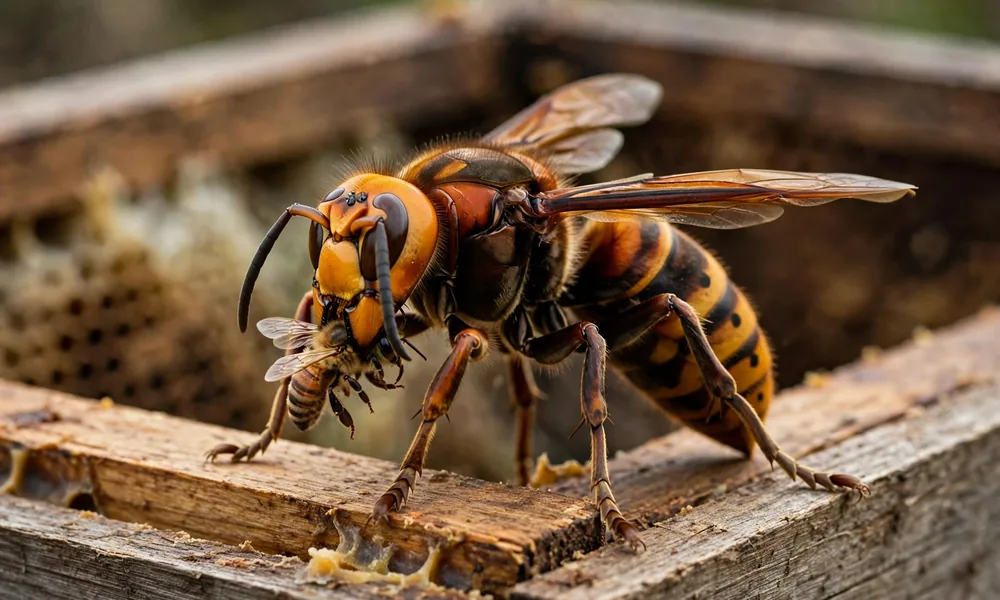
The hornet’s hunting is what made it famous, and it is worth describing plainly, because it is one of the most efficient killing machines in the insect world. A hornet on the hunt will hover outside a honeybee hive, catch the bees as they come and go, and kill them one by one with its mandibles, biting off the head and carrying the thorax back to the nest. A single hornet can kill about 40 bees in a minute. That is only the beginning. When a scout finds a hive worth raiding, it marks the hive with a pheromone that calls in its nestmates, and a group of 20 to 30 hornets will then attack the hive together, in what beekeepers call the slaughter phase. They kill the defending bees, they occupy the hive, and they take the brood back to their own nest to feed their larvae. A group that size can kill 5,000 to 25,000 bees in one to six hours, and a colony of 30,000 bees can be destroyed in an afternoon.
The hornets do not hunt honeybees alone. They take other large insects too, including other wasps, beetles, mantises and butterflies, and they will also take spiders and the larvae of other insects. They also rob the hives they have destroyed, eating the honey as well as the brood. The European honeybee has no defence against the hornet, because it has never lived alongside it. The Asian honeybee, which has shared the forests of East Asia with the hornet for millions of years, has learned a defence, and it is one of the cleverest in the insect world.
How Asian giant hornets behave
Asian giant hornets are social wasps, and their behaviour is the behaviour of a colony, not of a single insect. The colony is founded by one queen in the spring, and it grows through the summer until, at its peak in the late summer and autumn, it holds several hundred workers, all of them daughters of the queen, all of them female, and all of them working for the colony. The workers build the nest, feed the larvae, hunt for meat and defend the entrance, following the chemical signals of their sisters. The queen stays in the nest, laying eggs, and the colony lives and dies as one animal. A hornet away from its colony is a lost animal, and a colony without its queen is a dying one.
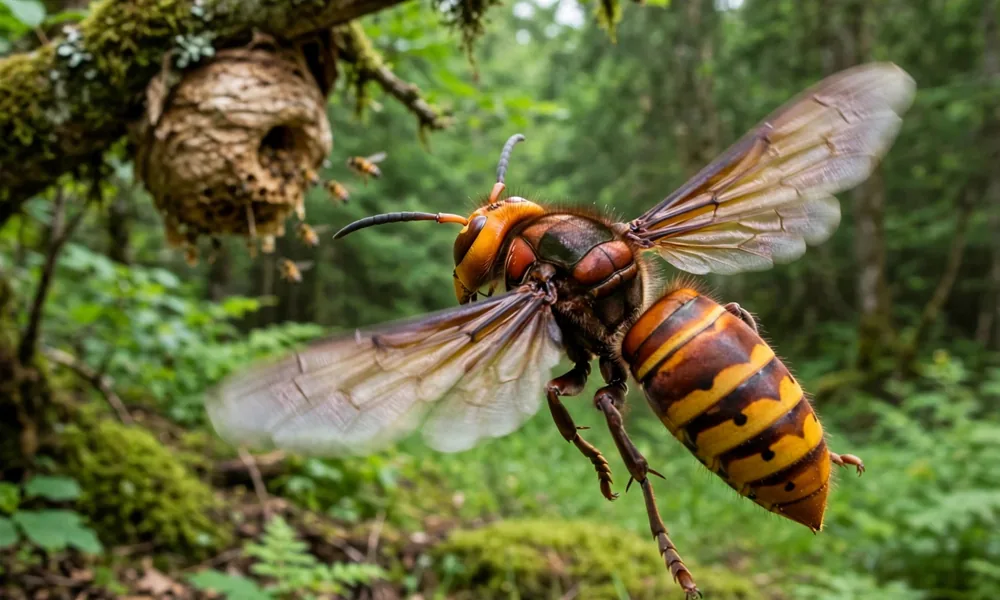
The hornet’s most famous behaviour is the raid, and it follows a pattern. First comes the hunting phase, when lone hornets pick off bees at the hive entrance, one by one. Then a scout finds a hive that is worth a full attack, and it marks the hive with a pheromone that other hornets can follow. Then comes the slaughter phase, when a group of hornets arrives together and kills the defending bees, and finally the occupation phase, when the hornets take over the hive and carry the brood home. The whole raid can take a few hours, and when it is over the hive is empty and the hornets have the brood and the honey. It is why beekeepers in Japan and China dread the late summer, when the colonies are at their largest and the raids are at their worst.
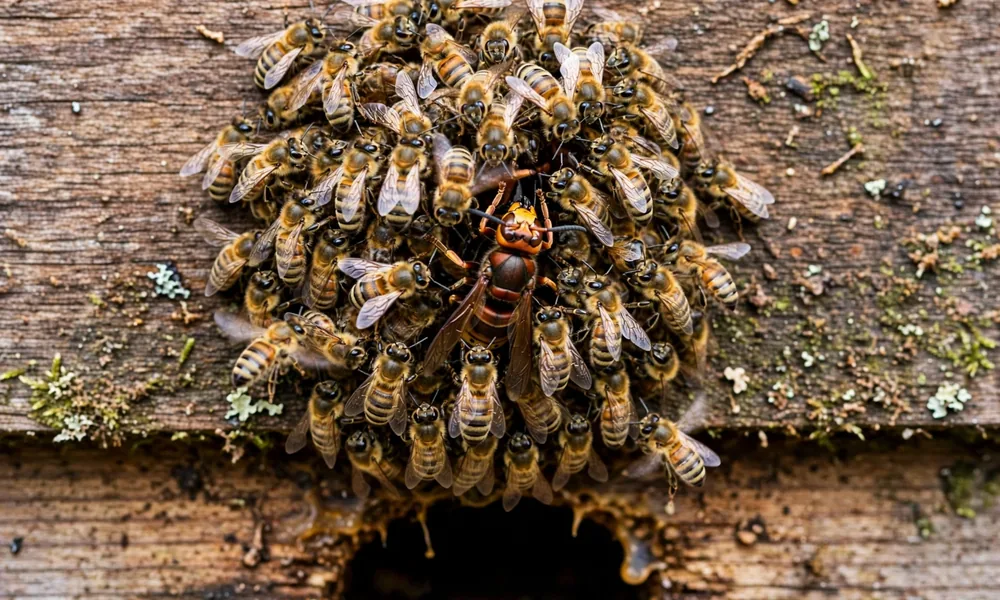
The Asian honeybee’s defence is the hornet’s most famous defeat. When a hornet scout arrives at the hive, a few hundred bees pour out, surround the hornet and form a tight ball around it, buzzing and vibrating their flight muscles to raise the temperature inside the ball to about 47 degrees Celsius. The hornet dies of the heat, and the scout never lives to call in its nestmates. The European honeybee does not do this, and that is why it is so vulnerable. The hornets have their own defences too. They can sting repeatedly, because their sting is smooth and does not stick in the skin the way a honeybee’s does, and they can mark an enemy with a pheromone that calls in more hornets. A hornet that is attacked will fight back, and that is why the safest thing to do with a giant hornet is to leave it alone.
Breeding and life cycle
Asian giant hornets breed once a year, and the whole colony lives for a single season. The year begins in the spring, when the mated queens wake from their winter sleep, hidden in the soil, in leaf litter or in rotting wood, where they have spent the cold months alone. A queen that has survived the winter comes out hungry, and she feeds on tree sap for a few weeks before she starts her nest. She chooses a hollow, a burrow or a cavity, and she builds the first few papery cells herself, chewing wood into pulp and shaping it with her mandibles, and she lays her first eggs in those cells. She feeds the first larvae herself, hunting alone, and when the first workers emerge, usually around July, she stops leaving the nest and lays eggs for the rest of her life.
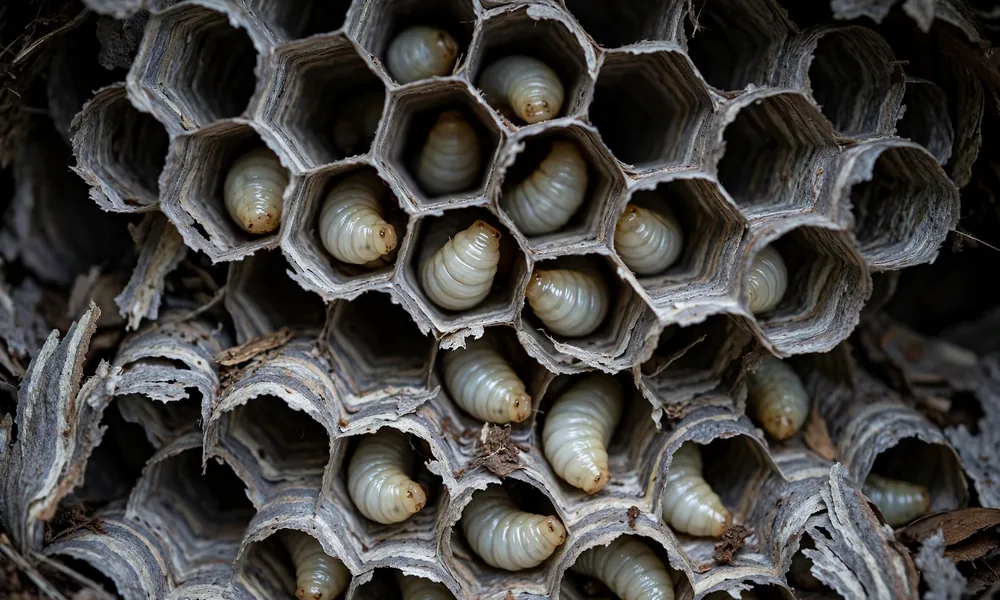
The colony grows fast through the summer, and the workers take over all the work. They build new combs, they hunt, they feed the larvae and they guard the entrance, and the queen does nothing but lay eggs until the colony is at its largest in the late summer and the autumn. The larvae are big, pale and barrel-shaped, about 1 to 1.5 inches long, and they hang in their cells, fed by the workers with the meat of bees. In the autumn the colony changes, and the nest raises new queens and males, the only members of the colony that will leave it. The new queens and the males fly out on mating flights, and after mating the males die, and the new queens fly off to find a place to spend the winter. The old queen dies, the workers die, and the nest falls silent and empty, and only the new queens, hidden in the soil, carry the colony into the next year.

The life cycle is a gamble, and the odds are against the queen from the start. Most queens do not survive the winter, and most of those that do fail to found a nest. A queen that succeeds can raise a colony of several hundred workers, but even a successful colony lasts only a few months, and the whole year’s work comes down to the handful of new queens that fly out in the autumn. The workers live for about a month each, the males for a few weeks, and only the queens live for close to a year, from one autumn to the next.
Conservation status
Asian giant hornets are not listed as threatened, and they have never been formally assessed for the IUCN Red List, which records them as Not Evaluated. The species is common across a huge range in East Asia, its colonies are numerous, and there is no sign that it is in decline. The hornet is a top predator in its world, and it is not a species that needs saving. What needs saving, in the hornet’s case, is the wildlife around it, above all the honeybees and the wild insects that the hornet hunts.
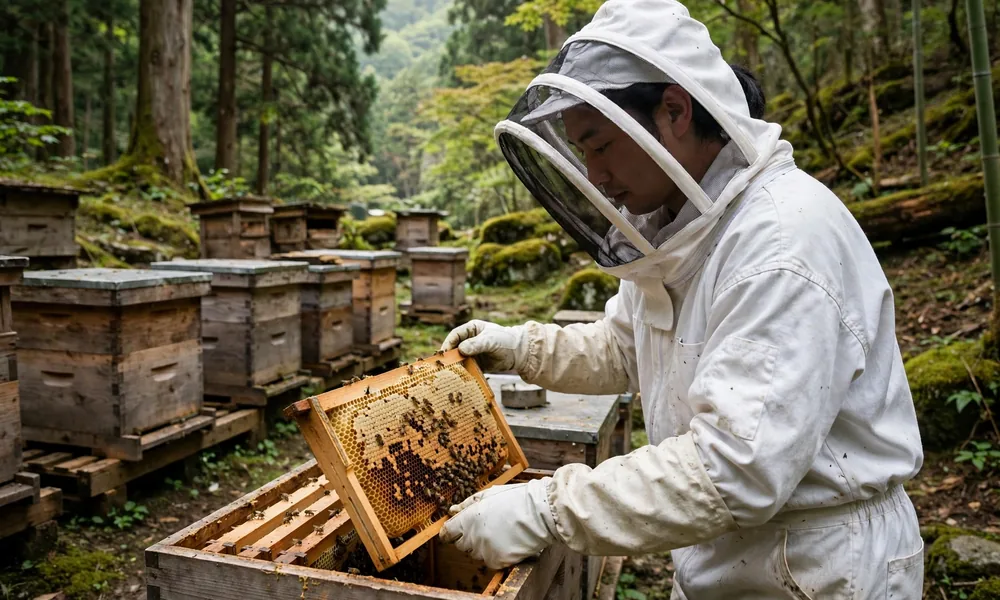
The hornet’s impact is felt most by beekeepers, and it is a serious one. In Japan, where the hornet is common, the European honeybee, which has no defence against it, can lose whole apiaries to a single season of raids, and beekeepers spend the late summer guarding their hives, fitting narrow entrances that a hornet cannot get through and setting traps baited with fermented rice wine. The Asian honeybee defends itself with its heat ball and usually survives, but the European bee does not, and the loss of a colony is a loss of pollination as well as of honey. The hornet also shares its forests with the birds that eat it, the mammals that dig up its nests and the other insects that compete with it for food. Our Japanese macaque guide follows one of the forest animals that shares the hornet’s mountains, a monkey that lives in the same woods and eats from the same trees.
The Washington State story is the hornet’s other conservation lesson, and it is a hopeful one. When the hornet was found in North America in 2019, scientists and beekeepers feared the worst, because the European honeybees of the Pacific Northwest had no defence against it. Instead, a five-year effort of trapping, public reporting and nest destruction found and destroyed four nests and stopped the invasion before it began. The eradication, announced on 18 December 2024, was a rare case of humans winning against an invasive insect. The hornet is still watched for in Washington, and the traps are still set, because a single mated queen in a shipping container could start it all again.
Best seasons for Asian giant hornet watching
The best season for Asian giant hornet watching is the late summer and autumn, from August to October, when the colonies are at their largest and the hornets are at their most visible. This is the season when the workers are out in force, hunting at the hive entrances and drinking at the sap flows, and a hornet is easiest to see then, big and loud and unmistakable. The best weeks are September and October, when the new queens and males are flying on their mating flights. In the spring the hornets are few, because only the queens are out, and in the winter there are none at all.

The best hours are the warm afternoons, when the hornets are hunting and the sun is on the forest. Look for them at the entrances of honeybee hives, where they hover and pick off the bees as they come and go, and at the sap flows on oak trees. The best places are the lowland forests and the woodland edges of Japan, Korea and China, and the best way to watch them is from a distance, with binoculars, because a hornet near its nest will call in its sisters. If you go, go in September, go in the afternoon, and watch from well away, and you will have seen the largest hornet in the world at work.
Staying safe around Asian giant hornets
Asian giant hornets are dangerous, and there is no honest way to write about them without saying so plainly. The sting is about 6 millimetres long, the venom contains mandaratoxin, a neurotoxin that can kill even a person who is not allergic, and the hornet can sting repeatedly, because its sting does not stick in the skin the way a honeybee’s does. An estimated 30 to 50 people die each year in Japan after being stung by giant hornets, most of them from an allergic reaction or from kidney failure after many stings. The hornets are not aggressive towards people who leave them alone, but they will defend their nest and their food, and a person who disturbs either can be stung many times at once.
There are a few rules that matter, and they are simple. Never approach a nest, never disturb the ground near a nest entrance, and never swat at a hornet, because a hornet that is attacked will mark you with a pheromone that calls in more hornets. If a hornet comes near you, stay still, keep your arms down and move away slowly. Wear light-coloured clothing in the forest, avoid strong perfumes and sweet drinks, and keep food covered. If you are stung, leave the area at once, wash the wound, and get medical help straight away, especially if you are stung more than once, or if you feel faint, short of breath or swollen around the face and throat. A single sting is painful, and survivors have described it as feeling like a hot nail driven into the flesh, but it is rarely fatal on its own. Many stings can be, and the sensible approach is to admire the hornet from a long way off.
Asian giant hornet watching checklist
A little preparation turns a walk in a Japanese forest into a real chance of seeing an Asian giant hornet at its best, big and loud in the afternoon sun.
- A forest in Japan, Korea or China in September or October, when the colonies are at their largest and the hornets are at their most visible.
- A warm afternoon, when the hornets are hunting at the hive entrances and drinking at the sap flows on oak trees.
- Binoculars, so you can watch the hornet from a safe distance and see the orange head and the banded abdomen clearly.
- Light-coloured clothing and no strong perfume, so that the hornets are not drawn to you by colour or by sweet smells.
- A buddy and a charged phone, so that a walk in the forest stays safe if a nest is found or a sting happens.
- Knowledge of the nearest hospital, so that a sting, especially more than one, gets medical help straight away.
- Respect for the animal and the forest, keeping your distance from the nest, never swatting at a hornet, and leaving the colony in peace.
Frequently asked questions
How big do Asian giant hornets get?
Asian giant hornets are the largest hornets in the world. Workers measure 3.5 to 3.9 centimetres long, and queens can reach 5.5 centimetres, with a wingspan of up to 7.6 centimetres. That makes a queen about four times the length of a honeybee, and a worker about the length of a paperclip. Males are smaller than the queens, and they have no sting at all.
Are Asian giant hornets dangerous to people?
Yes, Asian giant hornets are dangerous, though they are not aggressive towards people who leave them alone. Their sting is about 6 millimetres long, it can pierce a beekeeper’s suit, and their venom contains mandaratoxin, a neurotoxin that can be lethal even to people who are not allergic. An estimated 30 to 50 people die each year in Japan after being stung. Never approach a nest, and never swat at a hornet.
What do Asian giant hornets eat?
Adult Asian giant hornets eat tree sap, nectar, honey and soft fruit, and they drink the sweet juices of fallen fruit. Their larvae eat meat, above all honeybees, which the workers kill with their mandibles and carry back to the nest, and in return the larvae secrete a rich fluid that the adults drink. A single hornet can kill about 40 bees in a minute, and a group of 20 to 30 can destroy a colony of 30,000 bees in a few hours.
How do Japanese honeybees defend themselves?
Japanese honeybees defend themselves with a heat ball. When a hornet scout arrives at the hive, a few hundred bees pour out, surround the hornet and form a tight ball around it, buzzing and vibrating their flight muscles to raise the temperature inside the ball to about 47 degrees Celsius. The hornet dies of the heat, because it cannot survive a temperature that the bees themselves can just barely bear, and the scout never lives to call in its nestmates.
Are Asian giant hornets still in the United States?
No, Asian giant hornets, renamed the northern giant hornet in the United States, were declared eradicated from Washington State on 18 December 2024, after no hornets were seen for three years. The hornets were first found in North America in 2019, in British Columbia and in Blaine, Washington, and four nests were found and destroyed in Whatcom County in 2020 and 2021.
How is this guide different from the Antarctic krill guide?
This guide covers the Asian giant hornet, a 5.5-centimetre flying hunter of the forests of East Asia that stings, hunts honeybees with its mandibles and builds a papery nest underground, while our Antarctic krill guide covers a 6-centimetre marine crustacean that lives in swarms of billions in the freezing Southern Ocean, filters microscopic diatoms from the water and feeds blue whales, penguins and seals. One is a wasp you can hear buzzing through a forest in the autumn; the other is a nearly transparent animal of the open sea you may only ever see as a red stain in the water.
Conclusion
The asian giant hornet species is a reminder that size is not an accident in nature, and that an animal built on a bigger scale can do things no smaller animal can. A queen 5.5 centimetres long, with a wingspan of 7.6 centimetres and a sting 6 millimetres long, is a hunter that can take a honeybee in the air, destroy a colony of 30,000 bees in an afternoon and hold a whole forest in respect. It is a social wasp, a builder of papery nests and a mother of hundreds, and a creature that lives for a single season and bets everything on the queens that fly out in the autumn.
If you go looking for one, go to a lowland forest in Japan in September, go in the afternoon, and watch from a distance. Find a hive entrance, find a sap flow on an oak, and listen for the deep buzz, and you will have met the largest hornet in the world.