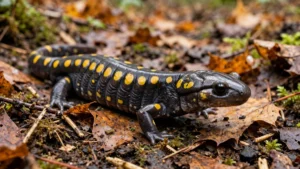
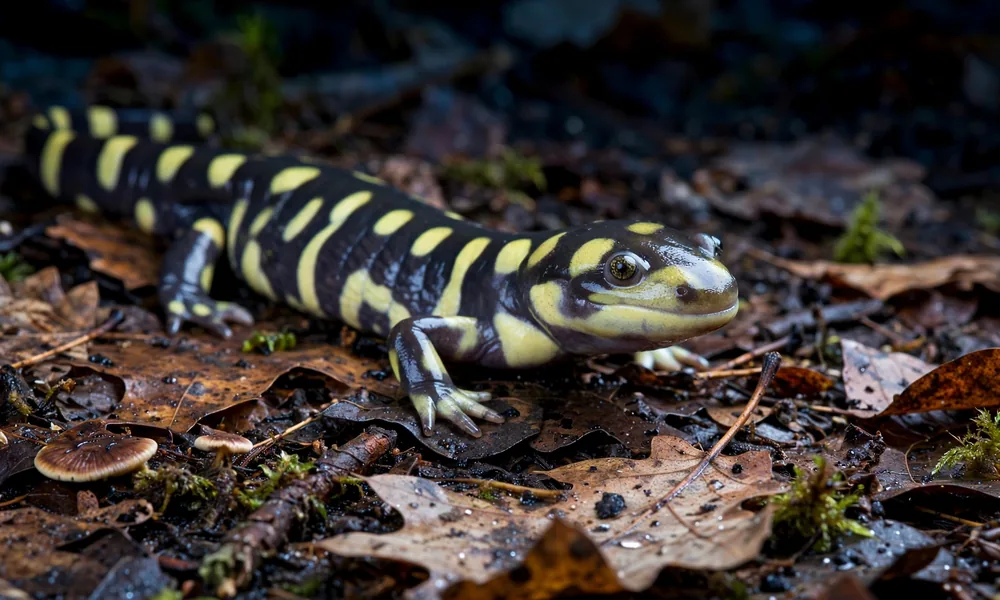
The tiger salamander species is the largest land-dwelling salamander on Earth, a thick-bodied, yellow-striped amphibian that spends most of its life underground in burrows across North America and returns to ponds only to breed. If you are asking what a tiger salamander is, the short answer is a mole salamander of the genus Ambystoma, a dark, glossy animal marked with yellow bars and spots like its namesake, that grows to about 20 centimetres long, eats worms, insects and small frogs, and can live for 15 years in the wild. It is the most wide-ranging salamander in North America, found from southern Canada to eastern Mexico, and it is one of the few amphibians that can stay a gilled, water-living larva all its life and still breed.
Most people will never see one, and that is the point. A tiger salamander spends much of its life below ground, tucked away in a burrow it dug itself or borrowed from a mouse, coming out on wet nights to hunt and crossing the land only when the spring rains call it back to water. The animal you meet on a rainy night is a shy, slow-moving hunter with a broad head, sturdy legs and a long tail, and its skin is mildly toxic, so it is best admired and left alone. This guide follows the whole animal: how it looks, where it lives, what it eats, how it breeds, and why a creature that seems so secretive is doing so well across a whole continent.
Key takeaways
- The tiger salamander species is Ambystoma tigrinum, the largest land-dwelling salamander on Earth, with most adults measuring 15 to 21 centimetres and the biggest animals reaching 33 centimetres and about 125 grams.
- It is the most wide-ranging salamander in North America, living across most of the United States, southern Canada and eastern Mexico, in grassland, woodland and prairie close to ponds.
- Adults live mostly underground in burrows up to 61 centimetres deep, coming out on wet nights to hunt worms, insects, snails, slugs, spiders, frogs and mice.
- Some tiger salamanders never leave the water at all, staying gilled, water-living adults that breed in permanent ponds, a trick called neoteny.
- It is listed as Least Concern, with a stable population across most of its range, though local numbers fall where breeding ponds are drained, built over or stocked with fish.
The tiger salamander species and their relatives
The tiger salamander belongs to the family Ambystomatidae, the mole salamanders, a small family of stout, burrowing salamanders found only in North America. The family holds a single genus, Ambystoma, and every member of it shares the same basic plan: a thick body, a broad head, short sturdy legs, and a life split between a burrow on land and a pond for breeding. The tiger salamander is the biggest and the most widespread of them all, and it is the one most people mean when they talk about a mole salamander.
The genus is Ambystoma, a name that covers about thirty species of mole salamanders, from the tiny, secretive animals of the eastern woods to the great aquatic axolotl of Mexico. The lead species of this guide, the eastern tiger salamander, Ambystoma tigrinum, lives across most of the eastern and central United States, from the Atlantic coast west to the Great Plains, and it grows to 33 centimetres at most, though most adults are far smaller. A typical adult measures 15 to 21 centimetres from snout to tail and weighs around 100 to 125 grams, and the largest animals on record reach 33 centimetres, about the length of a school ruler.
| Type | Animal | Where it lives | Best-known food | Length or Weight |
|---|---|---|---|---|
| Family | Mole salamanders (Ambystomatidae) | Grassland, woodland and prairie across North America | Worms, insects and small animals | Up to 33 cm long |
| Genus | Mole salamanders (Ambystoma) | Ponds and burrows across North America | Worms, insects and small animals | Up to 33 cm long |
| Species | Eastern tiger salamander (Ambystoma tigrinum) | Most of the United States, southern Canada and eastern Mexico | Worms, insects, frogs and mice | 15 to 21 cm long, up to 33 cm |
| Species | Barred tiger salamander (Ambystoma mavortium) | Western North America, from Canada to Mexico | Worms, insects and small animals | 15 to 23 cm long |
| Species | California tiger salamander (Ambystoma californiense) | Central Valley and coastal hills of California | Worms and insects | 15 to 20 cm long |
| Species | Spotted salamander (Ambystoma maculatum) | Woodlands of eastern North America | Worms, insects and slugs | 15 to 25 cm long |
The closest relatives of the tiger salamander are the other great mole salamanders of the west. The barred tiger salamander, Ambystoma mavortium, lives across western North America, from southern Canada to northern Mexico, and it looks much the same, a thick-bodied animal with yellow bars on a dark back, growing to 23 centimetres. It was long treated as a western form of the tiger salamander itself, and the two were only recognised as separate species when genetic work showed they had been apart for a very long time. The California tiger salamander, Ambystoma californiense, is a smaller cousin of the Central Valley and coastal hills of California, growing to 20 centimetres, and it is listed as threatened in parts of its range because its vernal pools have been drained for farming and building.
Within the genus, the mole salamanders sort themselves by the ground they live on and the size they reach. The spotted salamander, Ambystoma maculatum, lives in the woodlands of eastern North America, and it grows to 25 centimetres, a dark animal marked with two neat rows of yellow spots down its back rather than the tiger salamander’s ragged bars. Like the axolotl, the tiger salamander is a member of the genus Ambystoma that can keep its larval features into adult life, but the axolotl is a small, soft-bodied animal of a few Mexican lakes that never leaves the water, while the tiger salamander is a land-living burrower that only returns to the pond to breed.
What a tiger salamander looks like
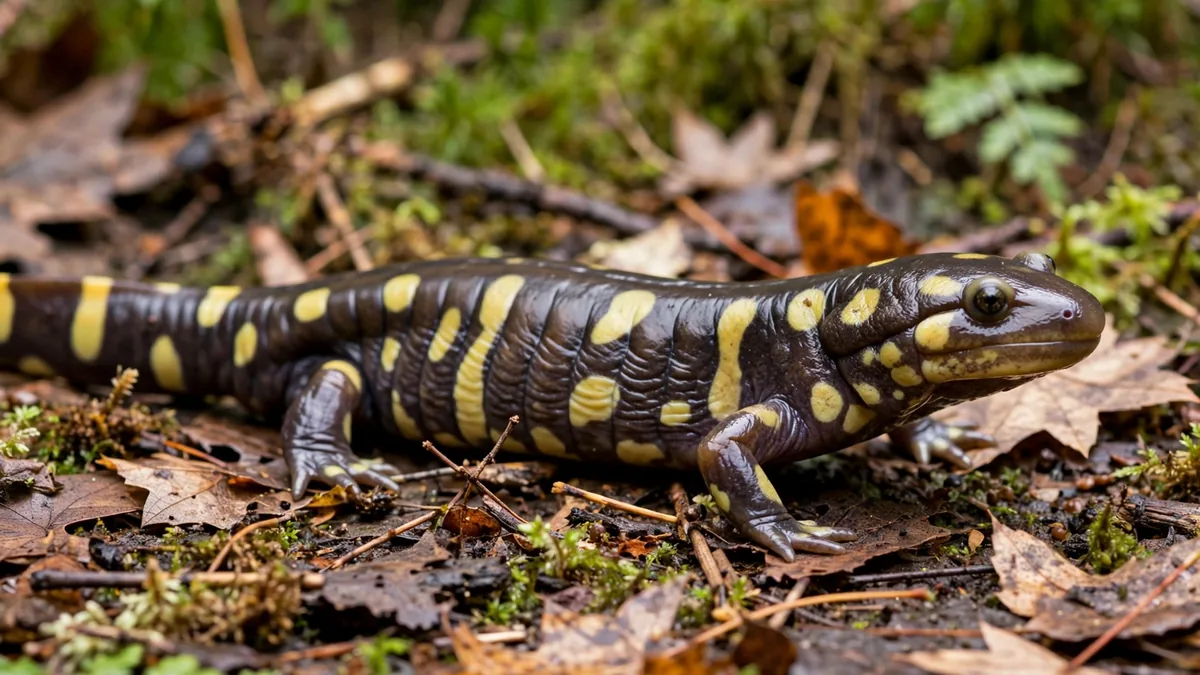
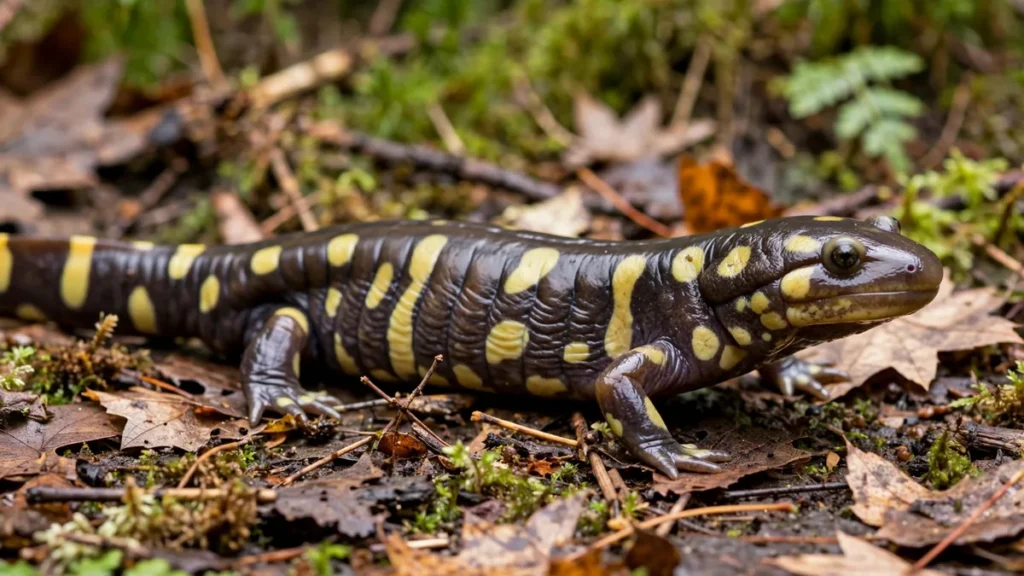
A tiger salamander looks like an animal built for digging and for waiting, and in a sense it is. The body is long and thick, flattened a little from above, with a broad head that takes up a good share of its length, four short, sturdy legs, and a long tail that is rounded rather than flattened. The skin is smooth and glossy, dark brown or black along the back, and it is marked with irregular bars, blotches and spots of bright yellow or olive green, a pattern that varies so much from one animal to the next that no two look quite alike. The belly is paler, grey or yellowish, and the whole animal has a soft, almost rubbery look when it is wet.
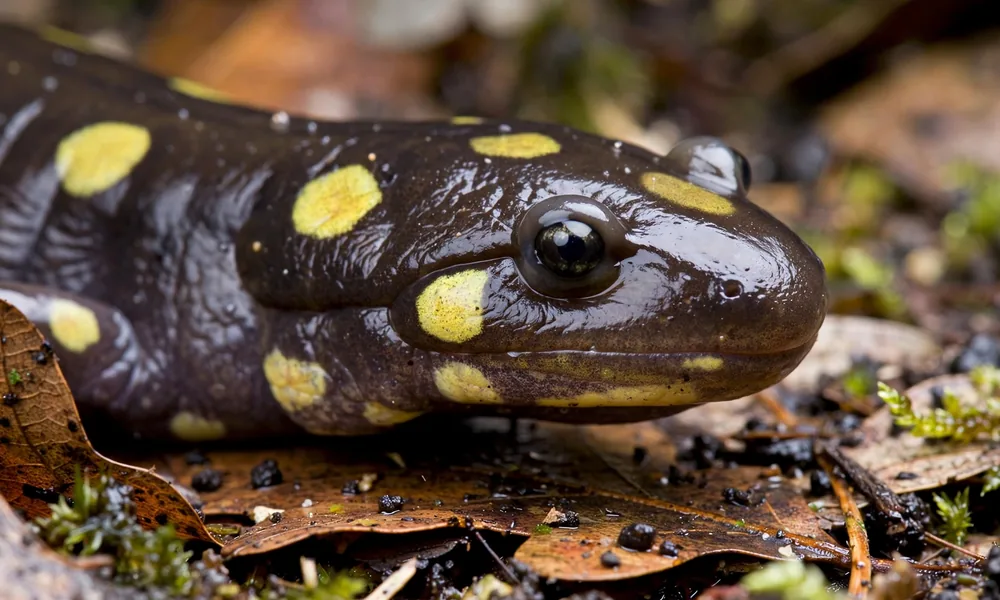
The head is the most distinctive part of the animal, and it is built for a life spent underground and in the dark. The snout is short and rounded, the mouth is wide, and the eyes are large and dark, set wide apart on top of the head. The teeth are small and numerous, set in rows along the jaws, and they are made for gripping rather than chewing, because the salamander swallows its food whole. The front feet are broad and padded, with four toes, and they are the digging tools the animal lives by, while the back feet carry five toes and do the pushing.
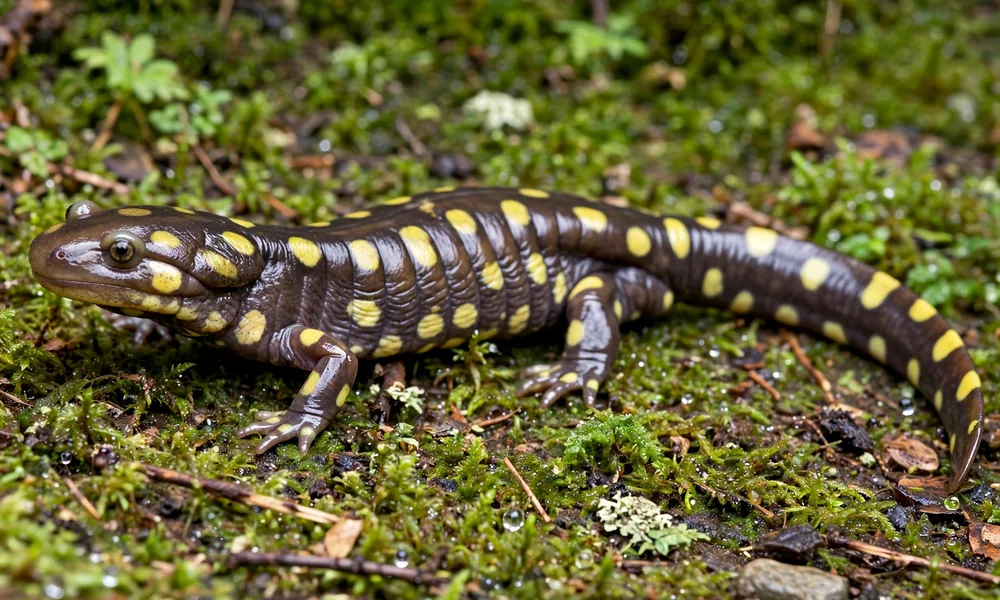
The skin is the animal’s real defence, and it is the reason the salamander looks the way it does. The glands in the skin make a mild toxin that tastes foul to most predators, and a dog or a bird that picks one up will usually drop it again and leave it alone. The skin is also the animal’s lung in part, because it breathes through its damp skin as well as through its lungs, which is why it must stay moist and why it hides away in the heat of the day. The skin is slimy to the touch, and it is covered in a mucus that protects it from infection and helps it slip through narrow gaps in the soil.
The size of a tiger salamander depends on its age and its pond, and the range is wide, because the animals keep growing all their lives. A typical adult is 15 to 21 centimetres long and weighs around 100 to 125 grams, and a good animal in a rich pond will be longer than that. The biggest animals on record reach 33 centimetres and about 125 grams, and the largest land-living salamander on Earth, as National Geographic describes it, is the tiger salamander itself. Males and females are much the same size, and the sexes are hard to tell apart outside the breeding season, when the male’s cloaca, the vent at the base of the tail, swells. The young hatch at only a few millimetres long, and they do not breed until they are four or five.
Compared with other salamanders, the tiger salamander is easy to tell apart once you know what to look for. No other land salamander comes close to its bulk, and no other combines a broad head, sturdy digging feet, a long rounded tail and bold yellow bars on a dark back. The spotted salamander is the animal most often confused with it in a photograph, and the two can be separated by the pattern, two neat rows of round yellow spots in the spotted salamander against the tiger salamander’s ragged bars and blotches, and by the range, since the spotted salamander keeps to the eastern woodlands while the tiger salamander roams the grasslands and prairies as well.
Where tiger salamanders live
Tiger salamanders live across most of the United States, southern Canada and eastern Mexico, and they are animals of grassland, woodland and prairie close to water. Their range is the widest of any salamander in North America, stretching from the Atlantic coast to the Rocky Mountains and from the Canadian prairies south to the highlands of Mexico, and they are found in almost every state where a pond and a patch of loose soil meet. They are absent only from the far north, the driest deserts and the highest mountains, and they are commonest where the land is flat, the soil is soft, and the ponds are fish-free.
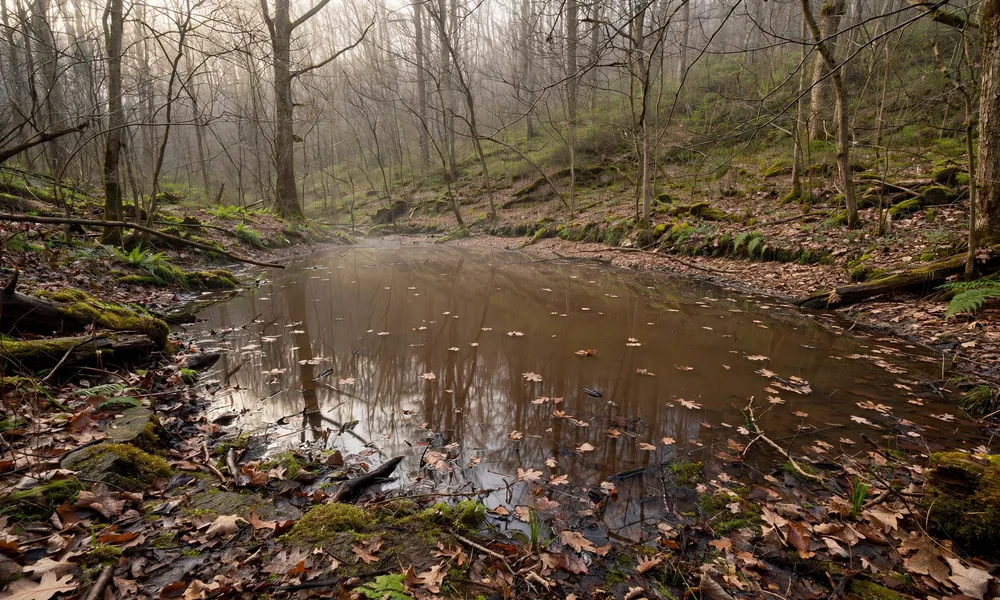
The habitat they choose is the ground itself, and they are rarely found far from a burrow. Most tiger salamanders spend the day hidden in burrows they dig themselves in soft soil, in the burrows of mice and gophers, or under logs and stones, and they come out at night to hunt in the leaf litter nearby. They favour loose, damp soil that is easy to dig, and they are rarely found where the ground is paved, ploughed flat or baked hard by the sun, which sets a hard limit on where they can live. The ponds they breed in are usually shallow, temporary pools that fill with the spring rains and dry out by late summer, which keeps them free of fish.
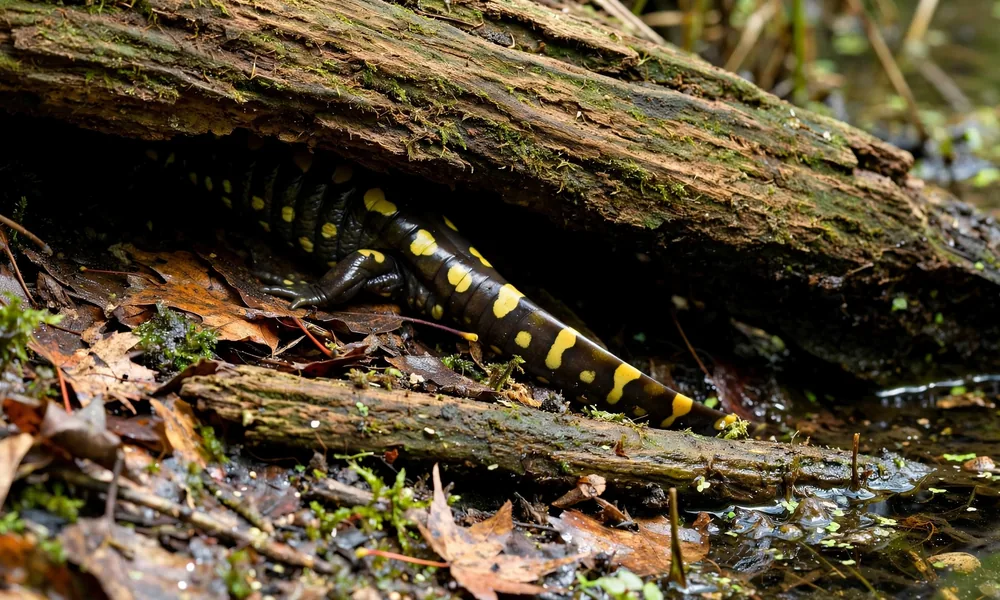
The burrow is the centre of a tiger salamander’s life, and it is a remarkable piece of engineering for an animal with no tools but its feet. The burrows may reach 61 centimetres, about two feet, below the surface, and they stay cool and damp through the hottest summer and the coldest winter, which is why the salamander can live in places where the weather above ground would kill it in hours. A single burrow may be used for months at a time, and the salamander will often return to the same pond year after year, crossing the same stretch of ground on the same rainy nights.
What tiger salamanders eat
Tiger salamanders are hunters, and their diet is written on the ground itself. The everyday food is worms, and a tiger salamander will eat almost any earthworm it can find in the damp soil, along with insects, snails, slugs and spiders. They also eat frogs, mice and even baby snakes, and a salamander that has fed well may not need to eat again for days. They are the top predators of their burrows and their ponds, and nothing much in the leaf litter eats an adult tiger salamander, though its skin toxin helps with that too.
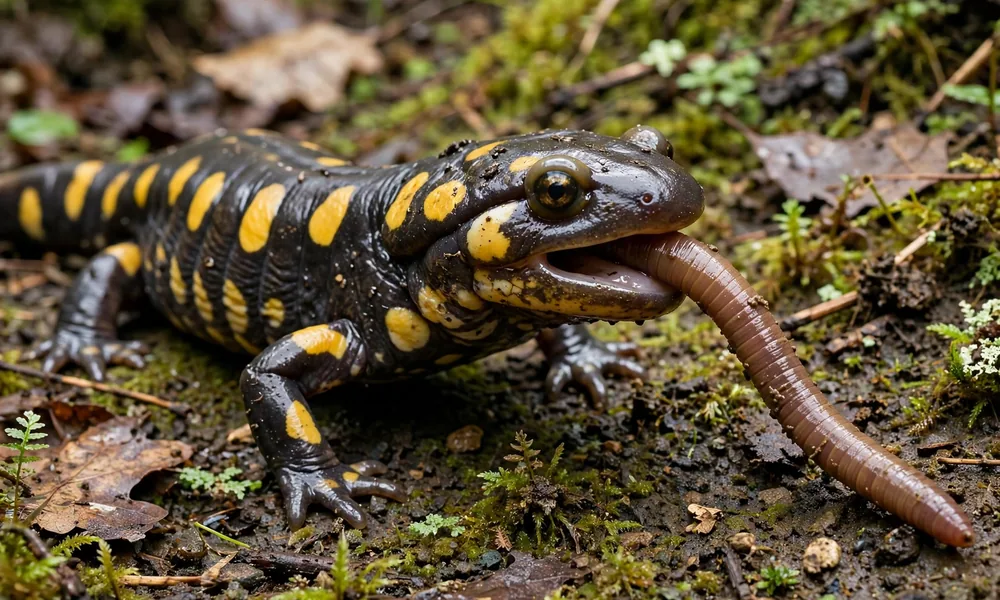
What sets the tiger salamander apart is how it hunts. It does not chase its prey, and it does not hunt in a pack. It waits in its burrow mouth or moves slowly through the leaf litter, and when something wiggles within reach it lunges forward and snaps it up in its wide mouth, and the whole strike is over in a fraction of a second. The larvae hunt the same way in the water, lying still among the pond weeds and lunging at anything small that swims past, from water fleas and mosquito larvae to tadpoles, and they will eat each other when food is short.
Feeding follows the rhythm of the rain and the night, and it is busiest after dark. Tiger salamanders feed most actively on wet nights, when the worms are out and the ground is soft, and they rest in the day, holding in their burrows where the food is thin. They are famous for being able to fast for a very long time, and animals in captivity have gone for weeks without eating. A salamander that has fed well in the spring will carry the fat through the summer, when the ground dries out and the hunting is poor.
How tiger salamanders behave
Tiger salamanders are night animals, and their day is a quiet round of hiding, waiting and hunting in the dark. They spend the daylight hours tucked away in a burrow or under a log, saving energy, and they come out at dusk to hunt in the leaf litter, moving slowly through the damp ground, never rushing, never chasing far. They are not strong travellers over distance, and they do not need to be: their life is lived within a few dozen metres of burrow and pond. When a larger animal passes, a tiger salamander will often freeze and sink into the shadows, and if that fails it will dart back down its burrow and wait.
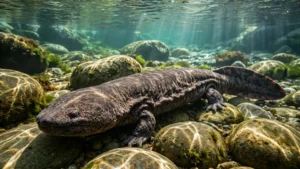
The most famous behaviour in the tiger salamander is the one it does not do: grow up. In permanent ponds, some tiger salamanders never lose their larval gills at all, and they stay in the water for life as gilled, breeding adults, a trick called neoteny. These animals are often called waterdogs, and they can grow even bigger than the land adults, reaching about 38 centimetres in some populations, with broad heads and a taste for anything that swims. In one Yellowstone study, gilled adults made up about 3 per cent of the animals sampled, and they were found only in the lakes that never dried out.
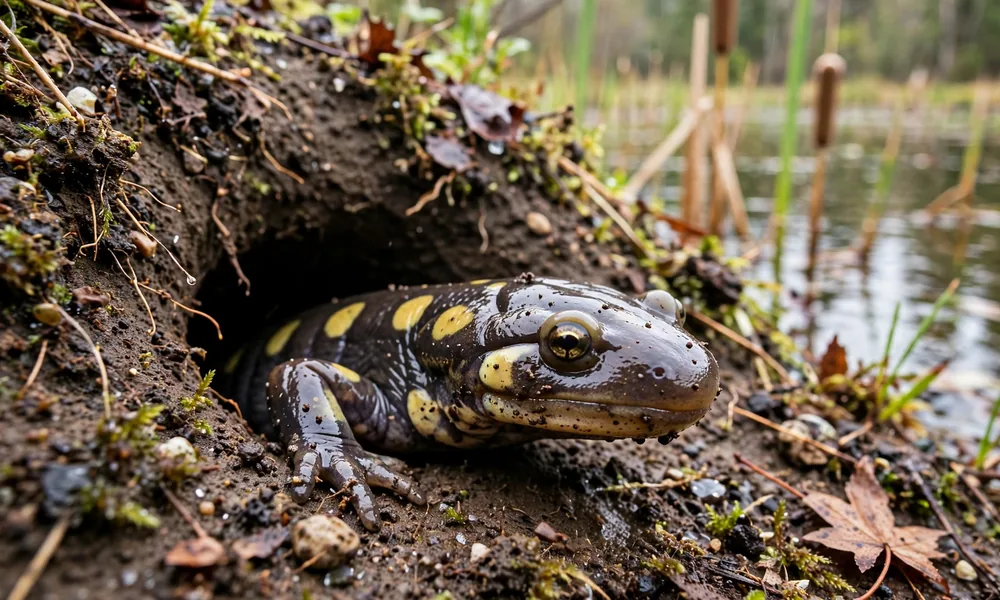
When a tiger salamander is threatened, its first response is to freeze and hide, relying on its dark skin and its stillness to vanish against the leaf litter, and if that fails it will dart down the nearest burrow and stay there until the danger passes. Tiger salamanders have no venom and no bite that matters to a person, though a large animal can give a sharp nip if it is picked up, and a salamander brought out of its burrow will rarely live long if it is kept in dry air, because its skin dries out and it cannot breathe properly. The salamander is a prey item itself only when it is young, and it is eaten by fish, birds and snakes in its first years, while an adult has few natural enemies on land.
Breeding and life cycle
Tiger salamanders breed once a year, and the timing is set by the rain. The breeding cycle begins in late winter or early spring, when the adults leave their burrows on wet nights and migrate to the ponds where they were born. The males arrive first, and they court the females in the shallow water with a slow, circling dance, nudging and rubbing against them until the female is ready. The male then deposits a small packet of sperm on the pond bottom, and the female picks it up with her cloaca, fertilising her eggs inside her body before she lays them.
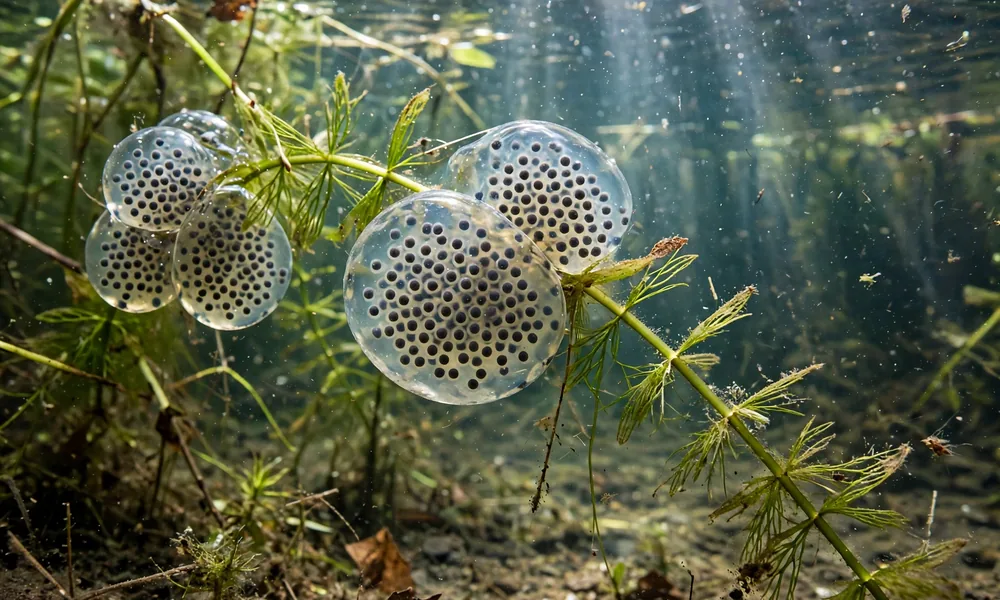
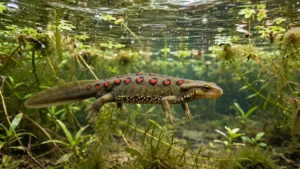
The female lays her eggs in the pond in jelly masses attached to submerged weed, sticks or stones, and each mass holds 100 to 250 eggs, with a single female laying several masses over several nights. The eggs are small when they are laid, only a few millimetres across, and they hatch after about three to four weeks, depending on the temperature of the water. The larvae that emerge are fully aquatic, with feathery external gills and a fin along the tail, and they grow fast on a diet of water fleas, mosquito larvae and tadpoles. In a pond that dries early they may transform in a few weeks, while in a deep, permanent pond they may stay in the water for months, and some never transform at all.
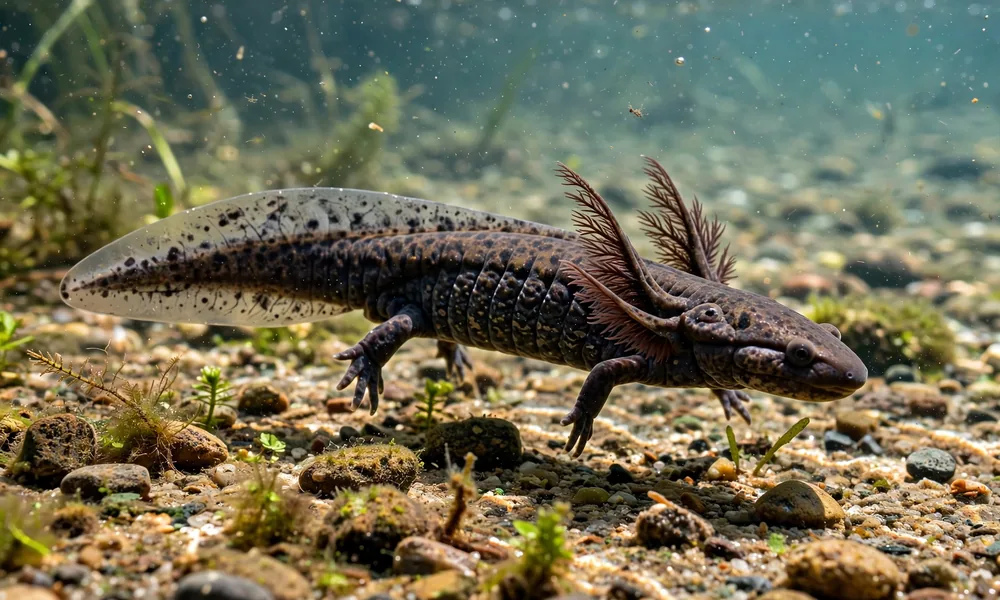
Growth is fast in a good pond and slow in a poor one, and a young tiger salamander can take a long time to become an adult. The larvae hatch at only a few millimetres long, and they look nothing like the adult at all, small and dark with feathery external gills that they keep until they are big enough to leave the water. The young are independent from the day they hatch, able to feed and hide within hours, but most of them will never reach adulthood, eaten by fish, dragonfly larvae and other predators in their first weeks. Maturity comes at four to five years of age, and the animals then keep growing for the rest of their lives. Wild animals average 12 to 15 years, and captive animals have lived for up to 25 years.
Conservation status
The tiger salamander is listed as Least Concern by the International Union for Conservation of Nature, and the reasoning is straightforward: it is common across most of its huge range, and its numbers are stable in most places. That broad picture hides a more uncertain local one, because the salamander is tied to the fate of the ponds it breeds in. An animal that needs a fish-free pond in spring and a patch of soft, unploughed ground to dig in cannot live where the ponds are drained, the ground is paved, or the water is stocked with fish, and a pond that loses its tiger salamanders loses its top predator soon after.
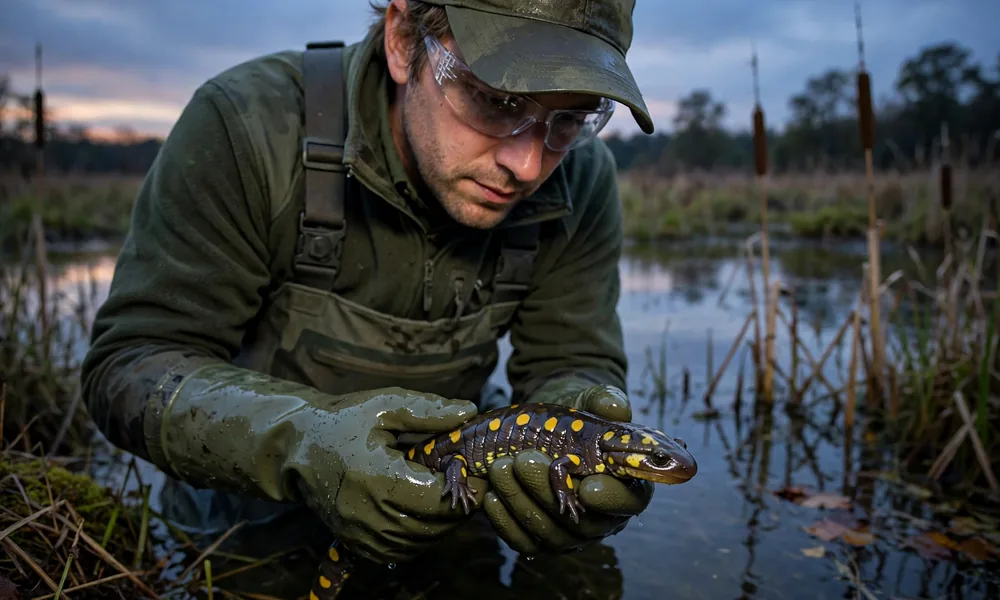
The main pressure is the loss of breeding ponds. For decades the vernal pools and farm ponds of North America have been drained for building and farming, filled in for roads, or stocked with fish that eat the eggs and larvae, and the salamanders have vanished from many of the ponds where they were once common. Road traffic is a quieter killer, because the adults cross roads on rainy spring nights to reach their ponds, and many are run over before they get there. Pesticides that wash into the ponds are a further threat, because a salamander breathes through its skin and takes in whatever is in the water.
The most useful conservation work is practical, and it is the same work that helps the whole pond. Protecting the vernal pools from draining and filling keeps the fish-free water the salamander needs, and keeping a strip of soft, unploughed ground around each pond gives the adults somewhere to dig. There are no easy answers, and none of the work will matter unless the ponds themselves are protected.
Best seasons for tiger salamander watching
The best time to look for a tiger salamander is the late winter and early spring, when the breeding season is under way and the animals are at their most active, though no season will show you one from the bank in daylight. Tiger salamanders are present in their burrows all year round, so there is no wrong season in the strict sense, but a visit on a wet night in February or March, when the rain is falling and the adults are crossing to their ponds, is the time when the animals are most likely to be found. In the summer the animals are deep in their burrows, holding cool and damp, and they are hardest to find then.
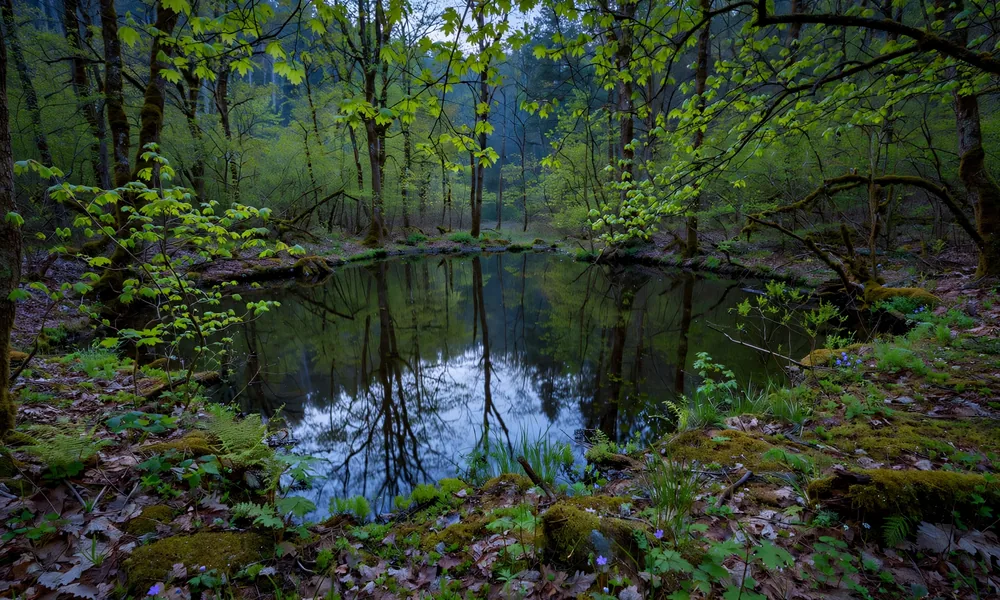
The best hours are the night, when the salamanders are out hunting in the leaf litter and the torchlight can find them on the damp ground. From about dusk until midnight, the animals are at their most active, moving slowly through the wet leaves, and they are at their easiest to see then, if you move gently and keep your light low. A slow walk along a pond edge with a red torch, watching for a dark shape with yellow bars on the ground, is all you need, and the salamander will often hold still long enough to see the broad head and the yellow markings clearly.
Staying safe around tiger salamanders
A tiger salamander is not dangerous to people, and there is no safety warning that belongs to the animal itself. It has no venom, it does not bite unless it is picked up, and it will not chase or threaten a walker, because it lives in a burrow and it will never meet one. The safety rules for watching tiger salamanders are the rules of the pond and the road: watch the water, watch the traffic, and respect the animal that you came to see. Never handle a salamander with dry hands, and never keep one out of its burrow longer than you must, because an animal that breathes through its skin will dry out and suffer quickly in air.
There are a few practical points for the night itself. Work with a buddy, stay within your depth, and keep an eye on the weather, which can change fast in the spring and turn a quiet pond edge into a cold, wet night in an hour. A tiger salamander will not hurt you, but a road at night can, and the sensible approach is to enjoy the animal and respect the dark ground it lives on.
Tiger salamander watching checklist
A little preparation turns a wet night beside a vernal pond into a real chance of seeing a tiger salamander at its best, lying on the leaf litter with its yellow bars in the torchlight.
- A vernal pond in late winter or early spring, when the breeding season is under way and the animals are at their most active.
- A wet night, when the salamanders are out hunting in the leaf litter and crossing to their ponds.
- Loose, damp soil and leaf litter near the pond, where the salamander can dig its burrow and find its food.
- A red torch, so you can see the animal without blinding it or driving it back down its burrow.
- Sturdy boots with a good grip, so that wet ground and a muddy pond edge stay safe from start to finish.
- A buddy and a charged phone, so that a night in the woods stays safe if the weather turns.
- Respect for the animal and the pond, keeping your distance, keeping the salamander damp and in the ground, and leaving the pond as you found it.
Frequently asked questions
How big do tiger salamanders get?
Most tiger salamanders measure 15 to 21 centimetres from snout to tail, and a good adult weighs around 100 to 125 grams. The largest animals on record reach 33 centimetres, and the gilled, water-living adults of permanent ponds can grow even bigger, to about 38 centimetres in some populations.
What do tiger salamanders eat?
A tiger salamander eats worms, insects, snails, slugs, spiders, frogs, mice and even baby snakes, which it takes in the dark with a sudden snap of its wide mouth. The everyday food is worms, and a salamander that has fed well may not need to eat again for days. The larvae eat water fleas, mosquito larvae, tadpoles and the larvae of other salamanders, and they will eat each other when food is short.
Why do tiger salamanders have yellow stripes?
Tiger salamanders have yellow stripes and blotches for two reasons, and both are about staying alive. The bold pattern breaks the animal up against the leaf litter, so it is hard to see when it holds still, and it also warns predators that the skin carries a mild toxin that tastes foul. The pattern varies so much from one animal to the next that researchers can tell individuals apart by their markings, much as people are told apart by their fingerprints.
Are tiger salamanders dangerous?
No, tiger salamanders are not dangerous to people. They have no venom, they do not bite unless they are picked up, and they will not chase or threaten a walker, because they live in burrows and they will never meet one. Their whole defence is built on being hard to see, hard to find and hard to catch, and their first response to a threat is to freeze and hide down the nearest burrow. The safety rules for watching them are the rules of the pond and the road: watch the water, watch the traffic, and wear sturdy boots on wet ground.
Can you keep a tiger salamander as a pet?
You can in some places, where they are legal to keep, but it is a serious commitment and not a casual pet. A tiger salamander needs a large tank with deep, damp soil to dig in, a shallow pool of clean water, live worms and insects to eat, and cool temperatures all year round, and it can live for up to 25 years in captivity. A tiger salamander belongs in a burrow beside a pond, not in a living room.
How is this guide different from the spotted salamander guide?
This guide covers the tiger salamander, a thick-bodied burrower of up to 33 centimetres that lives in grassland, woodland and prairie across most of North America, hunts worms and mice on wet nights, and can stay a gilled, water-living adult for life, while our spotted salamander guide covers a woodland salamander of up to 25 centimetres that keeps to the forests of eastern North America, wears two neat rows of yellow spots rather than ragged bars, and always leaves the water to live on land as an adult. One is a wide-ranging digger you meet on a rainy night in open country; the other is a forest animal you meet under a log in the eastern woods.
This guide also goes well beyond our generic frog guide, which covers frogs as a whole, from the pond edge to the rainforest, without settling on any one animal. The frog guide tells you what a frog is and how frogs live in general, while this guide stays with a single species, the tiger salamander, through its burrows and breeding ponds, its neoteny and its night hunting, with sizes, weights and life spans checked against the latest sources. If you want the broad picture of frogs, the generic guide is the place to start; if you want the tiger salamander itself, this is the guide to read.
Conclusion
The tiger salamander species is a reminder that an animal does not need to be fast or fierce to be unforgettable. A broad head, sturdy digging feet, bold yellow bars on a dark back, and a body longer than a school ruler have made the tiger salamander the most famous salamander on land, at home in the burrows and ponds of North America for millions of years.
If you go looking for one, go to a vernal pond in late winter, go at night, and walk slowly along the bank with a red torch and a quiet step. Find the damp leaf litter, watch for a dark shape with yellow bars on the ground, and wait for it to move, and you will have met the tiger salamander that turns a dark, empty stretch of woodland into a place of sudden, ancient wonder.