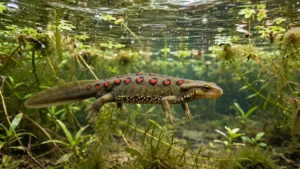
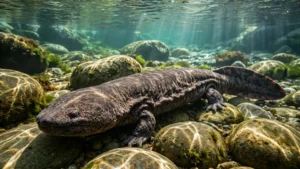
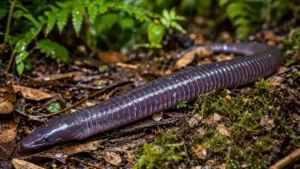
The hellbender species is North America’s largest salamander, a flat, wrinkled giant that spends its whole life underwater in the cool, fast streams of the eastern United States. If you are asking what a hellbender is, the short answer is a fully aquatic salamander, Cryptobranchus alleganiensis, that grows to about 74 centimetres at most, weighs up to 2.5 kilograms, breathes almost entirely through the folds of skin along its sides, and hunts crayfish by night under large flat rocks. It is an animal most people will never see, because it lives where the water runs clear and cold, and it spends the daylight hours tucked out of sight.
Hellbenders have been around for a very long time. Their family, the giant salamanders, has occupied streams in one form or another for around 65 million years, and the hellbender’s flat body, tiny eyes and frilly skin folds are all answers to the same problem: how to live, breathe and hunt in fast water without ever leaving it. This guide follows the whole animal, from the way it looks and the streams it needs, through what it eats and how it behaves after dark, to the father who guards his eggs for months under a single rock, and the reasons its numbers are falling in so many rivers.
Key takeaways
- The hellbender species is Cryptobranchus alleganiensis, the only living member of its genus, and the largest salamander in North America, growing to about 74 centimetres at most and weighing up to 2.5 kilograms.
- Hellbenders breathe mainly through their skin, using the wrinkled folds along their sides to take oxygen from the water, and they need clean, cool, fast-flowing streams with plenty of dissolved oxygen.
- Crayfish make up most of the diet, with small fish, insects, tadpoles and worms taken as well, and hellbenders hunt at night, walking along the stream bed rather than swimming.
- The male digs a nest under a large flat rock, the female lays 150 to 900 eggs in long strings, and the male then guards them alone for ten to twelve weeks until they hatch.
- The hellbender is listed as Near Threatened, and its populations have declined across much of its range because of silt, pollution, damming and the loss of the big flat rocks it needs for shelter and nesting.
The hellbender species and their relatives
Hellbenders belong to the family Cryptobranchidae, the giant salamanders, a small and ancient family with only two living genera. One is Cryptobranchus, which holds the hellbender alone, and the other is Andrias, which holds the giant salamanders of China and Japan. The family sits in the order Caudata, the salamanders and newts, and it is one of the oldest groups of living amphibians, with a fossil history that reaches back tens of millions of years. The name Cryptobranchus comes from Greek words meaning hidden gill, a nod to the gill slits that adults keep even though they no longer have proper external gills.
The lead species of this guide is the eastern hellbender, Cryptobranchus alleganiensis alleganiensis, which is the form found through most of the range, from southern New York south to northern Georgia and west to Missouri and Arkansas. Adults are usually 30 to 60 centimetres long, with the largest reaching about 74 centimetres, and they weigh 1.5 to 2.5 kilograms. A second subspecies, the Ozark hellbender, Cryptobranchus alleganiensis bishopi, lives in a small number of rivers in Missouri and Arkansas, and it is federally listed as endangered in the United States, a sharper warning than the species-wide picture.
| Type | Animal | Where it lives | Best-known food | Length or Weight |
|---|---|---|---|---|
| Family | Giant salamanders (Cryptobranchidae) | Eastern North America and East Asia | Crayfish, fish and invertebrates | About 30 cm to 1.8 m long |
| Genus | Hellbenders (Cryptobranchus) | Eastern and central United States | Crayfish and small fish | Up to 74 cm long |
| Species | Eastern hellbender (Cryptobranchus alleganiensis alleganiensis) | Southern New York to northern Georgia | Crayfish and small fish | Up to 74 cm long |
| Species | Ozark hellbender (Cryptobranchus alleganiensis bishopi) | Rivers of Missouri and Arkansas | Crayfish and small fish | Usually under 60 cm long |
| Species | Chinese giant salamander (Andrias davidianus) | Mountain streams of China | Fish, crayfish and frogs | Up to 1.8 m long |
| Species | Common mudpuppy (Necturus maculosus) | Lakes and rivers of North America | Crayfish, fish and insects | Up to 40 cm long |
The closest relatives of the hellbender are the giant salamanders of Asia, and the comparison puts its size in perspective. The Chinese giant salamander, Andrias davidianus, grows to 1.8 metres, more than twice the length of the largest hellbender, and the Japanese giant salamander, Andrias japonicus, grows to about 1.5 metres. Both live in fast mountain streams, both breathe through their skin, and both are in far worse trouble than the hellbender, with the Chinese species listed as Critically Endangered.
The animal most often confused with a hellbender is the common mudpuppy, Necturus maculosus, which shares many of the same rivers and grows to about 40 centimetres. The two are easy to separate once you know what to look for, because the mudpuppy keeps large, feathery external gills all its life and has only four toes on each hind foot, while the adult hellbender has no external gills and has five toes on each hind foot. Like the frog, the hellbender is an amphibian that depends on clean water, but the frog divides its life between water and land, while the hellbender never leaves the stream at all.
What a hellbender looks like
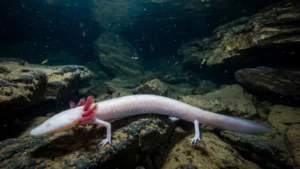
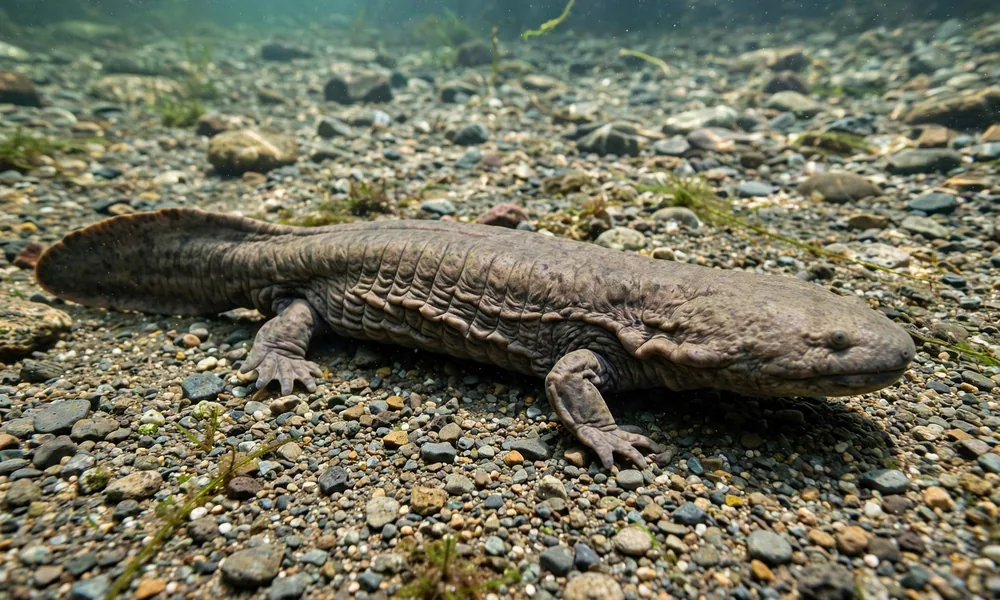
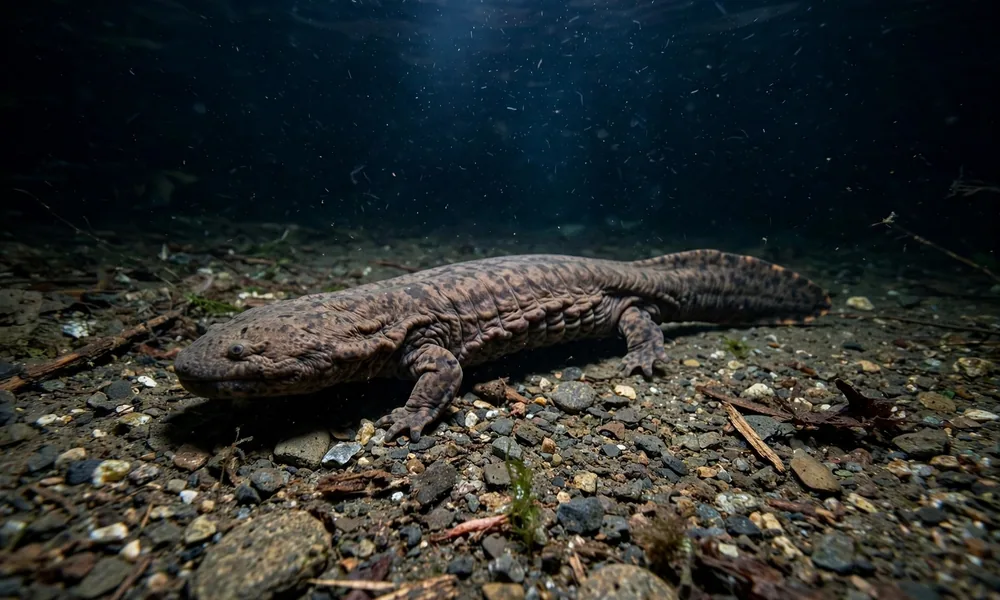
A hellbender looks like something left over from an older world, and in a sense it is. The body is broad and flat, pressed down as if a weight had sat on it, with a wide, flat head, a long tail flattened from side to side like a rudder, and four short, stout legs that seem too small for the animal they carry. The skin is slimy and loose, hanging in thick folds along the sides of the body, and the colour runs from grey to olive brown and sometimes almost black, often with dark spots on the back and a paler belly.
The skin folds are the most important part of the animal, and they are the reason it looks the way it does. A hellbender has working lungs, but it uses them mainly for buoyancy, and it takes almost all of its oxygen through its skin, through the dense network of tiny blood vessels in those folds. The folds increase the surface area of the skin, so more water flows over more blood, and the animal can breathe without ever surfacing. In warm water, or in water low in oxygen, a hellbender will rock gently from side to side, and that rocking moves fresh water over the folds, which is a small, constant piece of work that keeps it alive.
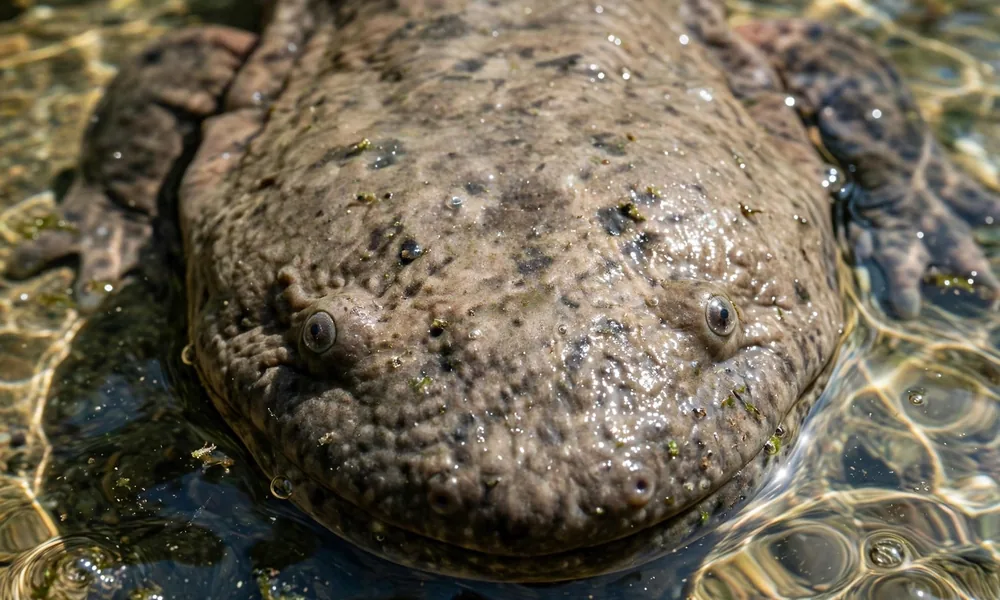
The head is wide and flat, with two tiny, beady eyes set on top, and the eyes are so small that they look like an afterthought. Hellbenders do not rely on sight, and their eyes are useful mainly for telling light from dark, while the real senses are smell and touch, and the sensitive skin that feels the movement of water around them. The mouth is wide, with small teeth, and the front feet have four toes while the hind feet have five, each toe tipped with a pad that grips the rock.
Size is what sets the hellbender apart from every other salamander in North America. Most adults measure 30 to 60 centimetres from snout to tail, and the largest on record reach about 74 centimetres, which is roughly the length of a man’s arm from elbow to fingertip. Adults weigh 1.5 to 2.5 kilograms, and females tend to live longer than males and so grow larger. Young hellbenders look like small copies of the adults, except that the larvae have external gills, which they lose as they grow, and a single open gill slit remains on each side of the neck in the adult.
Compared with other large salamanders, the hellbender is easy to tell apart once you have seen one. No other salamander in North America combines a body this flat and this large with loose skin folds along the sides and no external gills in the adult, and no other salamander is so completely tied to fast, rocky streams. The mudpuppy is the nearest lookalike, and the gills give it away at a glance, while the sirens, long eel-like salamanders of the south-east, have only front legs and no hind legs at all.
Where hellbenders live
Hellbenders live in the cool, clear streams and rivers of the eastern and central United States, from southern New York south to northern Georgia and west to Missouri, Arkansas and a small part of Kansas and Oklahoma. Their range follows the Appalachian Mountains and the river systems that drain them, including the Ohio, Tennessee, Susquehanna and Allegheny river systems, and they are animals of the uplands, where the water runs fast over rock and gravel. They are not found in the slow, warm, muddy rivers of the lowlands, and they are not found in ponds or lakes.
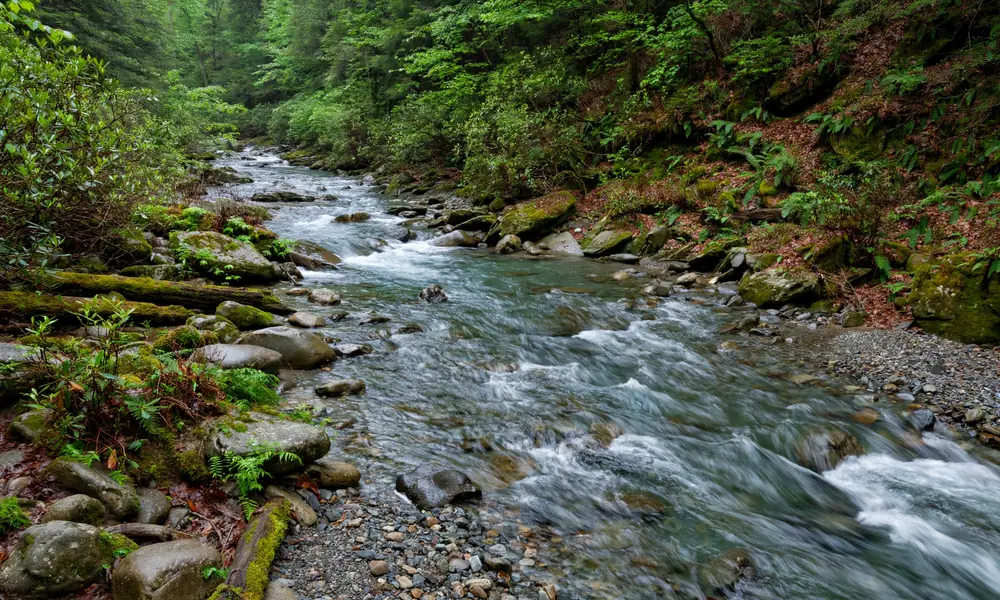
The habitat they need is narrow, and that narrowness is the heart of their trouble. Hellbenders need large streams and rivers with fast-flowing, clear water and a rocky bottom, and they need large, flat rocks, partly buried in the stream bed, with a hollow underneath that they can use as a shelter and a nest. They need water that is cool, usually below 20 degrees Celsius, and rich in dissolved oxygen, because they breathe through their skin, and warm or still water holds too little oxygen for them. They also need gravel on the stream bed rather than mud, because the young hide among the stones, and mud smothers both the shelter and the eggs.
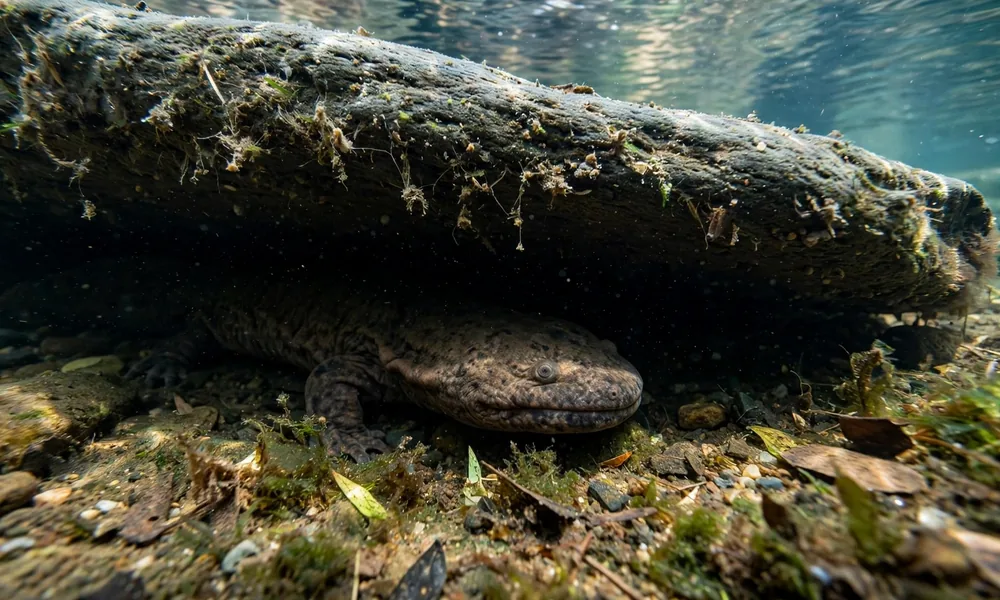
A hellbender’s home is a small patch of stream, and it does not wander far. Adults hold a home range of roughly 2,000 square metres around a shelter rock, and they may use the same rock for years, returning to it night after night. They are solitary animals, and each rock tends to hold one adult, except in the breeding season, when a male will defend his nest rock against every other hellbender that tries to enter. If the rocks are removed, whether by people clearing a stream or by a flood that rolls them away, the hellbenders leave, and they may not come back.
The streams that suit hellbenders best are the ones with forested banks, because the trees shade the water and keep it cool, and their roots hold the soil that would otherwise wash in as silt. A stream that runs through open farmland or a town, with bare banks and warm, cloudy water, is rarely any good for them, and the animals vanish from such places long before the stream looks ruined to a human eye. That sensitivity is why hellbenders are called indicators of healthy streams: where they thrive, the water is clean, and where they have gone, something has already gone wrong.
What hellbenders eat
Hellbenders are hunters, and their diet is written on the stream bed itself. The everyday food is crayfish, and crayfish make up the bulk of what a hellbender eats through the warmer months, when the crayfish are active and easy to find under the stones. They also eat small fish, insects and their larvae, worms, molluscs, tadpoles and small frogs, and they will eat other hellbenders and their eggs when the chance comes. A hellbender is not a picky eater, but it is a patient one, and it takes what the stream offers.
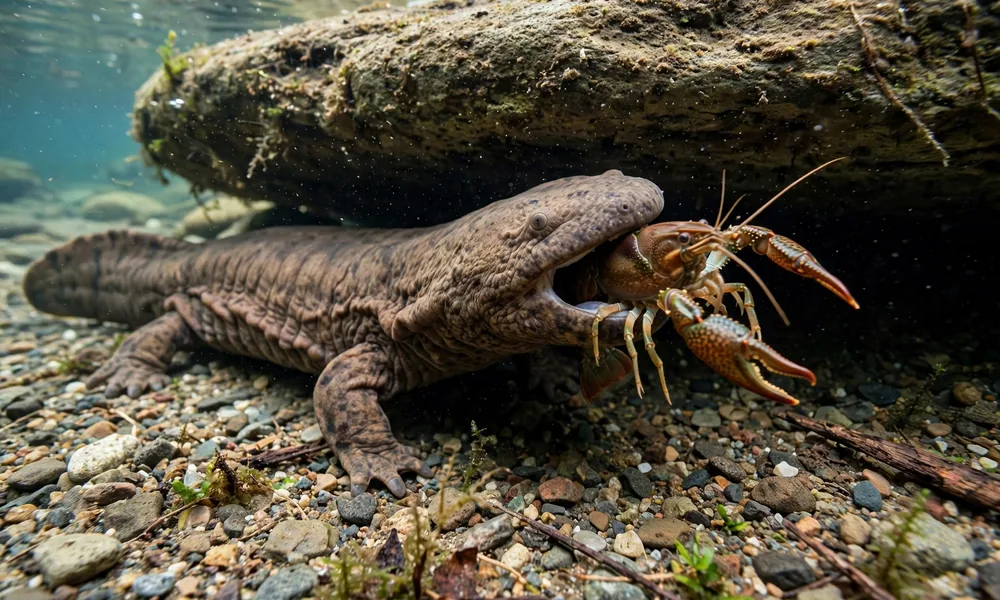
What sets the hellbender apart is how it hunts. It does not chase its prey, and it does not swim after fish in open water. It walks along the stream bed on its short legs, gripping the rock with its toe pads, and it feels for crayfish hiding under stones, using its sensitive skin and its sense of smell to find them in the dark. When it finds one, it opens its wide mouth and sucks the prey in, or it grabs it and crushes it, and the crayfish is swallowed whole. Like the axolotl, the hellbender is a salamander that feeds by suction in the water, but the axolotl is a still-water animal of a Mexican lake that hovers and snaps, while the hellbender is a stream animal that walks the river bed and hunts under stones.
Feeding follows the seasons, and it is busiest in the warm months. Crayfish make up most of the diet in summer, while fish make up a larger share in winter, when the crayfish are less active and harder to find. Hellbenders generally stop eating altogether when the water rises above about 22 degrees Celsius, which is one more reason they need cool streams, and they do not range far in search of food, usually staying within 9 to 18 metres of the centre of their territory. A hellbender that has fed well can go for days without eating again, and its slow, cold-water life burns little energy.
How hellbenders behave
Hellbenders are night animals, and their day is a quiet round of hiding, waiting and hunting in the dark. They spend the daylight hours under their rock, pressed flat against the stream bed, saving energy and staying out of sight, and they come out at night to walk the river bed and hunt. They are not strong swimmers, and they rarely swim at all: their tail is shaped like a rudder, but they use it little, and they move by walking, gripping the stones with their toes and letting the current flow over their backs.
The rocking motion is the behaviour most people notice first when they see a hellbender in a tank, and it is easy to mistake for restlessness. In fact it is breathing: the animal sways gently from side to side, and the movement draws fresh, oxygen-rich water over the folds of skin along its sides, where the blood vessels lie close to the surface. In a fast stream the current does this work for free, but in still water the hellbender has to do it itself, and an animal that stops rocking in warm, still water is an animal in trouble.
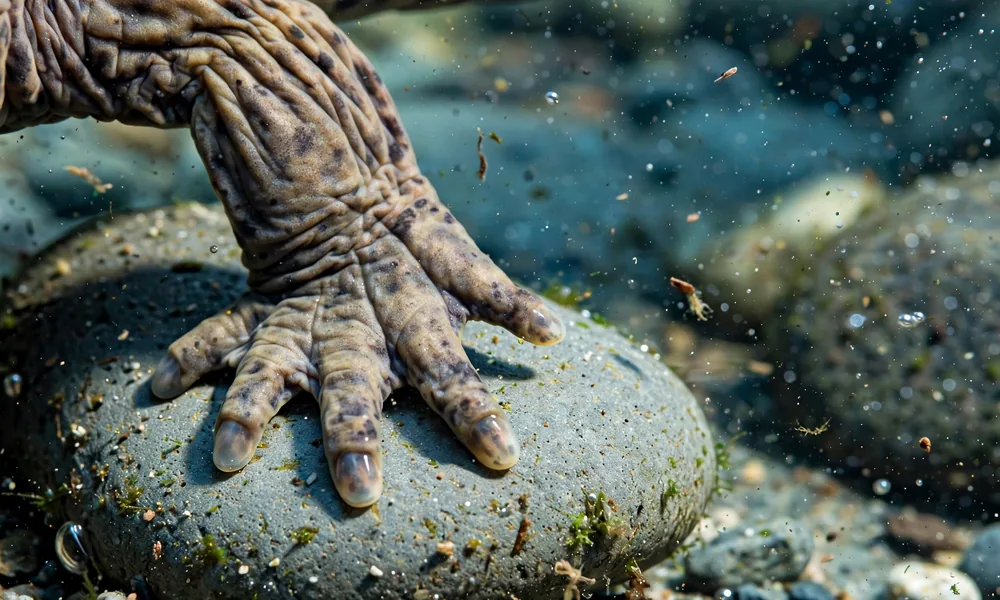
Hellbenders are solitary and, outside the breeding season, they keep to themselves. They defend their shelter rock against other hellbenders, and two adults under one rock is a rare sight, though a male may tolerate a female near his nest rock in the breeding season. They have no venom and no bite that matters to a person, though a large hellbender can give a sharp nip if it is picked up carelessly, and their first response to a threat is to stay still under the rock and hope not to be noticed. Their predators are few as adults, but raccoons, mink and river otters will take them when they can, and herons and large fish take the young.
Breeding and life cycle
Hellbenders breed in late summer and early autumn, from August to early November depending on latitude and water temperature, and the breeding season is the one time of year when these solitary animals come together. The males go first, staking out the best nest rocks, the large, flat stones with a good cavity underneath and few entrances, and excavating a saucer-shaped hollow in the gravel beneath them. A dominant male, sometimes called a den master, will defend his rock against every other hellbender, biting intruders, male and female alike, until the females he wants are allowed in.
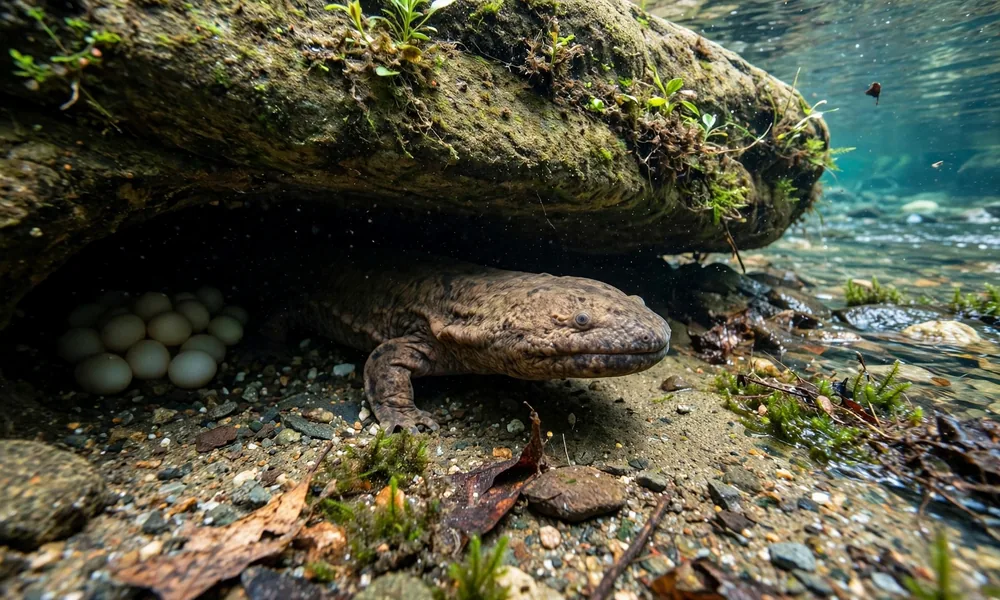
The female enters the nest and lays her eggs in long strings, like strings of pearls, onto the nest bed, and the male fertilises them in the water as she lays them. A single female lays 150 to 900 eggs, with 200 to 400 being typical, and a male may attract more than one female to his nest in a season, so a single nest can hold 1,000 eggs or more. The eggs are round, 5 to 7 millimetres across, and they lie in a soft, yellowish mass that holds them together in the current.
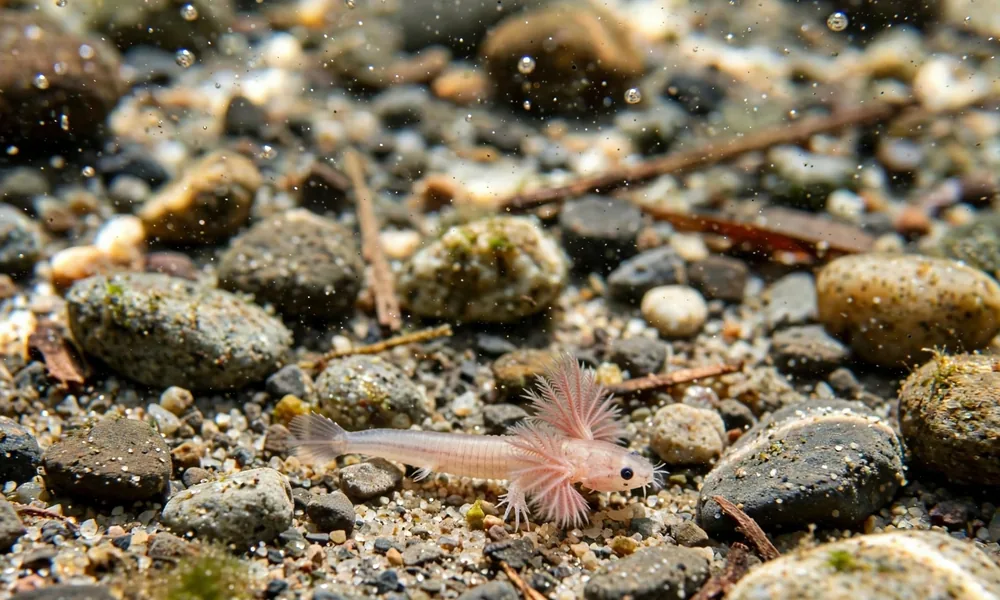
Once the eggs are laid, the male drives the female out and takes over the nest alone, and this paternal care is unusual among salamanders. He guards the eggs for ten to twelve weeks, fanning them with his tail to keep fresh, oxygen-rich water flowing over them, chasing off predators and other hellbenders, and eating any eggs that grow fungus, which keeps the rest of the clutch healthy. The eggs hatch after 45 to 75 days, depending on water temperature, into larvae 25 to 30 millimetres long, with external gills and a yolk sac that feeds them at first. The larvae stay in the nest for a few days, then disperse into the gravel, where they hide for a year or two before they are big enough to be seen in the open. Hellbenders reach maturity at about five years old, and they can live 30 years in the wild, with some estimates suggesting they may live far longer.
Conservation status
The hellbender is listed as Near Threatened on the IUCN Red List, and that single label hides a starker local picture. Populations have declined through most of the historic range, and in many states the animals are now rare where they were once common, with the Ozark hellbender federally listed as endangered and the eastern form listed as endangered in several states. The decline is not the work of one cause, but of many small ones adding up in the same streams, and it has been going on for decades.
The main pressure is silt. When soil washes off bare banks, ploughed fields, building sites and logging roads, it settles on the stream bed and fills the gaps between the stones, smothering the gravel where the young hide and the hollows under the rocks where the eggs are laid. Pollution is the second pressure, because a hellbender breathes through its skin, and the chemicals that wash into a stream, from pesticides and fertilisers to mine drainage and road runoff, pass straight into its blood. Dams are the third, because they slow the water, warm it, and trap the silt, turning a fast, cold stream into a warm, still pool that a hellbender cannot live in.
The most useful conservation work is practical, and it starts with the stream itself. Protecting the forested banks keeps the water cool and holds the soil, and keeping silt out of the water keeps the gravel clean for the young. Captive breeding programmes in zoos are now raising young hellbenders and releasing them into streams where the wild animals have gone, and artificial nest boxes, concrete shelters sunk into the stream bed, are giving males a place to breed where the natural rocks have been lost. The hellbender’s future depends less on any single project than on whether its streams stay cold, clear and fast.
Best seasons for hellbender watching
The best time to look for a hellbender is late summer and early autumn, when the breeding season brings the males to their nest rocks and the water is still warm enough to snorkel in. From late August through October, the males are at their most visible, guarding the entrance to the nest with their heads showing at the gap under the rock, and a careful snorkeller who moves slowly and lifts no stones can sometimes see one without disturbing it. The animals are present in the streams all year round, so there is no wrong season in the strict sense, but the breeding season is when they are most likely to be in one place.
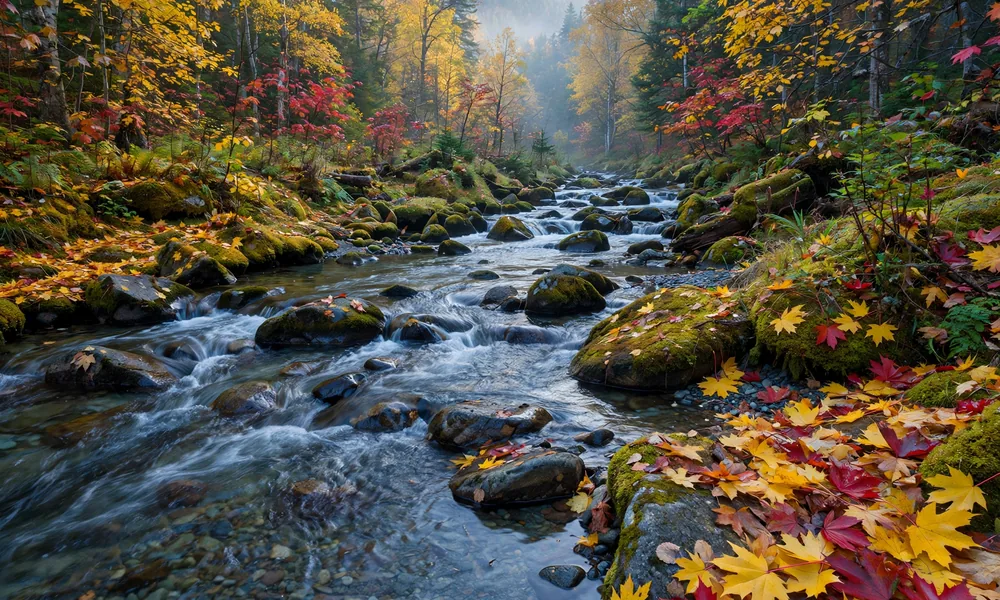
The best hours are the night, when the hellbenders leave their rocks and walk the stream bed to hunt, and a red-filtered torch on a quiet stretch of stream can show one out in the open. By day they are under the rocks, and the only honest way to see one is to snorkel slowly over the stream bed and look for the flat head at the edge of a rock, without lifting or rolling the stone. Never turn a rock to find a hellbender, because the rock is its home and its nest, and a rolled rock can crush the eggs or leave the animal with nowhere to go.
Staying safe around hellbenders
A hellbender is not dangerous to people, and there is no safety warning that belongs to the animal itself. It has no venom, it does not chase or threaten a swimmer, and a bite from a large animal is painful but not dangerous, and it only happens if the animal is picked up. The safety rules for watching hellbenders are the rules of the stream itself: cold, fast water over slippery rock, with deep pools and sudden drops, and the sensible approach is to enjoy the animal and respect the water it lives in.
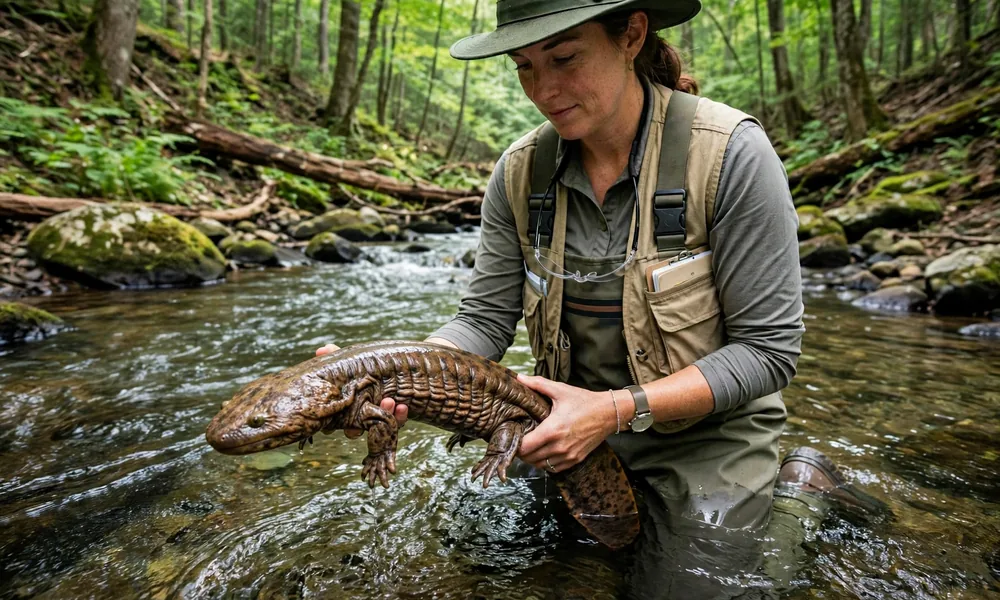
There are a few practical points for the water itself. Never wade alone in a fast stream, wear shoes with a good grip on wet rock, and keep an eye on the weather upstream, because a mountain stream can rise fast after rain. Do not handle a hellbender at all if you can avoid it, and if you must move one, for a survey or a rescue, wet your hands first and support the body, because dry hands damage the slimy skin that the animal breathes through. A hellbender out of the water for more than a few minutes is an animal in danger, so keep it wet, keep it brief, and put it gently back under its own rock.
Hellbender watching checklist
A little preparation turns a quiet evening on a mountain stream into a real chance of seeing a hellbender at its best, out hunting under the stones.
- A clear, cold, fast-flowing stream in the Appalachians or the Ozarks, with large flat rocks and gravel on the bed.
- A visit in late summer or early autumn, when the males are guarding their nest rocks and easiest to find.
- A night visit with a red-filtered torch, when the hellbenders leave their rocks and walk the stream bed to hunt.
- A slow snorkel over the stream bed by day, looking for a flat head at the edge of a rock without lifting or rolling any stone.
- Sturdy shoes with a good grip on wet rock, and a companion, so that a fast stream stays safe from start to finish.
- A camera that works in low light, so you can record a hellbender without a bright flash that startles it.
- Respect for the animal and the stream, keeping your distance, keeping the hellbender wet, and leaving every rock exactly where you found it.
Frequently asked questions
How big do hellbenders get?
Most hellbenders measure 30 to 60 centimetres from snout to tail, and a good adult weighs 1.5 to 2.5 kilograms. The largest hellbenders on record reach about 74 centimetres, which makes the hellbender the largest salamander in North America and the fourth largest aquatic salamander in the world, after the giant salamanders of China and Japan. Females tend to live longer than males, and so they tend to grow larger.
What do hellbenders eat?
A hellbender eats mostly crayfish, which make up the bulk of its diet through the warmer months, and it also takes small fish, insects and their larvae, worms, molluscs, tadpoles and small frogs. It hunts at night, walking along the stream bed and feeling for crayfish under the stones, and it swallows its prey whole. In winter, when crayfish are less active, fish make up a larger share of the diet.
How do hellbenders breathe?
Hellbenders breathe mainly through their skin, using the wrinkled folds along their sides to take oxygen from the water. The folds are full of tiny blood vessels close to the surface, and they increase the area of skin in contact with the water, so the animal can take in enough oxygen without surfacing. Hellbenders do have lungs, but they use them mainly for buoyancy, and in warm or still water they rock gently from side to side to move fresh water over the folds.
Are hellbenders dangerous?
No, hellbenders are not dangerous to people. They have no venom, they do not chase or threaten swimmers, and they spend their lives under rocks in fast streams where they rarely meet a person at all. A large hellbender can give a sharp nip if it is picked up, so the sensible approach is not to handle one. Their first response to a threat is to stay still under the rock and hope not to be noticed.
Can you keep a hellbender in an aquarium?
You can, but only in a specialist set-up, and most people should not try. A hellbender needs cold, clean, fast-flowing, oxygen-rich water, large flat rocks to hide under, and live crayfish to eat, and it grows to more than half a metre long, so it needs a very large tank. In many states it is also illegal to collect or keep one without a permit, because the species is protected. A hellbender belongs in a mountain stream, not in a living room.
How is this guide different from the goliath frog guide?
This guide covers the hellbender, a salamander of up to 74 centimetres that lives its whole life underwater in the cold streams of eastern North America, breathes through the folds of its skin and hunts crayfish by night under flat rocks, while our goliath frog guide covers the world’s largest frog, Conraua goliath, a frog of up to 32 centimetres from snout to vent and 3.25 kilograms that lives in the fast rivers of Cameroon and Equatorial Guinea and builds stone nests in the rapids. One is a long, flat, wrinkled salamander that never leaves the water; the other is a heavy, powerful frog that hops between river and rainforest bank.
Conclusion
The hellbender species is a reminder that a stream can hold a giant and still look empty. A flat, wrinkled salamander of up to 74 centimetres, breathing through its skin and hunting crayfish by night under a single flat rock, has lived in the rivers of eastern North America for around 65 million years, and it asks for very little: cold, clear, fast water, a gravel bed, and a rock to call home.
If you go looking for one, go in late summer, go at night, and walk a cold mountain stream slowly, with a red-filtered torch and a companion, and look for the flat head at the edge of a rock. Find the rock, leave it where it lies, and you will have met the hellbender that turns an ordinary stretch of stream into a place with a 65-million-year history hiding under a stone.