The eastern newt species is a small salamander of eastern North America that lives three different lives in one body, hatching as a gilled larva in a pond, wandering the forest floor for years as a bright orange juvenile, and then returning to the water as a green adult to breed. If you are asking what an eastern newt is, the short answer is Notophthalmus viridescens, a member of the true newt family Salamandridae that grows to about 13 centimetres at most, lives for 12 to 15 years in the wild, and carries tetrodotoxin in its skin, a potent neurotoxin that makes it unpalatable to fish and crayfish. It is common across much of the eastern United States and Canada, yet most people only ever meet one of its three forms.
That three-part life is what makes the eastern newt worth a proper guide rather than a quick identification note. The same animal changes colour, changes habitat and changes shape, and each stage has its own food, its own predators and its own way of staying alive. This guide follows the whole animal: how it looks at every stage, where it lives in pond and forest, what it eats, how it breeds, why it is poisonous, and how to watch for it without harming it.
Key takeaways
- The eastern newt species is Notophthalmus viridescens, a small salamander of eastern North America in the family Salamandridae, growing to about 13 centimetres and living for 12 to 15 years in the wild.
- One animal lives three lives: an aquatic larva with external gills, a bright orange land-dwelling juvenile called a red eft, and a green aquatic adult that returns to the water to breed.
- The skin contains tetrodotoxin, a potent neurotoxin also found in pufferfish, and the red eft advertises it with bright orange warning colouring edged with black-bordered red spots.
- Adults live in small lakes, ponds, vernal pools and slow streams, while red efts spend one to seven years on land in damp forest, sheltering under leaf litter and logs.
- The species is listed as Least Concern, with four recognised subspecies, and its main pressures are pond loss, road deaths on wet nights and the pet trade.
The eastern newt species and their relatives
Eastern newts belong to the family Salamandridae, the true newts and salamanders, a family that spans Europe, Asia and North America and includes some of the most familiar pond amphibians in the world. The genus is Notophthalmus, a small North American group of three species, and the eastern newt is by far the most widespread of them, ranging from the Maritime provinces of Canada west to the Great Lakes and south to Florida and Texas. The name Notophthalmus means back eye, a reference to the way the animal seems to watch from every angle, and viridescens means becoming green, a nod to the adult colouring that replaces the orange of youth.
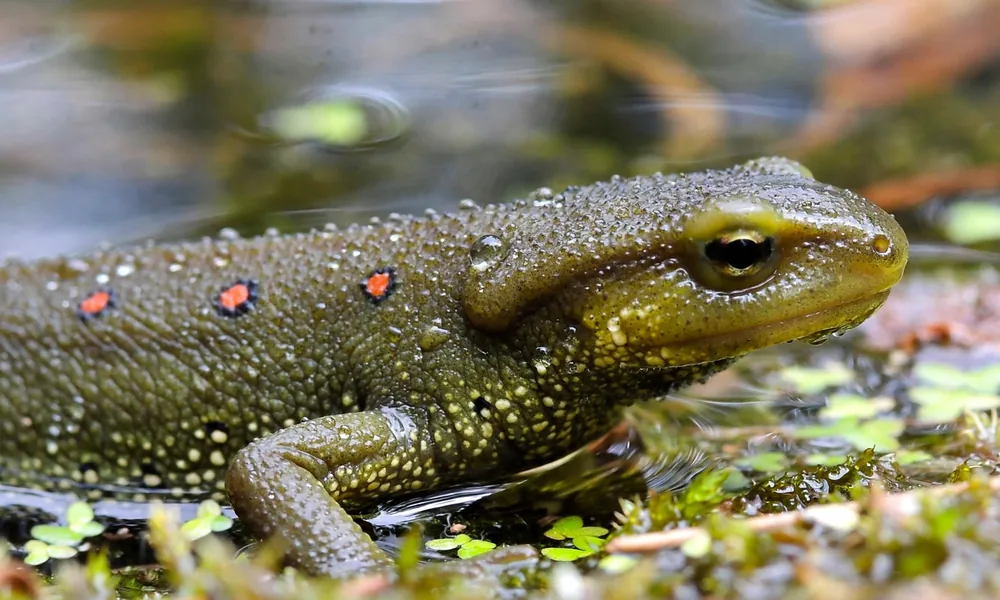
Four subspecies are recognised, and they divide the range between them in a neat geographical pattern. The red-spotted newt, Notophthalmus viridescens viridescens, is the most widespread form, found through the north-east and the Appalachians, and it is the form most people picture, with a clear row of black-bordered red spots down each side. The central newt, Notophthalmus viridescens louisianensis, lives through the central states and the deep south, grows to between 6.4 and 10 centimetres, and carries fewer, smaller red spots. The broken-striped newt, Notophthalmus viridescens dorsalis, lives on the coastal plains of North and South Carolina, where its red markings join into broken stripes, and the peninsula newt, Notophthalmus viridescens piaropicola, lives in peninsular Florida, where it is darker, often lacks red spots altogether, and frequently skips the land stage entirely.
| Type | Animal | Where it lives | Best-known food | Length or Weight |
|---|---|---|---|---|
| Family | True newts and salamanders (Salamandridae) | Europe, Asia and North America | Small invertebrates | About 7 cm to 20 cm long |
| Genus | North American newts (Notophthalmus) | Eastern and southern North America | Aquatic and land invertebrates | About 6 cm to 13 cm long |
| Species | Eastern newt (Notophthalmus viridescens) | Eastern North America | Insect larvae, snails and worms | Up to 13 cm long |
| Species | Striped newt (Notophthalmus perstriatus) | Florida and southern Georgia | Small aquatic invertebrates | About 5 cm to 10 cm long |
| Species | California newt (Taricha torosa) | California | Worms, snails and insect larvae | About 13 cm to 20 cm long |
| Species | Smooth newt (Lissotriton vulgaris) | Europe and western Asia | Small invertebrates and tadpoles | About 7 cm to 11 cm long |
The closest relative of the eastern newt is the striped newt, Notophthalmus perstriatus, a smaller animal of Florida and southern Georgia that grows to between 5 and 10 centimetres. It lives in much the same kind of pond, and like the eastern newt it has a land stage, though its red markings form stripes rather than spots, and its range is far smaller, which is why it is the rarer and more vulnerable of the two.
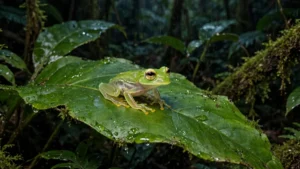
The California newt, Taricha torosa, is a cousin from the far side of the continent, a much larger animal that grows to between 13 and 20 centimetres and lives in the ponds and streams of California. It shares the eastern newt’s chemical defence, carrying tetrodotoxin in its skin, and it shares the same warning strategy, a bright orange belly that tells a predator to think twice. Like the frog, the eastern newt is an amphibian that needs both water and land to complete its life, but the frog makes the change once, from tadpole to adult, while the newt makes it twice, from larva to land juvenile and back to water again.
What an eastern newt looks like
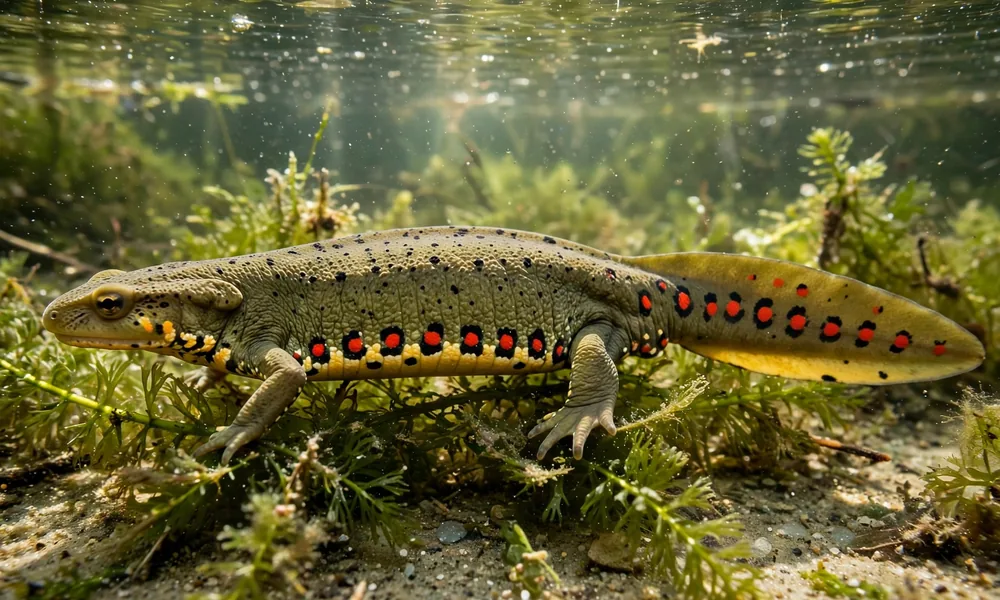
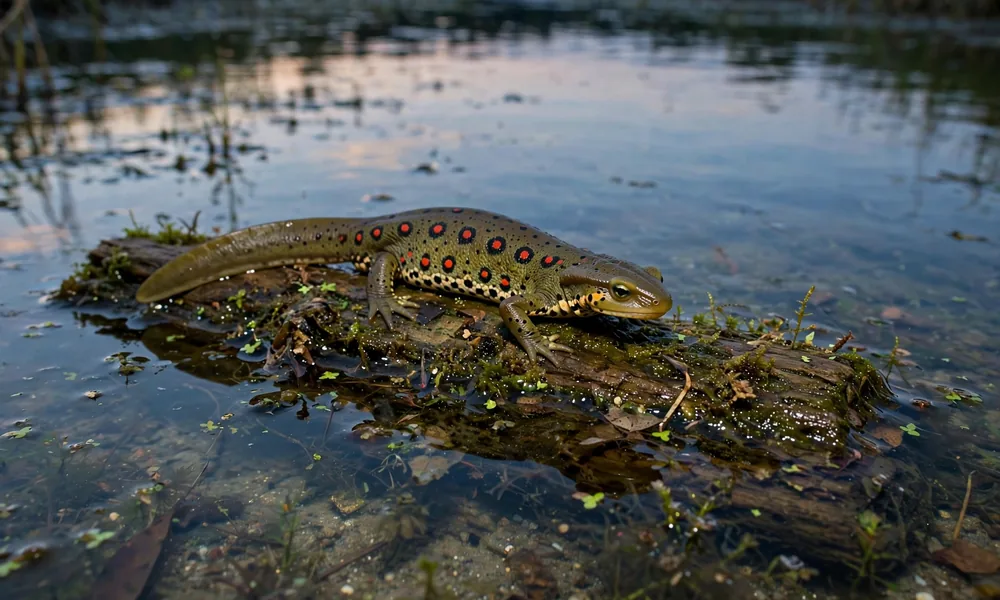
An adult eastern newt is a small, sturdy salamander, and it looks quite different from the bright orange animal most people remember from the forest floor. The adult is olive-green to yellowish-brown above, with a paler yellow belly marked with small black spots, and a row of black-bordered red spots runs down each side of the back, though the number and the brightness vary, and some animals carry as many as 21 spots in total. The skin is rough rather than slimy, drier to the touch than most salamanders, and the tail is flattened sideways like a paddle, which is the adult’s swimming tool.
The sexes look much alike for most of the year, and telling them apart takes a close look at the breeding season. In spring the male develops a broader, more strongly flattened tail fin, and his hind legs grow thicker, with dark, rough pads on the inner thighs that help him grip the female during courtship. The female is often a little plumper when she is carrying eggs, and her tail stays narrower. The adult’s green and brown melts into pondweed, while the juvenile’s orange shouts a warning.
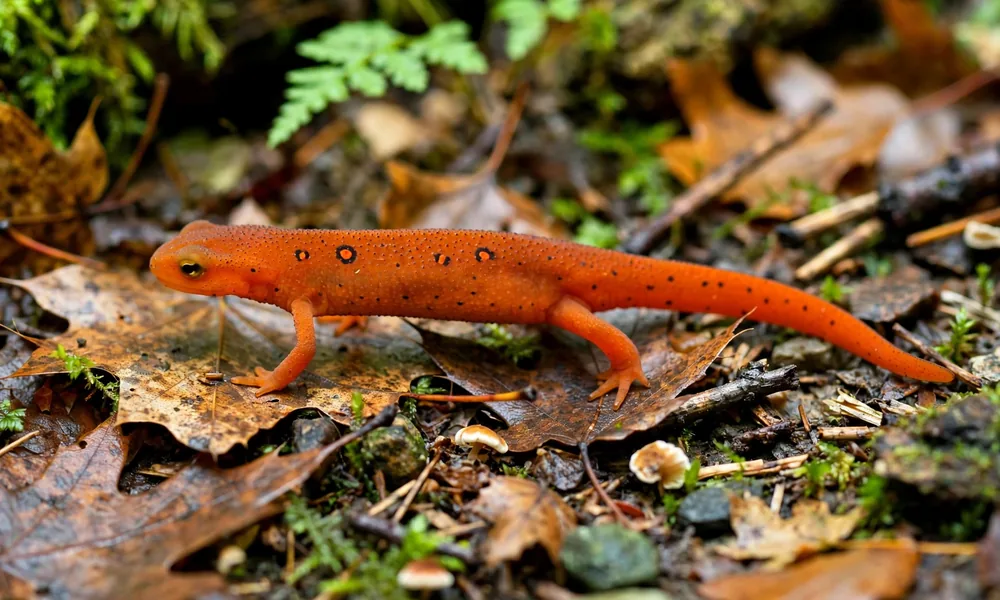
The red eft is the stage that stops people in their tracks, and it is worth describing properly because it is so often mistaken for a different animal altogether. After the larva loses its gills and leaves the water, it becomes a terrestrial juvenile coloured bright orange to reddish, marked with the same dark-edged red spots it will keep as an adult, and it walks the forest floor on four short legs with its tail held off the ground. Efts are smaller than adults, often only about 4.5 centimetres long when they first leave the water, and their skin is rougher and drier still, which suits a life among leaves rather than in a pond.
Size varies with subspecies and with sex, but the range is narrow, because no eastern newt is ever a big animal. Adults usually measure between 7 and 13 centimetres from snout to tail, and the red-spotted subspecies is the largest of the four, growing to about 14 centimetres in exceptional animals. The central newt is smaller, at 6.4 to 10 centimetres, and the broken-striped newt is smaller still. An adult weighs only a few grams, light enough to sit on a pondweed leaf without bending it, and light enough that a heron can swallow it whole, which is why the toxin matters so much.
Compared with other newts, the eastern newt is easy to tell apart once you know the spots. No other North American newt combines an olive-green adult with a clear row of black-bordered red spots and a bright orange juvenile stage, and no other salamander in its range has quite the same rough, dry skin. The California newt is larger and has a plain orange belly with no red spots on its back, the smooth newt of Europe is smaller and lacks the red spots entirely, and the striped newt has stripes where the eastern newt has spots, so a careful look at the back settles the question.
Where eastern newts live
Eastern newts live across eastern North America, from the Maritime provinces of Canada west to the Great Lakes and south through the eastern United States to Florida and Texas, spanning much of the eastern half of the continent. Within that huge range they are animals of small water and damp woodland, and they are rarely found far from a pond, a lake edge, a vernal pool or a slow stream. They favour water that is still or slow-moving, rich in pondweed and leaf litter, and they avoid fast rivers and deep open lakes, where fish are plentiful and hiding places are few.
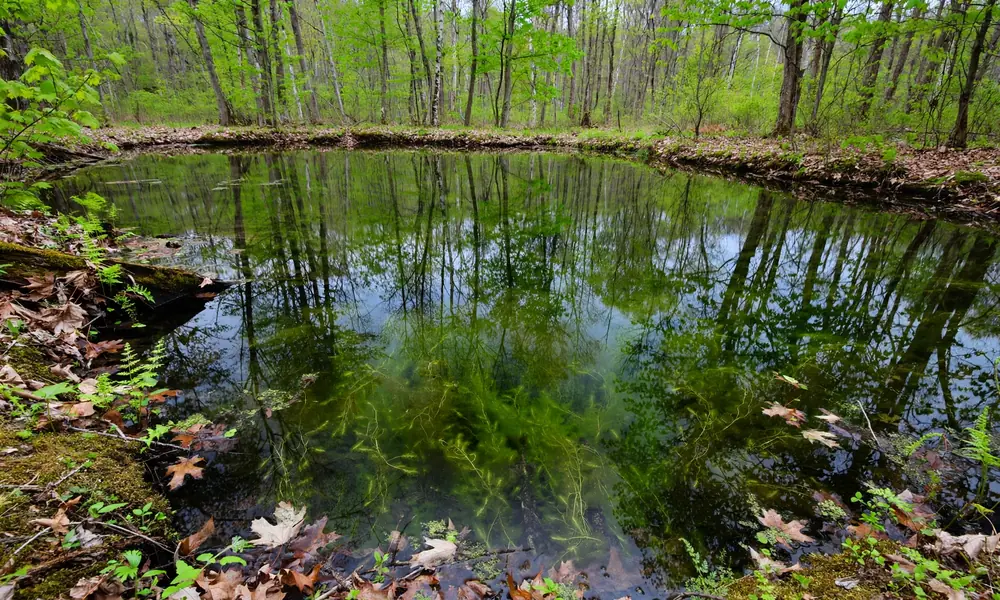
The habitat they choose changes with the stage of life, and that is the key to finding them. Adults live in the water itself, among submerged plants, under logs and stones, and in the soft mud at the pond edge, coming up to the surface to breathe and sinking back down to hunt. Larvae live in the same water, in the weed beds and the shallow margins where the food is richest. Red efts live on land, in the moist forest around the pond, sheltering under leaf litter, logs, stones and damp ground cover, and they are most often found on wet days, after rain, when the forest floor is soft and the air is humid.
Depth matters less than cover, and a shallow pond with plenty of weed will hold more newts than a deep lake with bare banks. Adults are usually found in water less than a metre deep, often much shallower, and they spend the winter at the bottom of the pond, under the ice where it forms, slowing down and waiting for spring.
The eastern newt has been found in places that seem unlikely for such a small animal, and it now turns up in garden ponds, farm ponds and woodland pools across its range, wherever the water is clean and the banks are damp. It is absent from ponds that are heavily polluted, from water that is stocked with large numbers of hungry fish, and from forest that has been cleared right to the water’s edge, because a newt that has nowhere damp to walk cannot reach its pond at all.
What eastern newts eat
Eastern newts are hunters, and their diet is written on the pond and the forest floor alike. The everyday food of the adult is small aquatic invertebrates: midge larvae and other immature insects, small crustaceans, snails and worms, taken from among the pondweed and the mud. Adults will also eat frog eggs and small tadpoles when they find them, and they are not above eating the larvae of their own kind, which is one reason the larval stage is the most heavily preyed upon part of the life cycle.

What sets the eastern newt apart is how its diet changes with its body. The larva eats small invertebrates in the water, including water fleas, snails and beetle larvae, and it grows fast on that rich food. The red eft eats small invertebrates on land, mainly the animals of humus and leaf litter, including snails, springtails and soil mites, and it hunts by day and by night whenever the ground is damp. The adult returns to the water and eats the aquatic food again, and an adult that has fed well in spring will carry the fat it needs through the breeding season.
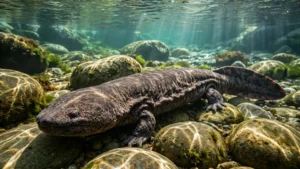
Feeding follows the rhythm of the day and the season, and it is busiest in the warmer months. Adults feed most actively in spring and summer, when the pond is warm and the insect larvae are plentiful, and they slow down in winter, when the water is cold and the food is thin. Red efts feed whenever they are out on the forest floor, and they are most often seen hunting after rain, when snails and springtails are on the surface and the leaf litter is easy to move through. Like the axolotl, the eastern newt is a salamander that hunts by sight and by smell in the water, but the axolotl stays in the water for its whole life, while the newt hunts on land for years in between.
How eastern newts behave
Eastern newts are quiet, unhurried animals, and their day is a slow round of sheltering, hunting and basking in the damp. Adults spend much of the day among the pondweed, coming up to breathe and sinking back down, and they are most active in the morning and the evening, when the light is soft and the pond is calm. Red efts are most active on wet days and at night, when the forest floor is damp enough for their skin to stay moist, and on dry days they hide under logs and leaf litter and wait for rain.
The most famous behaviour in the eastern newt is the eft’s long walk through the forest, the dispersal stage that carries the species from one pond to another. A red eft may travel far from the pond where it hatched, walking through damp woodland for one to seven years, and that wandering is what keeps the ponds connected, ensuring that newts from different ponds meet and breed. The eft stage is the longest part of the life for many animals, and it is the stage that does the exploring, while the adult stage does the breeding.
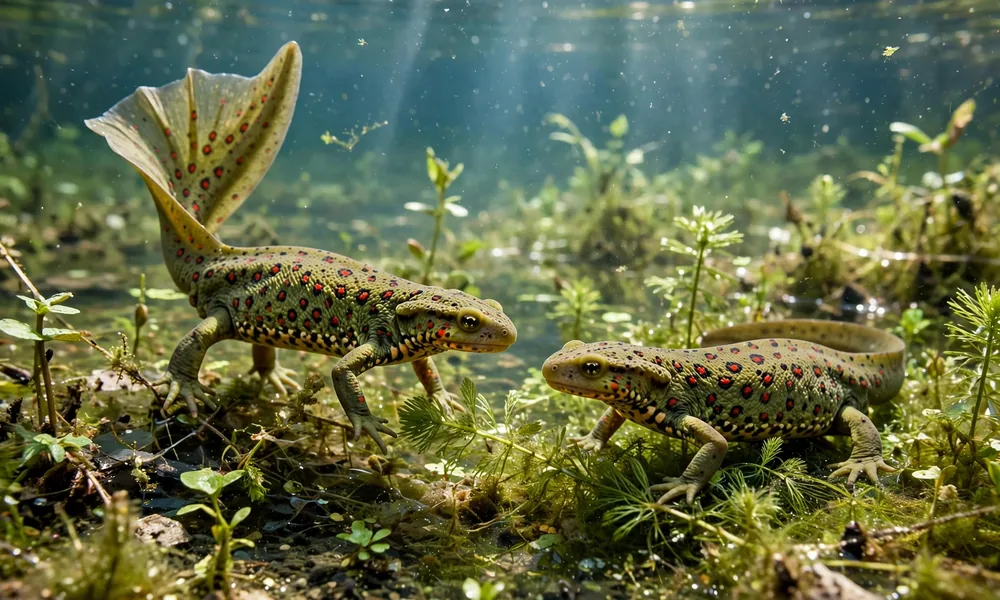
When an eastern newt is threatened, its first response is to stay still and let its colouring do the work, and if that fails it will swim away into the weed or slip under a log. The toxin is the real defence, and most predators learn quickly: a fish that mouths a newt and finds it unpalatable will spit it out and remember the orange colour next time. Birds and mammals are also deterred, though some, like raccoons, have learned to eat the newt while avoiding the skin. The newt has no bite that matters to a person, and a newt handled gently and briefly will usually sit still in the hand, though it should be put back where it was found and never kept.
Newts can also regrow what they lose, and that is one of the quiet marvels of the animal. An eastern newt can regrow limbs lost to injury, and it can repair or replace parts of the heart, the spinal cord and other organs, a power that has made it a subject of serious scientific study. Regrowth is slow, but a newt that loses a leg can grow a working one back.
Breeding and life cycle
Eastern newts breed once a year, from late winter to early spring, when the water is warming and the ponds are full. Both males and females reach sexual maturity at about three years old, and the breeding migration often follows rainfall, when the forest floor is wet enough for the adults to walk safely back to the water. Males and females may mate with more than one partner in a season, and males prefer larger females, though no evidence has been found that females prefer one male over another.
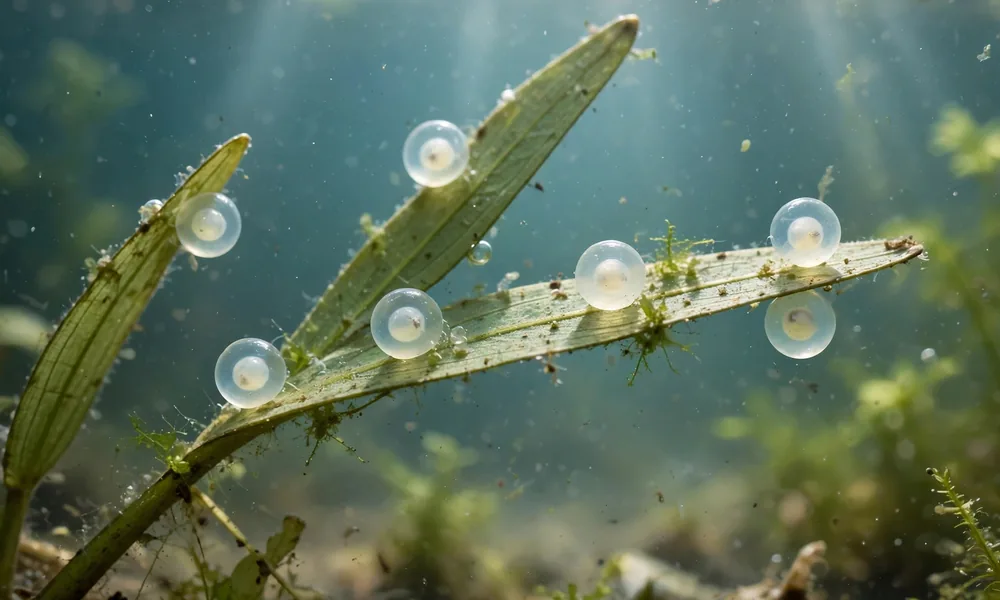
Courtship is a performance, and it is worth watching if you are lucky enough to see it. The male fans his tail and wiggles to release a scent that draws the female to him, and the female is attracted by the male’s spots as well as by his movements. He positions himself above and in front of her, gripping her sides just behind her forelegs with his hind legs and rubbing her snout with the side of his head, and then he deposits a spermatophore, a small packet of sperm, on the bottom of the pond. The female picks it up with her cloaca and uses it to fertilise the eggs she carries, and rival males may drop their own spermatophores nearby in the hope that she picks up theirs instead.

The female lays her eggs one at a time, over several weeks, and the numbers are generous because the losses are heavy. She lays between 200 and 400 jelly-covered eggs in a season, each one attached singly to submerged vegetation, and the eggs hatch after three to eight weeks, depending on the temperature of the water. The larvae that hatch are brown-green, with feathery external gills and a flattened tail, and they feed and grow in the pond where they hatched, shedding their gills after two to five months and transforming into red efts.
Growth is slow and the journey is long, and a young newt can take years to become an adult. The larva becomes an eft after about three months in the water, the eft lives on land for one to seven years, most often two or three, and then it returns to the water and becomes a sexually mature adult, developing a broader tail fin and the duller green colouring suited to life among submerged plants. In the peninsula newt, and sometimes in the broken-striped newt, the eft stage is skipped altogether, and the larva transforms directly into a sexually mature aquatic adult that never loses its external gills, a condition called neoteny. How long an eastern newt lives is well known for a salamander: about 7 to 10 years in the wild is typical, and some individuals live for 12 to 15 years.
Conservation status
The eastern newt is listed as Least Concern by the International Union for Conservation of Nature, and the reasoning is straightforward: it has a huge range, it is found across much of eastern North America, and no single pressure threatens the species as a whole. NatureServe lists it as Secure, which tells the same story at a continental scale. That broad picture hides a more uncertain local one, because a newt that needs both a pond and a damp forest cannot live where either half of its home is gone.

The main pressures are practical and local, and they are the same pressures that face most pond amphibians. Ponds are drained for building, filled in for farming, or stocked with fish that eat every larva they find, and the damp forest around them is cleared right to the water’s edge, leaving the efts with nowhere to walk. Roads are a quieter killer: on wet spring nights, when adults are walking back to the ponds to breed, many are killed by cars, and a single road beside a breeding pond can take a heavy toll year after year.
The pet trade is a smaller pressure, but it is a real one, because eastern newts are common aquarium pets, collected from the wild or sold commercially, and wild collection can lead to over-exploitation in places where the trade is heavy. Release is the greater risk: a captive newt released into a pond where it does not belong can spread disease to wild populations, and it can carry animals from one region into another. The most useful conservation work is practical, and it is the same work that helps the whole pond: protecting small ponds and vernal pools, keeping a belt of damp woodland around them, and leaving logs and leaf litter where the efts can shelter.
Best seasons for eastern newt watching
The best time to look for an eastern newt is spring, when the adults are back in the ponds to breed and the water is warming, though no season is entirely wrong. Adults are present in the water for much of the year, so a pond visit in late winter or early spring, from about February to May depending on how far south you are, is the time when the newts are most often seen, courting among the pondweed and laying their eggs one at a time. In the far north the season starts later, and in Florida it starts earlier, but spring is the season everywhere.

The best hours are the morning and the evening, when the adults are most active in the pond, and the best weather is wet weather, when the red efts are out on the forest floor. After rain, walk slowly through damp woodland near a pond, look under logs and among the leaf litter, and you may find a bright orange eft walking in the open, easy to see and easy to photograph. A slow walk around a pond edge, with your eyes on the weed beds and the shallow margins, is all you need, and the newts will often sit still long enough to see the green back and the red spots clearly, if you move gently and keep your distance.
Staying safe around eastern newts
An eastern newt is not dangerous to people in the ordinary sense, but it is poisonous, and that is worth taking seriously. The skin contains tetrodotoxin, a potent neurotoxin, and while the amount in one newt is far too small to harm a person who simply touches it, the toxin can make a dog or a cat very ill if the animal is eaten, and it can irritate eyes and mouths if it is transferred there on unwashed hands. Never eat a newt, never let a pet eat one, and never handle one and then touch your face.
There are a few practical points for the pond itself. Wash your hands after handling any amphibian, and handle a newt only briefly, with wet hands, and put it back exactly where you found it, because a newt that is moved to a different pond may not survive there. Work with a buddy, stay within your depth, and keep an eye on the weather, which can change fast on a wet spring day. A newt will not hurt you, but the pond can, and the sensible approach is to enjoy the animal and respect the water it lives in.
Eastern newt watching checklist
A little preparation turns a spring walk by a pond into a real chance of seeing an eastern newt at its best, green in the water or orange on the forest floor.
- A small woodland pond or vernal pool in spring, when the adults are back in the water to breed and the efts are out after rain.
- A wet morning or evening, when the forest floor is damp and the newts are most active in the open.
- A slow walk around the pond edge, watching the weed beds and the shallow margins for a green back and a row of red spots.
- A look under logs and among leaf litter in the damp forest nearby, where the bright orange red efts shelter by day.
- Wet hands and a gentle touch, handling a newt only briefly and putting it back exactly where it was found.
- A camera that works in low light, so you can record the newt without picking it up or disturbing the pond.
- Respect for the animal and the pond, keeping your distance, keeping the newt in its own home, and leaving the water as you found it.
Frequently asked questions
How big do eastern newts get?
Most eastern newts measure between 7 and 13 centimetres from snout to tail, and a good adult weighs only a few grams. The red-spotted subspecies is the largest of the four, growing to about 14 centimetres in exceptional animals, while the central newt grows to between 6.4 and 10 centimetres and the broken-striped newt is smaller still. Red efts are smaller than adults, often only about 4.5 centimetres long when they first leave the water.
What is a red eft?
A red eft is the terrestrial juvenile stage of the eastern newt, the bright orange animal that walks the forest floor for one to seven years between its time as a water larva and its return to the pond as a green adult. The eft is coloured bright orange to reddish, with black-bordered red spots, and the colour is a warning: the eft’s skin carries tetrodotoxin, and its bright colouring tells predators that it is unpalatable. After its years on land, the eft returns to the water and becomes the aquatic adult.
Are eastern newts poisonous?
Yes, eastern newts are poisonous, though they are not dangerous to a person who simply touches one. Their skin contains tetrodotoxin, a potent neurotoxin of the same type found in pufferfish, and the toxin makes the newts unpalatable and dangerous to predators such as fish and crayfish. The red eft carries the highest concentration, roughly ten times that of the drab adult, and its bright orange colouring is the warning that goes with it. Wash your hands after handling one, and never let a pet eat one.
What do eastern newts eat?
An eastern newt eats small invertebrates, and its diet changes with its stage of life. The larva eats water fleas, snails and beetle larvae in the pond, the red eft eats snails, springtails and soil mites in the leaf litter, and the adult eats midge larvae, other aquatic insect larvae, small crustaceans, snails and worms among the pondweed. Adults will also eat frog eggs and small tadpoles when they find them, and they are not above eating the larvae of their own kind.
Can you keep an eastern newt as a pet?
You can, and many people do, because eastern newts are common aquarium pets, but most people should think carefully before they try. A newt needs clean, cool water with plenty of pondweed, a damp land area, and live food, and it can live for 12 to 15 years, which is a long commitment for such a small animal. Never collect one from the wild if you can avoid it, never release a captive newt into a pond where it does not belong, because it can spread disease to wild populations, and always wash your hands after handling it.
How is this guide different from the common toad guide?
This guide covers the eastern newt, a small salamander of up to 13 centimetres that lives three lives, as a gilled larva, a bright orange land juvenile and a green aquatic adult, and carries tetrodotoxin in its skin, while our common toad guide covers a much larger, warty land amphibian that hops rather than swims, breeds in a single spring rush and has no land juvenile stage at all. One is a pond animal you meet in the water and on the damp forest floor; the other is a garden animal you meet on a lawn at dusk.
Conclusion
The eastern newt species is a reminder that a small animal can live a large life. A gilled larva, a bright orange juvenile that walks the forest for years, and a green adult that returns to the pond to breed have made the eastern newt one of the most remarkable salamanders of North America, at home in the ponds and the damp woodland of the whole eastern half of the continent.
If you go looking for one, go in spring, go after rain, and walk slowly around a small woodland pond with your eyes on the weed beds and the leaf litter. Find the still water, watch for a green back and a row of red spots, or an orange flash among the leaves, and you will have met the newt that turns an ordinary pond into a place of quiet, three-part wonder.