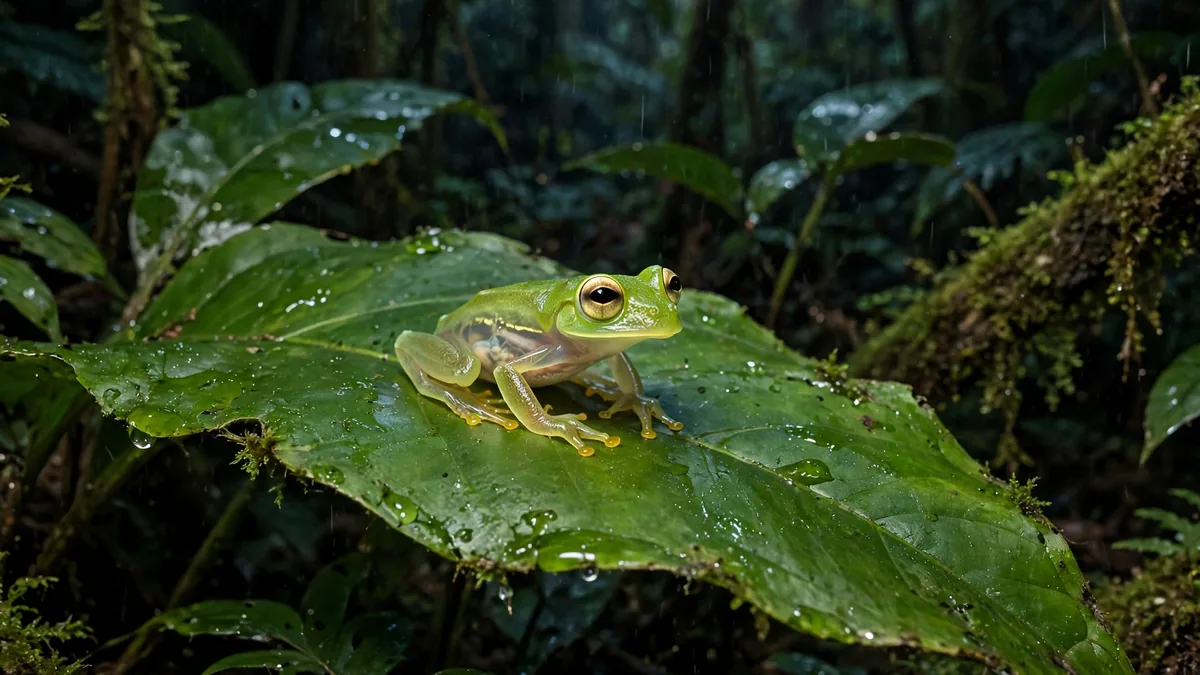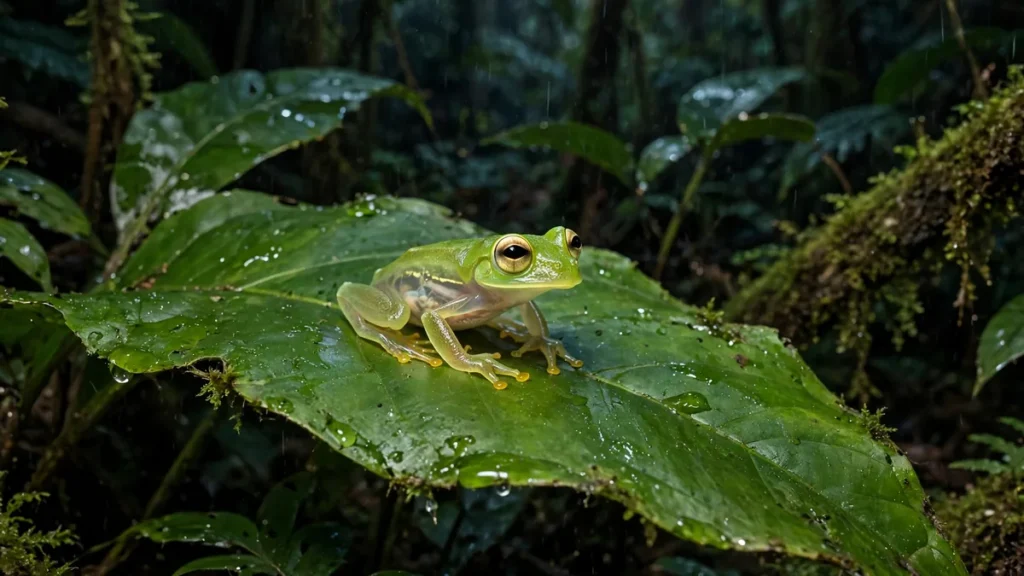
The glass frog species are small tree frogs of Central and South America whose belly skin is so clear that you can watch the heart beat through it, a trick of transparency that no other land vertebrate manages quite so well. If you are asking what a glass frog is, the short answer is any member of the family Centrolenidae, a group of about 160 described species, most of them only 20 to 30 millimetres long, that live on leaves overhanging fast, clear streams in wet tropical forest. From above they are plain lime green and easy to walk past; turn one over, and the liver, the intestines and the pulsing heart sit in plain view.
That transparency is not a party trick, and it is not the whole story either. Glass frogs are nocturnal hunters, careful fathers that guard their eggs on leaves above the water, and animals of very small ranges, so that one cleared hillside can threaten a whole species. This guide follows the whole family, with Fleischmann’s glass frog, Hyalinobatrachium fleischmanni, as its lead species: how the frogs look, where they live, what they eat, how they breed, why they turn clear when they sleep, and how to watch for them without harming them.
Key takeaways
- The glass frog species belong to the family Centrolenidae, about 160 described species of small nocturnal tree frogs from southern Mexico to Bolivia and south-eastern Brazil.
- Most adults measure only 20 to 30 millimetres long, and the largest species, the Pacific giant glass frog, reaches about 81 millimetres, still small enough to sit on a leaf.
- The belly skin is transparent, so the heart, liver, intestines and bones are visible in the living frog, and sleeping frogs hide about 89 per cent of their red blood cells in the liver to become more transparent.
- Males call from leaves overhanging fast streams, females lay 18 to 30 eggs on the underside of a leaf, and the male guards the clutch until the tadpoles drop into the water below.
- Glass frogs are not venomous or poisonous, and all species were listed on CITES Appendix II in 2022, with about half of the species assessed so far considered threatened.
The glass frog species and their relatives
Glass frogs belong to the family Centrolenidae, a family of small tree frogs restricted to the American tropics, and they are close relatives of the tree frogs of the family Hylidae, with which they share long legs, expanded toe pads and a life spent largely off the ground. The family runs from southern Mexico through Central America and down the Andes into Bolivia, with a second concentration in the Amazon basin, and it occupies lowland rainforest at sea level up to cloud forest above 2,300 metres. Counts change as new species are described, but the family is generally given as about 158 to 160 species, and older sources that list 133 species are simply out of date.
Fleischmann’s glass frog, Hyalinobatrachium fleischmanni, also known as the northern glass frog, is the lead species of this guide, and it is the animal that defines the whole family in most people’s minds. It is one of the most widely distributed species in the family, occurring from southern Mexico through Central America to western Ecuador and reaching elevations above 1,600 metres, and it is the species used in the 2022 study that solved the mystery of glass frog transparency. Males measure 19 to 28 millimetres long, females 23 to 32 millimetres, and the back is pale green with pale yellow spots, the belly is white, and the bones are white rather than green.
| Type | Animal | Where it lives | Best-known food | Length or Weight |
|---|---|---|---|---|
| Family | Glass frogs (Centrolenidae) | Southern Mexico to South America | Ants, flies and small insects | About 18 mm to 81 mm long |
| Genus | Glass frogs (Hyalinobatrachium) | Central and South America | Small insects and spiders | About 19 mm to 32 mm long |
| Species | Fleischmann’s glass frog (Hyalinobatrachium fleischmanni) | Southern Mexico to Ecuador | Ants and small flies | About 19 mm to 32 mm long |
| Species | Pacific giant glass frog (Centrolene geckoideum) | Colombia and Ecuador | Small insects | Up to 81 mm long |
| Species | La Palma glass frog (Hyalinobatrachium valerioi) | Costa Rica to Ecuador | Ants and small insects | About 20 mm to 30 mm long |
| Species | Emerald glass frog (Centrolene prosoblepon) | Central and South America | Small insects and spiders | About 21 mm to 28 mm long |
The closest relative of Fleischmann’s glass frog in size and fame is the Pacific giant glass frog, Centrolene geckoideum, a frog of Colombia and Ecuador that grows to 81 millimetres. It lives in upper montane cloud forest along swiftly flowing, shaded streams with numerous waterfalls, and it is a true giant among glass frogs, though it is still a small animal by the standards of most frogs, and its males grow to between 70 and 81 millimetres while its females reach 61 to 73 millimetres.
Within the family, the glass frogs sort themselves by the colour of their bones and the shape of their backs. The La Palma glass frog, Hyalinobatrachium valerioi, is a frog of Costa Rica to Ecuador that grows to between 20 and 30 millimetres, and like Fleischmann’s glass frog it has white bones, while the emerald glass frog, Centrolene prosoblepon, is a frog of Central and South America that grows to between 21 and 28 millimetres and has green bones, a difference that helps specialists tell the species apart. Like the frog, the glass frog is a tailless amphibian with long hind legs and a two-stage life, but the ordinary frog lays its eggs in the water, while the glass frog lays its eggs on a leaf above the water and lets the tadpoles drop in.
What a glass frog looks like
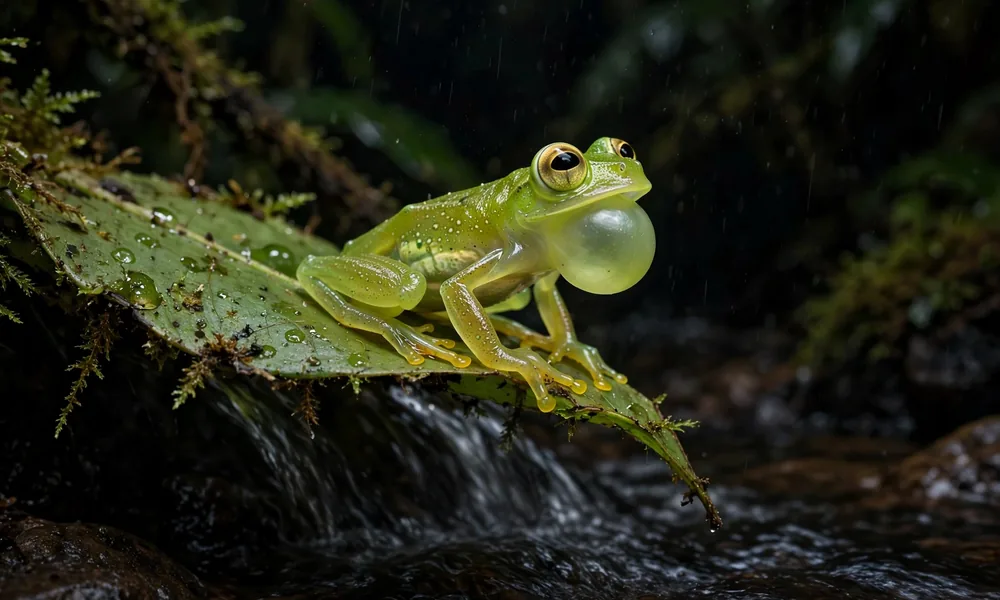
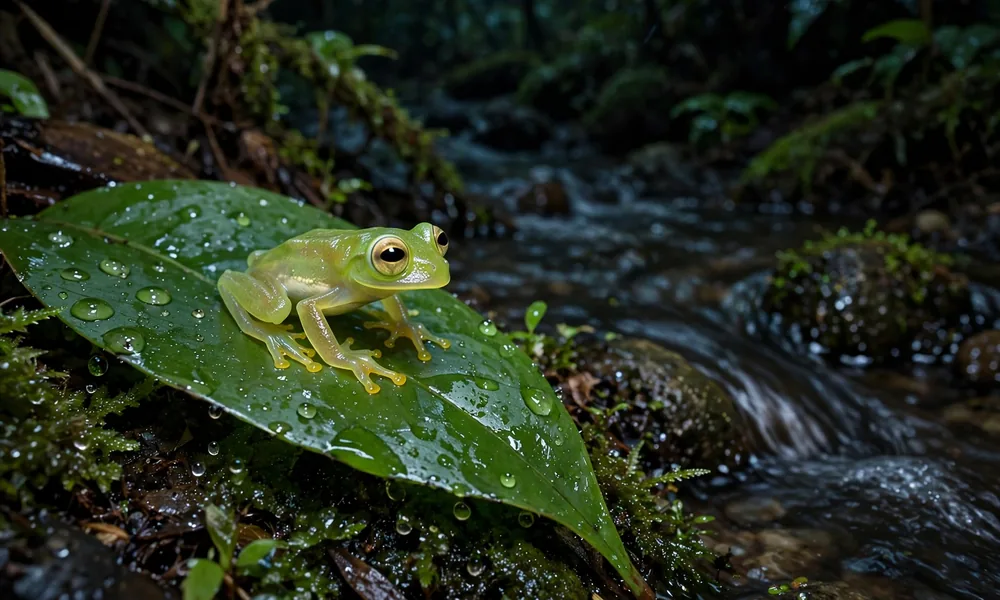
A glass frog looks, from above, like a small green leaf that has learned to hop. The back is lime green, sometimes with pale yellow spots or darker green markings, and the skin is smooth, delicate and often slightly frosted, so that the body seems to melt into the leaf it sits on. The eyes are large and directed forward, with a gold or pale iris, and the head is round when seen from above and blunt when seen from the side. The legs are long and thin, the toes are webbed and tipped with expanded pads that grip wet leaves, and the whole animal weighs only 5 to 14 grams, depending on the species.
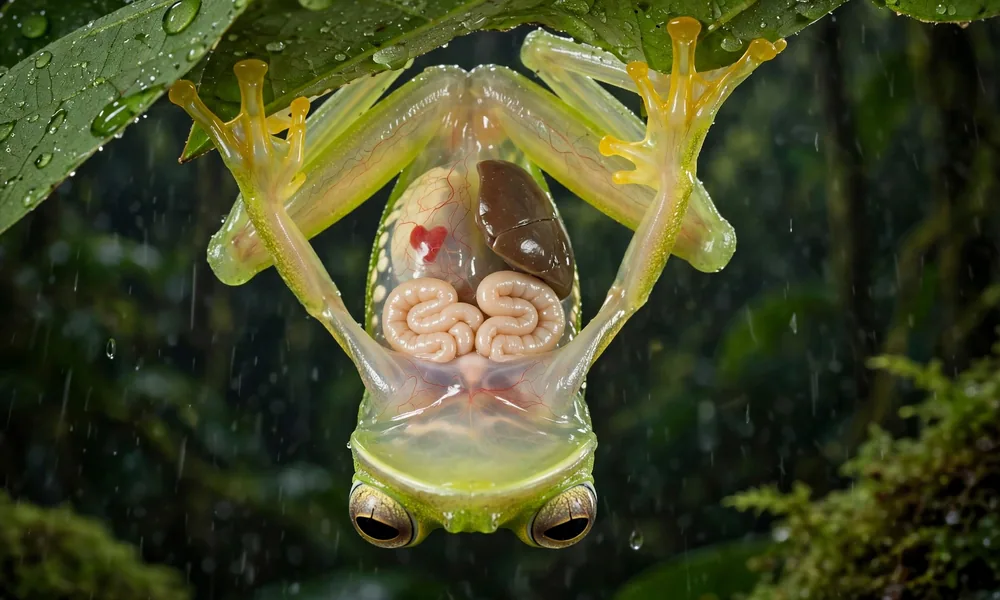
The belly is the part that gives the family its name, and it is worth describing properly because it is so unlike anything else on land. The ventral skin is transparent, and frequently the membrane that encloses the internal organs is transparent too, so that the beating heart, the liver, the intestines, the blood vessels and even the bones are clearly visible through the underside in the living frog. In many species the bones are white, and in others they are green, and the colour of the bones is one of the characters that specialists use to tell species apart. From the top the view is poorer, because the frog has thick muscles on its back that hide the organs from sight.

The sexes look much alike, and telling them apart takes a close look at size and at behaviour. In many species the females are a little larger than the males, and in Fleischmann’s glass frog the males measure 19 to 28 millimetres while the females measure 23 to 32 millimetres. Males of some species carry a small hook on the back, thought to be used in fights with other males or in defence of a territory or an egg clutch, and males call at night while females do not, which is the surest way to tell them apart in the field.
Size varies with species, but the range is narrow, because no glass frog is ever a big animal. Most members of the family are small, reaching 18 to 30 millimetres from snout to rump, and the largest species, the Pacific giant glass frog, reaches 81 millimetres, which is still smaller than many common frogs. A typical Fleischmann’s glass frog fits on a coin, and a whole family of them could sit on a single large leaf without crowding it, which is why they are so easy to walk past and so hard to find.
Compared with other tree frogs, the glass frog is easy to tell apart once you have seen its belly. No other frog of the American tropics combines a lime-green back with a transparent underside through which the organs are visible, and no other frog has quite the same combination of forward-facing eyes, expanded toe pads and a life spent on leaves above running water. The ordinary tree frog is green too, but its belly is opaque, and its eggs are laid in the water rather than on a leaf, so a careful look underneath settles the question.
Where glass frogs live
Glass frogs live in the wet forests of the American tropics, from southern Mexico through Central America and down the Andes into Bolivia, east to north-eastern Argentina and south-eastern Brazil, and they are animals of humid forest and running water. Within that huge range they are tied to vegetation along and above streams, predominantly in montane cloud forest, and they are rarely found far from a fast, clear stream. They favour water that is clean and shaded, with leaves overhanging it, and they avoid still ponds and slow rivers, where the tadpoles cannot burrow into the gravel as they need to.

The habitat they choose is the leaf, not the water, and that is the key to finding them. Adults live on leaves, usually on the undersides of large leaves such as heliconia, hanging over the stream, and they are most often found a metre or two above the water, where the eggs can be laid and the tadpoles can drop straight in. During the dry season, from late November to April, they live high in the canopy, where the moisture lasts longest, and in the wet season they come down to the streamside leaves to breed.

Altitude matters, and the family spans a remarkable range of it. Glass frogs occupy lowland rainforest at sea level up to cloud forest above 2,300 metres, but nearly all of them need the same thing: vegetation leaning over a clear, fast stream, because the stream is where the tadpoles end up. Fleischmann’s glass frog reaches elevations above 1,600 metres, and the Pacific giant glass frog lives in upper montane cloud forest, where the streams are swift, shaded and full of waterfalls.
The glass frog has been found in places that seem unlikely for such a delicate animal, and it now turns up in forest fragments and streamside vegetation across its range, wherever the forest is still damp and the water is still clean. It is absent from forest that has been cleared right to the water’s edge, from streams that are polluted or silted up, and from places where the canopy has gone, because a frog that sleeps on a leaf in the open sun will dry out and die.
What glass frogs eat
Glass frogs are hunters, and their diet is written on the leaves they sit on. The everyday food is small insects: ants, flies, moths and other tiny flying and crawling animals that land on the leaf or pass within reach, taken with a quick flick of the tongue. They also eat spiders and other small invertebrates, and a glass frog that has fed well on a wet night may not need to hunt again until the next night.
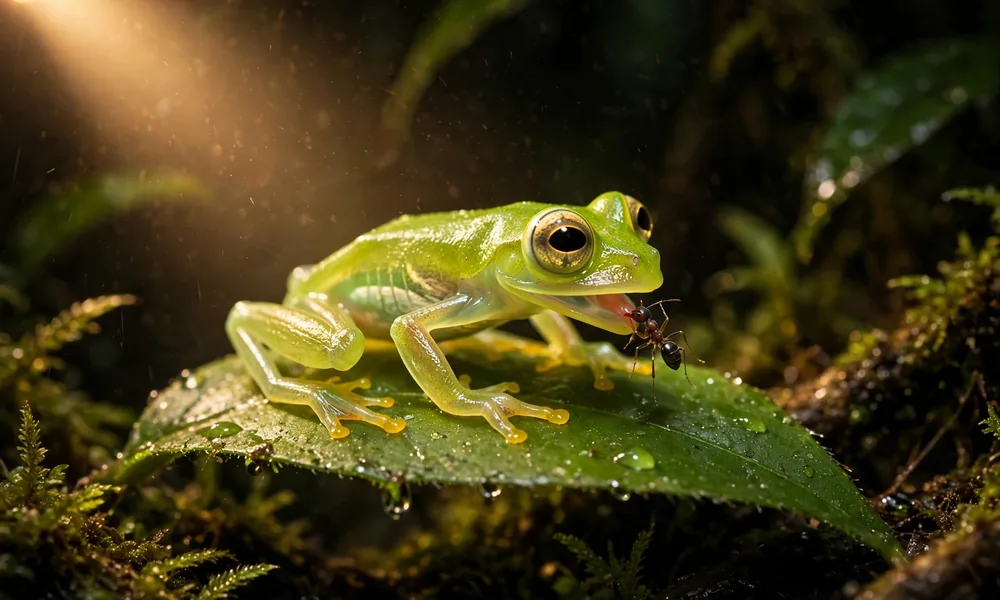
What sets the glass frog apart is how little it needs to eat to stay alive. The frog is small, it moves slowly, and it spends the day asleep and motionless, so its energy needs are low, and a few ants a night are enough to keep it going. Young frogs eat smaller prey, and they grow slowly on that thin food, taking a year or two to reach the size of an adult. Tadpoles eat differently altogether, feeding on detritus in the gravel and leaf litter at the bottom of the stream, rather than hunting live prey at all.
Feeding follows the rhythm of the night, and it is busiest after dark. Glass frogs are nocturnal, and they hunt at night, when the insects are out and the leaves are wet, and they rest in the day, sleeping upside down on the underside of a leaf. In the wet season, when the insects are plentiful, they feed well, and in the dry season, when they live high in the canopy, they feed less. Like the axolotl, the glass frog is an amphibian that hunts small animals in and around water, but the axolotl hunts underwater for its whole life, while the glass frog hunts on leaves above the water and only its tadpoles live in the stream.
How glass frogs behave
Glass frogs are night animals, and their day is a quiet round of sleeping, calling and guarding eggs in the dark. They spend the daylight hours asleep upside down on the underside of a large leaf, their bodies turned almost transparent, and they wake at dusk to hunt and to breed. They are not strong jumpers over distance, and they do not need to be: their life is lived within a few metres of a stream, up and down the leaves, and the whole forest is their hunting ground.
The most famous behaviour in the glass frog is the transparency itself, and it is worth understanding properly because it was only solved in 2022. When a glass frog sleeps, it removes about 89 per cent of its red blood cells from circulation and packs them into its liver, which is wrapped in reflective crystals, and its transparency increases two to threefold, so that the sleeping frog transmits 34 to 61 per cent more light than an active one. When the frog wakes and needs to move, the blood flows out of the liver and back into circulation, and the cells re-pack into the liver within about an hour of the frog settling down again.
Calling is the second behaviour that defines the night, and it is how a male holds his leaf. Males of Fleischmann’s glass frog call under the leaves, and their calling usually begins at dusk, sometimes lasts until dawn, and decreases as the night progresses. The call is a soft, high-pitched, bell-like note, repeated to attract females and to warn rival males away, and a male that is holding eggs or in amplexus does not call at all. Males defend small territories on leaves above streams, and they will fight other males that come too close, using the small hook on the back to push a rival off the leaf.
When a glass frog is threatened, its first response is to stay still and let its transparency do the work, and if that fails it will leap away into the dark and hide under another leaf. Glass frogs have no venom and no poison, and a glass frog handled gently will usually sit still in the hand, though it should be put back where it was found and never kept. The frog’s whole defence is built on being hard to see, hard to find and hard to catch, and its first response to a threat is to disappear into the green of the leaf that is its home.
Breeding and life cycle
Glass frogs breed in the rainy season, from about May to October for Fleischmann’s glass frog, though the exact months vary with the region, and the timing is set by the rain that fills the streams and wets the leaves. Males establish leaf territories on the undersides of leaves overhanging streams, and they call from dusk until dawn to attract females. A male may guard up to five clusters of eggs in a single territory, mating with more than one female in turn, and male care that lasts this long is rare in amphibians, since most frogs leave right after laying their eggs.
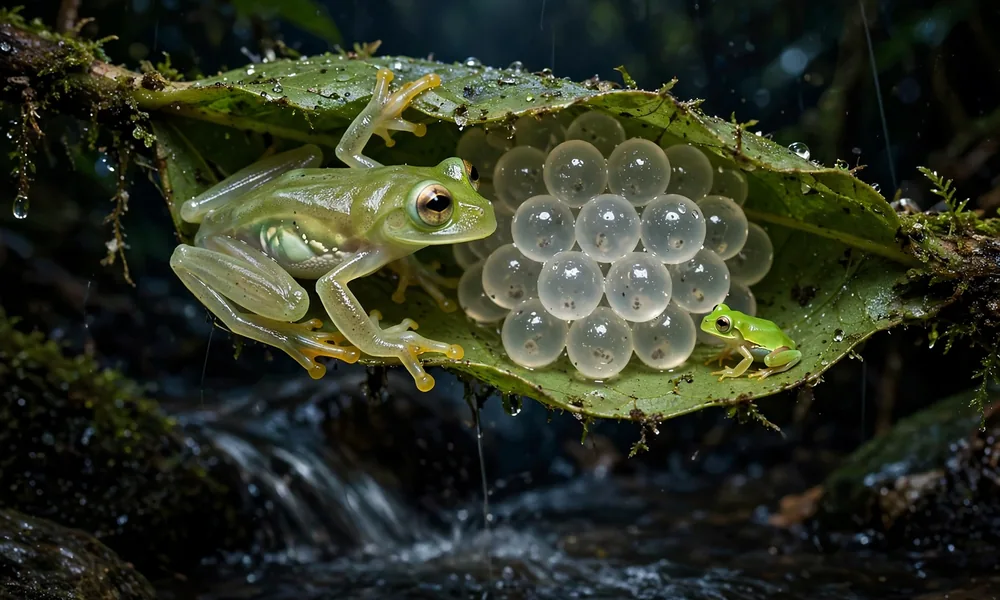
The pair enters amplexus, the characteristic frog mating embrace, and the female deposits a gelatinous egg mass on the underside of the leaf. Clutch sizes are small, typically 18 to 30 eggs in Fleischmann’s glass frog, and larger in some other species, and the number depends on the time of year the eggs are laid. The eggs are laid on the underside of leaves overhanging the water, so that when they hatch the tadpoles fall straight into the stream below, and the male remains with the clutch for several days after the female departs.
The male’s care is practical, and it makes the difference between a clutch that hatches and one that does not. He guards the eggs against predators, most importantly the flies whose larvae feed on the embryos inside the clutch, and during dry spells at night he presses his body against the eggs and wets them with water stored in his bladder, to stop them from drying out. Roughly 80 per cent of clutches are eaten or destroyed, despite his care, which is why the male’s guarding matters so much, and why a male that guards well leaves more young than one that does not.
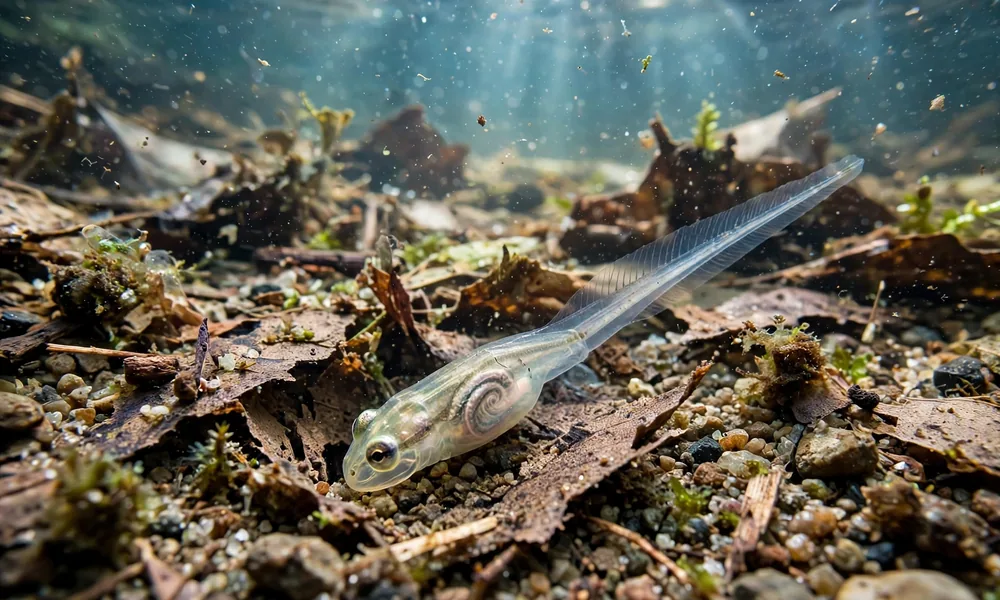
Growth is slow and the journey is long, and a young glass frog can take a year or two to become an adult. The eggs hatch after about 10 to 15 days, and all the tadpoles in a clutch hatch within a day, wriggling out of the jelly and dropping straight into the stream below. The tadpoles are muscular and elongated, with powerful tails, and they burrow into the gravel and leaf litter at the bottom of the stream rather than swimming in the open water. They change colour as they develop, from yellow to orange to red, and hatching happens almost exclusively in the orange or red stage. Development to metamorphosis is slow, taking one to two years in Fleischmann’s glass frog, and the young are independent from the day they hatch, able to feed and hide within hours, but most of them will never reach adulthood.
Conservation status
There is no single conservation status for the glass frog family, because it is a family of about 160 species, and each species has its own range and its own risks. As a family, glass frogs are not rare, but individual species often are, because many are confined to a single valley or ridge, and a large share of the species assessed by the International Union for Conservation of Nature is listed as threatened or data deficient. About half of the species assessed so far are considered threatened, with 11 listed as Critically Endangered, 39 as Endangered and 19 as Vulnerable in one recent count, alongside 62 listed as Least Concern and 14 as Data Deficient.
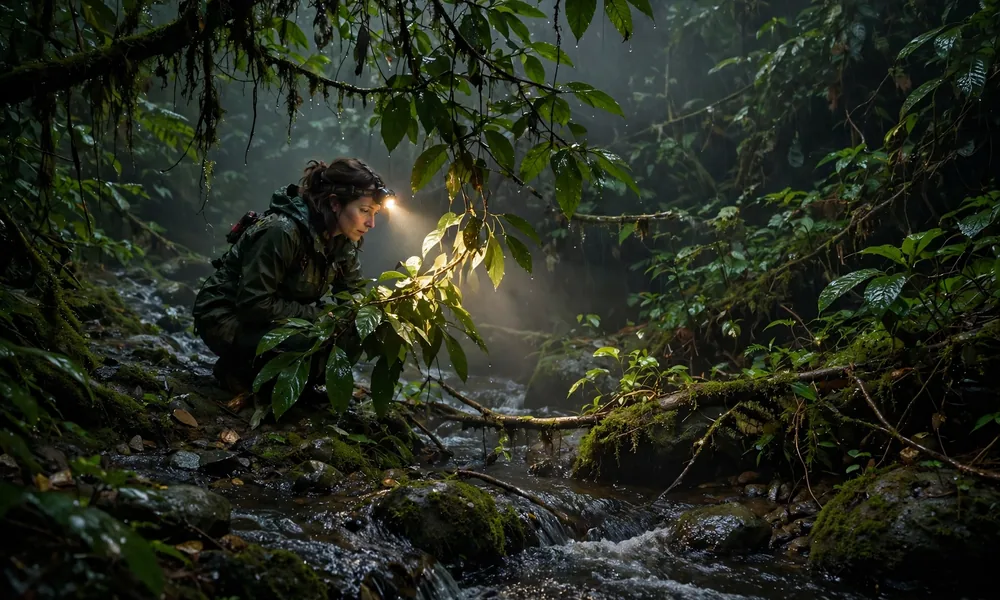
The main pressures are habitat loss and fragmentation, climate change, disease such as chytridiomycosis, and growing trade in live frogs. Many species live in small areas, so one patch of lost forest can threaten a whole species, and a frog that lives only in forest fragments covering less than 100 square kilometres has nowhere to go when the forest goes. All glass frog species were listed on CITES Appendix II in November 2022, so international trade now needs permits, which is a practical step against the pet trade, though it does not help a frog whose stream has dried up.
The most useful conservation work is practical, and it is the same work that helps the whole forest stream. Protecting the forest along streams keeps the shade and the leaves that the frogs need, and protecting the streams themselves keeps the clean, fast water that the tadpoles need. There are no species-specific conservation measures for most glass frogs, and the work that matters most is the protection of the small, damp, streamside places where they live.
Best seasons for glass frog watching
The best time to look for a glass frog is the rainy season, from about May to October, when the males are calling from the streamside leaves and the females are laying their eggs, though no season will show you one from a distance. Glass frogs are present in the forest all year round, so there is no wrong season in the strict sense, but a night walk in the wet season, when the streams are full and the leaves are wet, is the time when the frogs are most often found. In the dry season, from late November to April, they live high in the canopy, where the moisture lasts longest, and they are much harder to find.
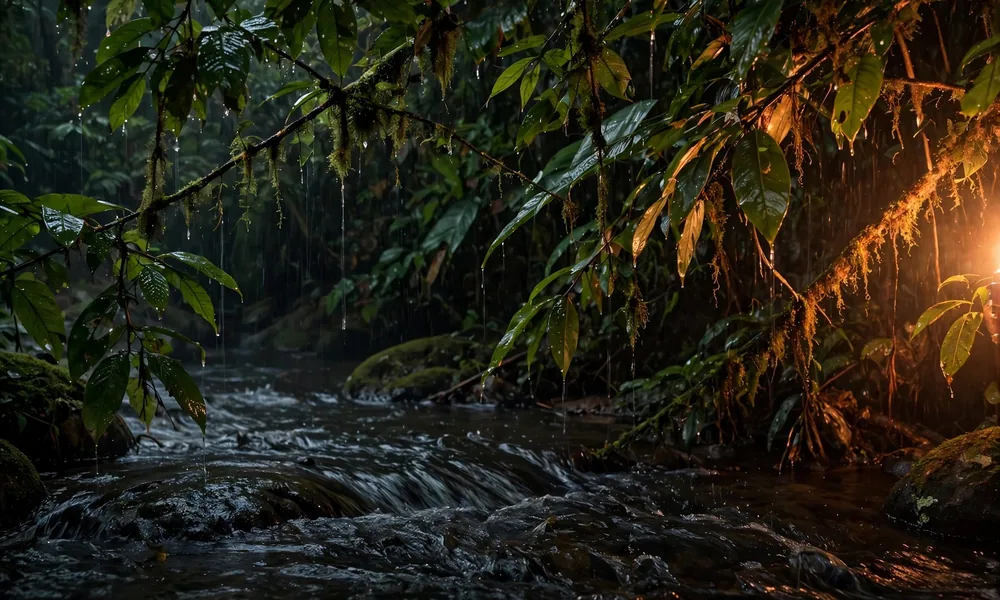
The best hours are the night, when the glass frogs are awake and calling and the torch can find them on the leaves above the stream. From about dusk until dawn, the frogs are out hunting and breeding, and they are at their most active then, calling in soft bell notes and guarding their eggs. A slow walk along a forest stream, with a dim torch and a careful eye on the undersides of the leaves, is all you need, and the frogs will often sit still long enough to see the green back and the clear belly, if you move gently and keep your distance.
Staying safe around glass frogs
A glass frog is not dangerous to people, and there is no safety warning that belongs to the frog itself. It has no venom and no poison, it does not bite, and it will not chase or threaten a person, because it is a tiny animal that lives on a leaf above a stream and it will never meet one except by accident. The safety rules for watching glass frogs are the rules of the rainforest at night: watch the ground, watch the water, and respect the frog that you came to see.
There are a few practical points for the forest itself. Work with a buddy, stay on the trail, and keep an eye on the weather, which can change fast in a tropical forest. Wear boots with good grip, carry a torch with a dim setting, and keep clear of the slippery rocks at the stream edge. Wash your hands after handling any frog, and handle a glass frog only briefly, with wet hands, and put it back exactly where you found it, because a frog that is moved to a different leaf may not survive there.
Glass frog watching checklist
A little preparation turns a night walk by a forest stream into a real chance of seeing a glass frog at its best, green on a leaf with its clear belly showing.
- A forest stream in the rainy season, from about May to October, when the males are calling and the females are laying eggs.
- A night walk, when the glass frogs are awake and hunting and the torch can find them on the leaves.
- A dim torch, so you can look under the leaves without blinding the frog or disturbing the stream.
- A slow walk along the stream edge, watching the undersides of large leaves overhanging the water for a green back.
- Wet hands and a gentle touch, handling a frog only briefly and putting it back exactly where it was found.
- Boots with good grip and a buddy, so that a night in the rainforest stays safe from start to finish.
- Respect for the frog and the forest, keeping your distance, keeping the frog on its own leaf, and leaving the stream as you found it.
Frequently asked questions
How big do glass frogs get?
Most glass frogs measure between 20 and 30 millimetres from snout to rump, and a good frog weighs only 5 to 14 grams. A typical Fleischmann’s glass frog is about 19 to 28 millimetres long if it is a male, and 23 to 32 millimetres if it is a female, and the largest species, the Pacific giant glass frog, reaches about 81 millimetres. No glass frog is ever a big frog, whatever its transparent belly may suggest.
Why are glass frogs transparent?
Glass frogs are transparent because their belly skin and their muscles transmit more than 90 to 95 per cent of visible light, and because, when they sleep, they hide about 89 per cent of their red blood cells in their liver, which is wrapped in reflective crystals. The red blood cells are the problem, because they absorb light strongly, and by packing them away the frog increases its transparency two to threefold, transmitting 34 to 61 per cent more light than when it is active. The transparency is camouflage: a sleeping frog on a leaf is almost invisible to a predator looking up from below.
Are glass frogs poisonous?
No, glass frogs are not venomous or poisonous. They have no toxin in their skin, they do not bite, and they will not harm a person who handles one gently, though you should always wash your hands afterwards and put the frog back where you found it. Their whole defence is built on being hard to see, hard to find and hard to catch, and their first response to a threat is to stay still and let their transparency do the work.
What do glass frogs eat?
A glass frog eats small insects, mainly ants, flies, moths and other tiny flying and crawling animals that land on its leaf, taken with a quick flick of the tongue. It also eats spiders and other small invertebrates, and a few ants a night are enough to keep it going, because it is small, it moves slowly, and it spends the day asleep. Tadpoles eat differently, feeding on detritus in the gravel and leaf litter at the bottom of the stream.
Can you keep a glass frog as a pet?
You can, but most people should not try. A glass frog needs a tall, humid terrarium with live plants, leaves overhanging clean water, and live insects to eat, and it is a delicate animal that is easily stressed by handling and by dry air. All glass frog species were listed on CITES Appendix II in 2022, so international trade now needs permits, and a frog that is taken from the wild may not survive in captivity. A glass frog belongs on a leaf above a forest stream, not in a living room.
How is this guide different from the eastern newt guide?
This guide covers the glass frog, a tiny tree frog of 20 to 30 millimetres that lives on leaves above fast streams in Central and South America, turns almost clear when it sleeps, and lays its eggs on a leaf for the father to guard, while our eastern newt guide covers a small salamander of up to 13 centimetres that lives three lives in pond and forest in North America, turns bright orange as a juvenile, and carries tetrodotoxin in its skin. One is a frog you meet at night on a rainforest leaf; the other is a newt you meet in spring in a woodland pond.
Conclusion
The glass frog species are a reminder that a frog does not need to be big to be unforgettable. A clear belly through which the heart beats, a body that hides its own blood in its liver to turn transparent, and a father that guards his eggs on a leaf above a stream have made the glass frog the most famous small frog of the American tropics, at home on the leaves above the fast, clear streams of the wet forest.
If you go looking for one, go in the rainy season, go at night, and walk slowly along a forest stream with a dim torch and a careful eye on the undersides of the leaves. Find the clean water, watch for a small green back and a clear belly, and wait for the soft bell call, and you will have met the frog that turns an ordinary leaf into a place of quiet, see-through wonder.