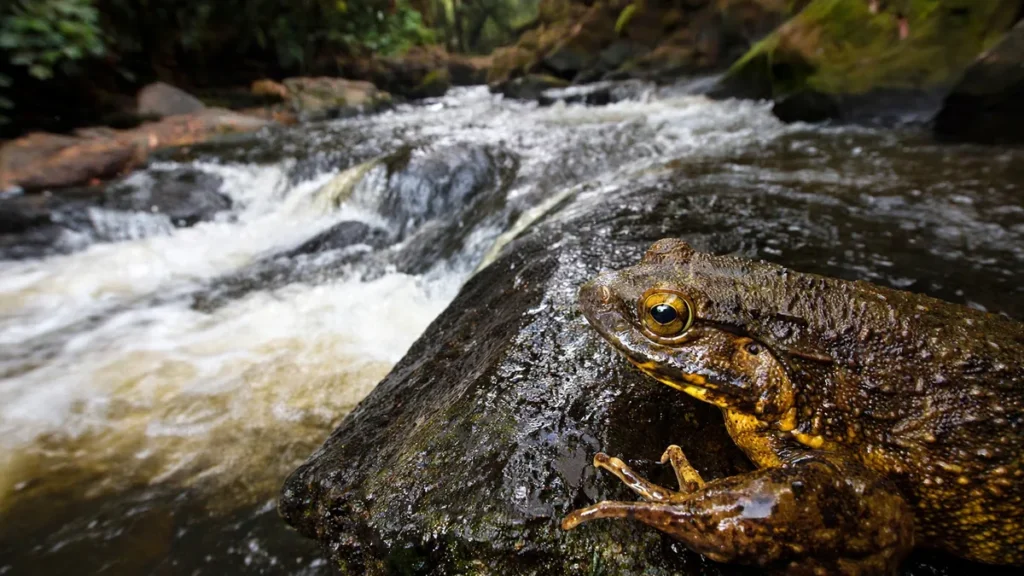
The goliath frog species is the largest frog on Earth, a frog the size of a small cat that lives in the fast, clear rivers of Cameroon and Equatorial Guinea. If you are asking what a goliath frog is, the short answer is Conraua goliath, a frog that grows to about 32 centimetres from snout to vent and weighs up to 3.3 kilograms, that cannot croak because it has no vocal sac, and that builds its own nesting pools by moving stones weighing up to two kilograms with its powerful hind legs. It is Endangered, it lives in only a narrow band of West African rainforest, and it is hunted for food in much of its range.
That combination of great size and narrow home has made the goliath frog famous far beyond the rivers it lives in, and it has also made it one of the most vulnerable frogs on Earth. It does not sing, it does not call, and it does not wander far from the water, because its whole life is tied to fast, oxygen-rich rivers and to the single plant its tadpoles eat. This guide follows the whole story: how the frog looks, where it lives, what it eats, how it builds its nests, why it is Endangered, and how to watch for it without putting yourself or the frog at risk.
Key takeaways
- The goliath frog species is Conraua goliath, the largest living frog, reaching about 32 centimetres from snout to vent and up to 3.3 kilograms, with its legs stretched out making it up to 80 centimetres long.
- Goliath frogs live only in fast-flowing rivers and waterfalls in south-western Cameroon and Equatorial Guinea, in a narrow band of coastal rainforest.
- The frog has no vocal sac and cannot croak, communicating instead with soft whistles, and it can jump up to three metres to escape danger.
- Goliath frogs build nesting pools by clearing and damming rock pools and moving stones of up to two kilograms, a behaviour only documented in 2019.
- The species is Endangered, with numbers falling by more than half over three generations, mainly because of hunting for food and the loss of its river habitat.
The goliath frog species and their relatives
The goliath frog belongs to the family Conrauidae, a family with only one genus, Conraua, the slippery frogs, a group of large frogs from sub-Saharan Africa. The genus is Conraua, a name that honours Gustav Conrau, a German trader in Cameroon who collected the holotype of Conraua robusta, the type species of the genus. The genus now holds seven recognised species, spread across West and Central Africa, and the goliath frog is the largest of them all, and the largest frog in the world.
Conraua goliath was described in 1906 by the Belgian-British zoologist George Albert Boulenger, as Rana goliath, from a specimen collected at Efulen in southern Cameroon. The species name goliath is a reference to the biblical giant, and it was well chosen, because this is a frog that dwarfs every other frog on the planet. The goliath frog is also known as the giant slippery frog and the goliath bullfrog, and its skin is slippery to the touch, which is how the whole genus got its common name.
| Type | Animal | Where it lives | Best-known food | Length or Weight |
|---|---|---|---|---|
| Family | Slippery frogs (Conrauidae) | Sub-Saharan Africa | Insects, fish and small animals | About 10 cm to 32 cm long |
| Genus | Slippery frogs (Conraua) | West and Central Africa | Insects, fish and small animals | About 10 cm to 32 cm long |
| Species | Goliath frog (Conraua goliath) | Cameroon and Equatorial Guinea | Insects, crabs, fish and small frogs | Up to 32 cm long, up to 3.3 kg |
| Species | Cameroon slippery frog (Conraua robusta) | Western Cameroon and eastern Nigeria | Insects and small animals | Males to 140 mm, females to 122 mm |
| Species | Abo slippery frog (Conraua crassipes) | Nigeria to Gabon | Insects and small animals | Smaller than the goliath frog |
| Species | Allen’s slippery frog (Conraua alleni) | Sierra Leone to Ivory Coast | Insects and small animals | Smaller than the goliath frog |
The closest relative of the goliath frog in size and habit is the Cameroon slippery frog, Conraua robusta, a frog of western Cameroon and eastern Nigeria that grows to 140 millimetres in males and 122 millimetres in females. It lives in and near cold, fast-flowing streams at elevations of 750 to 1,400 metres, in grassland and forest, and it does not need tree cover, so it can be found in some urban areas. It is the type species of the genus, the frog that defines what a Conraua is, and it is listed as Vulnerable, threatened by the same habitat loss that threatens its larger cousin.
Within the genus, the frogs sort themselves by the rivers they live in and the size they reach. The Abo slippery frog, Conraua crassipes, is a frog of eastern Nigeria through Cameroon into the Democratic Republic of Congo and Gabon, and Allen’s slippery frog, Conraua alleni, is a frog of the western Upper Guinean forests, from Sierra Leone through Guinea and Liberia to western Ivory Coast. The goliath frog and the Cameroon slippery frog are sister species, which means they share a more recent common ancestor with each other than with any other Conraua, and the three largest species in the genus do not form a single group, which tells scientists that large size evolved more than once in this family. Like the frog in general, the goliath frog begins life as a tadpole and ends it as a four-legged adult, but no ordinary frog grows to 32 centimetres, and no ordinary frog builds a nest out of stones.
What a goliath frog looks like
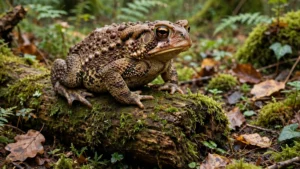
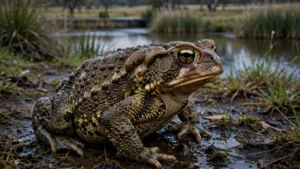
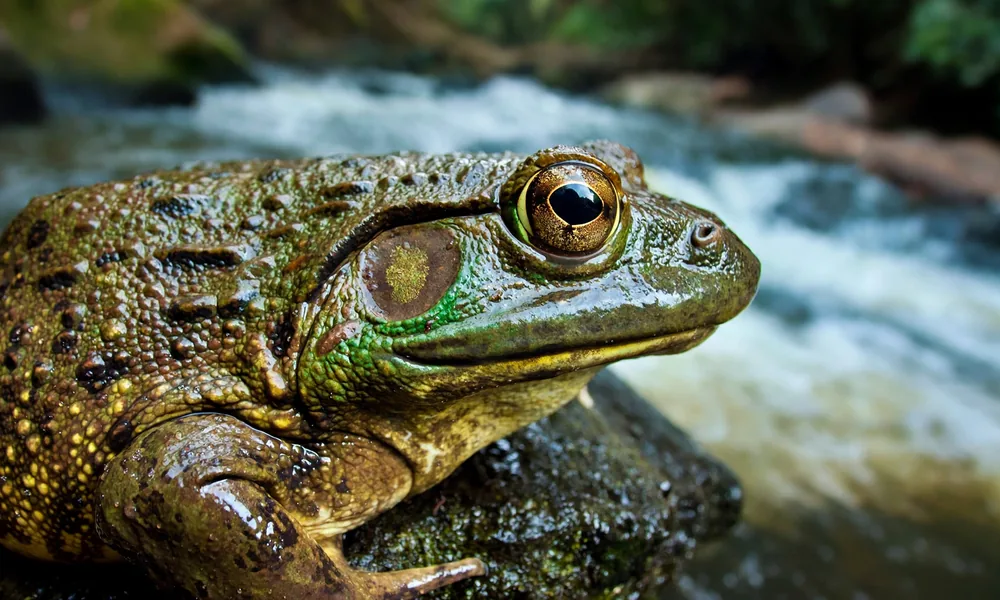
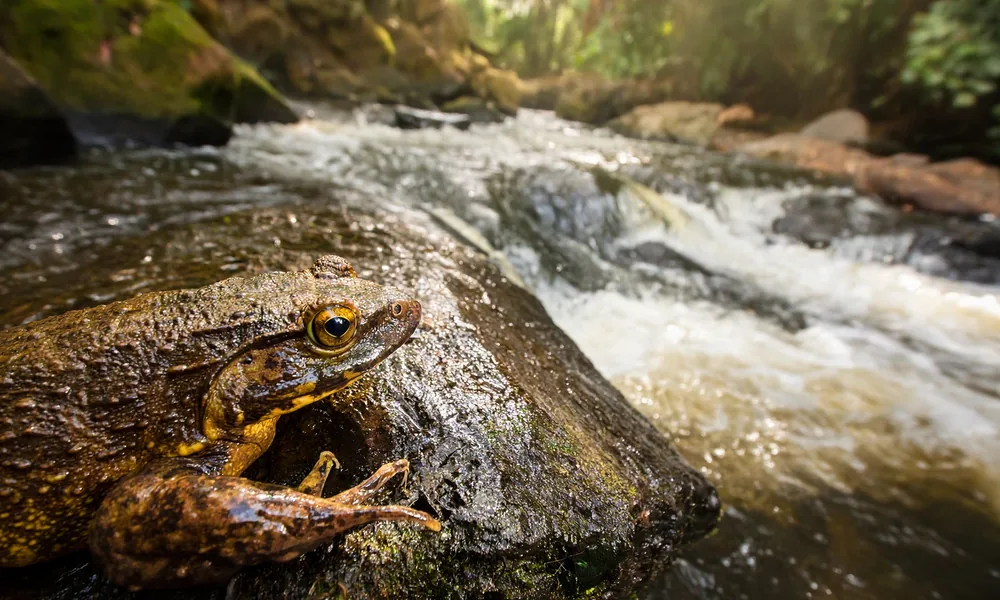
A goliath frog looks like a frog that has been scaled up without losing any of its frogness. The body is broad and muscular, with powerful hind legs that are built for jumping and swimming, and the skin is smooth and slippery, green-brown on the back and paler underneath, with a mottled pattern that breaks up its outline on a wet rock. Adults reach 17 to 32 centimetres from snout to vent, and they weigh between 600 grams and 3,250 grams, with the largest adults, which are often females, weighing 3 kilograms or more. With the legs stretched out, the largest frogs can measure more than 80 centimetres from nose to toe, which is about the length of a small domestic cat.
The size is the first thing anyone notices, and it is the whole point of the frog. The heaviest verified specimen, caught in the Muni River system in 1960, weighed 3,305 grams and had a snout-to-vent length of 34.0 centimetres, and the longest verified specimen, caught in the same river system in 1966, weighed 3,100 grams and had a snout-to-vent length of 35.6 centimetres. There are unverified claims of considerably larger frogs, but they are dubious, and the verified figures are impressive enough. A sample of fifteen frogs weighed between 600 and 3,250 grams, which tells you that a typical adult goliath frog is a heavy animal, about the weight of a small chicken.

The head is broad and flat, with large eyes set wide apart and a wide mouth that gives the frog a calm, watchful expression. The ears are sharp, and the frog can hear well, which matters for an animal that cannot call, because it must listen for the sounds of danger and of prey. The front legs are strong, and the hind legs are enormous, with long toes that are fully webbed for swimming, and the feet are built for pushing off a rock and launching the frog through the air. The skin is slippery to the touch, which is how the frog escapes a grip, and it must stay moist, which is why the frog is never far from water.
Compared with other large frogs, the goliath frog is easy to tell apart once you know what to look for. No other frog is as large, no other frog lives in such fast water, and no other frog builds a nest out of stones. The American bullfrog, which is the largest frog in North America, grows to about 20 centimetres and weighs about half a kilogram, which is a big frog by any ordinary standard, and it is still less than a third of the weight of a large goliath frog. The Cameroon slippery frog is the one most often confused with it, and it is less than half the size, with a different call and a different home in colder, higher streams.
Where goliath frogs live
Goliath frogs live in one small and very specific part of the world, and they live nowhere else. They are found only in south-western Cameroon and in Equatorial Guinea, in a narrow band of coastal rainforest that runs from the last 200 kilometres of the Sanaga River basin in Cameroon in the north to the last 50 kilometres of the Benito River basin in Equatorial Guinea in the south. The range is about 150 to 200 kilometres wide, and it is a fringe of dense equatorial forest that runs somewhat parallel to the coast and is surrounded by rivers.
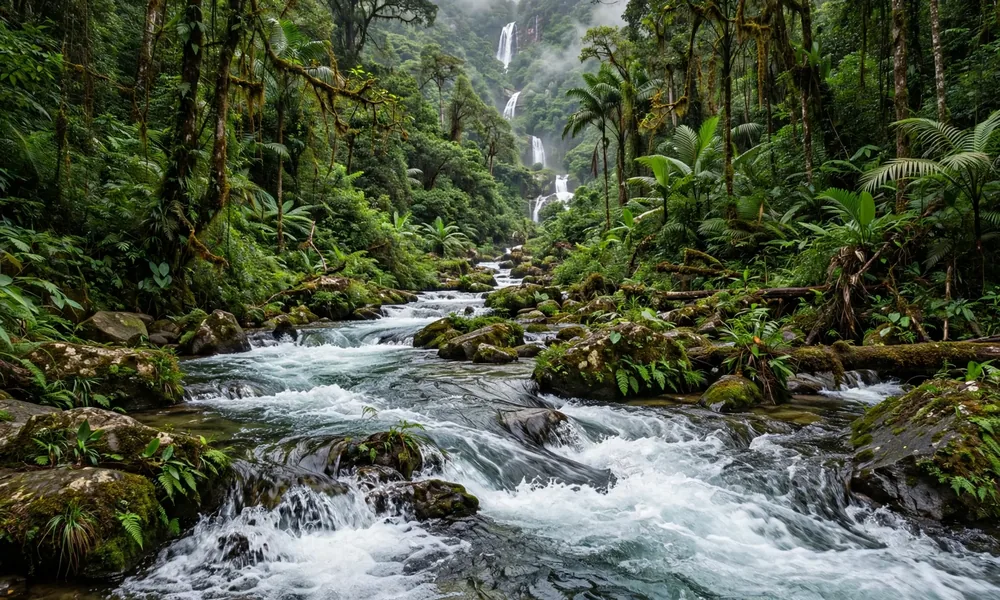
The habitat they choose is fast water, and they are rarely found far from it. Goliath frogs live in and near fast-flowing rivers with sandy bottoms, near waterfalls and rapids, in dense lowland rainforest. They are found in the Sanaga Basin, mainly near the Nachtigal cascades and in the Sakbayeme rapids, in the Kienke Basin, in the Ntem Basin, mainly near the rapids of the Mensolo and Nsana, and in the Mbia Basin, where they are abundant in the rapids and cascades. The water must be clear, cool and rich in oxygen, because the frog’s skin breathes through the water and the tadpoles need the oxygen in the rapids to survive.
The range is not only small, it is broken up. The rivers that the frogs live in are separated by stretches of forest and farmland, and the frogs cannot easily move between river systems, because they are tied to the water and cannot cross dry land for long. That fragmentation matters, because a frog that lives in a river that is dammed or polluted cannot easily move to another river, and a small population in a single river is far more vulnerable to a bad year than a large one spread across many rivers. The frog’s whole future depends on the rivers staying fast, clear and connected.
What goliath frogs eat
Goliath frogs are hunters, and their diet is written on the riverbank itself. The everyday food is insects, especially beetles, dragonflies and locusts, and other large invertebrates, and the frogs also eat worms, spiders, scorpions, freshwater crabs and shrimp, small fish, and other frogs. Their size lets them take prey that smaller frogs cannot, and they have been known to eat baby turtles, young snakes and small mammals, and a bat was once found in a goliath frog’s stomach. In captivity, they have been known to eat adult white mice, which tells you something about the size of the mouth.
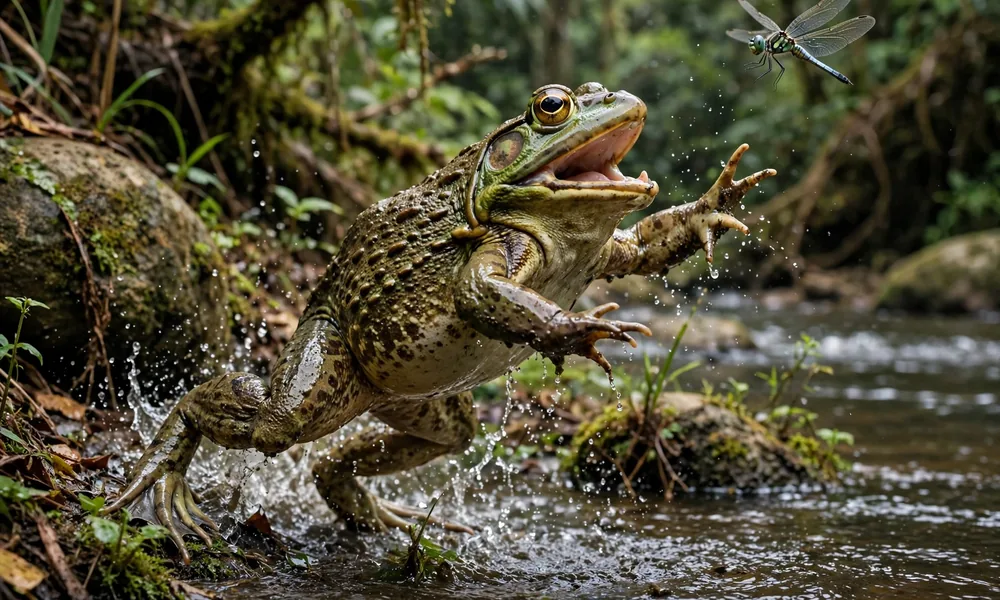
What sets the goliath frog apart is how widely it hunts, on land and in water alike. A study of the frog’s diet found that it eats a wide variety of food, suggesting that it is omnivorous with a carnivorous preference, and that its prey are terrestrial, aquatic and semi-aquatic, which means it hunts both on land and in the water. Food preferences were different among the different weight groups of frogs, with frogs weighing less than 400 grams eating annelids, arachnids, myriapods, insects, crustaceans, gastropods and reptiles, and frogs weighing more than 1,000 grams eating arachnids, myriapods, insects, crustaceans and gastropods, with a significantly higher occurrence of myriapods. The young eat smaller prey, and the diet expands as the frog grows.
Feeding follows the rhythm of the day and the night, and it is busiest after dark. Goliath frogs are mainly nocturnal, emerging at dusk to hunt and patrol their territories along the riverbanks, and they feed most actively at night, when the insects are flying and the riverbank is alive with movement. They hunt by sight and by ambush, sitting still on a rock or at the water’s edge and waiting for prey to come within reach, then lunging with a snap of the jaws. Like the axolotl, the goliath frog is an amphibian whose diet changes as it grows, but the axolotl is a water animal that hunts in the dark of a Mexican lake and never leaves the water, while the goliath frog is a river animal that hunts on land at night and returns to the water by day.
How goliath frogs behave
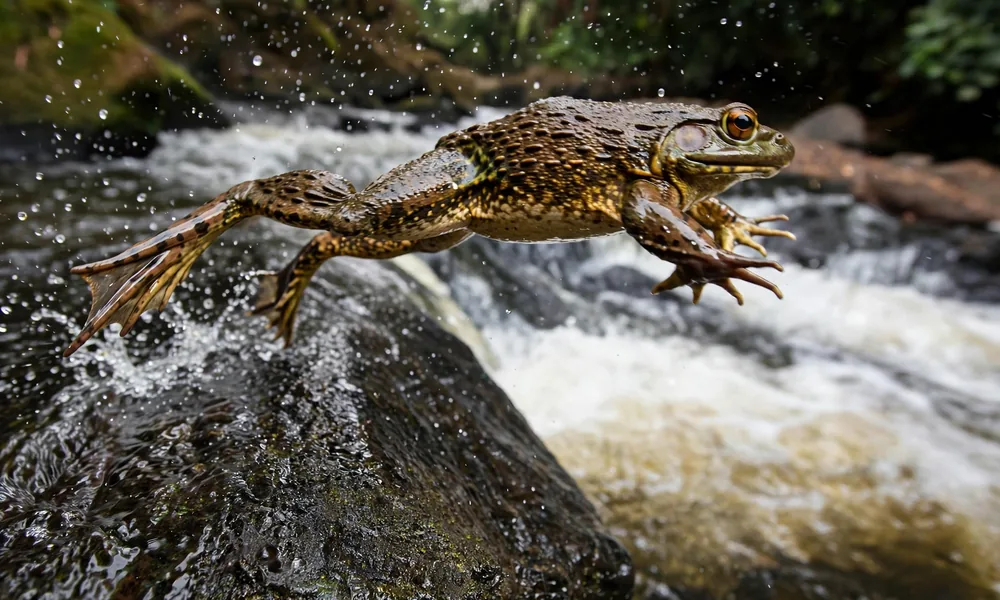
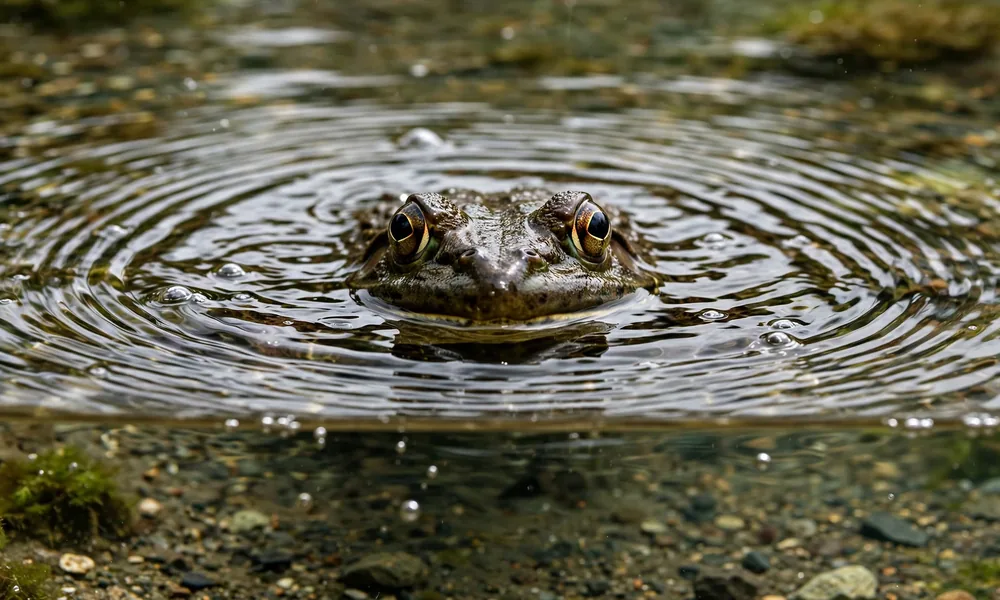
Goliath frogs are night frogs, and their day is a quiet round of sitting in the river, basking on a rock, and waiting for dusk. They spend the daylight hours in the water, with only part of their heads above the surface, saving energy and staying cool, and they venture onto the riverbanks at night to search for food, patrol their territories, and look for a mate. They are solitary outside the breeding season, and they are territorial, with individual frogs maintaining access to specific stretches of riverbank and defending those stretches from rivals. When a larger animal approaches, a goliath frog will often slip silently into the water and vanish, and if that fails it will jump, and a jump of up to three metres is enough to clear most dangers.
The most famous behaviour in the goliath frog is the one that was only discovered in 2019, when researchers in Cameroon found that the frogs build nests. The frogs excavate nesting ponds beside the main river by moving rocks weighing up to two kilograms, clearing vegetation, moving gravel and pebbles, and creating shallow pools partly isolated from the main flow, where the water is calmer and the eggs and tadpoles can develop safely. Male frogs guard these constructed nests through the night, defending them against rival males and potential predators, and the discovery of nest-building in such a large, ancient lineage suggests that active environmental modification may be more widespread among frogs than anyone had appreciated.
Breeding and life cycle
Goliath frogs breed during the dry season, from December to March, when the rivers are lower and the nesting pools are easier to build and defend. The species is polygynous, which means that one male mates with more than one female, and the males are territorial, wrestling each other for dominance over the best stretches of riverbank. In preparation for breeding, the males create water-filled egg deposition sites by clearing leaf litter and other debris from rock pools and river-scoured depressions, or by excavating holes in gravel riverbanks, and in some cases they move rocks up to half of their body weight to do it.
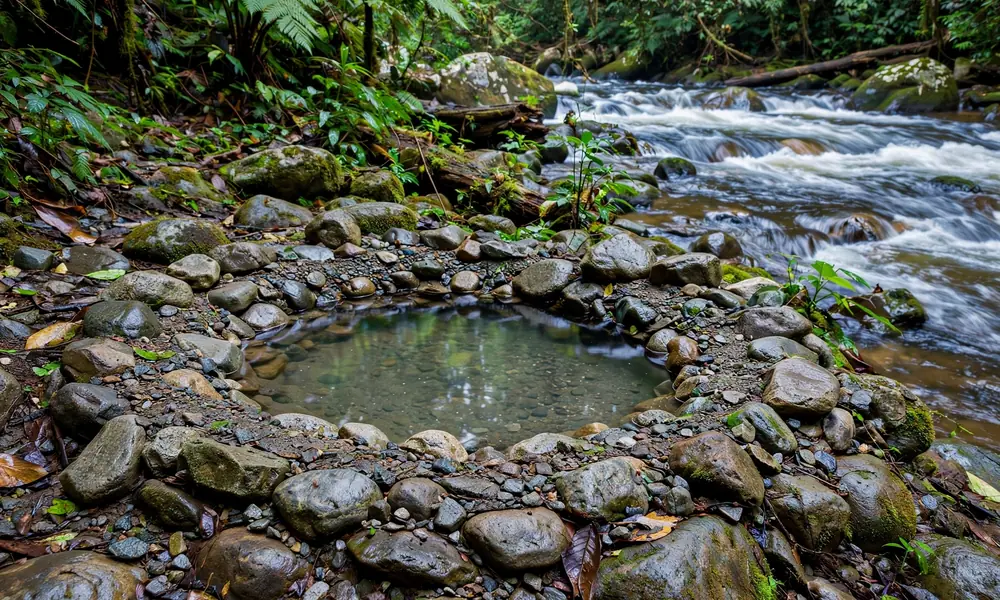
There are three main nest types, all semi-circular in shape and located in or near a river. The first type is made by clearing a section in an existing river pool, the second by expanding an already existing pool and damming it off from the river, and the third by digging a new pool roughly one metre wide and ten centimetres deep, sometimes moving quite large stones in the process. The physical demands of building a nest are thought to have selected for stronger and larger frogs over time, which may be one reason the goliath frog is so large. After mating, a breeding female lays hundreds of eggs, and the egg masses consist of several hundred to a few thousand eggs, each approximately 3.5 millimetres across, often attached to aquatic vegetation.
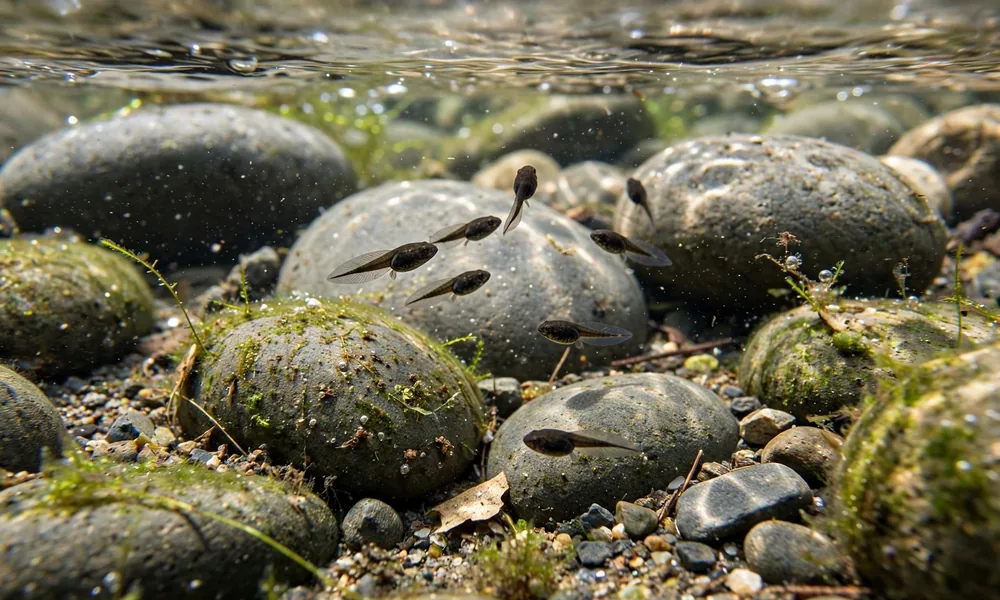
The eggs hatch in the nesting pools, and the tadpoles develop there for 85 to 95 days, feeding on the single aquatic plant Dicraeia warmingii that grows on the rocks in the rapids. The tadpoles are about a centimetre long when they hatch, and they grow steadily through their first month, feeding on leaves and on the plant, and by the third month their hind legs are forming and they are about 40 millimetres long. By the end of the third month, their front legs have appeared, their tails have begun to regress, and they begin to put their heads out of the water to breathe. The young are independent from the day they hatch, able to feed and hide within hours, but most of them will never reach adulthood, eaten by fish, shrimp and other predators in their first weeks.
Conservation status
The goliath frog is listed as Endangered on the IUCN Red List, and it has been listed as Endangered since 2004, and the reasoning is straightforward: it has a tiny range, its numbers have fallen by more than half over three generations, and the pressures on it are not letting up. The frog is also listed on Appendix II of CITES, which controls international trade in the species, and four of the seven species in the genus Conraua are threatened, which tells you that the problem is not one frog, but a whole family of large river frogs in a region where the rivers are under pressure.

The main pressure is hunting. The goliath frog is considered a food source in its native range, and its large size makes it an appealing meal, because a single frog can feed a family. The frog is protected from collecting, trade and wanton killing in Cameroon, and exports are regulated in Equatorial Guinea, where no more than 300 goliath frogs may be exported per year for the pet trade, but local residents continue to hunt it, and the hunting is the main reason the numbers have fallen. The IUCN has highlighted the need for conservation measures in cooperation with local communities, to make sure that hunting occurs at sustainable levels, because a ban that no one follows does not save a frog.
The most useful conservation work is practical, and it is the same work that helps the whole river. Protecting the remaining forest from further clearing keeps the rivers cool and clear, and working with local communities to manage hunting at sustainable levels keeps the frogs in the rivers. Captive breeding in zoos also helps, because it keeps a safety population alive and teaches people about the frog without taking animals from the wild. The goliath frog’s future depends on the rivers staying fast, clear and full of frogs, and that depends on the people who live beside them.
Best seasons for goliath frog watching
The best time to look for a goliath frog is the dry season, from December to March, when the frogs are breeding and the rivers are lower and easier to walk beside. Breeding happens in the dry season, and the males are building nests, the females are laying, and the frogs are guarding their pools through the night, so a visit in the dry months gives you the best chance of seeing the frogs at their busiest. The frogs are present in the rivers all year round, so there is no wrong season in the strict sense, but a visit in the wet season will show you fewer frogs and rivers that are harder to walk beside.
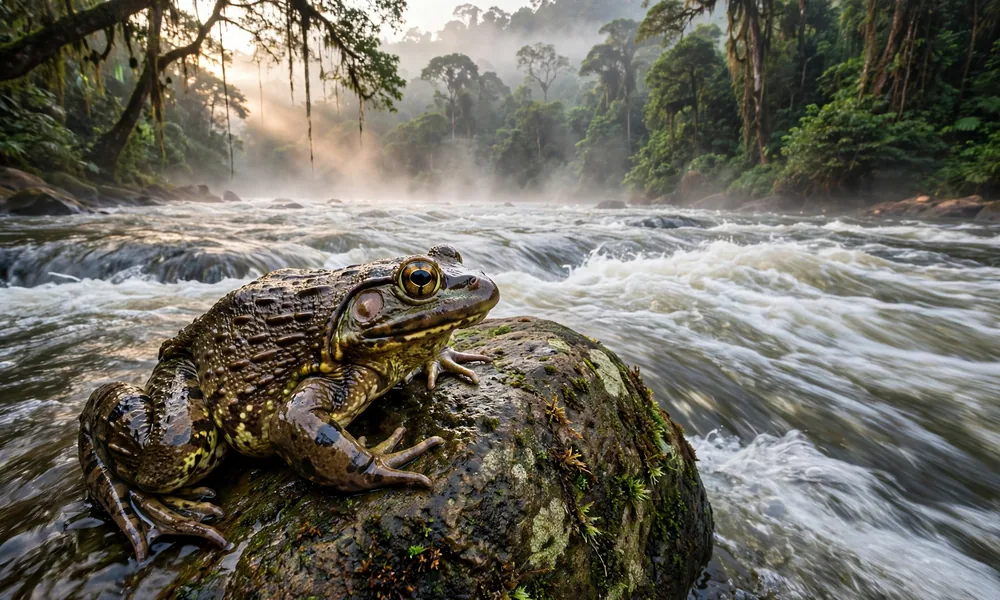
The best hours are the night and the dawn, because the goliath frog is a nocturnal frog and it is out on the riverbanks after dark. From dusk until dawn, the frogs are hunting, patrolling their territories and guarding their nests, and they are at their most active then, slipping through the water and leaping across the rocks. A slow walk along the riverbank with a local guide, watching the rocks ahead of you and listening for the soft whistle, is all you need, and the frogs will often sit still long enough to see them clearly, if you move gently and keep your distance.
Staying safe around goliath frogs
A goliath frog is not dangerous to people, and there is no safety warning that belongs to the frog itself. It has no venom, it does not bite, and it will not chase or threaten a person, because it is a shy frog that slips into the water at the first sign of danger. The safety rules for watching goliath frogs are the rules of the river and the rainforest: watch the water, watch the weather, and respect the frog that you came to see. Never lean over the side of a rock in fast water, never handle a frog with dry hands, and never keep a goliath frog out of the water longer than you must, because a frog that dries out will die quickly.
There are a few practical points for the river itself. Work with a buddy, stay within your depth, and keep an eye on the weather, which can change fast in the Cameroon rainforest. Wear a life jacket when you are in a boat, and keep clear of the fast water and the rapids when the river is high. A goliath frog will not hurt you, but the river can, and the sensible approach is to enjoy the frog and respect the fast water it lives in. The frog’s predators include lizards, snakes and crocodiles, and the river holds all three, so a watcher who is watching the frog should also be watching the water.
Goliath frog watching checklist
A little preparation turns a night on a Cameroon riverbank into a real chance of seeing a goliath frog at its best, sitting on a rock with the river running fast behind it.
- A local guide who knows the river and the frog, and who can find the rapids where the frogs live.
- A visit in the dry season, from December to March, when the frogs are breeding and the rivers are lower.
- A night walk, when the frogs are out on the riverbanks hunting and guarding their nests.
- Good waterproof boots with grip, so that a wet rock beside a fast river stays safe underfoot.
- A torch with a red filter and a camera that works in low light, so you can record the frog without blinding it.
- A life jacket and a buddy, so that a night by a fast river stays safe from start to finish.
- Respect for the frog and the river, keeping your distance, keeping the frog in the water, and leaving the river as you found it.
Frequently asked questions
How big do goliath frogs get?
Most goliath frogs measure between 17 and 32 centimetres from snout to vent, and a good frog weighs between 600 grams and 3,250 grams, with the largest adults weighing 3 kilograms or more. The heaviest verified specimen weighed 3,305 grams and measured 34.0 centimetres, and the longest verified specimen measured 35.6 centimetres and weighed 3,100 grams. With the legs stretched out, the largest frogs can measure more than 80 centimetres from nose to toe, which is about the length of a small domestic cat.
What do goliath frogs eat?
A goliath frog eats insects, especially beetles, dragonflies and locusts, and other large invertebrates, and it also eats worms, spiders, scorpions, freshwater crabs and shrimp, small fish, and other frogs. Its size lets it take prey that smaller frogs cannot, including baby turtles, young snakes and small mammals, and a bat was once found in a goliath frog’s stomach. Tadpoles eat only one thing, the aquatic plant Dicraeia warmingii, which grows on rocks in rapids and near waterfalls.
Why do goliath frogs build nests?
Goliath frogs build nests to give their eggs and tadpoles calm water in which to develop, away from the fast current of the main river. The frogs clear and dam rock pools and move stones of up to two kilograms to create shallow pools partly isolated from the main flow, where the water is calmer and the eggs and tadpoles are safer from predators and from being washed away. The behaviour was only documented in 2019, and it is thought to have selected for larger and stronger frogs over time, because moving heavy stones takes a powerful frog.
Are goliath frogs dangerous?
No, goliath frogs are not dangerous to people. They have no venom, they do not bite, and they will not chase or threaten a person, because they are shy frogs that slip into the water at the first sign of danger. Their whole defence is built on being hard to catch, hard to hold, and hard to find, and their first response to a threat is to jump up to three metres away into the fast water. The safety rules for watching them are the rules of the river itself: watch the water, watch the weather, and wear a life jacket in a boat.
Can you keep a goliath frog as a pet?
You can, but only with the right permits, and most people should not try. A goliath frog needs a large, cool, fast-flowing river in miniature, with clean, oxygen-rich water, rocks to bask on, and a diet of live insects, fish and small animals, and it grows to more than three kilograms, which is far too large for an ordinary terrarium. It is also a protected species, and its export is regulated, so a pet frog should only ever come from a legal, captive-bred source. A goliath frog belongs in a Cameroonian river, not in a living room.
How is this guide different from the golden poison frog guide?
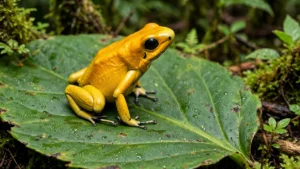
This guide covers the goliath frog, a giant, silent river frog of up to 32 centimetres and 3.3 kilograms from Cameroon and Equatorial Guinea that cannot croak and builds its nests out of stones, while our golden poison frog guide covers a tiny, bright yellow frog of about six centimetres from Colombia that carries batrachotoxin in its skin and is dangerous to touch. One is a frog you watch on a rock in a fast river at night, huge and harmless; the other is a frog you watch on the leaf litter in daylight, tiny and deadly.
Conclusion
The goliath frog species is a reminder that a frog does not need to sing to be unforgettable. A frog the size of a small cat, silent in a fast river, building a nest out of stones that weigh half as much as it does, and jumping three metres in a single leap, is a creature that deserves both respect and protection.
If you go looking for one, go to a Cameroonian river in the dry season, go at dusk with a local guide, and walk slowly along the bank with your eyes on the rocks and your ears open for a soft whistle. Find the rapids, watch for a broad back on a wet stone, and wait for the frog to slip into the water, and you will have met the goliath frog that turns a fast, clear stretch of West African river into one of the most remarkable places in the animal kingdom.