The Panamanian golden frog species is one of the most famous small animals in the Americas, a bright golden toad no bigger than a matchbox that lives, or lived, beside the fast mountain streams of west-central Panama. If you are asking what a Panamanian golden frog is, the short answer is Atelopus zeteki, a true toad in the family Bufonidae, a diurnal stream-side hunter between 35 and 63 millimetres long, coloured yellow-green to bright gold with black spots, and listed as Critically Endangered by the International Union for Conservation of Nature, most likely extinct in the wild since the late 2000s. It is a national symbol of Panama, a frog that waves at its rivals, and a species that now survives mainly in captive breeding colonies.
That last fact is the one that shapes everything else in this guide. The Panamanian golden frog was once common enough along its home streams for visitors to spot it easily, perched on mossy rocks in the daylight, and then the amphibian chytrid fungus swept through Panama and the frog vanished from the wild within a few short years. The last widely accepted wild sightings date to 2009, and the El Copé population had already collapsed in 2004. What follows is the whole story as it stands today: how the frog looks, where it lived, what it eats, how it waves instead of shouting over the roar of the water, how it breeds in mountain streams, and how a network of zoos and conservation centres in Panama and the United States is keeping it alive, with a trial reintroduction of 100 captive-bred frogs begun in August 2025.
Key takeaways
- The Panamanian golden frog species is Atelopus zeteki, a true toad in the family Bufonidae, endemic to the mountain streams of west-central Panama.
- Females grow to 45 to 63 millimetres long and weigh 4 to 15 grams, while males are smaller at 35 to 48 millimetres and 3 to 12 grams.
- The frog is diurnal and communicates by semaphore, waving a front foot at rivals and mates because its calls are drowned out by rushing stream water.
- Its bright golden skin advertises potent toxins, including zetekitoxin, and one frog is said to carry enough toxin to kill 1,200 mice.
- It is listed as Critically Endangered, most likely extinct in the wild since 2009, and survives in captive assurance colonies, with a trial reintroduction begun in August 2025.
The Panamanian golden frog species and their relatives
The Panamanian golden frog belongs to the family Bufonidae, the true toads, a large and widespread family that includes the common toads of Europe and the cane toads of the tropics, and it sits in the genus Atelopus, the harlequin frogs or stubfoot toads. The genus is a Neotropical group of small, brightly coloured, diurnal toads that live beside mid- to high-elevation streams from Costa Rica south to Bolivia, and it has suffered more than almost any other amphibian group from the chytrid fungus, with about 70 per cent of its species now considered endangered or extinct. The name Atelopus comes from the Greek words for imperfect and foot, a reference to the short, stubby feet of these toads, and the species name zeteki honours the entomologist James Zetek, who worked in Panama in the early twentieth century.
Atelopus zeteki is the lead species of this guide, and it is the frog that defines the whole genus in the public mind, largely because it is so beautiful and because its story is so stark. It is endemic to Panama, living close to mountain streams on the eastern side of the Tabasará mountain range in Coclé and Panamá Oeste provinces, in the Cordilleran cloud forests of west-central Panama. Its historic range ran from the volcanic crater of El Valle de Antón and Cerro Campana east to the town of El Copé, and it lived at heights reaching about 4,000 feet above sea level, along streams in wet rainforest and in the drier cloud forest that stays foggy for much of the day. Like the frog, the Panamanian golden frog is an amphibian that begins life in water and ends it on land, but the ordinary frog of a garden pond is a creature of still water and damp grass, while the golden frog is a creature of fast, cold, oxygen-rich mountain streams and mossy rocks.
| Type | Animal | Where it lives | Best-known food | Length or Weight |
|---|---|---|---|---|
| Family | True toads (Bufonidae) | Worldwide, except Australia and Antarctica | Insects and other small invertebrates | About 35 mm to 63 mm long |
| Genus | Harlequin frogs (Atelopus) | Central and South America | Small insects and invertebrates | About 27 mm to 63 mm long |
| Species | Panamanian golden frog (Atelopus zeteki) | West-central Panama | Ants, beetles, flies and spiders | Up to 63 mm long |
| Species | Variable harlequin frog (Atelopus varius) | Costa Rica and Panama | Small insects and invertebrates | Up to 48 mm long |
| Species | Darien stubfoot toad (Atelopus certus) | Darien, eastern Panama | Small insects and invertebrates | About 40 mm long |
| Species | Limosa harlequin frog (Atelopus limosus) | Lowland Panama | Small insects and invertebrates | About 40 mm long |
The closest relative of the Panamanian golden frog in range and fame is the variable harlequin frog, Atelopus varius, a toad of Costa Rica and Panama that grows to 48 millimetres. It is also listed as Critically Endangered, and it wears a very different pattern, bright blotches on a dark, usually black, background, where the golden frog wears black spots on gold. Males of the variable harlequin frog grow to about 27 to 40 millimetres long, and females reach 34 to 48 millimetres, and like its golden cousin it lives beside fast streams and has been hit hard by the chytrid fungus, though some populations still survive in the wild.
Within the genus, the Panamanian golden frog sorts itself from its relatives by colour, by altitude and by the streams it chooses. The Darien stubfoot toad, Atelopus certus, is a toad of eastern Panama, listed as Critically Endangered, and the limosa harlequin frog, Atelopus limosus, is a toad of the lowland forests and stream banks of Panama, listed as Endangered, living lower down than the golden frog and in warmer, wetter forest. Both are being reared in captivity by the Panama Amphibian Rescue and Conservation Project, alongside the golden frog and the variable harlequin frog, and all four are part of the same rescue effort, a set of assurance colonies built before the wild populations vanished altogether.
What a Panamanian golden frog looks like
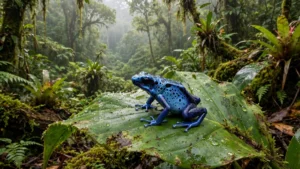
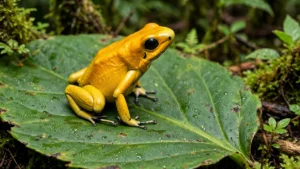
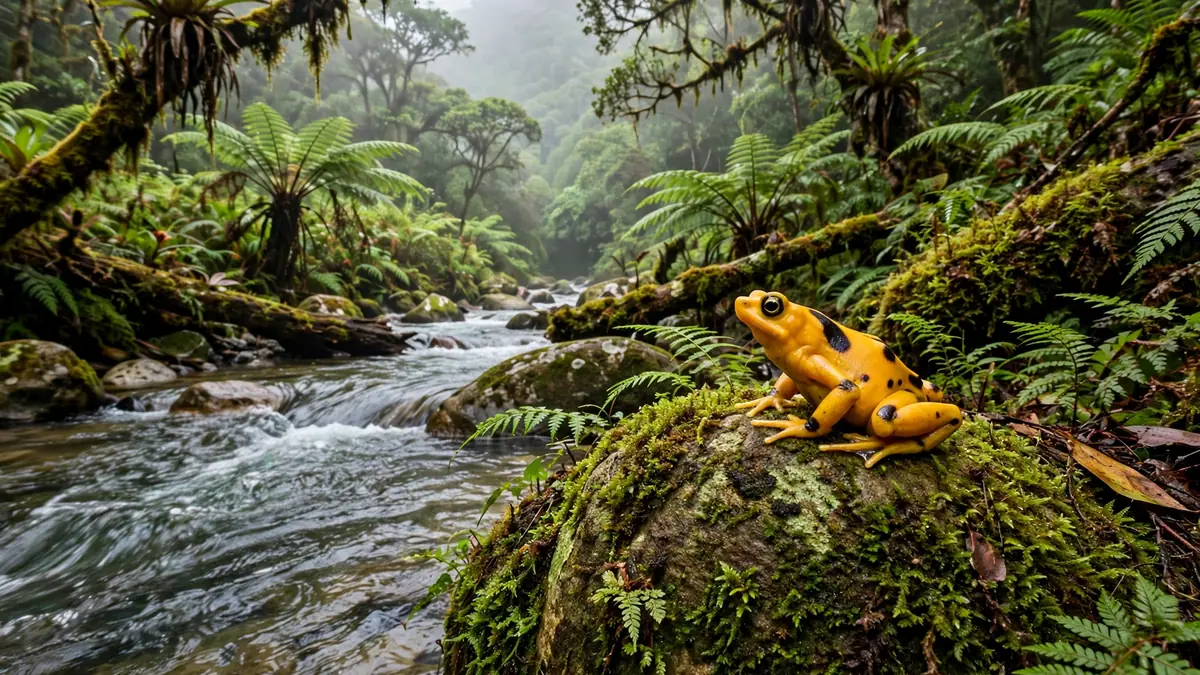
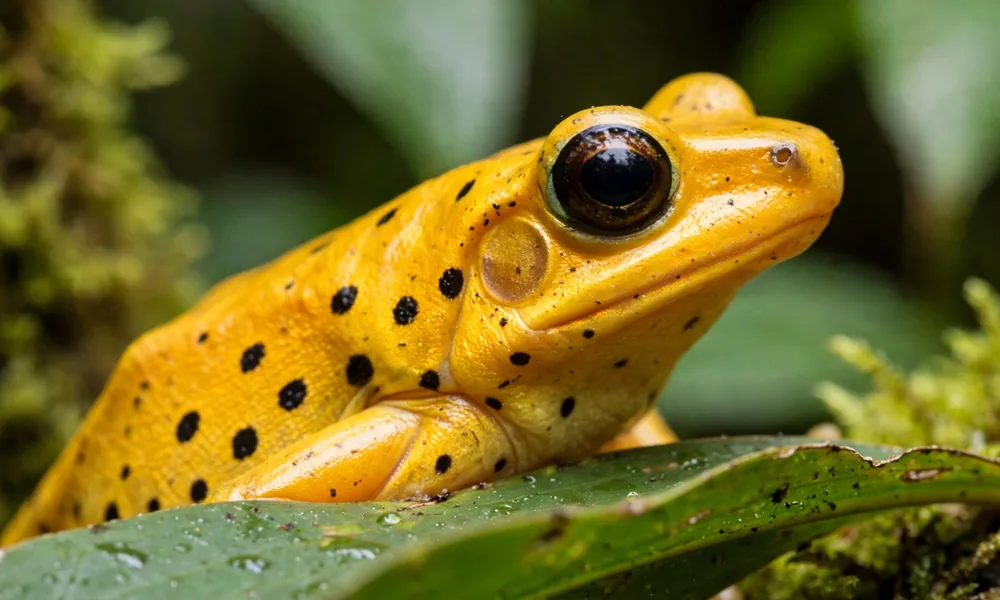
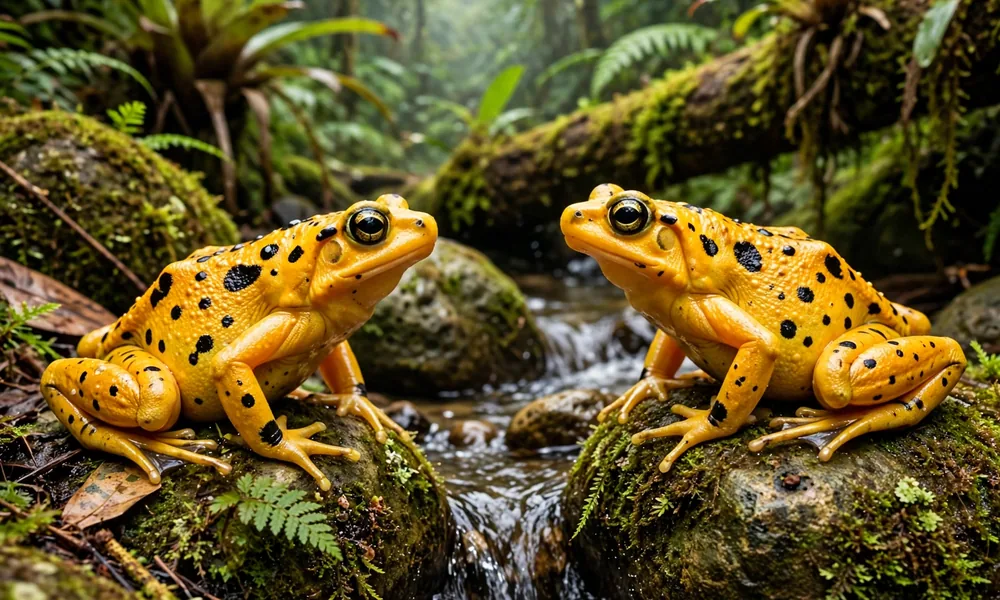
A Panamanian golden frog looks like a small jewel that has learned to sit still on a rock. The skin colour ranges from light yellow-green to bright gold, with some individuals showing black spots on their backs and legs, and the pattern varies from frog to frog, so no two look quite alike. The body is compact and toad-like, with short legs, a broad head and a slightly pointed snout, and the skin is smooth rather than warty, which is one of the reasons the frog looks more like a frog than a toad to most people who see it. The eyes are dark and prominent, set high on the head so the frog can watch the stream and the forest floor at the same time.
The size of a Panamanian golden frog depends on its sex, and the females are noticeably larger than the males. Females typically range from 45 to 63 millimetres in length and 4 to 15 grams in weight, while males are between 35 and 48 millimetres long and 3 to 12 grams in weight, so a large female is about two and a half inches long and weighs about as much as three paper clips. Golden frogs in dry habitats are substantially smaller than those in wet ones, and the species as a whole ranges from about 1.5 to 2.5 inches in size, which means the frog fits comfortably on the palm of a hand and can hide under a single large leaf.

The bright colour is not decoration, and it is not an accident. It is a warning, a form of aposematism, the same trick used by the poison dart frogs of South America, and it tells any predator that looks twice that this small animal is not worth eating. The skin carries a variety of toxins, including steroidal bufadienolides and guanidinium alkaloids of the tetrodotoxin class, and one of them, zetekitoxin AB, has been found to be a blocker of voltage-dependent sodium channels several orders of magnitude more potent than its analogue saxitoxin. One frog is said to contain enough toxin to kill 1,200 mice, and the bright colour advertises that defence so clearly that the frog can amble confidently through the forest in daylight, with only a casual response to potential threats.
Where Panamanian golden frogs live
Panamanian golden frogs live, or lived, in the cloud forests of west-central Panama, in the Cordilleran mountains that run down the spine of the country. Their home was the streams along the mountainous slopes, in wet rainforest and in the comparatively dry cloud forest, where high humidity and altitude keep the forest in a near-constant state of fog and there is little actual rainfall. They were found along streams on high slopes reaching heights of 4,000 feet above sea level, and they spent much of their time near the water, perched on moss-covered rocks or climbing in vegetation a few feet above ground level. The two places everyone names are the volcanic crater of El Valle de Antón and Cerro Campana, the only places where the frogs existed in the wild in their final years.
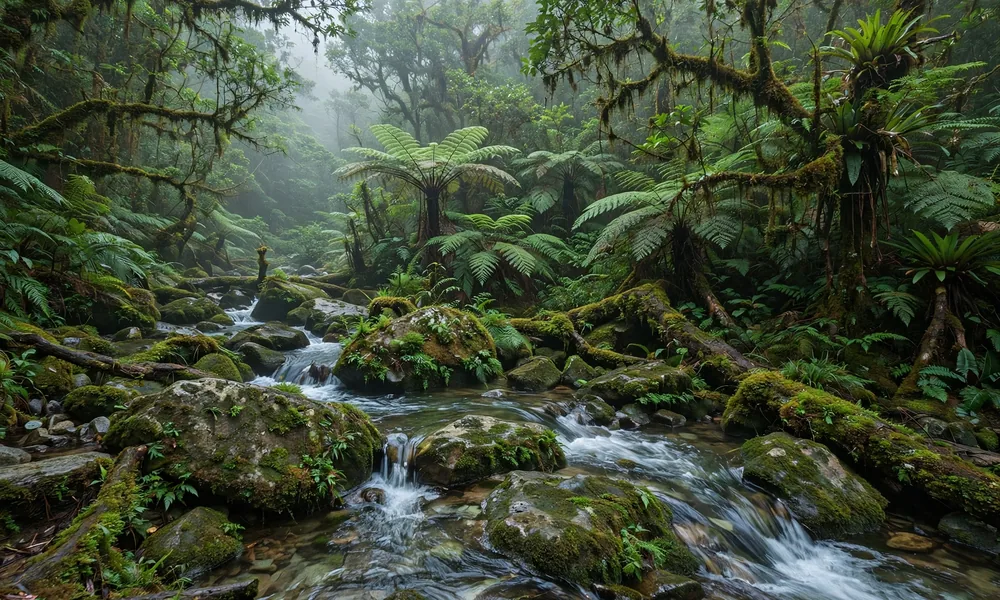
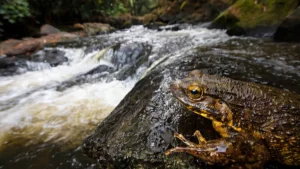
The habitat they choose is the stream itself, and they are rarely found far from running water. The frogs live close to mountain streams, on the rocks at the water’s edge, on the leaves of streamside plants and on the mossy boulders that break the current, and they need clean, cool, fast-flowing water, because their tadpoles develop in the stream and cling to rocks in the current. The water where the tadpoles live is cool, between about 20.4 and 21.3 degrees Celsius, and shallow, between 5 and 35 centimetres deep, and the adults stay close enough to the stream to return to it to breed, even when they wander a few feet up into the vegetation to hunt.
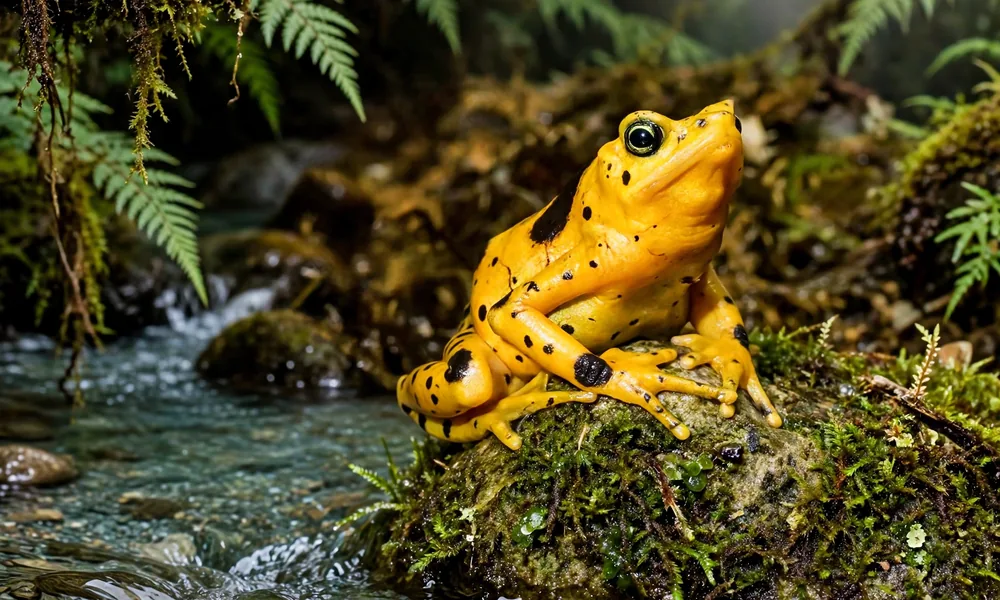
The range of the Panamanian golden frog was always small, and that smallness is part of why the fungus hit it so hard. It is endemic to Panama, which means it lives nowhere else on Earth, and its historic range covered only a strip of the Cordillera Central in Coclé and Panamá Oeste provinces, from El Valle de Antón and Cerro Campana east to El Copé. When the chytrid fungus reached El Copé in 2004, that population collapsed rapidly, and when it reached El Valle de Antón, the last stronghold, in the mid-2000s, the frogs disappeared there too. Vital habitat is also lost each year to small farms, commercial agriculture, woodlot operations, livestock range, industrial expansion and real estate development, and the forest around the old stream sites is now a patchwork of farms and second growth.
What Panamanian golden frogs eat
Panamanian golden frogs are insectivores, and their diet is written on the forest floor and the streamside vegetation. The everyday food is small insects, and they prey on ants, beetles, flies, wasps, silverfish, springtails, spiders and caterpillars, as well as other small invertebrates they find on leaves, on rocks and in the leaf litter. They are carnivores in the strict sense, eating no plant matter at all, and they hunt by sight, sitting still and watching for movement, then snapping out a sticky tongue to catch whatever comes within reach. Like the axolotl, the golden frog is an amphibian that feeds on small animals it can fit in its mouth, but the axolotl is a fully aquatic salamander that sucks prey into its mouth under water, while the golden frog is a land hunter that picks insects off leaves and rocks in the open air.

How Panamanian golden frogs behave
Panamanian golden frogs are day frogs, and their day is a quiet round of basking, hunting and waving in the open. They spend much of their time near mountain streams, perched on moss-covered rocks or climbing in vegetation a few feet above ground level, and they move slowly and deliberately, with none of the frantic hopping of a pond frog. Because their skin is toxic and their colour warns predators away, they can afford to be bold, ambling confidently through the forest in daylight, with only a casual response to potential threats, and that boldness is one of the first things visitors to El Valle used to notice about them.
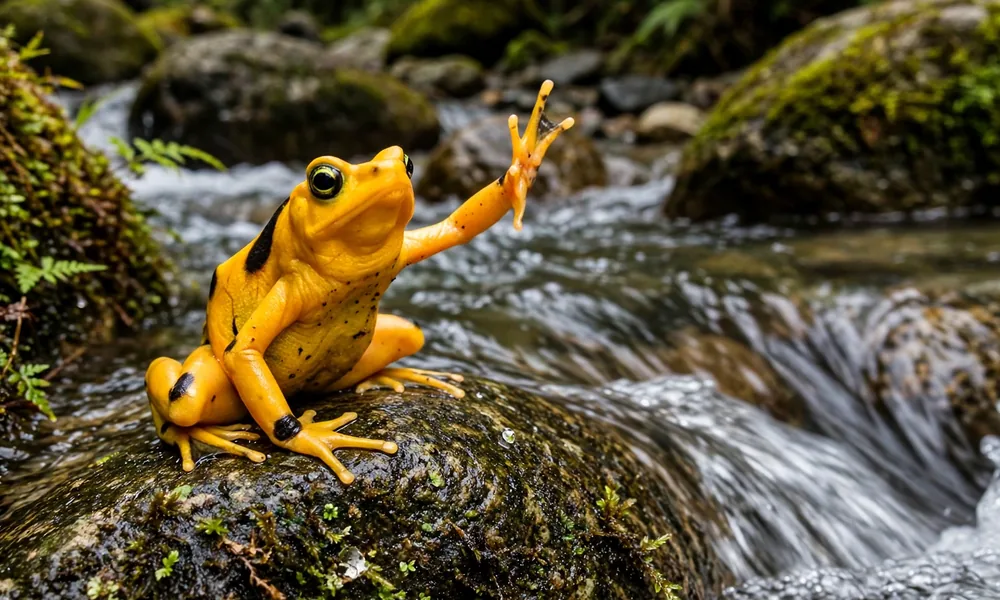
The most famous behaviour in the Panamanian golden frog is the semaphore waving, a form of communication that has made the species famous far beyond Panama. Because their habitat includes loud waterfalls and fast streams, the frogs cannot hear each other over the roar of the water, so they communicate not only with sounds from the throat but by waving a front foot, a slow, deliberate hand-wave that rivals and prospective mates can see. Males wave at each other to settle disputes over a good rock or a good calling spot, and they wave at females as part of courtship, and the wave is often accompanied by a foot-flagging display in which the frog raises a hind foot as well. It is a visual language, built for a noisy world, and it works because the frogs are out in the open in daylight, where a wave can be seen.
Breeding and life cycle
Panamanian golden frogs breed in the streams they live beside, and the timing is set by the rain. Breeding is seasonal, tied to rainfall, and the females lay their eggs in streams, usually above waterfalls where predatory fish cannot easily reach the eggs and tadpoles. The males call and hold the females in amplexus, the mating embrace in which the male clasps the female from behind, for extended periods before egg laying, and the female then lays a string of several hundred eggs in the shallow margins of the stream. A clutch is typically 200 to 600 eggs, and the eggs hatch after about nine days, which is fast for a mountain-stream frog and may be a way of getting the young out of the egg before the stream floods.
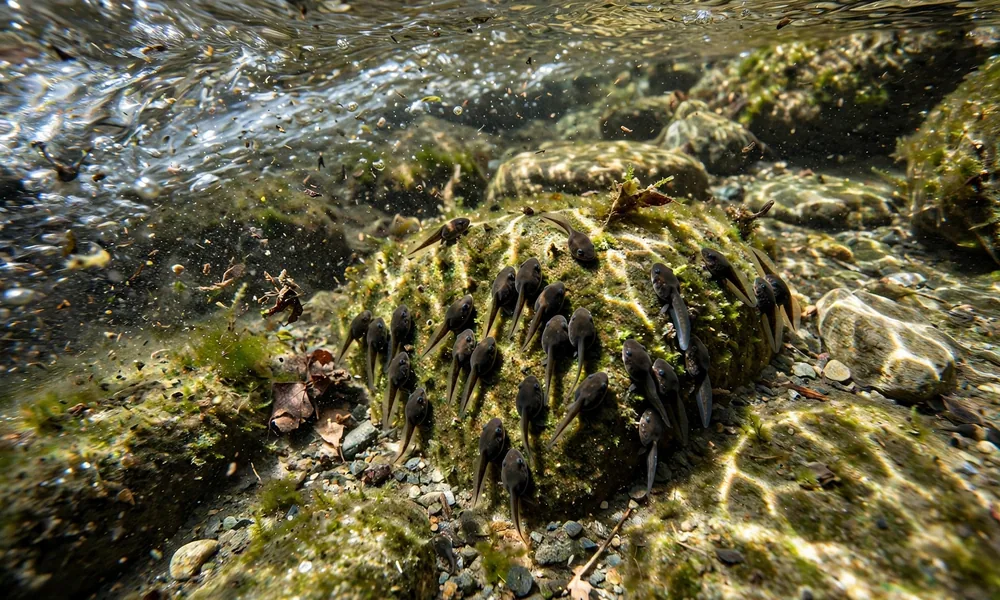
The tadpoles are entirely aquatic creatures, and they are built for fast water in a way that most tadpoles are not. They spend their time eating algae off rocks, and they have a suctorial disc on the underside, which resembles the sucker found on some catfish, and it lets them cling to rocks in the current without being swept downstream. They are typically around 5.8 millimetres in length and 4.3 millimetres in width when they first hatch, and they live in water between 20.4 and 21.3 degrees Celsius and between 5 and 35 centimetres deep, which is the cool, shallow, oxygen-rich water of a mountain stream in the dry season.
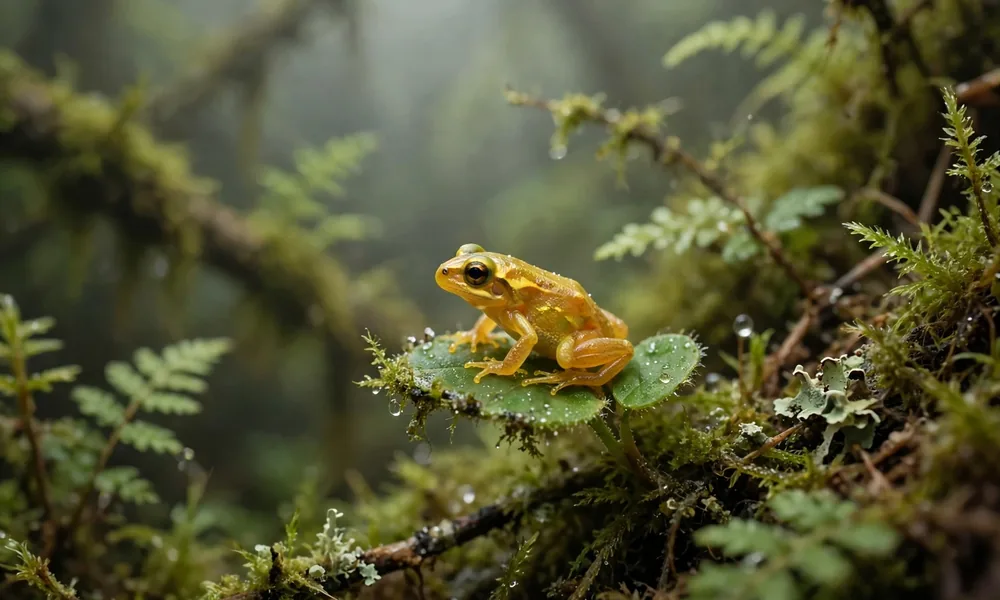
Growth is slow and carefully staged, and a young golden frog passes through four stages: larva or tadpole, juvenile, subadult and adult. The juvenile has a snout-to-vent length of 8.4 to 17.1 millimetres, and the subadult is about 28.3 millimetres long and weighs about 1.1 grams, and the young are independent from the day they metamorphose, able to feed and hide within hours, but most of them will never reach adulthood, eaten by fish and other predators in their first weeks. The lifespan of the Panamanian golden frog is about 12 years, and that long life for such a small animal is one of the reasons the captive breeding programme can work: a frog that lives twelve years has many breeding seasons in which to pass on its genes.
Conservation status
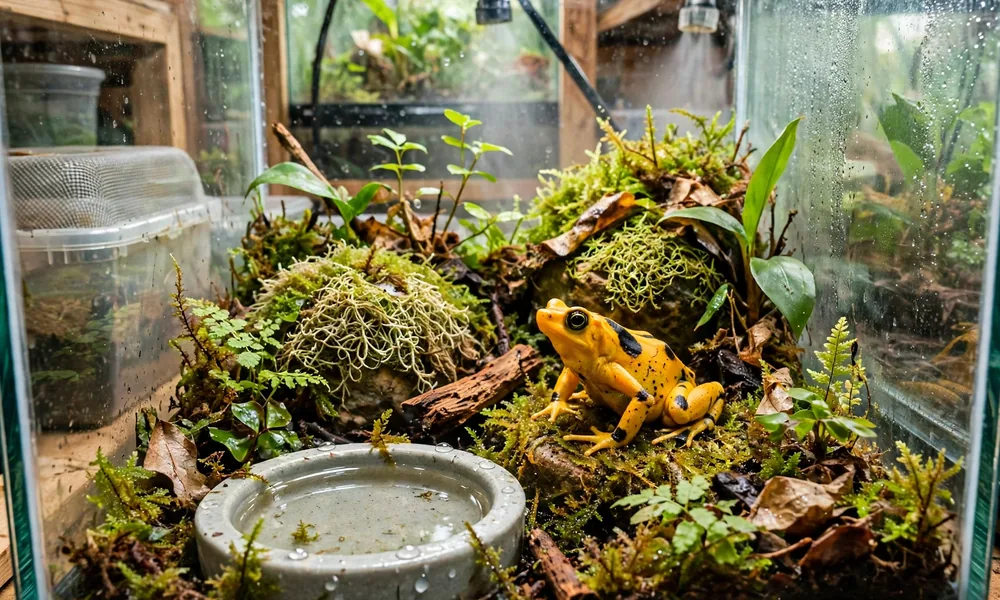
The Panamanian golden frog is listed as Critically Endangered by the International Union for Conservation of Nature, with the added note that it is possibly extinct in the wild, and the reasoning is straightforward: it has a tiny range, it has not been seen in the wild since 2009, and the disease that removed it is still present in its habitat. The IUCN assessment was last updated in 2018, and the Oakland Zoo’s summary puts it plainly: the species is believed to be extinct in the wild, and if any wild population still exists, it is believed to number fewer than 50 mature adults. That broad picture hides a more hopeful local one, because the frog is now one of the best-cared-for amphibians in the world, with a captive population of roughly 1,500 frogs maintained across a managed network in Panama and the United States.
The main pressure is disease. Chytridiomycosis, caused by the fungus Batrachochytrium dendrobatidis, swept through Panama’s highlands in the 2000s and eliminated this and many other amphibian species, and the fungus infects the frog’s skin, thickens it, disrupts the electrolyte balance of the blood and kills the animal. The fungus is believed to have first arrived in lower Central America in the late 1980s, and its spores can swim through water and hitch a ride on other wildlife and even on people’s shoes, which is why researchers disinfect their boots between streams. Habitat loss is the second pressure, with vital habitat lost each year to small farms, commercial agriculture, woodlot operations, livestock range, industrial expansion and real estate development, and over-collection for local hotels and for the pet trade added to the decline in the frog’s final years in the wild.
The most useful conservation work is practical, and it is the same work that is keeping the species alive today. In 2003, researchers collected about 40 healthy adult frogs from El Valle de Antón and Cerro Campana and shipped them to the Maryland Zoo, and the next year eight founder couples arrived at the Smithsonian’s National Zoo, where the first captive-bred golden frog, known as the Old Man, hatched in June 2005. The Panama Amphibian Rescue and Conservation Project, a collaboration involving the Smithsonian Tropical Research Institute, the Smithsonian’s National Zoo, the Cheyenne Mountain Zoo, the Houston Zoo and Zoo New England, built the El Valle Amphibian Conservation Center in 2006, and in 2013 it announced the first successful captive breeding of the golden frog there, when an egg clutch laid on 24 November 2012 grew into 42 healthy six-month-old frogs. In August 2025 the project began a trial reintroduction, releasing 100 captive-bred frogs into carefully selected habitat in soft-release pens, known as mesocosms, and about 70 per cent of the animals died of chytridiomycosis in the first 12 weeks, though the survivors were fully released afterwards and the results are expected to guide future reintroduction strategies rather than declare the species saved.
Best seasons for Panamanian golden frog watching
The best time to look for a Panamanian golden frog in the wild was the dry season, when the streams ran clear and low and the frogs sat out in the open on mossy rocks, though no season will show you one in the wild today. The frogs were present along their home streams all year round, so there was no wrong season in the strict sense, but the dry months, from about December to April, were the time when the water was clearest and the frogs were easiest to see, perched in the daylight where the sun reached the rocks. The breeding season, tied to rainfall, brought the frogs together at the streams, and a visit in the early rains would have shown you males calling and waving at each other in the open.

The best hours are the morning and the afternoon, when the frogs are out hunting in the daylight and the sun is on the rocks. From about mid-morning until late afternoon, the frogs are at their most active, waving, hunting and basking, and they are at their most visible then, sitting in the open where a careful observer can see the golden skin against the green moss. Today the honest answer is different: the best place to see a Panamanian golden frog is a zoo or a conservation centre, and the best time is Panama’s National Golden Frog Day, celebrated on 14 August, when the centres and the zoos that keep the frog run open days and talks about the species and its future.
Staying safe around Panamanian golden frogs
A Panamanian golden frog is not dangerous to people who leave it alone, and there is no safety warning that belongs to the frog itself beyond the obvious one: do not touch it, and do not eat it. Its skin carries potent toxins, and the toxin is dangerous if it gets into a cut, into the eyes or into the mouth, which is why researchers handle the frogs with wet hands, wear gloves where the work requires it, and wash their hands afterwards. A frog will not chase or threaten a person, and it will not bite, because it lives beside a mountain stream and it will never meet a swimmer in the way a pond frog might.
Panamanian golden frog watching checklist
A little preparation turns a morning beside a cloud forest stream into a real chance of understanding the golden frog, even if the frog itself is now seen only in a breeding centre.
- A visit to a zoo or conservation centre that keeps Panamanian golden frogs, booked in advance, so you can see the species up close.
- A morning walk beside a cloud forest stream in the dry season, when the water runs clear and the rocks are easy to see.
- Sturdy, disinfected boots, so you can walk the slippery streamside rocks without carrying chytrid fungus between streams.
- Binoculars and a camera that works in low light, so you can watch the streamside rocks without crowding them.
- A field guide to the frogs of Panama, so you can tell a golden frog from the variable harlequin frog and the other stream toads.
- A notebook for the semaphore waves, so you can record which frog waved first and how the other one answered.
- Respect for the frog and the stream, keeping your distance, keeping your hands off the frogs, and leaving the forest as you found it.
Frequently asked questions
How big do Panamanian golden frogs get?
Most Panamanian golden frogs measure between 35 and 63 millimetres from snout to vent, and a good frog weighs only a few grams. A typical female is 45 to 63 millimetres long and weighs 4 to 15 grams, and a typical male is 35 to 48 millimetres long and weighs 3 to 12 grams, so a large female is about two and a half inches long. Golden frogs in dry habitats are substantially smaller than those in wet ones, and the species as a whole ranges from about 1.5 to 2.5 inches in size, which means the frog fits comfortably on the palm of a hand.
What do Panamanian golden frogs eat?
A Panamanian golden frog eats small insects and other small invertebrates, which it takes on leaves, on rocks and in the leaf litter beside its home stream. The everyday food is ants, beetles, flies, wasps, silverfish, springtails, spiders and caterpillars, and the frog hunts by sight in daylight, snapping out a sticky tongue to catch whatever comes within reach. The tadpoles eat differently, grazing algae off rocks in the stream, and they spend their whole larval life in the water, clinging to the stones with a sucker-like disc.
Why do Panamanian golden frogs wave?
Panamanian golden frogs wave because their home is too loud for sound. They live beside fast mountain streams and waterfalls, where the roar of the water drowns out their calls, so they communicate by semaphore, waving a front foot at rivals and prospective mates in a slow, deliberate gesture that can be seen across the stream. Males wave at each other to settle disputes over a good rock, and they wave at females as part of courtship, and the wave is often accompanied by foot-flagging, in which the frog raises a hind foot as well.
Are Panamanian golden frogs dangerous?
Yes, in the sense that their skin is toxic, but no, in the sense that they will not attack you. A Panamanian golden frog carries potent toxins in its skin, including zetekitoxin, and one frog is said to contain enough toxin to kill 1,200 mice, which is why its bright golden colour warns predators away. The frog will not chase or bite a person, and the toxin is dangerous only if it gets into a cut, into the eyes or into the mouth, so the sensible rule is to look, to photograph, and not to touch.
Can you keep a Panamanian golden frog as a pet?
You should not, and in practice you cannot, keep a Panamanian golden frog as a pet. The species is Critically Endangered and nationally protected in Panama, it is listed on Appendix I of CITES, and the only frogs in captivity are held in managed assurance colonies by zoos and conservation centres for breeding, not for sale. It also needs cool, clean, fast-flowing stream water, a diet of small live insects and a carefully managed environment, and a frog taken from the wild would be a frog taken from a species that has almost nothing left. A golden frog belongs in a breeding centre, and one day, with luck, back in its home streams.
How is this guide different from the olm guide?
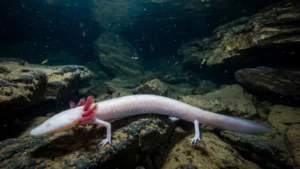
This guide covers the Panamanian golden frog, a bright golden, diurnal, stream-side toad of Panama that waves at its rivals in the daylight and is most likely extinct in the wild, while our olm guide covers a pale, blind, cave-dwelling salamander of the Dinaric karst that lives its whole life in the dark underground waters of Slovenia, Croatia and Bosnia and Herzegovina. One is a small golden frog you watch waving on a mossy rock in a sunlit cloud forest stream; the other is a long, pink-white salamander you meet only in a cave, in water you cannot see into without a light.
Conclusion
The Panamanian golden frog species is a reminder that a frog does not need to be big to be unforgettable. Bright golden skin with black spots, a wave instead of a call, toxins that can kill 1,200 mice, and a life beside the fast mountain streams of Panama have made the golden frog the most famous small toad of the Americas, a national symbol, and a species that vanished from the wild within a few short years of the chytrid fungus reaching its home.
If you go looking for one, go to a breeding centre or a zoo on National Golden Frog Day, go in the morning, and watch for a small golden frog on a mossy rock, waving one front foot in the light. Find the stream, watch for the gold against the green, and wait for the wave, and you will have met the frog that turns a quiet stretch of cloud forest into a place of sudden, golden excitement, and you will understand why Panama is working so hard to bring it home.