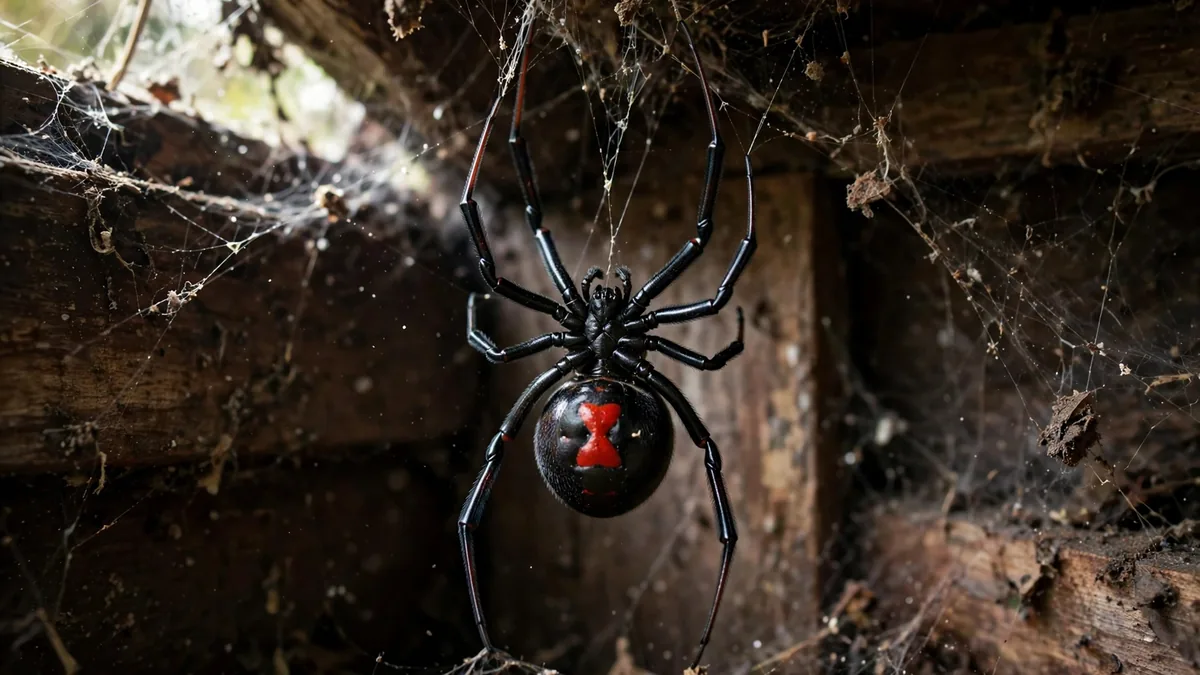
The black widow spider species are the most famous spiders in North America, small shiny black spiders whose females carry a red hourglass mark on the underside of a round abdomen and a venom that can make a grown person very ill. If you are asking what a black widow spider is, the short answer is a spider of the genus Latrodectus, one of about 30 widow species found in temperate regions around the world, with the adult female measuring only 8 to 13 millimetres in body length yet carrying a neurotoxic venom, alpha-latrotoxin, that acts on the nervous system. They are shy, solitary spiders that hang upside down in messy cobwebs close to the ground, in woodpiles, sheds, garages and dry grassland, and they would far rather drop from the web and play dead than bite anything as large as a person.
That mix of small size and serious venom is why the black widow has such a large reputation, and it is also why so much of that reputation is wrong. A black widow does not hunt people, it does not chase, and it does not guard its web like a dog guards a yard. It sits still, waits for a flying or crawling insect to blunder into the silk, and wraps it up. Bites happen almost entirely when the spider is squeezed against skin, when a hand reaches into a woodpile, when a shoe that has sat in a garage is put on, or when an egg sac is threatened. Deaths are extremely rare, and there has been no reliably reported death from a black widow bite in the United States for decades, because the amount of venom injected is tiny and modern medical care works well.
Key takeaways
- The black widow spider species belong to the genus Latrodectus, with about 30 species worldwide, and three of them, the southern, western and northern black widows, carry the name in North America.
- Adult females are shiny black with a red hourglass mark on the underside of the abdomen, a body 8 to 13 millimetres long and a leg span of 25 to 38 millimetres, while males are brown or grey, only 3 to 6 millimetres long, and do not bite people.
- Black widows hang upside down in tangled, three-dimensional cobwebs close to the ground, in woodpiles, sheds, garages, hollow logs and dry grassland, and they are most active in the warm months.
- The venom contains alpha-latrotoxin, a neurotoxin that causes cramping muscle pain, rigid abdominal muscles, sweating and nausea, yet deaths are extremely rare and most people recover fully within a few days.
- Each female lays several papery egg sacs in a summer, each holding 250 to 750 eggs, and the spiderlings hatch pale and darken with every moult until the females turn glossy black.
The black widow spider species and their relatives
Black widows belong to the family Theridiidae, the comb-footed spiders, a large family of spiders that build tangled cobwebs rather than the neat orb webs most people picture when they think of a spider. The name comb-footed comes from a row of serrated bristles on the hind legs, a small comb the spider uses to draw silk over its prey and wrap it tight, and the family holds thousands of species around the world, most of them small, shy and harmless to people. The black widows sit inside that family in the genus Latrodectus, a genus of about 30 species, and the name comes from Greek words meaning secret biter, a fair description of a spider that bites only when it is trapped.
The lead species of this guide is the southern black widow, Latrodectus mactans, the most common black widow in the south-eastern United States, ranging as far north as Ohio and as far west as Texas. It is the spider most people mean when they say black widow, and it is the one whose glossy black female, red hourglass and messy web have become the image of the whole genus. Like the spider, the black widow is an arachnid with eight legs and two body parts rather than an insect, but the ordinary garden spider builds its web in the open and sits in the middle of it in daylight, while the black widow builds a low, tangled cobweb in a dark corner and hangs upside down in it, hidden, waiting for the dark hours when its prey is moving.

| Type | Animal | Where it lives | Best-known food | Length or Weight |
|---|---|---|---|---|
| Family | Comb-footed spiders (Theridiidae) | Worldwide, temperate and tropical regions | Insects and other spiders | About 3 mm to 13 mm long |
| Genus | Black widows (Latrodectus) | Worldwide, temperate regions | Insects, other spiders and small invertebrates | About 3 mm to 13 mm long |
| Species | Southern black widow (Latrodectus mactans) | South-eastern United States | Flying and crawling insects | About 8 mm to 13 mm long |
| Species | Western black widow (Latrodectus hesperus) | Western North America | Insects and other spiders | About 8 mm to 13 mm long |
| Species | Northern black widow (Latrodectus variolus) | Northern and eastern North America | Insects and other spiders | About 8 mm to 13 mm long |
| Species | Redback (Latrodectus hasselti) | Australia and South-East Asia | Insects and other spiders | About 8 mm to 13 mm long |
The western black widow, Latrodectus hesperus, is the black widow of the western United States, from the Pacific coast to the deserts and mountains of the interior, and it is the species most often found around houses in California and the south-west. It looks very like the southern black widow, a shiny black female with a red hourglass, though the hourglass is sometimes broken into two triangles, and it lives in the same sort of places, in woodpiles, in garages, under stones and in the corners of outbuildings. The northern black widow, Latrodectus variolus, lives across the north and east of North America, from southern Canada to Florida, and it is a spider of woodland edges and stone walls as much as of sheds, often found in hollow logs and in the crevices of old stonework where a web can be tucked out of the wind.
Beyond North America, the most famous relative is the redback, Latrodectus hasselti, the black widow of Australia and parts of South-East Asia, a spider with a red stripe down the top of its black abdomen rather than only an hourglass beneath it. All of these spiders share the same build, the same tangled web, the same shy habits and the same venom, and all of them are far less dangerous in practice than their reputation suggests, because none of them wants anything to do with a person.
What black widow spiders look like
A female black widow is one of the easiest spiders in the world to recognise, and one of the hardest to mistake for anything else once you have seen her properly. She is a glossy, coal-black spider with a large, round, almost spherical abdomen, long slender legs, and a body that shines like polished jet in the light. Her body length, not counting the legs, is 8 to 13 millimetres, about the width of a thumbnail, and with her legs spread she measures 25 to 38 millimetres across. She weighs about a gram, around 0.035 ounces, which is less than a paperclip, and yet she is the largest spider in her family.
The mark that gives her away is the hourglass. On the underside of the abdomen, where it faces the ground when she hangs upside down, is a red marking shaped like an hourglass, sometimes a clean hourglass and sometimes two small red triangles, and sometimes orange or yellow rather than red. Many females also carry a red or orange patch just above the spinnerets, at the rear of the abdomen, and a few carry small red spots along the top of the abdomen as well. The hourglass is a warning, and it works the way warning colours work across the animal kingdom: a bird or a wasp that has once met a widow learns to leave black spiders with red marks alone, and the spider, which cannot run fast and has no shell to hide in, gains a little safety from a splash of colour.
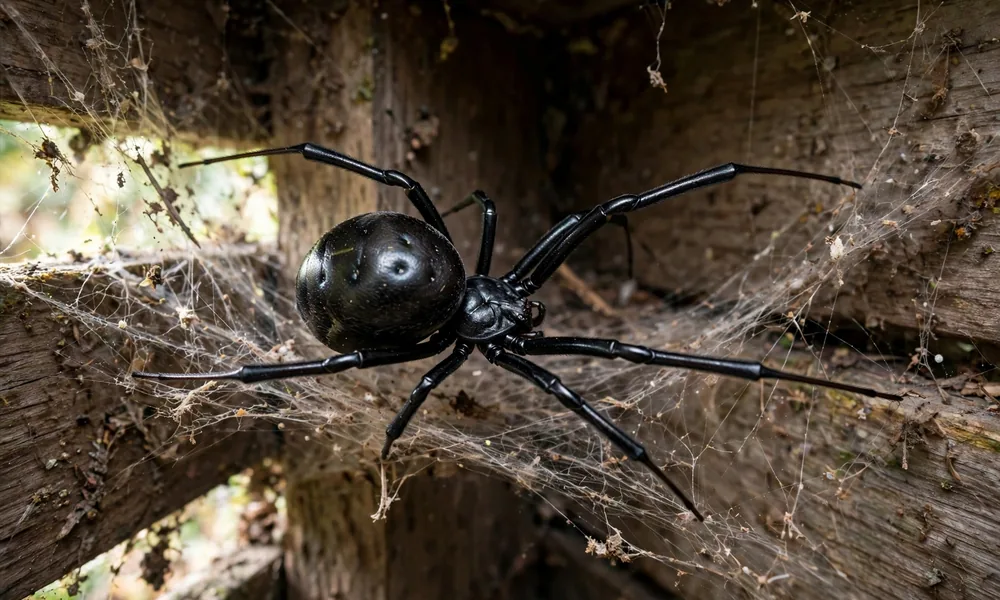
The male looks so different that a stranger would never guess the two belong to the same species. He is brown or grey rather than black, only 3 to 6 millimetres long, with a much smaller abdomen marked with red and white stripes and spots, and he keeps the pale colours of a young spider all his life. His fangs and venom glands are too small to pierce human skin, and he is not known to bite people at all. Young spiders hatch pale yellow or white with dark markings, and they darken with every moult, the females turning glossy black as they grow and the males keeping their lighter, striped pattern.
The name black widow comes from the female’s habit of eating the male after mating, a habit that was watched by early naturalists and has stuck in the public mind ever since. The truth is quieter than the story: females do sometimes kill and eat the male, but they do not always do so, and in the wild the male often slips away and may even mate again. Studies of the closely related redback found that females ate their mates only about two per cent of the time, and experts suspect the American black widows behave much the same way.
Where black widow spiders live
Black widows live in temperate regions around the world, and in the United States they are found mostly in the south and the west, though the northern black widow reaches into southern Canada and the southern black widow is common across the whole south-east. They live in forests, deserts and grasslands, and they live just as happily around people, in gardens, in sheds, in garages, in basements and in woodpiles. The three North American species divide the continent between them by region, as their names suggest.
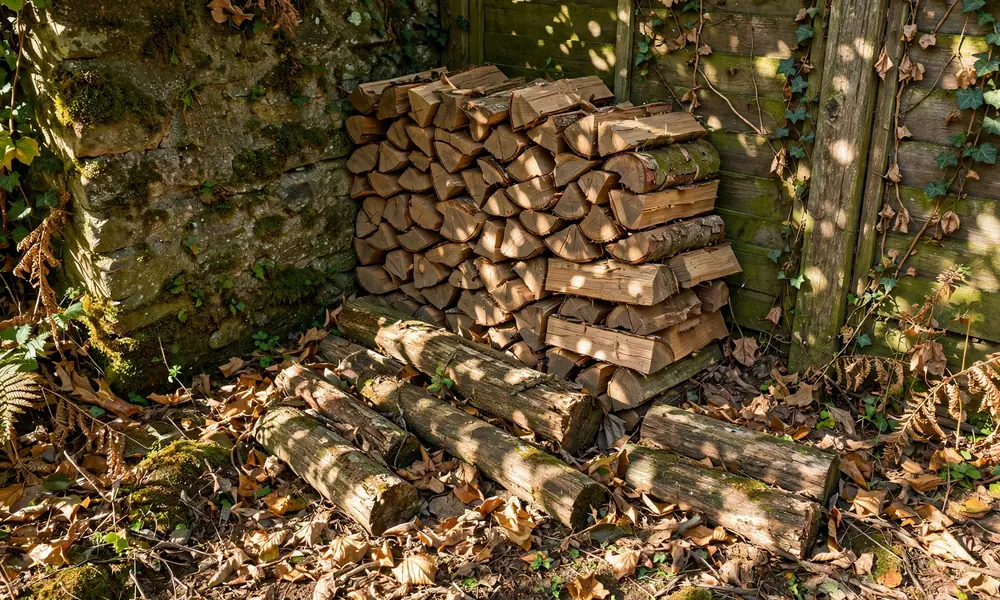
The web is always close to the ground, and that is the first thing to look for. A black widow builds a three-dimensional, tangled cobweb, not a flat orb, a messy-looking tangle of exceptionally strong silk with a small retreat, a silk-lined corner or hollow, tucked into the darkest part of it. The web is usually no more than a foot or two off the ground, in a covered or dark place: under a log, behind a drainpipe, in the corner of a shed, beneath a stone, in a hollow tree stump, or in the clutter of a garage. The silk is strong for its thickness, and the web is built to last, with the spider repairing it and adding to it for months rather than rebuilding it every night the way an orb-weaving spider does.

The spider’s range is set by warmth and dryness rather than by any one kind of landscape. Black widows do best where the summers are long and warm, and they are most active in the warm months, when insects are plentiful and the females are laying their egg sacs. In colder country they shelter through the winter in garages and basements, in woodpiles under snow, and in the warm corners of houses, which is why a spider that lives wild in the south can turn up indoors in the north.
What black widow spiders eat
Black widows eat insects and other small animals that blunder into the web, and they are patient hunters rather than active ones. The everyday food is flying and crawling insects: flies, beetles, ants, grasshoppers, cockroaches and moths, and any small spider that wanders into the silk is eaten too. The spider hangs upside down in the middle of the tangle, waiting, and when something touches a thread she feels the vibration through her feet, runs over, and bites it. The venom works fast on an insect, and the spider then wraps the prey in silk, drags it back to the retreat, and feeds on it at leisure, sucking out the liquefied insides and leaving the dry husk behind.

The web itself does much of the hunting. The silk is unusually strong, and the lower threads run down to the ground, where a walking insect trips over them and is hauled up into the tangle. A black widow has even been known to trap and eat small vertebrates, such as lizards and small snakes, when one blunders into a low web, though that is rare. The spiders eat little and often, and a female that has just laid an egg sac may go weeks without feeding while she guards it, living off the reserves in her large abdomen.
How black widow spiders behave
A black widow is a shy spider, and shyness shapes everything it does. It spends its life in one web, in one dark corner, and it leaves that web only when it must: when the web is destroyed, when the hunting fails, or, for a male, when it is time to find a mate. The female hangs upside down in the centre of the tangle for hours at a time, her red hourglass facing downwards, her legs spread to feel the silk, and she does not move unless a thread trembles. She is most active at night, when the insects are flying and the air is cool and damp, and during the day she sits in her retreat, a silk-lined pocket in the darkest part of the web, waiting for the evening.

When something large disturbs the web, the spider’s first response is not to bite but to escape. She drops from the web on a thread, curls her legs tight against her body, and plays dead on the ground, a small black ball that a bird or a wasp is likely to overlook. Only if she is squeezed, pinned against skin, or cornered with her egg sac does she bite, and even then the bite is a defensive one, often with little or no venom injected. Most bites happen in the warm months, when people are reaching into woodpiles, clearing sheds, or putting on shoes that have sat undisturbed in a garage.
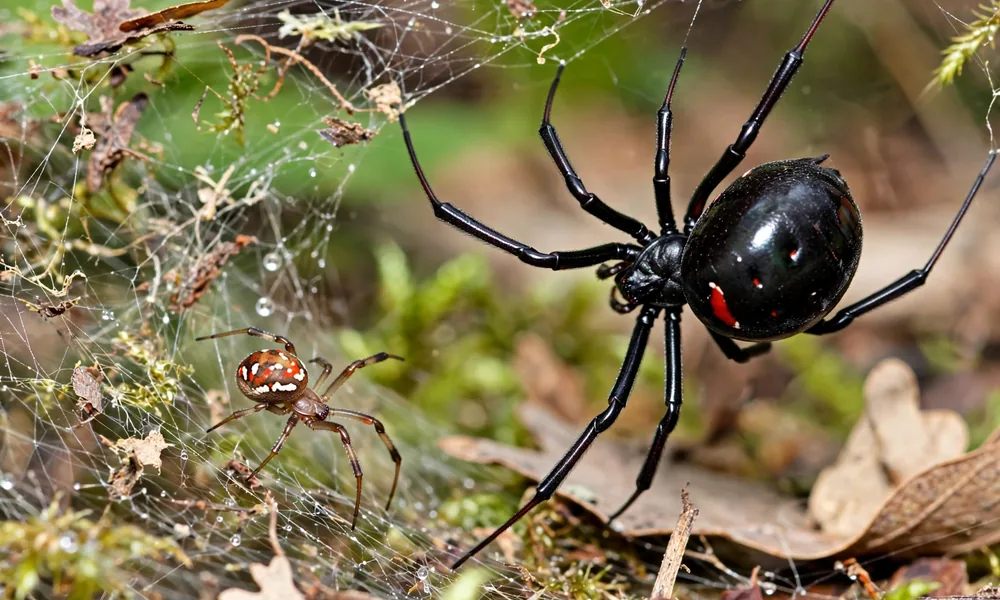
Mating is the one time a black widow leaves home, and it is the male who does the travelling. A mature male abandons his small web and wanders in search of a female, following the scent of her silk until he finds her web, and then he approaches with care, plucking the threads to announce himself rather than arriving as prey. He mates with her, and then, in most cases, he slips away. The female may mate more than once in a season, and she stores the sperm to fertilise several batches of eggs over the summer, which is why a single mating can produce hundreds of young. The males die shortly after mating, within a few weeks at most, while the females live on, guarding their webs and their egg sacs, for a year or more.
Breeding and life cycle
Black widows breed in the warm months, and the timing is set by the heat. A female mates in late spring or early summer, and she then lays several papery egg sacs over the course of the summer, each one suspended in the web near her retreat. Each sac is white or tan, about 1.25 centimetres across, and it holds 250 to 750 eggs, so a single female can produce well over a thousand young in one summer. She guards the sacs fiercely, sitting beside them and repairing the silk around them, and she will bite readily if a hand comes near them, which is one more reason to leave a web with egg sacs well alone.

The eggs hatch after about 14 to 30 days, and the spiderlings that emerge are pale and soft, whitish or pale yellow with dark markings, and no bigger than a pinhead. They stay on the mother’s web for a few days, moulting once or twice, and then they scatter, ballooning away on threads of silk caught by the wind or simply walking off to find a corner of their own. Females reach maturity in about 90 days, and they live for about a year after that, while the males mature faster and die within a few months of mating.
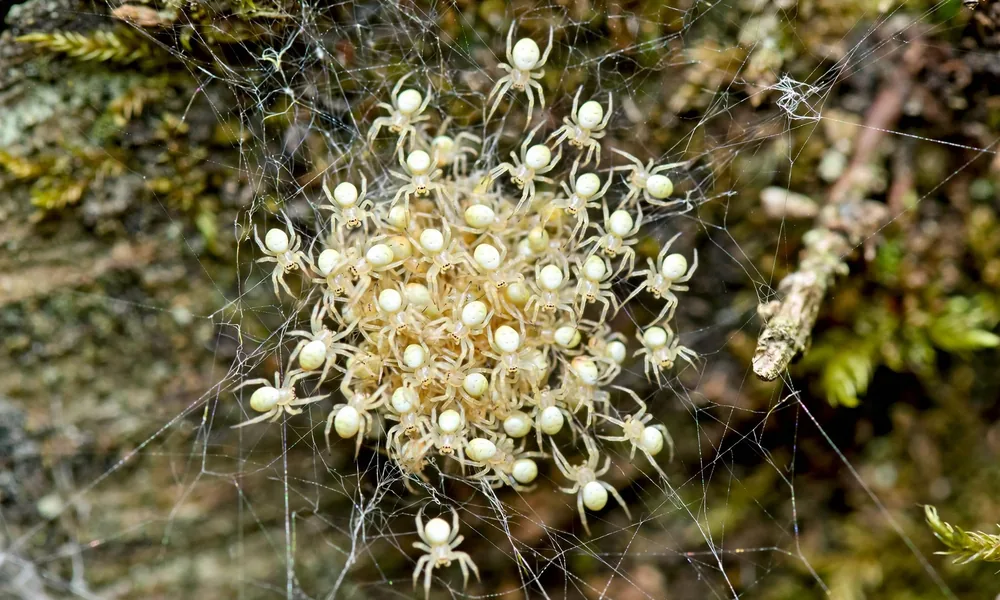
The life cycle is a short one, but it is a productive one, and the numbers explain why black widows are common even though so few young survive. Of the hundreds of eggs in each sac, most spiderlings are eaten by their siblings, by other spiders, by wasps and by birds, and only a handful reach adulthood. In warm climates the spiders can breed through much of the year, while in colder country the adults shelter through the winter and the young hatch with the spring warmth, starting the cycle again.
Conservation status
Black widows are not assessed by the International Union for Conservation of Nature, and they are not listed by any conservation programme, because they are common, widespread and in no danger at all. They are fairly common spiders, and they are afforded no special conservation protections, which is the honest answer for an animal that thrives around houses and in gardens across a whole continent. The three North American species are all abundant in their ranges, the redback is abundant across Australia, and the genus as a whole is one of the most successful groups of spiders on Earth, at home in deserts, grasslands, forests and cities alike.
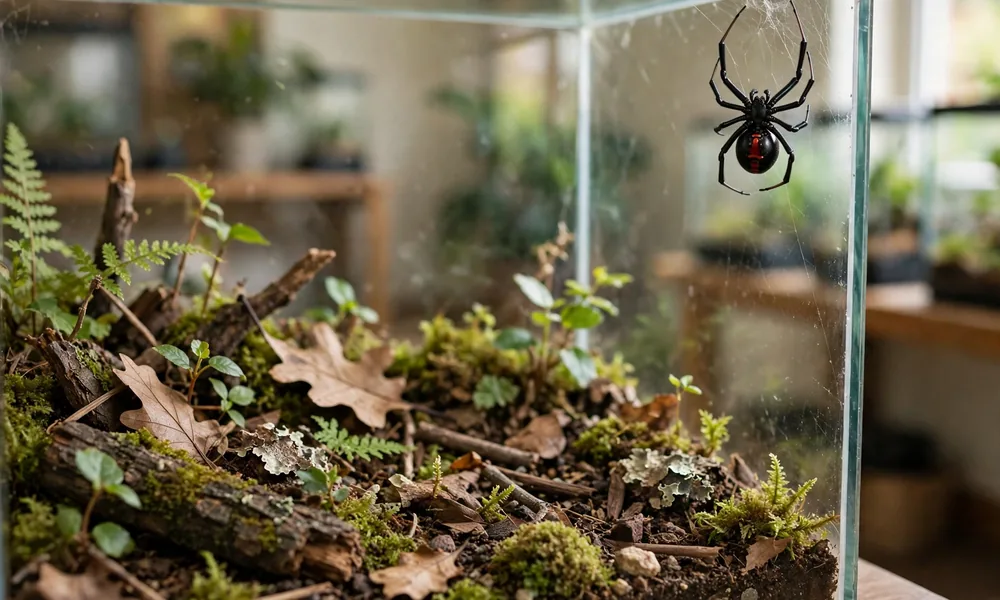
The main pressure on black widows is not people clearing their habitat but people clearing their webs, and even that barely dents their numbers. A shed that is swept out in spring will have a new web in it by summer, and the spiders face more pressure from other spiders than from people: the brown widow, Latrodectus geometricus, an introduced species from Africa, has spread through the southern United States and often takes over the same sheds and woodpiles. Even so, the black widows remain common, and no species in the genus is considered threatened.
The most useful thing a person can do for a black widow is also the simplest: leave it alone. A spider in a shed that nobody uses is doing no harm, and it is eating the flies and cockroaches that would otherwise be in the house. A spider in a place people do use can be moved with a jar and a piece of card, or swept gently into a container and released at the far end of the garden, and it will build a new web within a day. There is no need for sprays or for killing, and the black widow’s future is secure for as long as there are dark corners and warm summers.
Best seasons for black widow spider watching
The best time to look for a black widow is the warm season, from late spring through early autumn, when the females are large, glossy and sitting in the middle of their webs with egg sacs beside them. The spiders are present all year round in warm country, but they are easiest to find in the summer months, when the females are at their biggest and their webs are at their fullest. In the winter the spiders retreat into the warmest corners, into garages and basements, and they are harder to find.
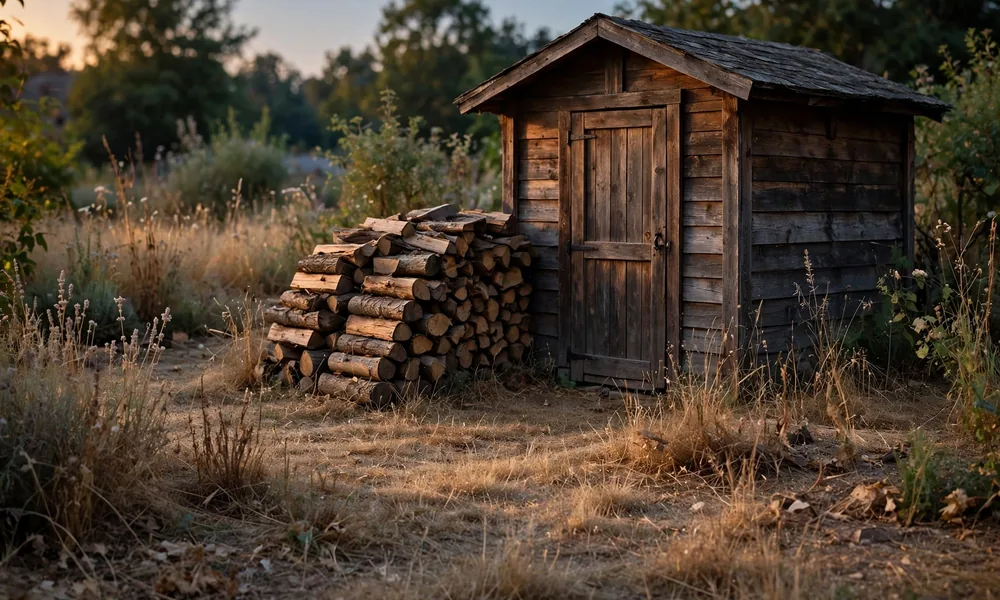
The best hours are the evening and the early night, when the spider is out in the middle of her web and the insects are flying. A torch with a red filter, held low so it does not dazzle the spider, will show the glossy black abdomen and the red hourglass clearly, and the web itself will shine in the beam. The family’s fame is such that National Geographic keeps a live profile of the black widow spiders, and a slow look around a woodpile at dusk, with a torch and a careful eye, is the best way to see one in the wild without ever touching it. Go in the summer, go at dusk, and look low, in the dark corners, and the spider will usually be there before you are.
Staying safe around black widow spiders
A black widow is not dangerous to people who leave it alone, and the safety rules are simple ones that cost nothing. Do not put a bare hand into a woodpile, into a shed corner, or into a box that has sat undisturbed in a garage, and wear gloves when you are clearing a shed, moving logs, or handling firewood. Shake out shoes and gloves that have been left in a garage before you put them on, and look before you reach behind a drainpipe or under a garden bench. A spider that is left alone will never come looking for you, and a web that is left alone will never hurt anyone.
If you are bitten, or you think you have been bitten, the advice is straightforward. The bite often feels like a pinprick or is barely felt at all, and the site shows little more than two faint punctures with mild redness, but within 30 to 60 minutes the characteristic symptoms begin: cramping muscle pain that spreads from the bite to the large muscle groups, rigid board-like abdominal muscles that are sometimes mistaken for appendicitis, heavy sweating, raised blood pressure, nausea and restlessness. Pain peaks in the first few hours and settles over one to three days, and most people recover fully with pain relief and rest. Seek medical care promptly, wash the bite with soap and water, and do not cut the bite or try to suck out the venom.
Black widow spider watching checklist
A little care turns an evening look around a shed or a woodpile into a safe chance of seeing a black widow at her best, glossy black in the torchlight with her hourglass on show.
- A warm summer evening, when the females are large and sitting in the middle of their webs with egg sacs beside them.
- A torch with a red filter, so you can see the glossy black abdomen and the red hourglass without dazzling the spider.
- Gloves and long sleeves, so a hand that brushes a woodpile or a shed corner is protected from any spider hiding there.
- Sturdy boots and a careful step, so you can walk around logs and stone walls without putting a foot where a web is strung low.
- A look before you reach, checking behind drainpipes, under benches and inside boxes before any bare hand goes in.
- A camera that works in low light, so you can photograph the spider in her web without crowding her or touching the silk.
- Respect for the spider and her web, keeping your distance, keeping your hands off her and her egg sacs, and leaving the corner as you found it.
Frequently asked questions
How big do black widow spiders get?
An adult female black widow measures 8 to 13 millimetres in body length, not counting her legs, and with her legs spread she reaches 25 to 38 millimetres across, roughly an inch to an inch and a half. She weighs about a gram, around 0.035 ounces, and her round abdomen can be more than 1.25 centimetres across when she is carrying eggs. The male is far smaller, only 3 to 6 millimetres long, brown or grey with red and white markings, and he is easy to overlook entirely, which is why most black widows anyone ever sees are females.
What do black widow spiders eat?
A black widow eats flying and crawling insects, and any small spider that wanders into the web, including flies, beetles, ants, grasshoppers, cockroaches and moths. She hangs upside down in her tangled cobweb, feels the vibration when something touches a thread, runs over and bites it, then wraps it in silk and drags it back to her retreat to feed. She has even been known to trap small lizards and small snakes in a low web, though that is rare.
Are black widow spiders dangerous?
Yes, in the sense that the bite of an adult female is medically significant, but no, in the sense that they will not attack you and deaths are extremely rare. The venom contains alpha-latrotoxin, a neurotoxin that causes cramping muscle pain, rigid abdominal muscles, sweating, raised blood pressure and nausea, and the pain can be severe for several hours. Most people recover fully within one to three days with pain relief, antivenom exists for cases where a doctor judges it necessary, and there has been no reliably reported death from a black widow bite in the United States for decades.
Do black widows really eat their mates?
Sometimes, but far less often than the name suggests. A female black widow does sometimes kill and eat the male after mating, and early naturalists watched it happen, which is how the spider got its name. In the wild, though, the male often slips away after mating and may even mate again, and studies of the closely related redback found that females ate their mates only about two per cent of the time. Experts suspect the American black widows behave much the same way, so the habit is real, but it is rare rather than routine.
Where do black widows build their webs?
A black widow builds a tangled, three-dimensional cobweb close to the ground, in a dark, dry and undisturbed place. Outdoors that means under logs, beneath stones, in hollow tree stumps and in the crevices of stone walls, and around houses it means woodpiles, sheds, garages, basements, behind drainpipes and inside boxes that have sat untouched. The web is usually no more than a foot or two off the ground, with a small silk-lined retreat tucked into the darkest part of it.
How is this guide different from the Asian giant hornet guide?
This guide covers the black widow spider species, small, shy, ground-dwelling spiders of the genus Latrodectus that hang upside down in tangled cobwebs in dark corners, hunt at night, and bite only when they are squeezed against skin, while our Asian giant hornet guide covers a large flying insect that hunts in daylight, ranges over open country in the air, and defends its nest in the open. One is a spider you meet by reaching into a woodpile at dusk; the other is a hornet you meet in the air on a summer afternoon, and the two animals could hardly live more different lives.
This guide also goes further than our general spider guide, which introduces spiders as a whole, because it follows one genus in depth: the three North American black widows and their redback cousin, the hourglass and the tangled web, the alpha-latrotoxin venom and what a bite really feels like, the egg sacs and the spiderlings, and the simple habits that keep a person safe around them. Our spider guide is the place to start if you want the broad picture of spiders; this guide is the place to come when you want to know the black widow itself, in full.
Conclusion
The black widow spider species are a reminder that a small animal can carry a large reputation, and that the reputation is only half the story. A glossy black female with a red hourglass, hanging upside down in a tangled web in a dark corner, eating the flies and cockroaches that blunder into her silk and guarding her papery egg sacs through the summer, is a spider that has earned its fame and outgrown it at the same time.
If you go looking for one, go on a warm summer evening, go with a torch and gloves, and look low, in the woodpile and the shed corner, where the web is strung close to the ground. Find the tangle of silk, watch for the glossy black abdomen and the red hourglass beneath it, and wait for the spider to move, and you will have met the black widow that turns a quiet corner of a garden into a place of sudden, small, unforgettable drama.