The blue crab species is the bright-clawed swimmer of the Atlantic coast, a crab with an olive-green shell, legs of vivid blue and a pair of flattened rear legs that work like paddles. If you are asking what a blue crab is, the short answer is Callinectes sapidus, a swimming crab of the family Portunidae, whose shell can reach about 23 centimetres across, about 9 inches, and which lives in the brackish estuaries of the western Atlantic, from Cape Cod to Argentina, with the Chesapeake Bay its most famous home. The name says it all in two languages: Callinectes is Greek for beautiful swimmer, and sapidus is Latin for savoury, a nod to a crab that is both one of the fastest swimmers among crabs and one of the most eaten animals in America.
The blue crab is a crab that lives its whole life on the move. It swims sideways through the water, walks across the muddy bottom, buries itself in the sand when danger comes, and sheds its shell about 25 times as it grows from a speck of plankton into a crab the width of a dinner plate. The females mate only once, after their final moult, and then carry up to a few million eggs in a spongy mass under their tails, swimming out to the salty mouth of the bay to set them free. This guide follows the crab from the estuary to the open sea: how it looks, where it lives, what it eats, how it breeds, and why a crab that is so common still needs the marshes and the clean water that make its life possible.
Key takeaways
- The blue crab species is Callinectes sapidus, a swimming crab of the family Portunidae, native to the western Atlantic from Cape Cod to Argentina and most famous in the Chesapeake Bay.
- Adults reach about 23 centimetres across the carapace, about 9 inches, weigh typically about a third of a pound, and live generally for three to four years.
- The last pair of legs is flattened into paddles, the males have bright blue claws, and the females have red-tipped claws and a broad rounded apron underneath.
- Blue crabs are omnivores that eat clams, mussels, oysters, worms, small fish, shrimp, plants and carrion, and they grow by moulting about 25 times in a lifetime.
- Each female mates only once, after her final moult, and carries a spongy egg mass of 750,000 to 3.2 million eggs, which hatch into larvae that drift out to sea before returning to the estuary.
The blue crab species and their relatives
Blue crabs belong to the family Portunidae, the swimming crabs, a family of true crabs whose last pair of legs is flattened into paddles for swimming. Most crabs are walkers, built for scuttling across the sea floor, but the swimming crabs have taken the crab body plan and turned it into a swimming machine, with a wide, flat shell, long spines for defence, and paddles that let them dart sideways through the water at surprising speed. The family holds many species in warm coastal waters around the world, and the blue crab is one of its largest and best known members, a crab that has become the symbol of the Chesapeake Bay and the state crustacean of Maryland.
The lead species of this guide is the blue crab itself, Callinectes sapidus, and it is the crab most people mean when they say blue crab, the one with the olive-green carapace, the blue legs and the long sharp spines at the sides of the shell. Like the crab, the blue crab is a decapod with ten legs, a hard shell and a pair of claws, but the ordinary shore crab is a walker that scuttles over rocks at low tide, while the blue crab is a swimmer that spends its days in the open water of the estuary, paddling sideways between the eelgrass beds and the muddy channels.
| Type | Animal | Where it lives | Best-known food | Length or Weight |
|---|---|---|---|---|
| Family | Swimming crabs (Portunidae) | Warm coastal waters worldwide | Small fish, molluscs and carrion | Up to about 23 cm across |
| Genus | Blue crabs (Callinectes) | Western Atlantic and Gulf of Mexico | Small fish, molluscs and worms | Up to about 23 cm across |
| Species | Blue crab (Callinectes sapidus) | Western Atlantic, Cape Cod to Argentina | Clams, mussels, worms and small fish | Up to 23 cm across |
| Species | Lesser blue crab (Callinectes similis) | Gulf of Mexico and western Atlantic | Small invertebrates | Up to 12 cm across |
| Species | Ornate blue crab (Callinectes ornatus) | North Carolina to southern Brazil | Small invertebrates | Up to 9.3 cm across |
The genus Callinectes holds 16 living species, all of them swimming crabs of the warm waters of the Americas, and the blue crab is the best known of them by a wide margin. Its closest lookalikes are smaller cousins that a casual observer could easily mistake for young blue crabs. The lesser blue crab, Callinectes similis, lives in the Gulf of Mexico and the western Atlantic, and the males grow to a maximum width of 122 millimetres, about 12 centimetres, while the females reach 95 millimetres, a little over half the width of a full-grown blue crab. It can be told from the blue crab by the six teeth on the front edge of its carapace, where the blue crab has only four, and by its smoother, more uniform shell.
The ornate blue crab, Callinectes ornatus, ranges from North Carolina to southern Brazil, and it is smaller still, with a maximum carapace width of only 93 millimetres, about 9.3 centimetres, compared with 230 millimetres in the blue crab, and it is therefore not commercially fished. It too has six frontal teeth where the blue crab has four, and its colours are more muted, a greenish brown rather than the blue crab’s bright blue. The two smaller cousins share the blue crab’s paddles and its sideways swimming, and they share its estuaries too, but neither of them grows to the size, or carries the fame, of Callinectes sapidus.
What blue crabs look like
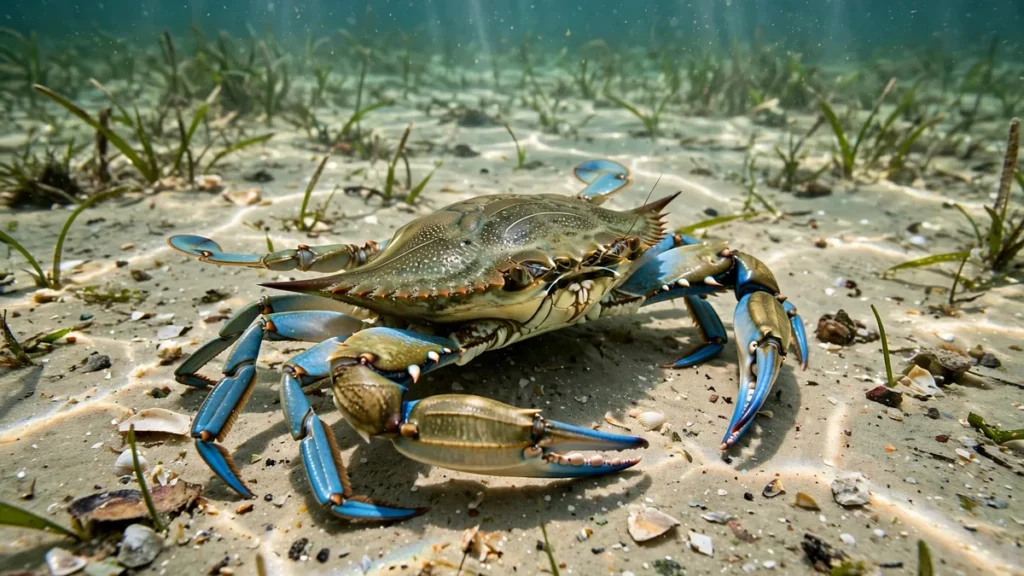
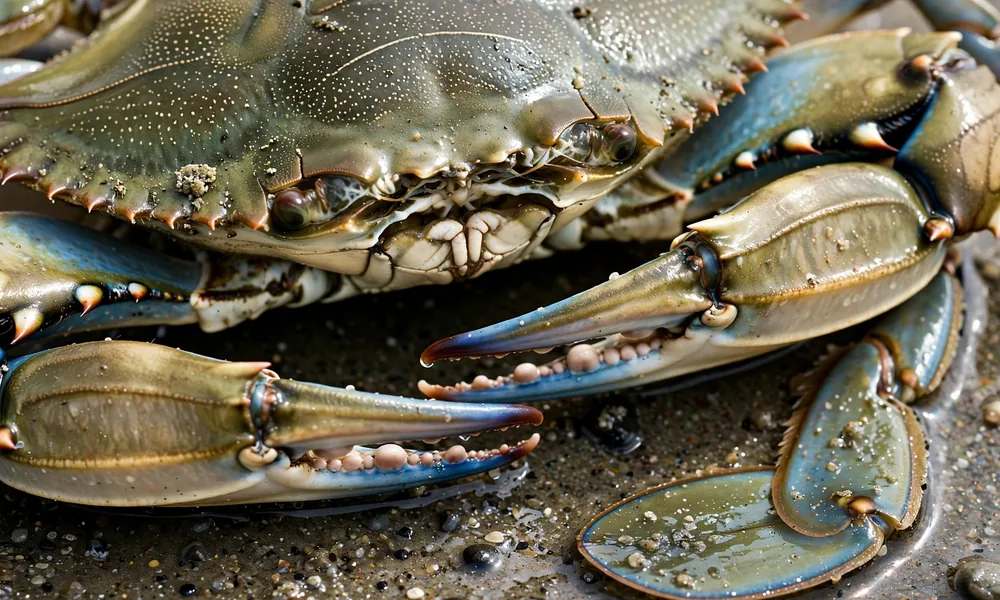
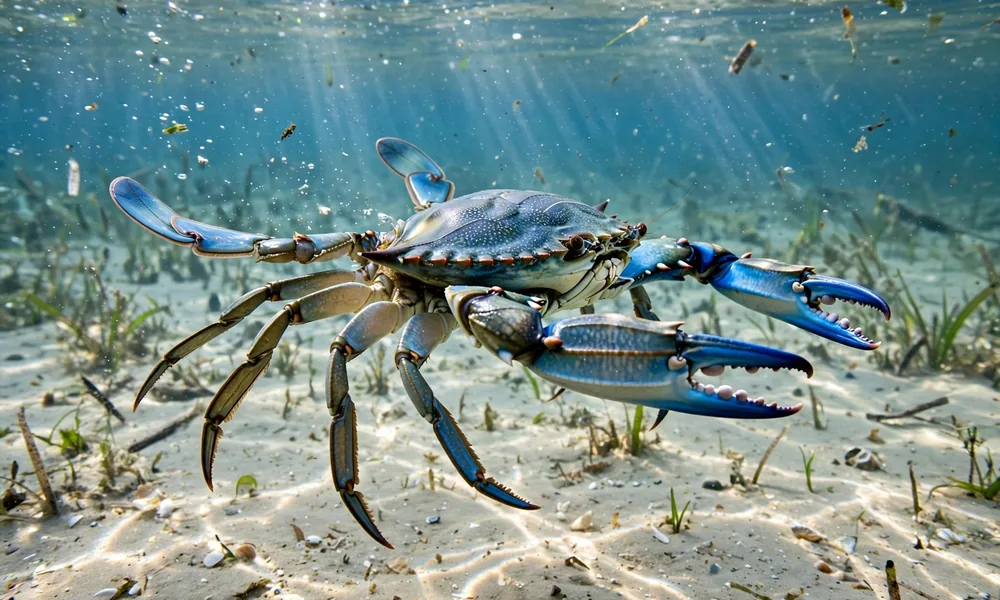
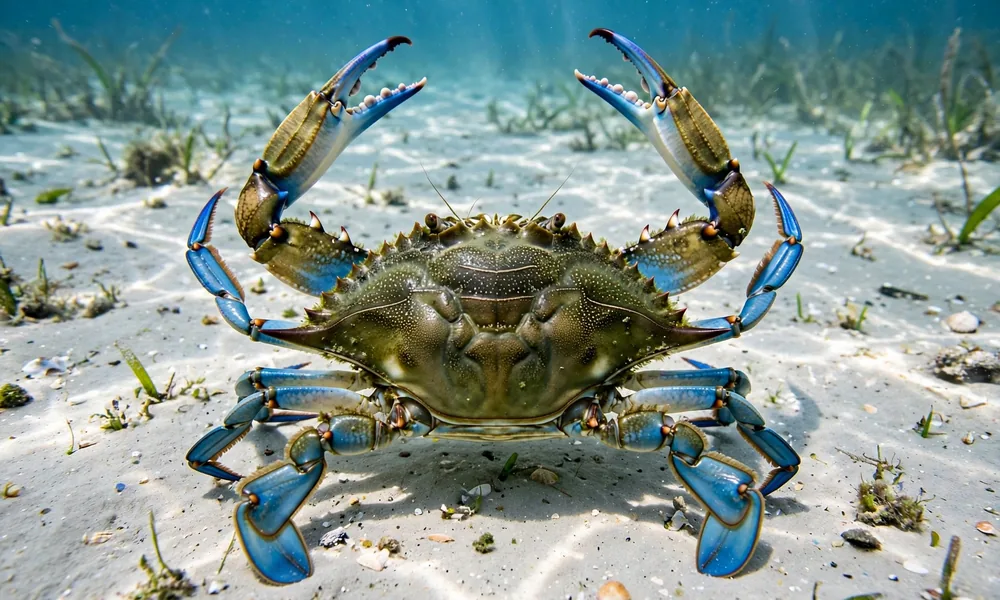
A blue crab is a wide, flat, handsome animal, built like a shield with legs. The shell, or carapace, is much wider than it is long, olive green to blue-green on top, and it can reach about 23 centimetres across from spine to spine, about 9 inches, with nine teeth along each front edge and the last pair drawn out into long, sharp lateral spines that give the shell its pointed wings. The crab is about 10 centimetres long from front to back, and a typical adult weighs about a third of a pound, though the largest blue crab caught in the Chesapeake Bay weighed 1.1 pounds and measured 10.72 inches across the carapace, a crab the size of a small dinner plate.
The colour is where the blue crab earns its name. The legs are bright blue, the claws are blue with darker tips, and the underside is whitish, while the top of the shell is olive green or blue-green, a combination that hides the crab well against the sandy bottom and the eelgrass. The blue comes from a pigment called astaxanthin bound to protein in the shell, and when the crab is cooked the protein breaks down and the pigment turns red, which is why a cooked blue crab is red rather than blue. The eyes sit on short stalks at the front of the shell, and they can swivel to watch for food and for danger at the same time.
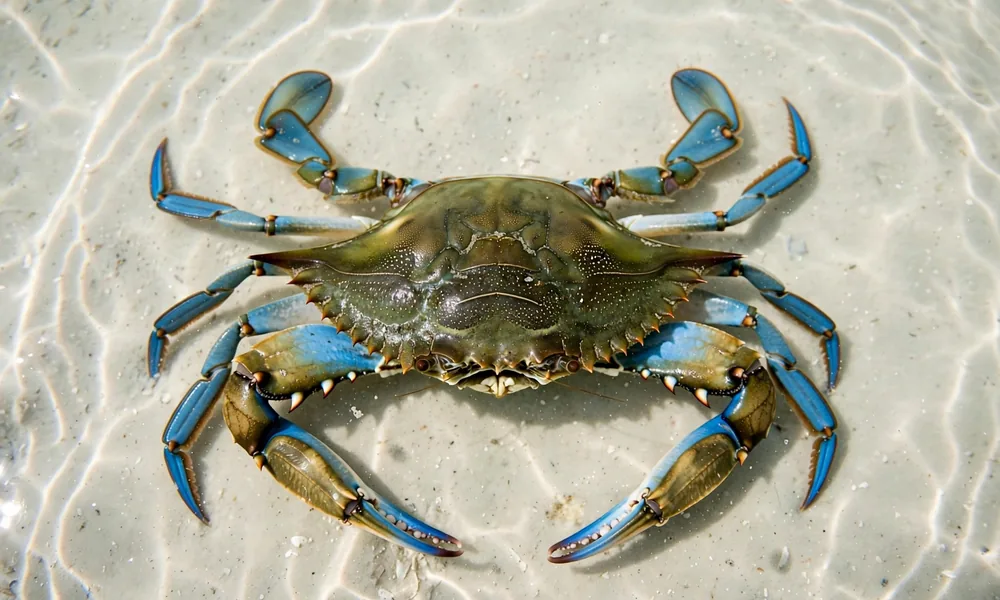
The sexes are easy to tell apart once you know what to look for, and crabbers have always known the difference at a glance. The males, called jimmies, have bright blue claws, a narrow apron underneath shaped like an inverted T, and they grow slightly larger than the females. The females, called sooks, have red-tipped claws, a broad rounded apron that covers most of the underside, and a shell that is often a little wider in proportion. When a female is carrying eggs, the apron bulges out over a spongy orange mass, the sponge, which darkens to brown and then black as the eggs near hatching. The claws are the crab’s tools and its weapons, strong enough to crack a clam shell, and the crab can drop a claw to escape a predator and regrow it, larger, after the next moult.
Where blue crabs live
Blue crabs live in the estuaries and coastal waters of the western Atlantic, from Cape Cod in Massachusetts south along the American coast, around the Gulf of Mexico, and down the coast of South America to Argentina. They are bottom-dwellers of brackish water, at home in the whole range of an estuary, from the saltiest water at the mouth of the bay to the almost fresh water of the back bays and tidal creeks. The Chesapeake Bay is their most famous home, and it holds the largest blue crab fishery in the world, but the crabs are just as much at home in the lagoons of Florida, the marshes of Louisiana, and the estuaries of Brazil.
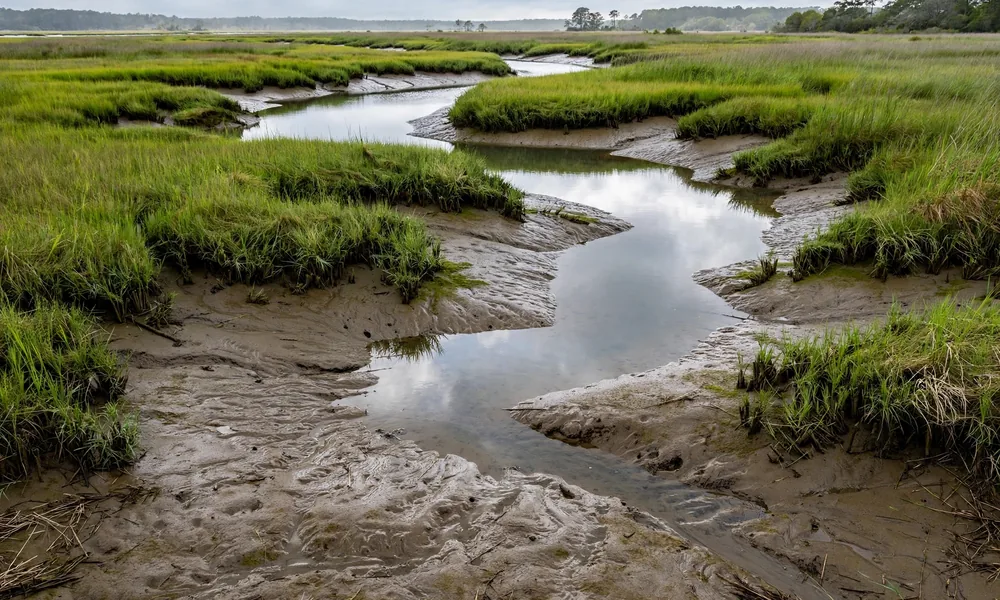
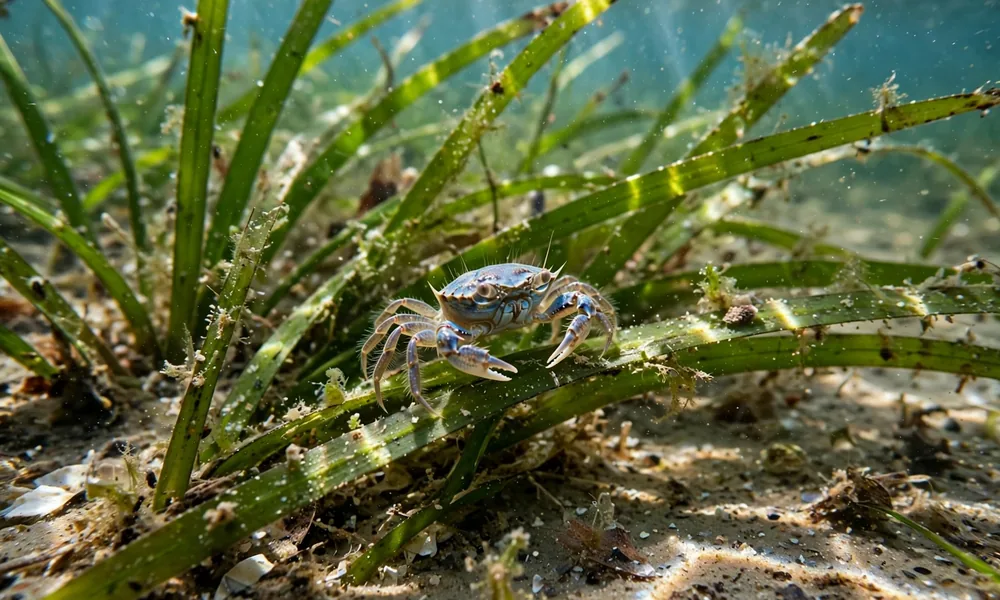
The habitat a blue crab chooses changes with its age and with the season. The young crabs settle in the shallow, sheltered waters of the estuary, among the eelgrass beds and the saltmarsh edges, where the water is warm and the food is plentiful and the grass hides them from fish. The adults move out into the deeper channels and the open bay, and the females, when it is time to spawn, travel to the high-salinity water at the mouth of the estuary, where the eggs can hatch into the sea. The crabs need salt water to breed and fresh water to feed, and the estuary, where the river meets the sea, gives them both within a few miles of each other.

Blue crabs are restless animals, and they move with the tides and the seasons. In the summer they are in the shallow water, feeding and moulting and mating, and in the winter the adults move into the deeper water and bury themselves in the mud, slowing down until the spring warmth wakes them. A crab that is frightened will bury itself in the sand in seconds, leaving only its eyes and the tips of its claws showing.
What blue crabs eat
Blue crabs are omnivores, and they eat almost anything they can catch, crush or scavenge. The everyday food is clams, mussels, oysters and other molluscs, worms, small fish, shrimp, crabs smaller than themselves, plants and carrion, and a blue crab will eat a dead fish as readily as a live clam. They hunt by smell and by touch as much as by sight, waving their antennae and their claws through the water until they find something edible, and then they crack it open with the claws and pick out the flesh with the smaller mouthparts. A crab that finds a bed of clams will work through it methodically, and a crab that finds a dead fish will feed until there is nothing left.
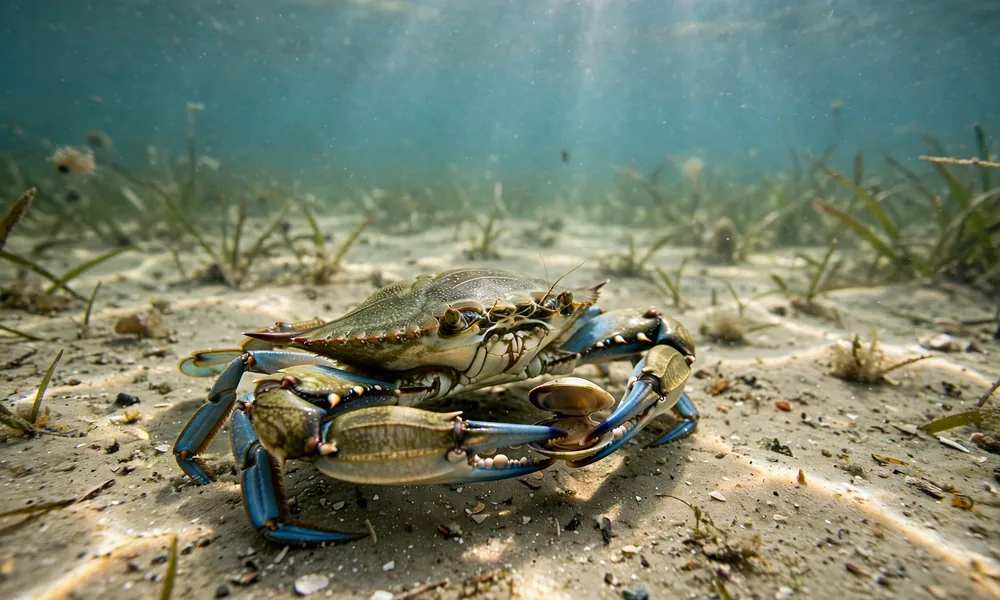
The claws do the heavy work, and they are built for it. The crusher claw, usually the right one, is thick and strong, made for cracking shells, while the cutter claw is slimmer and sharper, made for tearing flesh. The crab holds a clam in its walking legs, turns it until it finds the weak point, and then crushes the shell with a single snap, and the whole meal takes only a few minutes. Young crabs eat smaller food, tiny worms, small shrimp and the soft parts of dead animals, and they feed constantly, because a growing crab needs a great deal of food to build a new shell at every moult. The adults eat less often but take larger prey, and a big male can crack an oyster that a smaller crab could not open.
How blue crabs behave
A blue crab spends its day in a round of feeding, swimming and hiding, and it is an aggressive animal for its size. It swims sideways, paddling with its flattened rear legs, and it can dart across the water in a burst that surprises a fisherman who tries to catch it by hand. On the bottom it walks sideways too, in the crab’s usual manner, and it can run across the sand at a speed that looks clumsy until you try to catch it. When it is threatened it raises its claws, opens them wide, and waves them at the intruder, and if that does not work it will snap, and a snap from a large blue crab can draw blood.
The moult is the most dangerous time in a blue crab’s life, and the crab knows it. To grow, a crab must shed its hard shell, and it does so about 25 times in its life, roughly 18 moults for a female and 20 for a male after the larval stages, reaching adult size after 18 to 20 moults. The old shell splits along the back, the crab backs out of it, soft and pale and helpless, and it must hide in the eelgrass or bury itself in the mud until the new shell hardens, which takes a day or two. A soft crab is eaten by almost anything, by fish, by birds, by other crabs, and by people, who prize soft-shell crabs as food, so the crab moults in the shallowest, most sheltered water it can find.
Mating has its own ritual, and it is one of the strangest in the crab world. A female can mate only once in her life, in the soft-shell stage just after her final moult, and the male finds her before she moults, carries her beneath him in a cradle hold, and guards her while her shell is soft. The pair, called a doubler, swims together for days, the male on top and the female beneath, until she moults and they mate, and then the male keeps guarding her until her new shell hardens. The female stores the sperm for up to two years, using it to fertilise several broods of eggs, and she will never mate again. The male, meanwhile, may mate with several females over his life, guarding each one in turn.
Breeding and life cycle
Blue crabs breed in the warm months, and in the Chesapeake Bay mating and spawning run from spring to fall. The female mates once, after her final moult, and then she swims to the salty water at the mouth of the bay, where she extrudes her eggs onto the fine hairs of her swimmerets, the small paddles under her tail, and carries them in a spongy mass called the sponge. The sponge starts out orange, darkens to brown as the eggs develop, and turns almost black as hatching nears, and it can hold 750,000 to 3.2 million eggs in a single brood. The female carries the sponge for about two weeks, fanning it with her swimmerets to keep the water flowing over the eggs, and then the eggs hatch, all at once, in the salty water at the mouth of the bay.

The larvae that hatch are not crabs at all, but tiny planktonic animals called zoeae, and they drift out to sea on the tides. They go through seven zoeal stages and one megalopa stage before they begin to look like crabs, and the whole planktonic life takes four to eight weeks in the coastal water. The megalopa, the last larval stage, looks like a tiny crab with a long tail, and it swims back into the estuary on the incoming tide, settles among the eelgrass, and moults into a true juvenile crab, only a few millimetres across. The juveniles grow fast in their first summer, reaching 70 to 100 millimetres across, and they reach maturity in 12 to 18 months.
The females, after spawning, usually die within the year, while the males may live a little longer, guarding one female after another through the summer.
Conservation status
The blue crab has not been evaluated by the International Union for Conservation of Nature, and it is not listed by any conservation programme, because it is abundant across a huge range and in no danger of disappearing. It is one of the most common crabs in the western Atlantic, and it supports one of the largest crab fisheries in the United States, with the Chesapeake Bay alone landing millions of crabs a year. The crab’s numbers rise and fall with the weather, with the rain, and with the health of the estuary, but the species itself is secure, and no one who works with blue crabs worries that the crab will vanish.
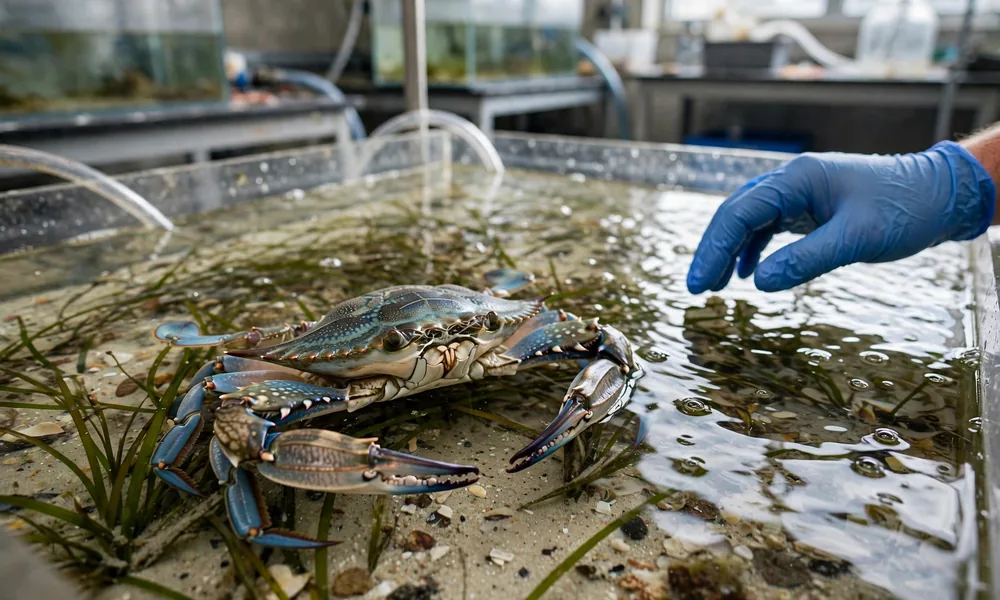
The pressures on the blue crab are the pressures on the estuary itself. When the marshes are filled in, the eelgrass beds die, and the shallow nursery water is lost, the young crabs have nowhere to hide and nowhere to feed. When the water is polluted, the crabs grow slowly and the females carry fewer eggs, and when the summer is hot and the oxygen in the deep water falls, the crabs crowd into the shallows. The fishery is managed with size limits, with a minimum body width of 5 inches in the Chesapeake, with closed seasons for egg-bearing females, and with limits on the catch of soft-shell crabs.
The most useful conservation work is the work that helps the whole estuary: protecting the saltmarshes from being filled, restoring the eelgrass beds where the juveniles hide, keeping the rivers clean so the water that flows into the bay is fit for a crab to live in, and leaving the egg-bearing females alone so that each sponge can hatch. A crabber who throws back a sponge crab is giving the bay millions of eggs, and a town that restores a marsh is giving the bay a nursery. The blue crab does not need a reserve or a breeding programme; it needs a healthy estuary, and a healthy estuary gives back far more than crabs.
Best seasons for blue crab watching
The best time to look for blue crabs is the summer, from late spring through early autumn, when the water is warm and the crabs are in the shallows, feeding and moulting and mating. The crabs are present in the estuary all year round, but they are easiest to see in the warm months, when they are active in the daytime and the water is clear enough to spot a blue claw against the sand. In the winter the adults move into the deeper water and bury themselves in the mud, and they are all but invisible until the spring warmth wakes them and brings them back into the shallows.

The best hours are the morning and the late afternoon, when the crabs are out feeding in the shallows and the sun is low enough to see into the water. A walk along a pier, a look into the eelgrass from a kayak, or a dip net dragged gently through the shallows will often turn up a crab, and a crab pot baited with a fish head will catch one within the hour. The crab’s fame is such that National Geographic keeps a live profile of the blue crab, and a morning on the Chesapeake in July, with a net and a bucket and a careful eye on the water, is the best way to see one in the wild. Go in the summer, go in the morning, and look in the shallows among the eelgrass, and the blue crab will usually be there before you are.
Staying safe around blue crabs
A blue crab is not dangerous to people who handle it properly, and the safety rules are simple ones that every crabber learns on the first day. Hold a crab from behind, gripping the shell from the rear so the claws cannot reach your fingers, and never pick a crab up by the claws or by the front of the shell. The claws are strong enough to crack a clam, and a snap from a large crab can cut a finger badly, so keep your fingers behind the shell and use tongs or a net where you can. A crab will not chase you, and it will not attack, but it will defend itself if it is grabbed, and it has every right to.
If a crab does nip you, the advice is straightforward. Wash the wound with soap and clean water, press it to stop any bleeding, and cover it with a clean dressing, and watch it for the next day or two, because a cut from brackish water can become infected if it is not kept clean. Seek medical care if the wound is deep, if it becomes red and swollen, or if you develop a fever, and tell the doctor that the cut came from brackish water. The crab itself carries no venom and no sting, and the only danger it offers is the pinch of its claws, which is easily avoided by holding the crab properly and by keeping small children a little further back from the bucket.
Blue crab watching checklist
A little preparation turns a morning on an estuary pier into a real chance of seeing a blue crab at its best, bright blue claws against the sand in the clear shallow water.
- A warm summer morning, when the crabs are feeding in the shallows and the water is clear enough to see into.
- A dip net and a bucket of estuary water, so you can lift a crab gently and look at it without harming it.
- A pair of tongs and a firm grip from behind the shell, so the claws cannot reach your fingers while you hold the crab.
- Polarised sunglasses, so you can see through the glare on the water and spot a crab against the sand and the eelgrass.
- Sturdy shoes for a slippery pier or a muddy bank, so you can walk the estuary edge without slipping into the water.
- A field guide to the crabs of the Atlantic coast, so you can tell a blue crab from its smaller cousins at a glance.
- Respect for the crabs and the estuary, keeping your hands off egg-bearing females, and returning every crab to the water when you are done looking.
Frequently asked questions
How big do blue crabs get?
A blue crab can grow to about 23 centimetres across the carapace, about 9 inches from spine to spine, and it is about 10 centimetres long from front to back. A typical adult weighs about a third of a pound, and the largest blue crab caught in the Chesapeake Bay weighed 1.1 pounds and measured 10.72 inches across the carapace. The males grow slightly larger than the females, and most crabs are caught before they reach their full size, so a crab of 15 to 20 centimetres across is a good crab by any measure.
What do blue crabs eat?
A blue crab eats clams, mussels, oysters and other molluscs, worms, small fish, shrimp, crabs smaller than itself, plants and carrion. It hunts by smell and by touch, waving its antennae and claws through the water until it finds something edible, and then it cracks the shell with its crusher claw and picks out the flesh with its smaller mouthparts. A crab that finds a bed of clams will work through it methodically, and a crab that finds a dead fish will feed until there is nothing left.
How long do blue crabs live?
Blue crabs generally live for three or four years, though the average lifespan is one to two years because so many crabs are harvested before they would die naturally. They reach maturity in 12 to 18 months, and they grow by moulting about 25 times in a lifetime, shedding the old shell and growing a new one. In the St. Johns River in Florida some blue crabs have survived to four years of age, and a crab that escapes the nets and the pots for three years has beaten very long odds.
Can blue crabs swim?
Yes, and they are among the fastest swimmers of all crabs. The last pair of legs is flattened into paddles, and the crab uses them to swim sideways through the water in short, fast bursts, steering with the other legs and the claws. Most crabs can only walk, but the blue crab can cross a bay in a night, and it swims to escape predators, to find food, and to reach the salty water at the mouth of the estuary when it is time to spawn. The paddles are the reason the family is called the swimming crabs.
Why do blue crabs turn red when cooked?
The blue colour of a live blue crab comes from a pigment called astaxanthin bound to protein in the shell, and the blue is the colour of the pigment-protein complex rather than the pigment itself. When the crab is cooked, the heat breaks the protein down and frees the pigment, and astaxanthin on its own is red, which is why a cooked blue crab is bright red rather than blue. The same pigment colours salmon and flamingos pink, and it is the reason a blue crab and a cooked blue crab look like two different animals.
How is this guide different from the black widow spider guide?
This guide covers the blue crab species, a fast-swimming, bright-clawed crustacean of the Atlantic estuaries that moults about 25 times, mates in the water and carries millions of eggs in a sponge under its tail, while our black widow spider guide covers a small, shy, ground-dwelling spider that hangs upside down in a tangled cobweb in a dark corner and bites only when it is squeezed against skin. One is a swimmer you meet with a dip net in the shallows of a summer estuary; the other is a spider you meet by reaching into a woodpile at dusk, and the two animals could hardly live more different lives.
This guide also goes further than our general crab guide, which introduces crabs as a whole, because it follows one species in depth: the paddles and the sideways swimming, the blue claws and the red-tipped females, the doubler pairs and the single mating, the sponge with its millions of eggs and the larvae that drift out to sea, and the Chesapeake Bay that has made this crab famous. Our crab guide is the place to start if you want the broad picture of crabs; this guide is the place to come when you want to know the blue crab itself, in full.
Conclusion
The blue crab species is a reminder that a crab does not need to be large to be remarkable. A wide olive-green shell, legs of vivid blue, paddles for swimming sideways, claws strong enough to crack a clam, a female that mates once and carries millions of eggs in a sponge, and a life spent between the river and the sea have made the blue crab the most famous crab of the Atlantic coast, at home in the estuaries from Cape Cod to Argentina.
If you go looking for one, go on a warm summer morning, go with a dip net and a bucket, and look in the shallows among the eelgrass, where the water is clear and the sand is pale. Find the flash of blue against the sand, watch for the sideways dart of the paddles, and wait for the crab to settle, and you will have met the blue crab that turns a quiet stretch of estuary into a place of sudden, bright, sideways excitement.