The blue-ringed octopus species is one of the smallest and most dangerous octopuses in the sea, a palm-sized animal whose yellowish skin flashes vivid blue rings when it feels threatened. If you are asking what a blue-ringed octopus is, the short answer is any of four species in the genus Hapalochlaena, above all Hapalochlaena lunulata, the greater blue-ringed octopus, a shallow-water octopus of the Indo-Pacific that grows to about 12 centimetres long and weighs about 55 grams, and carries the neurotoxin tetrodotoxin in its saliva. There is no antivenom, bites are often painless at first, and yet the animal is docile, solitary and shy, and it bites people only when it is picked up or stepped on.
That contrast, between a beautiful little octopus and a venom that can stop a person’s breathing, is the heart of this guide. A blue-ringed octopus spends its short life, about a year to a year and a half, hunting crabs in tide pools and on coral reefs from Japan to Australia, hiding in rock crevices, empty shells and discarded bottles, and changing its colour in an instant from dull brown to flashing blue. The female lays 60 to 100 eggs, guards them without eating for about a month, and dies soon after they hatch.
Key takeaways
- The blue-ringed octopus species are four species in the genus Hapalochlaena, above all Hapalochlaena lunulata, the greater blue-ringed octopus, of the Indo-Pacific.
- Adults are small enough to fit in a palm, rarely more than 22 centimetres long, with Hapalochlaena lunulata about 12 centimetres long and weighing about 55 grams.
- Their venom contains tetrodotoxin, a powerful neurotoxin that can cause paralysis and respiratory failure, and there is no antivenom.
- They are docile, solitary hunters that eat small crabs, shrimp and molluscs, and they bite people only when provoked, handled or stepped on.
- Three of the four species are considered of Least Concern by the IUCN, and the main threats are habitat damage, climate change and collection for the aquarium trade.
The blue-ringed octopus species and their relatives
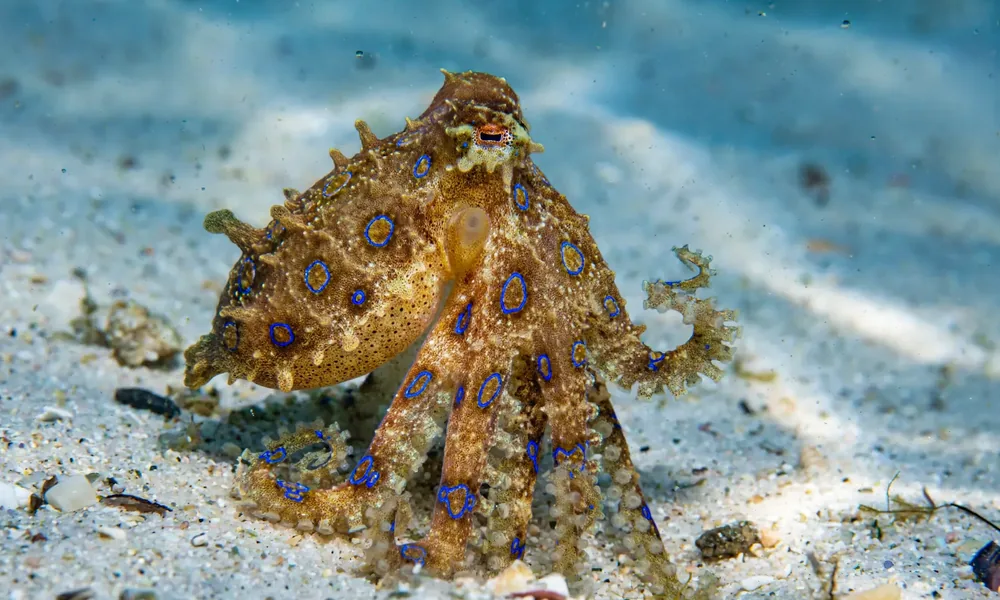
Hapalochlaena lunulata is the lead species of this guide, and it is the blue-ringed octopus most people meet. It is called the greater blue-ringed octopus, but the name refers to the size of its blue rings, which are 7 to 8 millimetres across, larger than those of the other members of the genus, not to its body, which is small. It was described by Quoy and Gaimard in 1832 and transferred to Hapalochlaena by Robson in 1929. Like the octopus, the blue-ringed octopus is a cephalopod with eight arms, a beak and a remarkable ability to change colour, but the ordinary reef octopus is a large animal, while the blue-ringed octopus is a palm-sized hunter whose colour change is a warning, not just camouflage.
| Type | Animal | Where it lives | Best-known food | Length or Weight |
|---|---|---|---|---|
| Family | Octopuses (Octopodidae) | Oceans worldwide | Crabs, shrimp and molluscs | Up to 22 cm long |
| Genus | Blue-ringed octopuses (Hapalochlaena) | Indo-Pacific tide pools and reefs | Small crabs and shrimp | About 10 to 22 cm long |
| Species | Greater blue-ringed octopus (Hapalochlaena lunulata) | Northern Australia to Japan | Small crabs and shrimp | About 12 cm long, about 55 g |
| Species | Southern blue-ringed octopus (Hapalochlaena maculosa) | Southern Australia | Small crabs and shrimp | Up to 20 cm long, about 26 g |
| Species | Blue-lined octopus (Hapalochlaena fasciata) | Eastern Australia | Small crabs and shrimp | About 15 cm long |
The closest relative in size and fame is the southern blue-ringed octopus, Hapalochlaena maculosa, the lesser blue-ringed octopus, which is the largest of the genus at up to 20 centimetres long, though it weighs only about 26 grams on average. It lives around the cooler southern coast of Australia, from southern Western Australia to Victoria and Tasmania, and it is the species most often found in the rock pools of Victoria and New South Wales. Like its northern cousin it is docile, it hunts crabs by day, and its venom contains tetrodotoxin, and it is listed as Least Concern by the IUCN, with no known conservation efforts directed at it specifically.
Within the genus, the species sort themselves out by range, by ring size and by the pattern of their markings. Hapalochlaena fasciata, the blue-lined octopus, is about 15 centimetres long and lives in the shallow coastal waters of Australia from southern Queensland to southern New South Wales, and its blue markings form lines rather than the neat rings of its cousins. Hapalochlaena nierstraszi, the fourth species, is known from only two specimens, is about 8 to 16 centimetres long and weighs 5 to 18 grams, and is found in the waters around India and the Andaman Islands. The rings are the field mark that matters: lunulata has fewer than 25 large rings on its mantle, each up to 8 millimetres across, while maculosa has smaller, more numerous rings, and fasciata has lines.
What a blue-ringed octopus looks like
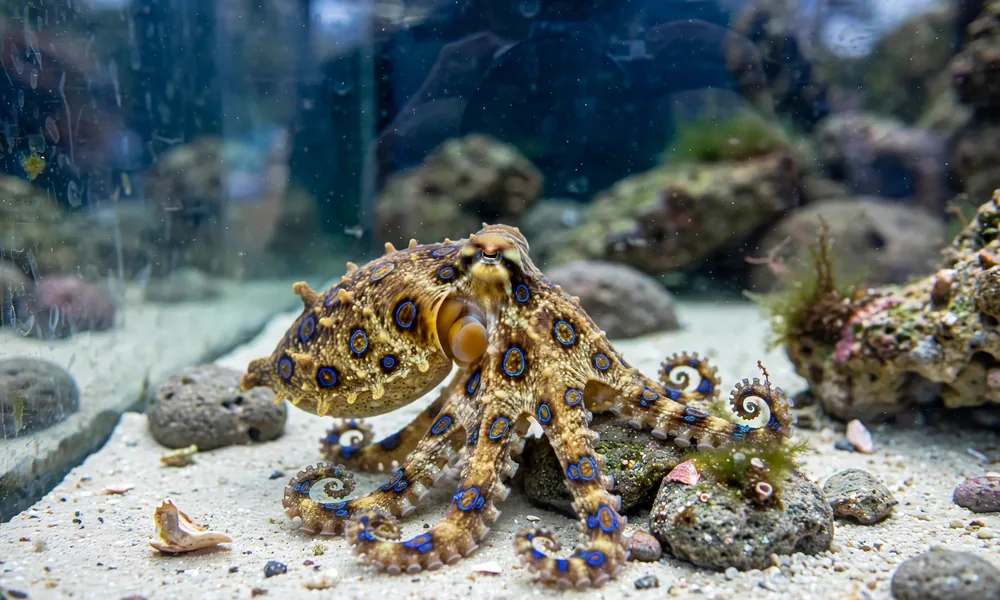
A blue-ringed octopus looks, at rest, like a small, unremarkable lump on the reef, and that is exactly the point. The body is soft and sac-like, the mantle is the size of a golf ball, and the skin is yellowish, tan or brown to grey, covered in small bumps called papillae that make it look rough, like a piece of coral rubble. The eight arms are relatively short, covered in suckers, and they spread out around the head in a star, and the whole animal, from the tip of its mantle to the ends of its arms, rarely measures more than 22 centimetres, or 8.7 inches, and weighs no more than 100 grams. Hapalochlaena lunulata, the greater species, is about 12 centimetres long and weighs about 55 grams on average, so it fits comfortably in the palm of a hand.
The rings are the feature that gives the animal its name, and they are worth looking at properly, because they are not always visible. At rest, the rings are faint, dull blue circles on the yellowish skin, easy to miss, and a resting octopus can look like any other small octopus on the reef. When the animal is alarmed, the rings flare into vivid, iridescent electric blue, each ringed with a dark brown centre, and the change happens in a fraction of a second. The greater blue-ringed octopus displays fewer than 25 blue rings on its mantle, each with a dark brown centre, and the rings extend out over the arms as well, so the whole animal lights up at once, a signal that is hard to miss and impossible to mistake for anything else.
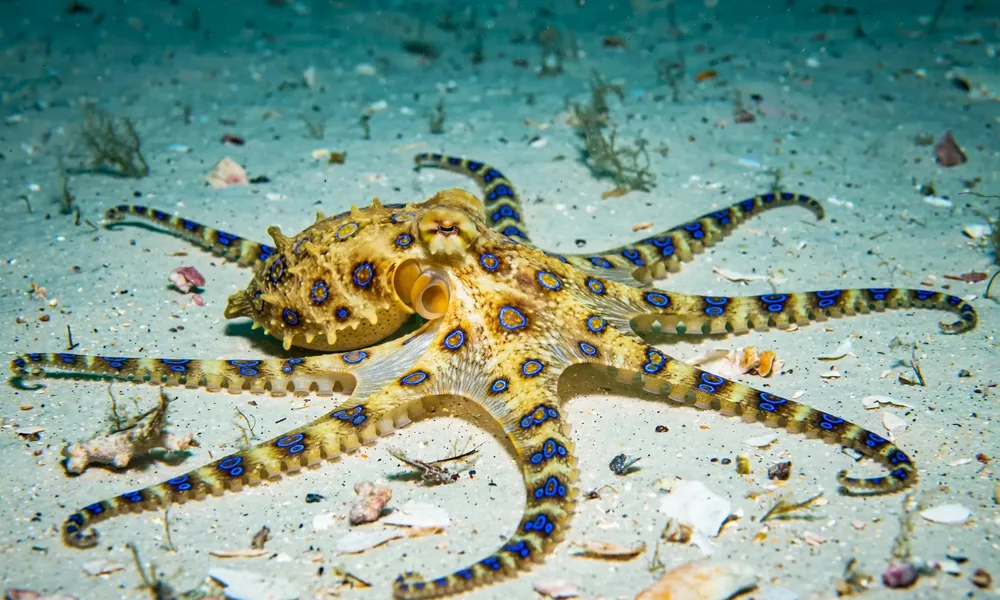
The colour change is made by the same machinery that all octopuses use, and the blue-ringed octopus uses it better than most. Its skin holds sacs of pigment called chromatophores, which can expand and contract in an instant, and beneath them lie iridophores, tiny reflective plates that bounce back blue light. When the animal is calm, the chromatophores cover the blue, and the skin looks brown or yellow, and when it is threatened, the chromatophores pull back and the iridophores flash. The result is a warning display, a form of aposematism, the same trick used by poison dart frogs and other toxic animals, and it tells any predator that looks twice that this small animal is not worth eating.
Under the skin, the anatomy is that of a small, efficient predator. The beak is small and sharp, hidden at the junction of the eight arms, and it is the beak that delivers the bite, piercing the shell of a crab or the skin of a hand. The eyes are large and watchful, with a horizontal pupil, and they give the octopus excellent vision, good enough to spot a crab from a distance and to recognise a threat approaching. The funnel, or siphon, sits under the head and is used for jet propulsion, and the mantle holds the internal organs, including the large posterior salivary glands where the venom is made, with the help of symbiotic bacteria that live in the glands.
Where blue-ringed octopuses live
Blue-ringed octopuses live in the shallow tropical and subtropical waters of the Indo-West Pacific, from Japan to Australia, and from Sri Lanka to the Philippines, Papua New Guinea, the Solomon Islands and Vanuatu. Hapalochlaena lunulata, the greater species, ranges from northern Australia to Japan, including Papua New Guinea, the Solomon Islands and Indonesia, as far west as Sri Lanka, while Hapalochlaena maculosa lives around the southern coast of Australia, and Hapalochlaena fasciata lives along the eastern coast from southern Queensland to southern New South Wales. They are animals of the shore, not of the open sea, and they are found in tide pools, on coral reefs, on reef flats and in shallow coastal waters, at depths of 0 to 20 metres.
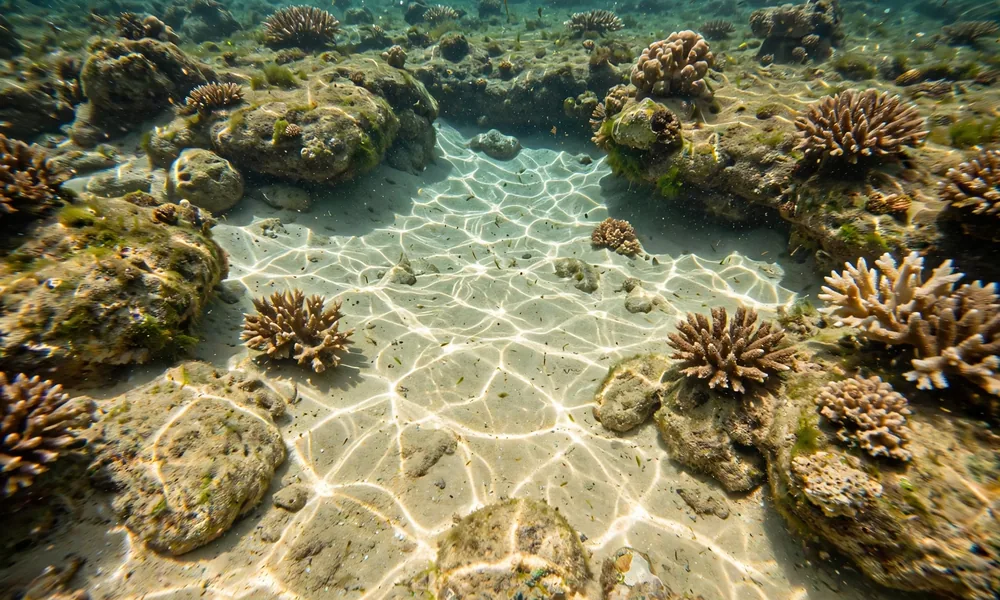
The habitat a blue-ringed octopus chooses is the bottom, and it is a bottom dweller in the fullest sense. It lives in a burrow or a den, a hole in the reef, a crevice among rocks, an empty seashell, or a discarded bottle or can, and it comes out only to hunt for food or to look for a mate. The entrance to the shelter is easy to recognise, because it is littered with the remains of meals, empty shells and hollowed-out crab legs, and the octopus will occupy one den for a long time, venturing out only to hunt. It prefers shallow water with a mixed seabed, rubble, reefs and sandy areas, and it is most often found in tide pools after a storm, digging around for crabs among the rocks.
The water matters, and the octopus is picky about it. It needs warm, clear, shallow water, and it lives where the tide leaves pools behind, where the coral rubble holds crabs, and where the sand is soft enough to dig in. It is not found in open water, and it does not swim in the water column the way a squid does, but it can jet across the bottom in a sudden burst when it needs to escape. The dens are often in the intertidal zone, the strip of shore that is covered at high tide and exposed at low tide, which is why beachcombers and rock-pool explorers are the people most likely to meet one, and why the meeting so often happens by accident, when a hand reaches into a pool or lifts a shell.

What blue-ringed octopuses eat
Blue-ringed octopuses are active carnivores, and they hunt during the day, which is unusual for an octopus, since many octopuses hunt at night. They eat small crabs above all, and they are primarily crab-eaters, taking hermit crabs, small swimming crabs and shore crabs, and they also eat shrimp, molluscs and bivalve shells, and occasionally small injured fish if they can catch them. The hunting is a matter of patience and a sudden pounce: the octopus glides near its prey, or lures it by wiggling the tip of an arm like a worm, and then it pounces, seizing the crab with its arms and pulling it towards its beak.
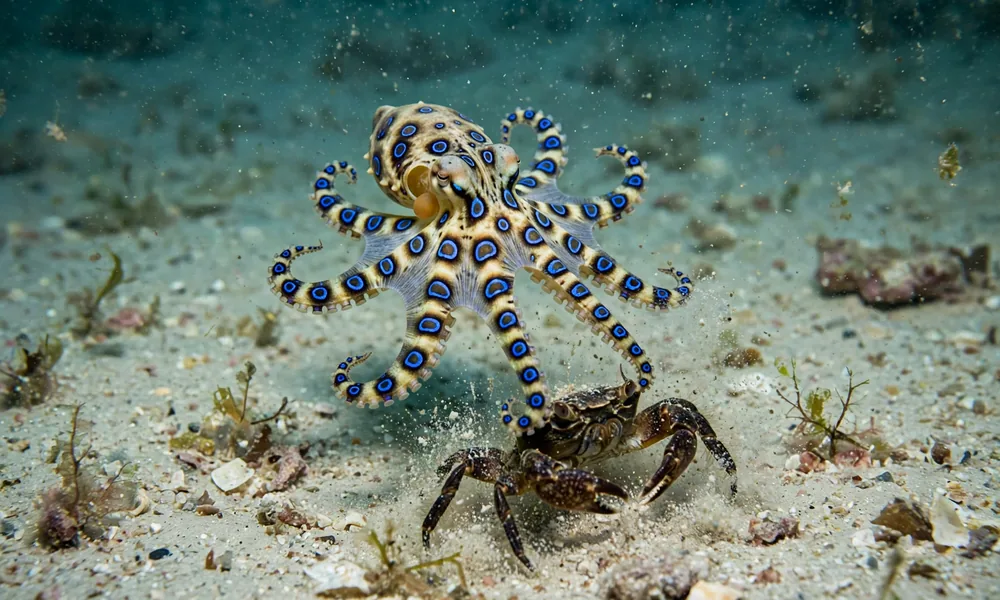
The venom is the tool that makes the hunt work, and it is used on prey long before it is ever used on a person. Once the octopus has bitten its prey, the venom in its saliva paralyses the crab, and the octopus can then eat it at leisure, using its beak to pierce the shell or the exoskeleton and to tear the flesh inside. The venom is made in the posterior salivary glands, with the help of endosymbiotic bacteria, chiefly Vibrio, Pseudomonas, Alteromonas and Bacillus, and the main toxin is tetrodotoxin, a neurotoxin also found in pufferfish and in rough-skinned newts. Tetrodotoxin blocks sodium channels in nerve cells, preventing signals from passing between nerves and muscles, and it paralyses a crab in seconds.
How blue-ringed octopuses behave
Blue-ringed octopuses are solitary animals, and each one lives alone in its den, hunting alone and meeting another octopus only to mate. They are not aggressive, and they do not bite without provocation, and there are no reported cases of unprovoked aggression towards humans. When they are left alone, they are calm, curious and surprisingly bold for such a small animal, and they will watch a diver or a rock-pool explorer from the entrance of their den, changing colour slowly as they assess the visitor. The docile nature is real, and it is the reason so many people are bitten: the octopus does not run away, and a person who mistakes its calm for tameness may pick it up.
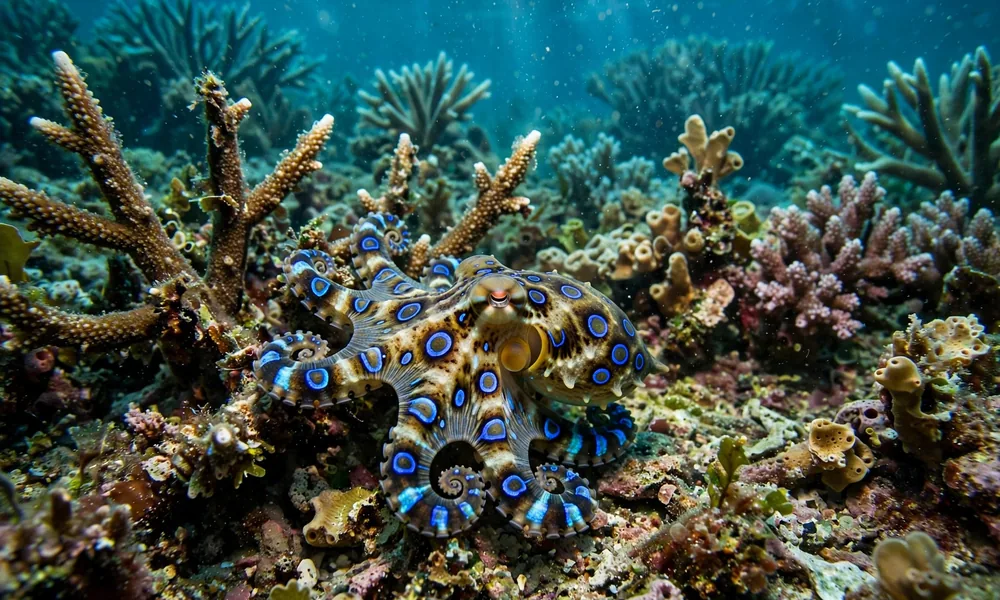
The flashing display is the centrepiece of blue-ringed octopus behaviour, and it is a warning, not a decoration. When the animal is disturbed, the blue rings flare, the skin darkens, and the whole octopus becomes a sign that says, in the language of the reef, do not touch me. The display is made by the chromatophores and iridophores in the skin, and it can be turned on and off in an instant, so the octopus can be brown one moment and blue the next. One species, Hapalochlaena fasciata, does not even need physical contact to secrete its tetrodotoxin, and it recognises predator threats through sight and smell, a reminder that the venom is a defence as well as a hunting tool.
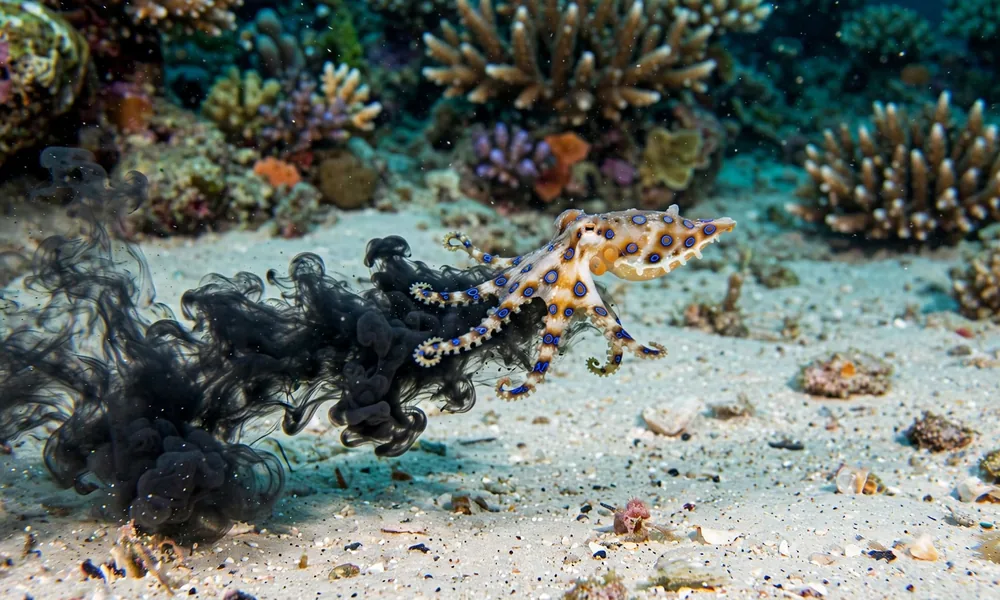
Movement is by crawling and by jet propulsion, and the octopus uses both, depending on the moment. Most of the time it crawls, its arms feeling their way over the sand and the rock, and its suckers gripping the surface, and when it needs to move fast, it takes water into its mantle and squeezes it out through its funnel, jetting backwards in a sudden burst. It can also release a cloud of ink, a dark puff that hangs in the water and confuses a predator while the octopus escapes, and the ink is a last resort, used only when the flashing rings have not been enough. The octopus is also a master of camouflage, and it can change its colour and its texture to match the sand or the coral, becoming almost invisible when it wants to be.
Breeding and life cycle
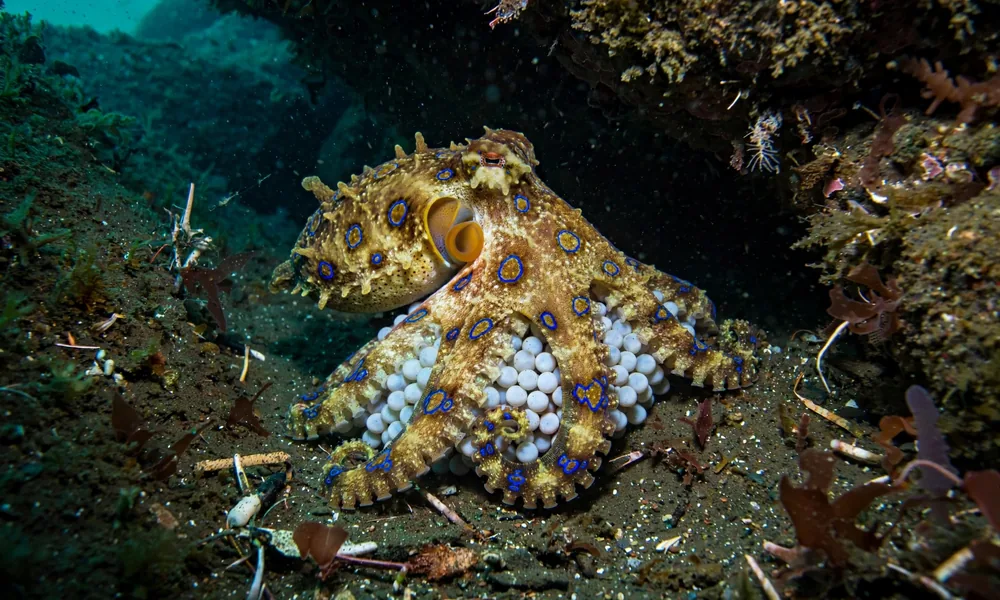
Breeding in blue-ringed octopuses is a once-in-a-lifetime event, and it is the end of the story for both parents. The male deposits sperm packets in the female’s oviduct, using a modified arm called a hectocotylus, and he dies soon after mating. The female then lays 60 to 100 eggs, which she keeps under her arms during the incubation period, which lasts about a month, and she does not eat while she guards them, fasting for 30 to 40 days until the eggs hatch. The eggs are coated with tetrodotoxin by the mother, a gift that repels predators, and the female dies soon after the eggs hatch, having given everything to the next generation.
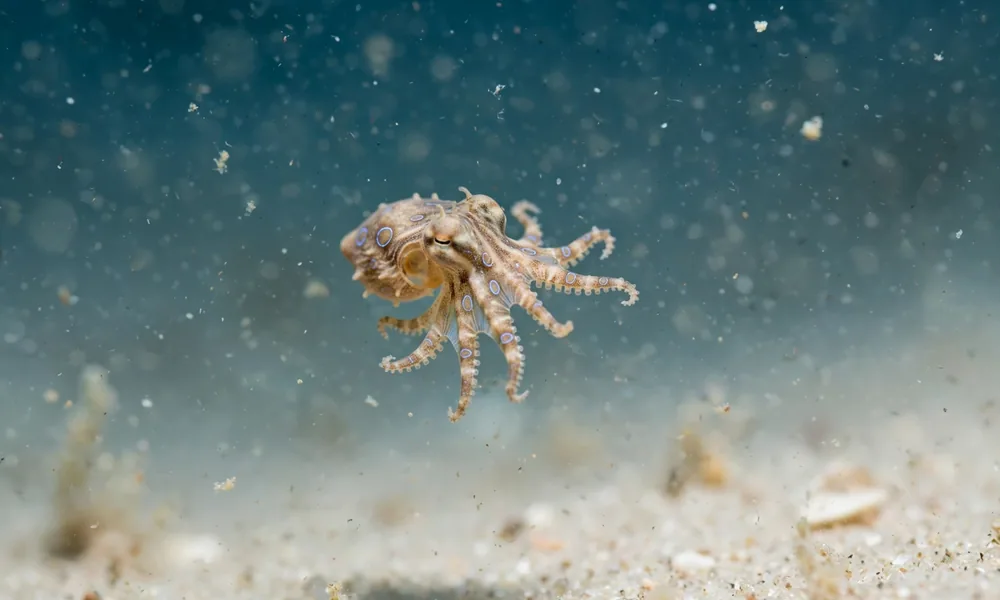
The babies that hatch are planktonic paralarvae, tiny octopuses about the size of a pea, that drift in the water column before settling to the bottom and growing into adults. They grow fast, reaching the size of a golf ball as adults, and the whole life, from hatching to death, lasts about 12 to 18 months for Hapalochlaena lunulata, a short life even by octopus standards. The breeding season varies according to the geographical area, and there is no single month when all blue-ringed octopuses breed, but the pattern is the same everywhere: one mating, one batch of eggs, and then death, a strategy called semelparity, which is common among octopuses.
The short life is the reason the species can be both common and vulnerable at the same time. A population can recover quickly from a bad year, because a new generation arrives within months, but it can also collapse quickly if the adults are taken in large numbers, because there is no older generation to fall back on. The female’s fasting is the most striking part of the cycle: a month without food, guarding eggs that she will never see grow up, and then death.
Conservation status
The blue-ringed octopus is listed as Least Concern by the IUCN, and the assessment covers the genus as a whole, with Hapalochlaena lunulata assessed as Least Concern in 2018, and Hapalochlaena maculosa also listed as Least Concern. As of 2026, the IUCN does not consider Hapalochlaena lunulata, Hapalochlaena maculosa or Hapalochlaena fasciata to be under threat, and the species are widespread and common in suitable habitat throughout their range. That is good news, and it is worth saying plainly, but it is not the whole story, because the threats that do exist are the slow, large ones that the Red List does not always capture.
Climate change, ocean acidification, urbanisation and pollution may be harming the shallow reefs and tide pools where blue-ringed octopuses live, and experts argue that these pressures are growing, even if the population has not yet fallen enough to change the Red List category. The aquarium trade is a more direct pressure, because blue-ringed octopuses are popular aquarium animals on account of their physical beauty, and they are often unsustainably sourced from the wild, taken from tide pools and reefs to be sold to hobbyists who may not understand what they are buying. There are currently no known conservation efforts for the southern blue-ringed octopus specifically, and no reserves or breeding programmes aimed at the genus as a whole.
The work that matters most is the ordinary work of keeping the shore intact: protecting coral reefs and tide pools, keeping the water clean, and leaving the animals in their dens. A blue-ringed octopus does not need a reserve the size of a country, but it does need a reef that is still a reef, and a tide pool that is still a tide pool, and a beachcomber who knows enough to look and not to touch.
Best seasons for blue-ringed octopus watching
Blue-ringed octopuses can be seen all year round in the tropics, because the water is warm and the animals are active in every season, and there is no single month when they vanish. The best time to look is at low tide, when the tide pools are exposed and the octopus is hunting in the shallows, and the best tides are the low spring tides, when the water drops furthest and the pools are at their largest. Calm, clear days are better than rough ones, because the water is clearer and the animals are easier to see, and a morning low tide is often the best of all, because the light is good and the pools have not yet been disturbed by the day’s visitors.
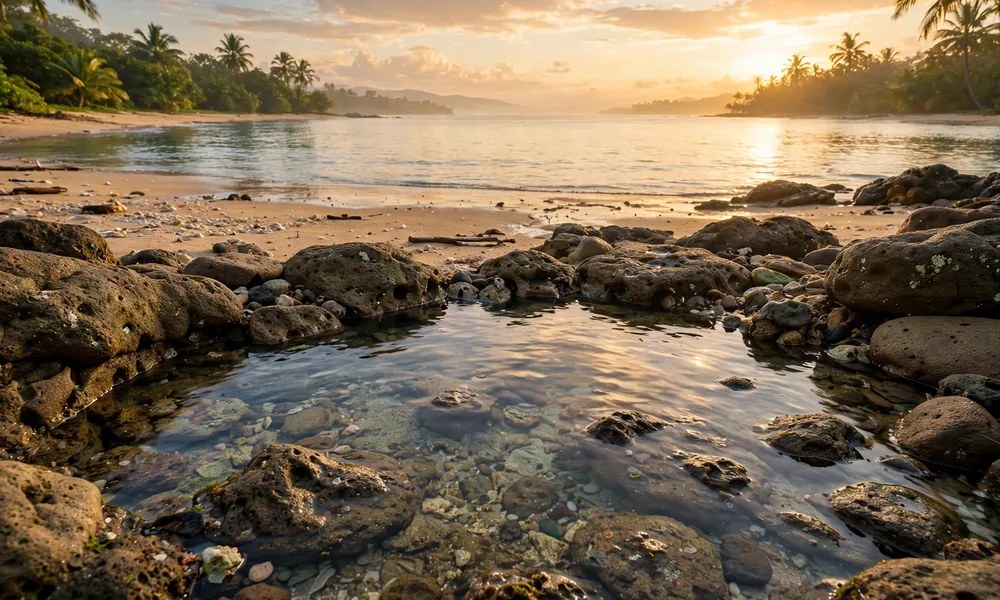
The warmer months are the best in the cooler parts of the range, such as southern Australia, where the water is warmer and the octopuses are more active, and in the tropics the season matters less than the tide. After a storm, the tide pools are worth a careful look, because the octopuses are often found digging around for crabs among the rocks that the storm has stirred up. Aquariums display blue-ringed octopuses all year round, though a responsible aquarium will tell you that the animal in the tank was not taken from the wild for display.
Staying safe around blue-ringed octopuses
Staying safe around a blue-ringed octopus is simple, and it comes down to one rule: do not touch it, do not pick it up, and do not put your hand into a hole or a shell where one might be hiding. The octopus is docile and it will not chase you, but it will bite if it is handled, stepped on or squeezed, and the bite is tiny and often painless, with many victims not realising they have been envenomated until respiratory depression and paralysis begins. Wear shoes on rocky shores, watch where you put your hands when you lift a rock or a shell, and keep children close and supervised in tide pools, because a small hand is the most likely to reach for a pretty little octopus.
If someone is bitten, treat it as a medical emergency and seek immediate medical help, even if the person feels fine, because the venom can take minutes to show its effects. Call emergency services at once, keep the victim still and calm, and do not apply a tourniquet or try to suck out the venom. There is no known antivenom for tetrodotoxin, but timely respiratory support can save lives, and rescue breathing and mechanical ventilation until the toxin wears off, over 24 to 72 hours, ensures survival in most cases. The venom is said to be enough to kill 26 adult humans within minutes, and at least three people have died from blue-ringed octopus venom as of 2026, so the danger is real, but a victim who reaches hospital quickly has a good chance of a full recovery.
Blue-ringed octopus watching checklist
A little preparation turns a morning at low tide into a real chance of seeing a blue-ringed octopus safely, and most of it fits in a small beach bag.
- A calm morning at low tide on a rocky shore with tide pools, when the water is clear and the pools are exposed.
- Sturdy shoes with a good grip, so you can walk on slippery rocks without putting a bare foot into a pool.
- A small torch and a pair of polarised sunglasses, so you can see into the pools without glare and without disturbing the animals.
- A field guide to the octopuses and tide pool animals of the Indo-Pacific, so you can tell a blue-ringed octopus from the other small octopuses.
- A camera with a zoom lens, so you can photograph the octopus from a safe distance without reaching towards it.
- A phone with the local emergency number saved, and a companion who knows where you are, because a bite needs help fast.
- Respect for the octopus and the shore, keeping your hands out of holes and shells, staying out of the water where you cannot see the bottom, and leaving every rock as you found it.
Frequently asked questions
How big do blue-ringed octopuses get?
Blue-ringed octopuses are small enough to fit in an adult human palm, and they rarely measure more than 22 centimetres, or 8.7 inches, from the tip of the mantle to the ends of their arms, and they weigh no more than 100 grams. Hapalochlaena lunulata, the greater blue-ringed octopus, is about 12 centimetres long and weighs about 55 grams on average, while Hapalochlaena maculosa, the southern species, is up to 20 centimetres long and weighs about 26 grams. The mantle itself is about the size of a golf ball, and the baby octopus is about the size of a pea when it hatches.
What do blue-ringed octopuses eat?
Blue-ringed octopuses eat small crabs above all, and they are primarily crab-eaters, taking hermit crabs, small swimming crabs and shore crabs, and they also eat shrimp, molluscs and bivalve shells, and occasionally small injured fish if they can catch them. They hunt during the day, pouncing on their prey, seizing it with their arms and pulling it towards their beak, and then they bite it, injecting tetrodotoxin, which paralyses the prey so the octopus can eat it at leisure. The remains of their meals, empty shells and hollowed-out crab legs, pile up at the entrance to their den.
Are blue-ringed octopuses dangerous to people?
Yes, blue-ringed octopuses are dangerous, but only if they are handled, stepped on or provoked, and they are not aggressive and do not bite without provocation. Their venom contains tetrodotoxin, a powerful neurotoxin that blocks sodium channels and can cause paralysis and respiratory failure, and there is no antivenom. Bites are tiny and often painless, with many victims not realising they have been envenomated until the symptoms begin, and at least three people have died from their venom as of 2026. The rule is simple: admire the rings from a distance, and never pick one up.
Why do blue-ringed octopuses flash blue rings?
Blue-ringed octopuses flash their blue rings as a warning, a form of aposematism that tells predators the animal is toxic and not worth eating. At rest the rings are faint, and the skin looks yellowish, tan or brown, but when the octopus is alarmed, the chromatophores in its skin pull back and the iridophores underneath flash vivid, iridescent blue, each ring with a dark brown centre. The change happens in a fraction of a second, and the whole animal lights up at once, a signal that is hard to miss and impossible to mistake for anything else on the reef.
Can you keep a blue-ringed octopus as a pet?
You should not keep a blue-ringed octopus as a pet, and in practice you should not try, because the animal is venomous, short-lived and difficult to keep, and it needs a specialist marine aquarium with the right water, the right food and the right den. Blue-ringed octopuses are popular aquarium animals because of their beauty, but they are often unsustainably sourced from the wild, and a bite in a home aquarium would be a medical emergency with no antivenom available. A blue-ringed octopus belongs on its reef, and the right way to see one is in a tide pool, from a safe distance, or in a responsible public aquarium.
How is this guide different from the blue morpho butterfly guide?
This guide covers the blue-ringed octopus, a small, venomous, solitary hunter of Indo-Pacific tide pools and coral reefs that grows to about 12 centimetres long, weighs about 55 grams and carries tetrodotoxin in its saliva, while our blue morpho butterfly guide covers a large, harmless, day-flying butterfly of the American rainforest with a wingspan of 13 to 20 centimetres that feeds on rotting fruit. One is an octopus you watch from a safe distance in a rock pool at low tide; the other is a butterfly you watch flashing blue along a forest trail in the morning.
This guide also goes further than our general octopus guide, which covers octopuses as a whole, their shared anatomy and their common habits. Here you get the blue-ringed octopus in full: the four species of Hapalochlaena, the size and weight of each one, the tetrodotoxin venom and the lack of an antivenom, the crab diet, the flashing rings, the 60 to 100 eggs and the month-long fast of the brooding female, and the tide pool watching advice specific to this small, beautiful and dangerous animal.
Conclusion
The blue-ringed octopus species is a reminder that the smallest animal on a reef can also be the most serious, a palm-sized octopus with a golf-ball mantle, eight short arms and a set of blue rings that flare like a warning light. Its venom can stop a person’s breathing, and there is no antivenom, and yet the animal is docile, solitary and shy, and it bites only when it is picked up or stepped on. Its whole life is short, about a year to a year and a half, and it spends it hunting crabs, guarding its den, and, once, laying the eggs that will carry the species forward.
If you go looking for one, go at low tide, on a calm morning, to a rocky shore with tide pools and coral rubble, and look, do not touch. Watch for the litter of crab shells at the entrance to a den, watch for the small, bumpy mantle on the sand, and watch for the blue rings, faint at rest and vivid when the animal is alarmed. Find the pool, keep your hands out of it, and leave the octopus where it is, and you will have met the most beautiful and the most dangerous small animal on the reef, and you will understand why the rings are a warning worth heeding.