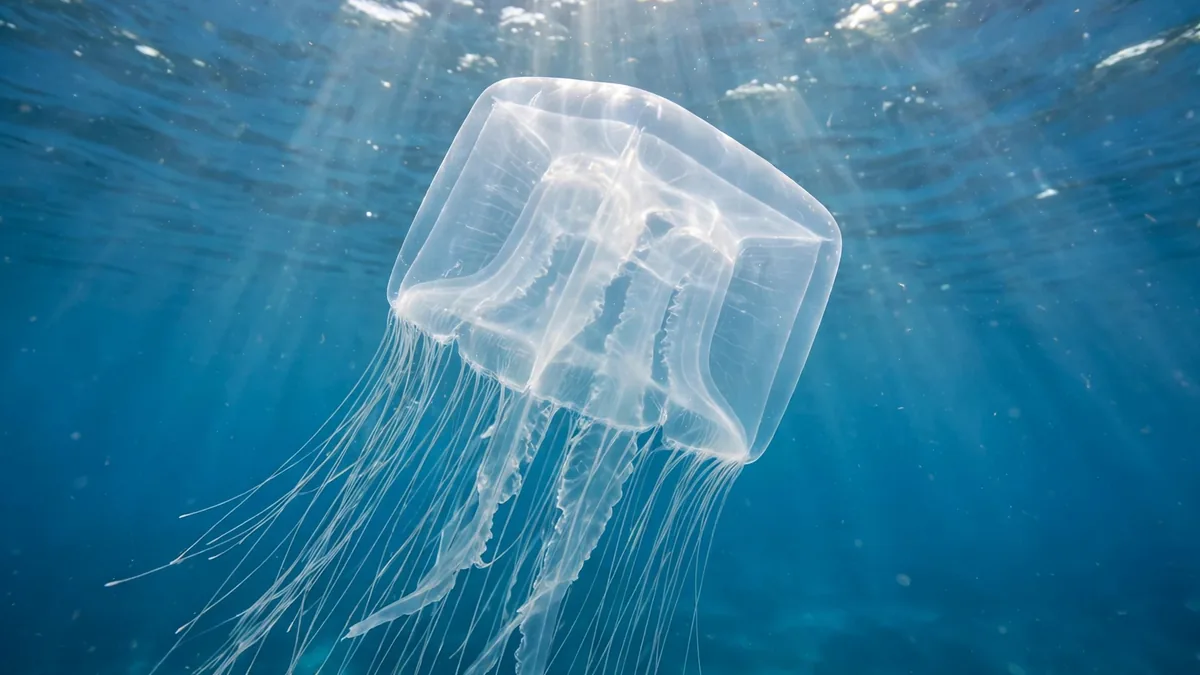
The box jellyfish species is the animal most people picture when they hear the words most venomous creature in the sea, a pale, almost invisible jellyfish with a cube-shaped bell and tentacles that can stretch to about 3 metres long. If you are asking what a box jellyfish is, the short answer is a fast-swimming, sharp-eyed jellyfish of the class Cubozoa, best known in the species Chironex fleckeri, the Australian box jellyfish, which lives in warm coastal waters off northern Australia and through the Indo-Pacific, hunts prawns and small fish by day, and carries venom strong enough to stop a human heart within minutes of a heavy sting. It has no brain, no heart and no bones, yet it can steer towards the light, dodge obstacles and chase down its dinner, which makes it one of the strangest and most capable animals in the ocean.
What makes the box jellyfish so unsettling is how ordinary it looks in the water. The bell is transparent, the tentacles are thin and pale, and a swimmer can be right beside one without seeing it at all, which is why the animal has such a fearsome reputation in the beach towns of Queensland and the Northern Territory. Yet the same animal is a marvel of simple engineering: twenty-four eyes arranged in clusters around its bell, a pulsing bell that jets it through the water at up to four knots, and tentacles lined with millions of stinging cells that fire like tiny harpoons. This guide follows the whole animal: how it looks, where it lives, what it eats, how it behaves, how it breeds, and how to share its waters safely.
Key takeaways
- The box jellyfish species is best known as Chironex fleckeri, the Australian box jellyfish, a member of the class Cubozoa, which holds about 50 described species of box-shaped jellyfish.
- Its bell is usually about 16 centimetres across but can reach about 35 centimetres, and up to 15 tentacles hang from each of its four corners, stretching to about 3 metres long when the animal is hunting.
- Box jellyfish have 24 eyes in four clusters of six, and they can swim at up to four knots, steering towards light and around obstacles instead of simply drifting with the current.
- They eat prawns, shrimp and small fish, which they stun with venom from millions of stinging cells, and a heavy sting can cause cardiac arrest in a person within minutes.
- Box jellyfish have not been evaluated by the International Union for Conservation of Nature, and they are abundant in warm coastal waters, appearing in northern Australia mainly from October to May.
The box jellyfish species and their relatives
Box jellyfish belong to the class Cubozoa, a small class of jellyfish named for the cube shape of their bells, and the class sits in the phylum Cnidaria, alongside the true jellyfish, the corals and the sea anemones. There are about 50 described species of box jellyfish, divided between two main groups: the chirodropids, which carry several tentacles on each corner of the bell, and the carybdeids, which usually carry only one tentacle on each corner. The chirodropids include the largest and most dangerous box jellyfish, while the carybdeids include the tiny Irukandji jellyfish, which are no bigger than a thumbnail yet can cause a dangerous illness of their own. Like the jellyfish, the box jellyfish is a soft-bodied animal with no brain, no heart and no bones, but the ordinary jellyfish of a summer beach drifts where the tide takes it, while the box jellyfish swims where it wants to go.
| Type | Animal | Where it lives | Best-known food | Length or Weight |
|---|---|---|---|---|
| Family | Chirodropids (Chirodropidae) | Northern Australia and Indo-Pacific | Prawns and small fish | Bell up to 35 cm across |
| Genus | Box jellyfish (Chironex) | Northern Australia to South-East Asia | Prawns and small fish | Bell up to 35 cm across |
| Species | Australian box jellyfish (Chironex fleckeri) | Northern Australia and New Guinea | Prawns and small fish | Up to 35 cm across |
| Species | Irukandji jellyfish (Carukia barnesi) | Tropical Australia | Small fish and prawns | Bell about the size of a thumbnail |
| Species | Mangrove box jellyfish (Tripedalia cystophora) | Caribbean and Indo-Pacific mangroves | Small crustaceans | Bell about 1 cm across |
The closest relatives of the Australian box jellyfish are the other members of the genus Chironex, a small group of large, many-tentacled box jellyfish found in warm waters from Japan to Thailand and Singapore, and the genus as a whole is the one that causes the most serious stings. Chironex fleckeri itself is the largest of the cubozoans, with a bell that usually reaches about 16 centimetres across but can grow to about 35 centimetres, which is roughly the size of a basketball, and a weight of up to about 2 kilograms, or 4.4 pounds. The Irukandji jellyfish, Carukia barnesi, is the opposite extreme, a thumbnail-sized box jellyfish of tropical Australia whose sting can cause Irukandji syndrome, a delayed illness of severe pain, nausea, sweating and a dangerous rise in blood pressure. The mangrove box jellyfish, Tripedalia cystophora, is a small Caribbean and Indo-Pacific species that lives among mangrove roots and is studied for its remarkable eyesight, and it is a reminder that not every box jellyfish is a danger to people.
What box jellyfish look like
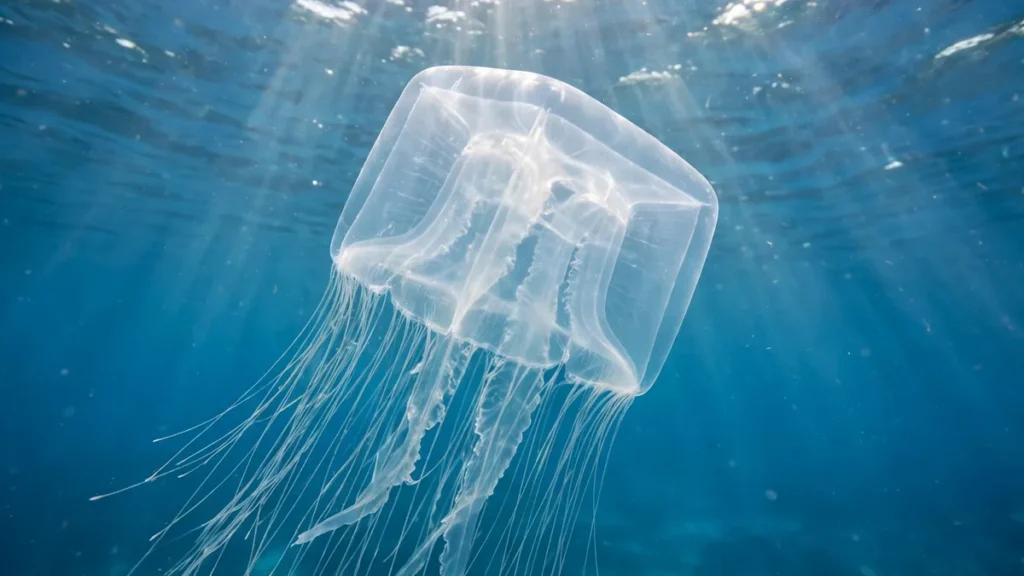
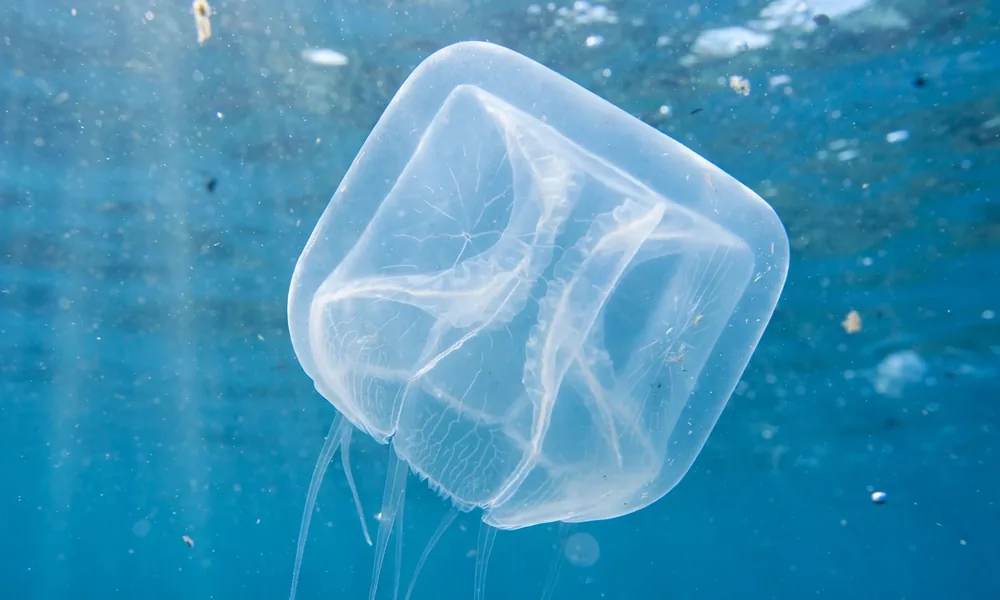
A box jellyfish looks like a piece of the sea that has learned to keep its own shape. The bell is a transparent cube, pale blue and almost glassy, with four flat sides and four corners, and from each corner hangs a stalk called a pedalium, which carries a cluster of tentacles. The bell is smooth and firm for a jellyfish, and it pulses gently to push the animal through the water, while the mouth hangs underneath, in the middle of the bell, and the stomach can be seen faintly through the transparent tissue. There is no head, no brain and no heart, only a simple nerve net that runs through the body and coordinates the pulsing of the bell and the firing of the stinging cells.
The size of a box jellyfish depends on the species, and the range is enormous. The Australian box jellyfish is the giant of the group, with a bell usually about 16 centimetres across and sometimes reaching about 35 centimetres, and a weight of up to about 2 kilograms, which is roughly the weight of a small bag of sugar. Its tentacles are the part that matters most: up to 15 tentacles hang from each of the four corners, making up to 60 tentacles in all, and each one can stretch to about 3 metres, or 10 feet, when the animal is hunting, then contract to only about 15 centimetres when it is swimming fast. The smallest box jellyfish, the Irukandji, has a bell only about the size of a thumbnail, yet its tentacles can still stretch to about a metre, which is why even a jellyfish you can barely see deserves respect.

The eyes are the most surprising part of a box jellyfish, and they are what set it apart from every other jellyfish. Each animal has 24 eyes, arranged in four clusters of six on the four sides of the bell, and each cluster holds two eyes with a proper lens, a retina, an iris and a cornea, much like the eyes of a vertebrate, alongside simpler eyes that sense light and dark. The animal has no brain to process what those eyes see, yet it can steer towards the light, avoid dark obstacles and keep itself in the shallow, food-rich water it prefers, which suggests that the nerve net does far more work than its simplicity suggests. The tentacles are lined with millions of stinging cells called cnidocytes, and each cell holds a tiny harpoon called a nematocyst, which fires in a fraction of a second when it senses the chemicals on the skin of prey.
Where box jellyfish live
Box jellyfish live in warm, shallow coastal waters, and they are found across the tropical Indo-Pacific, from the coasts of northern Australia and New Guinea to Indonesia, Malaysia, Singapore, the Philippines and Vietnam. The Australian box jellyfish is most at home along the northern Australian coast, from the Exmouth Gulf in Western Australia around the top of the continent to Gladstone in Queensland, and it is the jellyfish that beach towns in Queensland and the Northern Territory watch for every summer. Other box jellyfish live much further afield, in the Caribbean, the Gulf of Mexico, Hawaii and the Mediterranean, so the group as a whole is a creature of warm seas everywhere, even if the most dangerous species is an Australian one.

The habitat a box jellyfish chooses is the edge of the sea rather than the open ocean. It prefers calm, shallow water close to shore, around beaches, estuaries, river mouths and mangrove creeks, where its food gathers in large numbers and the water is warm enough for it to hunt by day. Young box jellyfish spend their early months in creeks and estuaries, growing in the sheltered, food-rich water before they move out to the coast as adults, and the adults follow the tides in and out, drifting close to shore on a rising tide and moving back out again as the water falls. They are rarely found in deep water, and they are rarely found in cold water, which is why the stinger season in northern Australia runs through the warm months, roughly from October or November to May.

The water a box jellyfish needs is warm, salty and clear enough for its eyes to work, and it avoids rough seas, sinking to the sea floor and waiting when the water turns rough. It is a creature of the surface layers, hunting in the top few metres where the light is good and the small fish gather, and it rests on the sea floor at night, when it is not hunting.
What box jellyfish eat
Box jellyfish are hunters, and their diet is written in the shallow water they patrol. The everyday food of the Australian box jellyfish is prawns and small fish, above all the small shrimp Acetes sibogae australis, along with crabs and other small pelagic invertebrates that gather in the warm coastal shallows. They hunt by day, when their eyes work best, and they use their tentacles like a net, trailing them through the water and waiting for a prawn or a small fish to brush against them, at which point the stinging cells fire and the prey is stunned almost at once. Like the octopus, the box jellyfish is a hunter that relies on speed and surprise rather than on a web or a trap, but the octopus is a clever animal with a brain, arms and a beak, while the box jellyfish is a brainless animal that hunts with light, touch and venom alone.
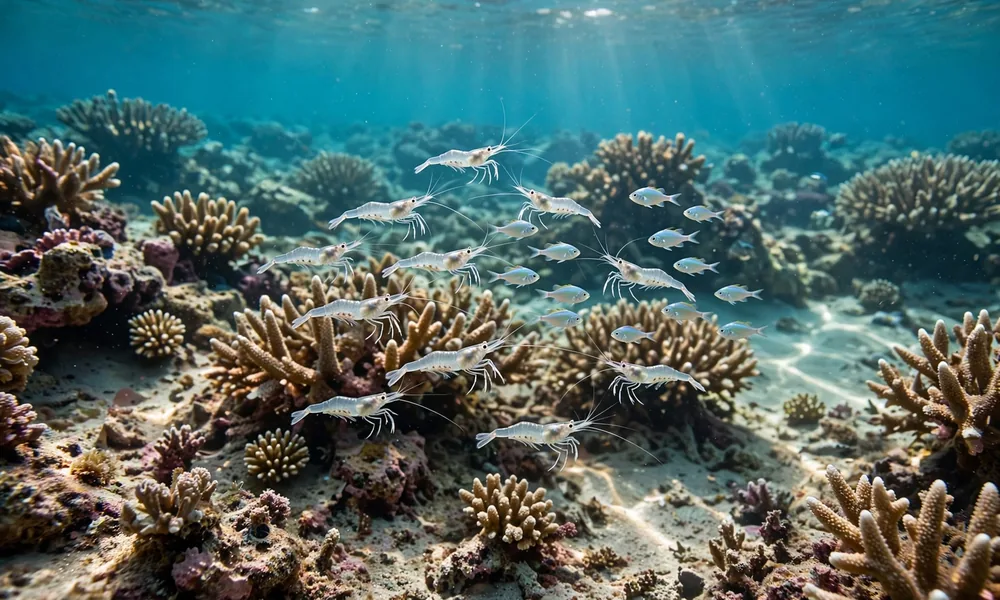
What a box jellyfish eats changes as it grows, and the change follows the size of its tentacles. The young animals eat small crustaceans and plankton in the creeks and estuaries where they grow up, and as they grow larger and their tentacles lengthen, they take bigger prey, moving from tiny shrimp to prawns and then to small fish that are large enough to be worth the venom. The venom is not wasted: it is made to stun or kill prey instantly, so that a struggling fish cannot damage the delicate tentacles, and once the prey is still, the tentacles contract and pass it up to the mouth, where it is swallowed whole. A box jellyfish eats little and often, taking what the tide brings, and it can go without food for a while when the water is rough or the prey is scarce.
The hunting style of a box jellyfish is the reason it is so different from other jellyfish, and it is also the reason it is so dangerous. A true jellyfish drifts and waits for food to drift into it, but a box jellyfish swims, and it swims towards the light where its prey gathers, steering with its eyes and pulsing its bell to jet through the water at up to four knots. It can cover a metre in a few seconds, and large specimens have been reported swimming at up to two metres per second in short bursts, which is fast for an animal with no brain and no muscles worth the name. The tentacles do the killing, the bell does the moving, and the eyes do the steering, and together they make a hunter that is far more active than its soft, drifting cousins.
How box jellyfish behave
Box jellyfish are day hunters, and their day is split cleanly in two: hunt by day, rest by night. They swim and feed in the daylight, when their eyes can guide them to the bright, food-rich shallows, and at night they sink to the sea floor and rest, their tentacles contracted and their bell still, until the morning light wakes them again. They are solitary animals, and they do not form groups or swarms, though several may gather in the same stretch of shallow water when the food is plentiful, and each one hunts alone, trailing its tentacles through the water and waiting for the touch of prey. They do not chase people, and they do not hunt people, and a sting is almost always an accident, when a swimmer walks or swims into tentacles they could not see.

The most famous behaviour in the box jellyfish is its swimming, and it is a trick that no other jellyfish can match. The bell contracts in a steady rhythm, jetting water out behind it and pushing the animal forward, and the animal can steer by changing the strength of the pulse on one side, turning towards the light or away from a dark obstacle. The eyes guide the steering, and experiments have shown that box jellyfish can avoid obstacles placed in their path, which is a remarkable feat for an animal with no central brain. The nerve net that runs through the bell coordinates the pulsing, the steering and the firing of the stinging cells, and it does so without any single place where the decisions are made.

The sting itself is a behaviour of pure reflex, and it is the part of the box jellyfish that people fear most. The stinging cells fire when they sense pressure and the chemicals on the outer layer of prey, and each cell shoots out a tiny harpoon that injects venom into whatever it touches. The venom attacks the heart, the nervous system and the skin all at once, and a heavy sting can cause excruciating pain, a rapid rise in blood pressure and then cardiac arrest, sometimes within two to five minutes. The amount of venom in a single large animal is said to be enough to kill 60 adult humans, and about 3 metres of tentacle contact is thought to be enough to deliver a fatal dose to an adult, which is why even a brief brush with a box jellyfish can be a medical emergency.
Breeding and life cycle
Box jellyfish breed in the warm months, and their life cycle is a strange two-act story, with a small, attached polyp on the sea floor giving rise to the free-swimming jellyfish that everyone recognises. The adult jellyfish release eggs and sperm into the water, and the fertilised eggs develop into tiny larvae called planulae, which settle on the sea floor and grow into polyps, small stalked animals that cling to rocks, shells and mangrove roots in creeks and estuaries. The polyps feed on tiny plankton and grow slowly through the cooler months, and when the water warms again, each polyp transforms itself, whole and entire, into a single young jellyfish, a process that is quite different from the true jellyfish, whose polyps bud off many young at once.
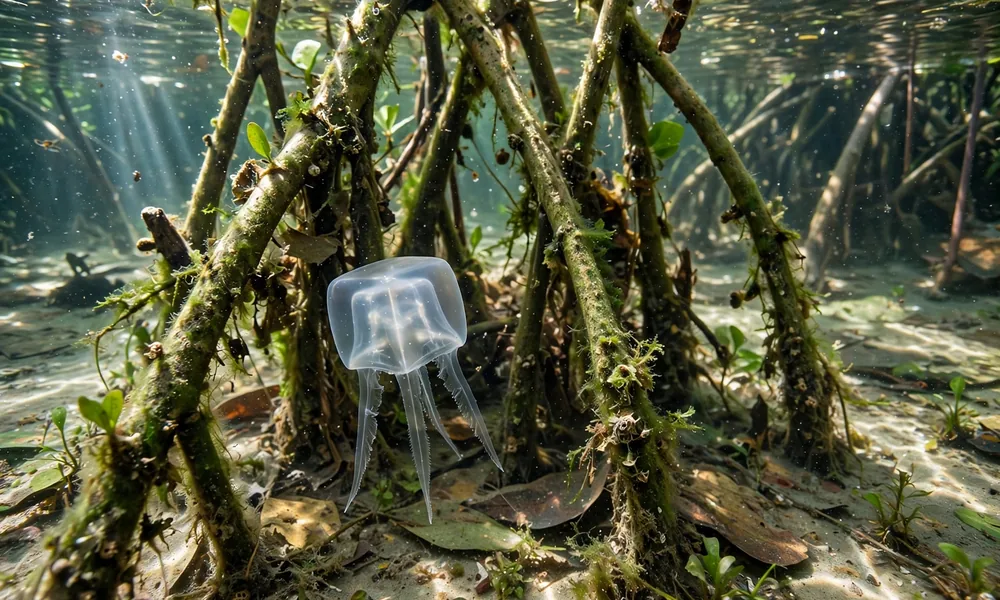
The young jellyfish that leaves the polyp is small, only a few millimetres across, and it grows quickly in the warm, food-rich water of the creeks, feeding on tiny crustaceans and growing new tentacles as its bell widens. It takes only a few months for a young Australian box jellyfish to reach its full size of 16 to 24 centimetres across, and it continues to grow until it is large enough to hunt prawns and small fish on the open coast. The whole medusa stage, the free-swimming jellyfish, lives for less than a year, and the animal is thought to live for up to one year in the wild, which means that the box jellyfish you meet on a summer beach is almost certainly in its first and only summer.

The breeding season follows the warm water, and in northern Australia the adult jellyfish are most common from October or November to May, when the sea is warmest and the food is most plentiful. The polyps wait out the cooler months in the creeks, and the adults die at the end of the season, so the population turns over almost completely each year, with a new generation growing up in the creeks every summer. That annual rhythm is why the stinger season is so predictable, and why beach managers can plan for it, putting up nets and warning signs before the first warm weeks of spring and taking them down again when the water cools.
Conservation status
The conservation status of the box jellyfish is, on paper, a blank. No species of box jellyfish has been evaluated by the International Union for Conservation of Nature, and none is listed by the Convention on International Trade in Endangered Species or on the United States federal list, which means that there is no formal conservation category for the animal at all. That is not because the animal is rare, but because it is abundant within its range, and because nobody has ever needed to protect a jellyfish whose sting can kill a person. The Australian box jellyfish is common in the warm coastal waters it calls home, and it is not considered at risk, which is a very different story from the one told by the threatened frogs and spiders of the rainforest.

The main pressure on box jellyfish is the same pressure on the whole coastal sea: warming water, pollution and the loss of the mangrove creeks and estuaries where the young grow up. Warmer seas may let the Australian box jellyfish spread further south, and may lengthen the stinger season, while pollution and coastal development can damage the creeks where the polyps live. There are no conservation efforts aimed at box jellyfish themselves, and there is no fishing for them, yet the health of the coastal waters matters to them as much as it matters to the fish and the corals they share the shallows with. A coast with clean water, healthy mangroves and intact estuaries is a coast where box jellyfish will go on thriving, for better and for worse.
Best seasons for box jellyfish watching
The best time to look for box jellyfish is the stinger season, when the water is warm and the animals are out hunting in the shallows, though no season will show you one from a safe distance without care. The animals are present in northern Australian waters mainly from October or November to May, and they are most common in the warmest months, from December to March, when the sea is at its warmest and the prawns and small fish are most plentiful. In the cooler months, from June to September, the adults are gone, and only the tiny polyps remain, hidden in the creeks, waiting for the water to warm again.

The best hours are the daylight hours, when the jellyfish are out hunting in the shallows and the water is clear enough to see them, and a visit to a stinger-net beach in the warm season, with a local guide or a lifeguard to ask, is the best way to learn about them safely. The box jellyfish is so well known that National Geographic keeps a live profile of the box jellyfish, and a guided reef trip or a visit to a marine centre, in the warm season, is the best way to see one without ever getting in the water with it.
Staying safe around box jellyfish
A box jellyfish is dangerous to people who meet it in the water, and there is no safety warning that matters more than the obvious one: do not swim where box jellyfish are known to be, and do not touch one, dead or alive. A jellyfish washed up on the beach can still sting, because the stinging cells fire for hours after the animal dies, and a child who picks one up can be stung as badly as a swimmer. The first aid for a sting is to get out of the water, call for help at once, and pour vinegar over the sting to stop any unfired stinging cells from firing, and never to rub the sting, or to wash it with fresh water, urine or alcohol, which can make more cells fire. An antivenom exists for the Australian box jellyfish, and it is carried by ambulance crews and hospitals near the beaches where the animal lives, but the most important treatment is speed, because a heavy sting can stop a heart within minutes.
Box jellyfish watching checklist
A little preparation turns a trip to a tropical beach into a safe chance of learning about box jellyfish at their best, in the warm shallows they hunt.
- A visit in the stinger season, from October to May, when the water is warm and the jellyfish are most active.
- A stinger-net beach with lifeguards on duty, so you can swim inside the net and learn about the animals safely.
- A stinger suit or a full-body lycra suit, so your skin is covered if you do get in the water.
- A bottle of vinegar in your beach bag, so you can treat a sting at once if someone is hurt.
- Binoculars and a camera, so you can watch the water from the shore without getting close to a jellyfish.
- A field guide to the jellyfish of northern Australia, so you can tell a box jellyfish from a harmless moon jellyfish.
- Respect for the sea and the animals in it, keeping your distance, keeping your hands off any jellyfish, and leaving the beach as you found it.
Frequently asked questions
How big do box jellyfish get?
Box jellyfish vary enormously in size, and the species matters more than the group. The Australian box jellyfish, Chironex fleckeri, is the largest of them all, with a bell usually about 16 centimetres across but sometimes reaching about 35 centimetres, and a weight of up to about 2 kilograms, or 4.4 pounds. Its tentacles can stretch to about 3 metres, or 10 feet, when it is hunting, and there can be up to 60 of them, with up to 15 hanging from each corner of the bell. The smallest box jellyfish, the Irukandji, has a bell only about the size of a thumbnail, yet its tentacles can still stretch to about a metre, so size is no guide to danger.
What do box jellyfish eat?
A box jellyfish eats prawns, shrimp and small fish, which it takes in the warm coastal shallows with its venomous tentacles. The everyday food of the Australian box jellyfish is prawns and small fish, above all the small shrimp Acetes sibogae australis, along with crabs and other small pelagic invertebrates. The young eat smaller crustaceans and plankton in the creeks where they grow up, and the adults take bigger prey as their tentacles lengthen, stunning each one with venom so that it cannot struggle and damage the delicate tentacles.
Are box jellyfish dangerous to people?
Yes, box jellyfish are dangerous to people, and the Australian box jellyfish is the most dangerous jellyfish in the world. Its venom attacks the heart, the nervous system and the skin all at once, and a heavy sting can cause excruciating pain, a rapid rise in blood pressure and then cardiac arrest, sometimes within two to five minutes. At least 64 people are known to have died from stings by Chironex fleckeri in Australia since 1883, and most of the victims were stung by large specimens with a bell wider than 15 centimetres. Most stings are mild, and many people are stung without ever knowing what touched them, but a heavy sting is a medical emergency, and anyone stung should get help at once.
Where do box jellyfish live?
Box jellyfish live in warm, shallow coastal waters across the tropical Indo-Pacific, from the coasts of northern Australia and New Guinea to Indonesia, Malaysia, Singapore, the Philippines and Vietnam. The Australian box jellyfish is most at home along the northern Australian coast, from the Exmouth Gulf in Western Australia to Gladstone in Queensland, and it prefers calm, shallow water close to shore, around beaches, estuaries, river mouths and mangrove creeks. Other box jellyfish live in the Caribbean, the Gulf of Mexico, Hawaii and the Mediterranean, so the group as a whole is a creature of warm seas everywhere.
Can you keep a box jellyfish as a pet?
No, you should not try to keep a box jellyfish as a pet, and in most places you would not be allowed to. A box jellyfish needs a large, specially designed tank with constantly moving seawater, a steady supply of live prawns and small fish, and careful handling by people trained to work with venomous animals, and even in a public aquarium it is a difficult and dangerous animal to keep. It is also an animal that can kill a person with a single heavy sting, so it belongs in the sea or in a professional marine centre, not in a home tank, and anyone who wants to see one should visit an aquarium or a marine centre instead.
How is this guide different from the blue-ringed octopus guide?
This guide covers the box jellyfish, a whole class of jellyfish, Cubozoa, led by the Australian box jellyfish, Chironex fleckeri, a transparent, cube-belled animal of warm coastal waters that swims by day, hunts prawns and small fish with 3-metre tentacles, and carries venom that can stop a human heart within minutes, while our blue-ringed octopus guide covers a single small octopus of Australian reefs that hides in rock pools by day, hunts crabs and shrimp at night, and flashes blue rings when it feels threatened. One is a drifting, brainless jellyfish you meet in the open shallows; the other is a clever, eight-armed hunter you meet tucked into a crevice on the reef.
This guide also goes further than our general jellyfish guide, which covers jellyfish as a whole, from the harmless moon jellyfish to the lion’s mane jellyfish, in a single broad sweep. That guide is the place to start if you want to know what a jellyfish is, while this guide stays with the box jellyfish for its whole length, following the Australian box jellyfish from its cube-shaped bell and its 24 eyes through its reef habitat, its prawn diet, its day hunting and its famous sting to the seasons and the checklist that will help you learn about one safely.
Conclusion
The box jellyfish species is a reminder that the most dangerous animal in the sea does not need teeth, or claws, or size to be feared. A transparent cube of a bell, 24 eyes and no brain at all, tentacles that can stretch to about 3 metres, and venom that can stop a heart within minutes have made the Australian box jellyfish the most venomous marine animal in the world, at home in the warm coastal waters from northern Australia to South-East Asia.
If you go looking for one, go in the stinger season, go to a netted beach with lifeguards on duty, and watch the water from the shore with your eyes open. Find the warm shallows over sand and reef, look for the pale, almost invisible bell in the clear water, and give it all the room in the world, and you will have met the box jellyfish that turns a quiet stretch of tropical coast into a place of sudden, respectful caution.