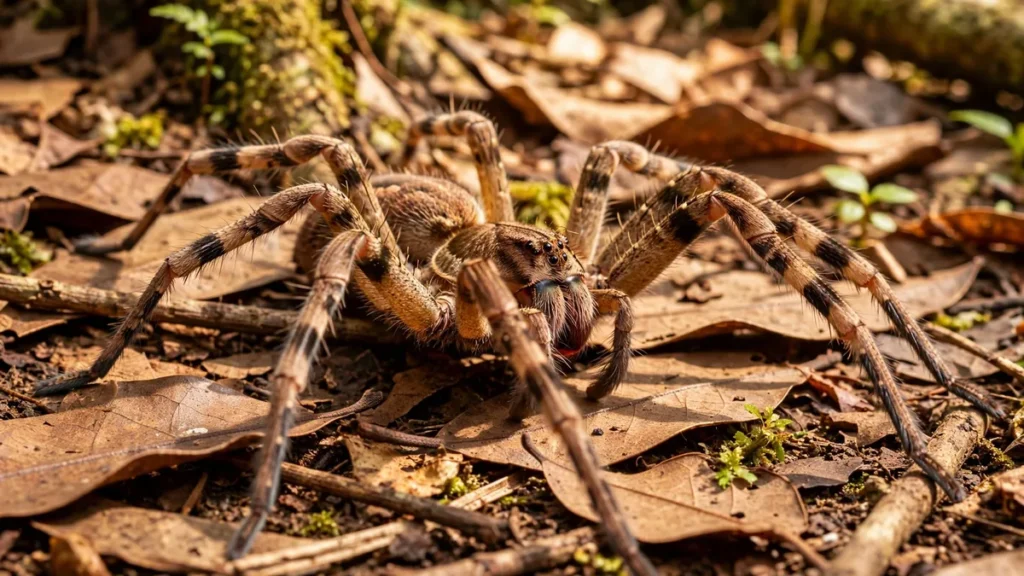
The brazilian wandering spider species is the spider most people picture when they hear the words most venomous spider in the world, a large, brown, fast-moving hunter that does not build a web at all. If you are asking what a Brazilian wandering spider is, the short answer is a nocturnal hunting spider of the genus Phoneutria, best known in the species Phoneutria nigriventer, which lives in the forests, banana plantations and houses of South America, walks the forest floor at night in search of prey, and carries a neurotoxic venom so potent that it has held a Guinness record as the world’s most venomous spider. It is not a spider that waits in a web for dinner to arrive, and it is not a spider that hides from trouble, which is why it has such a fearsome reputation in the towns and cities of Brazil.
What makes the Brazilian wandering spider so unsettling is how ordinary it looks in the leaf litter. The body is brown and hairy, the legs are long and banded, and a person can be right beside one without seeing it at all, which is why the animal has such a fearsome reputation in the houses and gardens of south-eastern Brazil. Yet the same animal is a marvel of simple hunting: eight eyes that work in the dark, legs that can carry it in a short, fast rush, and fangs that deliver a venom studied by doctors for the medicines it may one day yield. This guide follows the whole animal: how it looks, where it lives, what it eats, how it behaves, how it breeds, and how to share its forests safely.
Key takeaways
- The brazilian wandering spider species is best known as Phoneutria nigriventer, a member of the genus Phoneutria, which holds nine species of large wandering spiders in the family Ctenidae.
- Adult females reach about 30 to 48 millimetres in body length, males about 25 to 35 millimetres, and the leg span is usually about 13 to 15 centimetres.
- These spiders build no capture web at all, and they hunt on foot at night, resting by day in banana crowns, bromeliads, woodpiles and dark corners of houses.
- Their venom is a potent neurotoxin, and Phoneutria nigriventer has held a Guinness record as the world’s most venomous spider, judged by how little venom kills a laboratory mouse.
- The species is not evaluated by the International Union for Conservation of Nature, and females live about one to two years, sometimes longer.
The brazilian wandering spider species and their relatives
Brazilian wandering spiders belong to the genus Phoneutria, a small genus of large, robust hunting spiders in the family Ctenidae, the wandering spiders, and the genus sits in the order Araneae, alongside the wolf spiders, the huntsman spiders and the tarantulas. There are nine species in the genus, all of them nocturnal and all of them found in Central and South America, and they are called wandering spiders because they walk the forest floor at night in search of prey instead of building a web to catch it. The genus name comes from the Greek word for murderess, and the spiders are known in Brazil as aranhas armadeiras, or armed spiders, for the defensive stance they take when they feel threatened. Like the spider, the Brazilian wandering spider is an eight-legged hunter with fangs and venom, but the ordinary spider of a garden corner sits in a web and waits, while the Brazilian wandering spider walks the forest floor and hunts on foot.
| Type | Animal | Where it lives | Best-known food | Length or Weight |
|---|---|---|---|---|
| Family | Wandering spiders (Ctenidae) | Central and South America | Crickets and other insects | Body up to 48 mm long |
| Genus | Brazilian wandering spiders (Phoneutria) | Central and South America | Crickets, frogs and lizards | Body 17 to 48 mm long |
| Species | Brazilian wandering spider (Phoneutria nigriventer) | South-eastern Brazil and nearby countries | Crickets, katydids and frogs | Body 30 to 48 mm long |
| Species | Amazonian wandering spider (Phoneutria fera) | Amazon rainforest | Crickets, frogs and lizards | Body 17 to 48 mm long |
| Species | Bolivian wandering spider (Phoneutria boliviensis) | Central America to Argentina | Crickets and other insects | Body 17 to 48 mm long |
The closest relatives of the Brazilian wandering spider are the other members of the genus Phoneutria, and the genus as a whole ranges from Costa Rica and Nicaragua in the north to northern Argentina in the south. Phoneutria nigriventer is the best studied of the nine, and it is the one that accounts for the great majority of recorded bites, because it lives in the most densely populated part of Brazil. Phoneutria fera is the Amazonian species, a spider of the rainforest interior that is widely considered, with Phoneutria nigriventer, to be the most venomous of the genus. Phoneutria boliviensis is the most widespread of them all, with a range that runs from Central America south to Argentina, and its venom is less potent than that of its two famous cousins, which is why it causes milder bites.
What brazilian wandering spiders look like
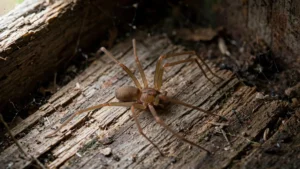
A Brazilian wandering spider looks like a large, brown, hairy spider that has been built for walking rather than for waiting. The body is robust and covered in short brown to greyish hairs, the legs are long and faintly banded, and the whole animal has the look of a large wolf spider, which is why it is so often confused with the harmless wandering spiders that share its forests. The colour is a mottled grey-brown to olive-brown, which blends into the leaf litter so well that a spider can be sitting in plain sight and still be invisible, and the underside of the body is dark, almost black in Phoneutria nigriventer, which is what the name nigriventer means. There is no bright warning colour, and no web to give it away, only a large, quiet spider on the forest floor.
The size of a Brazilian wandering spider depends on the sex, and the difference is easy to see once you know to look for it. Adult females are larger, reaching about 30 to 48 millimetres in body length, while adult males are smaller, reaching about 25 to 35 millimetres, and the species as a whole measures about 17 to 48 millimetres from the front of the body to the back. The leg span is what makes the animal look so big: usually about 13 to 15 centimetres, or about 5 to 6 inches, from the tip of one leg to the tip of the opposite leg, which is roughly the width of a human hand. The fangs are large for a spider of this size, and they are the part that matters most, because they are what deliver the venom.

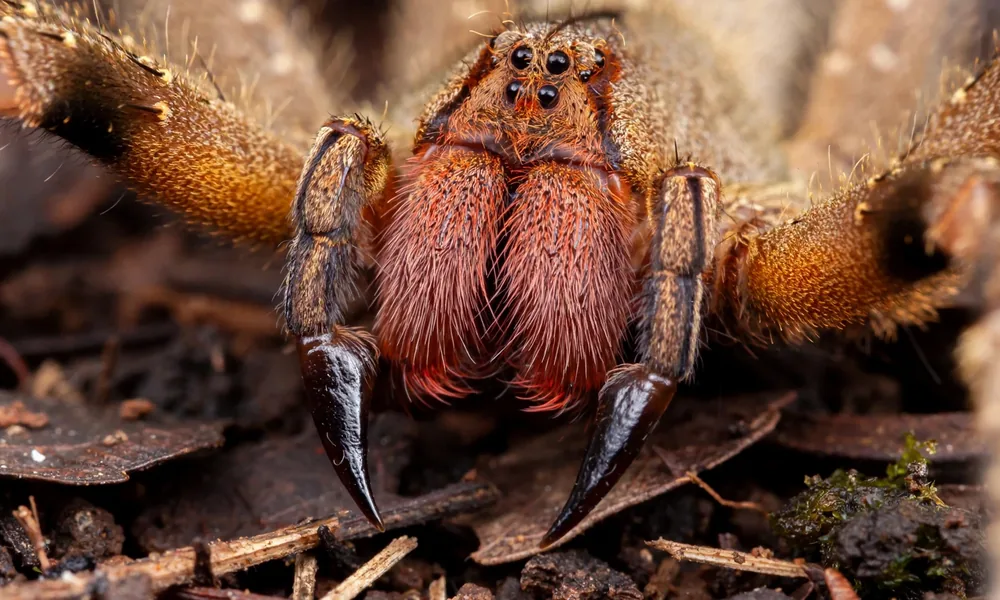
The most distinctive feature of a Brazilian wandering spider is the one you see only when it feels threatened. Many species in the genus have bright red hairs on the chelicerae, the structures on the face just above the fangs, and bands of black and yellow or white on the underside of the two front pairs of legs, and both are hidden while the spider is walking calmly through the leaf litter. The eyes are arranged in two rows, and they work well enough in the dark for the spider to hunt by touch and by vibration, sensing the footsteps of a cricket through the leaves and seizing it in a short rush. The legs are covered in fine hairs that sense the air and the ground, and the feet end in tufts of hairs that grip smooth surfaces, which is how the spider climbs banana plants and the walls of houses.
Where brazilian wandering spiders live
Brazilian wandering spiders live in the tropical and subtropical forests of Central and South America, and they are found nowhere else on Earth in the wild. The genus as a whole ranges from Costa Rica and Nicaragua through Panama, Colombia, Venezuela, the Guianas, Ecuador, Peru and Bolivia to Brazil, Paraguay and northern Argentina, and the different species divide that range between them, with some in the Amazon, some in the Atlantic forest and some in the far north. Phoneutria nigriventer, the best-known species, is not an Amazonian spider at all: its stronghold is south-eastern and southern Brazil, in the states of Minas Gerais, Espirito Santo, Rio de Janeiro, Sao Paulo, Parana, Santa Catarina and Rio Grande do Sul, extending into Paraguay, north-eastern Argentina and, at the margins of its range, Uruguay.
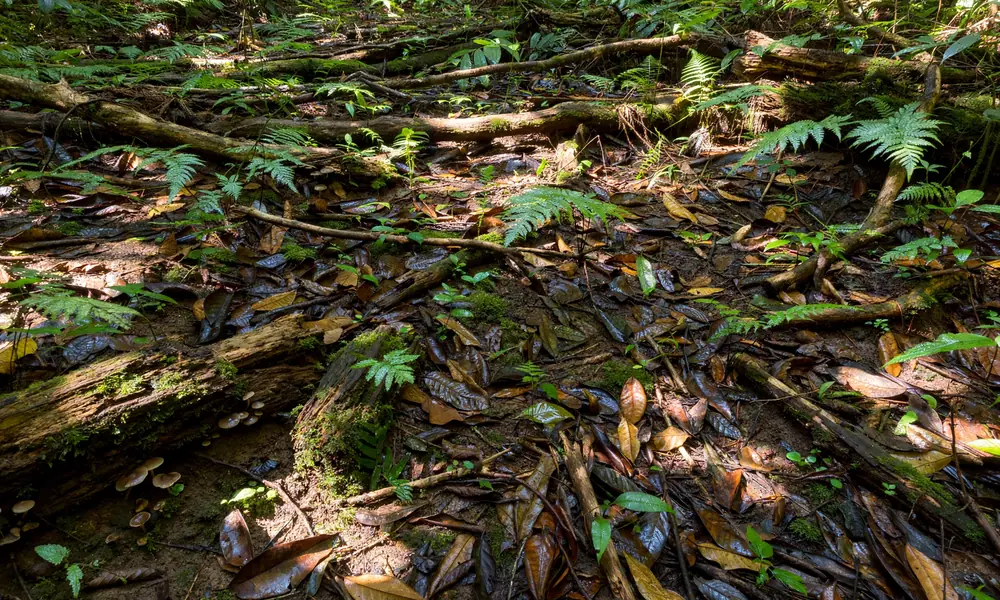
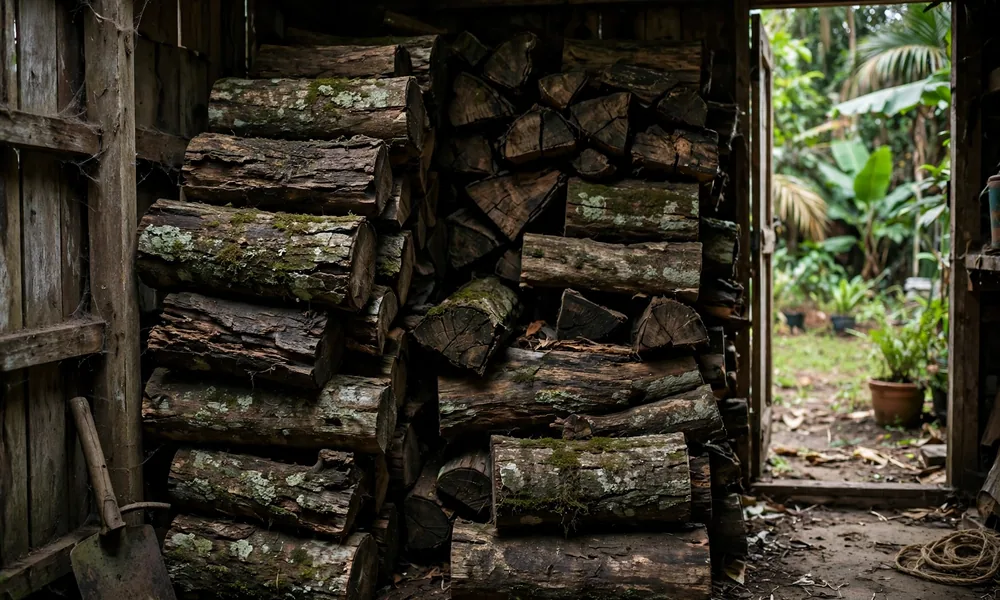
The habitat a Brazilian wandering spider chooses is the forest floor and the low vegetation, and it rarely climbs high into the trees at all. Its original home is the Atlantic forest and its edges, but it is one of the most successful spiders in South America at living alongside people, and it thrives in banana plantations, gardens, sheds, rubble and building sites, and in cities it turns up in garages, stacked timber, boxes and, in the classic story, inside shoes and clothing left on the floor. It rests by day inside banana crowns, bromeliads, rolled leaves, woodpiles and rubble, and it hunts after dark on the ground and in low vegetation, which is why a spider that lives in the forest can also be a spider that lives in a house.

The climate a Brazilian wandering spider needs is warm and humid, and it avoids cold and dry places, which is why it has never spread beyond the tropics and subtropics of the Americas. It is sometimes carried out of its range in banana shipments, and spiders have turned up in fruit markets far from South America, but they do not establish themselves there, because the winters are too cold for them to survive. The forest it needs is a forest with a deep layer of leaf litter, with fallen logs and dense undergrowth to hide in by day, and with enough insects, frogs and lizards to hunt by night, and a forest without those things is a forest without wandering spiders.
What brazilian wandering spiders eat
Brazilian wandering spiders are hunters, and their diet is written on the forest floor itself. The everyday food is large-bodied insects, above all crickets, katydids and cockroaches, along with other spiders, and occasionally tree frogs, small lizards and young mice, which are the largest prey a spider of this size can take. They hunt by touch and by vibration, locating prey in the dark and seizing it in a short rush, and they use their venom to subdue it quickly, because a struggling cricket can damage a spider’s legs. Like the spider of a garden web, the Brazilian wandering spider is a carnivore that feeds on animals it can overpower, but the web spider sits and waits for food to come to it, while the Brazilian wandering spider walks the forest floor and goes looking for its dinner.

What a Brazilian wandering spider eats changes as it grows, and the change follows the size of its fangs. The young spiders eat small insects and tiny spiders, and as they grow larger they take bigger prey, moving from small crickets to large katydids and cockroaches, and then to frogs, lizards and mice that are large enough to be worth the venom. The venom is not wasted: it is made to paralyse prey quickly, so that a frog or a lizard cannot struggle and injure the spider, and once the prey is still, the spider bites again and feeds, sucking the liquefied insides from its victim. A wandering spider eats little and often, taking what the night brings, and it can go without food for a while when the weather is cold or the prey is scarce.
The hunting style of a Brazilian wandering spider is the reason it is so different from other spiders, and it is also the reason it meets people so often. A web spider stays in one place, but a wandering spider walks, and it walks through the same gardens, sheds and houses that people walk through, which is why the two so often meet in the dark. The spider does not hunt people, and it does not chase people, and a bite is almost always an accident, when a person puts a hand or a foot where a spider is hiding. The spider hunts at night, when the insects are out, and it rests by day, when the insects are hidden, which is the opposite of the web spider’s quiet, patient life.
How brazilian wandering spiders behave
Brazilian wandering spiders are night spiders, and their day is split cleanly in two: rest by day, hunt by night. They rest by day in dark, sheltered places, inside banana crowns, bromeliads, rolled leaves, woodpiles and rubble, and they are so still and so brown that a person can stand beside a resting spider and not see it. As night falls they come out and begin to walk the forest floor, hunting, and looking for a mate, and they are solitary for most of the year, and they do not form groups or colonies, and each spider keeps to its own patch of forest floor, though several spiders may gather in the same banana plantation when the food is plentiful.

The most famous behaviour in the Brazilian wandering spider is the defensive stance, and it is a warning that works because the spider is so good at hiding first. When a wandering spider feels threatened, it rears up, raises its two front pairs of legs high, sways from side to side, and shows the bright red hairs on its chelicerae and the bands on the underside of its front legs, and the display is unmistakable, a spider that has gone from a brown lump on the ground to a raised, swaying, red-fanged animal in a single movement. The stance is a bluff in the same way that a cobra’s hood is a bluff, a warning that says leave me alone, and a spider that is left alone will usually drop back down and walk away.

The venom itself is a behaviour of pure chemistry, and it is the part of the Brazilian wandering spider that doctors study most. The venom is a mixture of neurotoxic peptides, grouped into families called PhTx1, PhTx2 and PhTx3, which hold open the sodium channels in nerve cells and block the calcium channels that control the release of neurotransmitters, so that nerve endings fire again and again and dump their chemicals into the body. The result is immediate, radiating pain, sweating, salivation and changes in blood pressure and heart rate, and in men and boys a prolonged and painful erection, which is caused by one of the PhTx2 toxins and is now studied as a lead for drugs to treat erectile dysfunction. The amount of venom needed to kill a 20-gram mouse has been shown to be only 6 micrograms when injected into a vein, which is why the spider holds a record for venom potency, even though most bites in people are far less serious than the reputation suggests.
Breeding and life cycle
Brazilian wandering spiders breed in the autumn, and their life cycle is a short, fast story, with a spider that grows up, mates, lays eggs and dies within about two years. The males wander widely in search of females in the autumn months, roughly from March to May in Brazil, which is also the time when most human bites happen, because the males are out walking in the open instead of hiding in their daytime shelters. The male does not court the female from a distance, but climbs onto her and mates in the usual position of the modern wandering spiders, and the female then stores the sperm in a separate chamber from her eggs until she is ready to fertilise them.
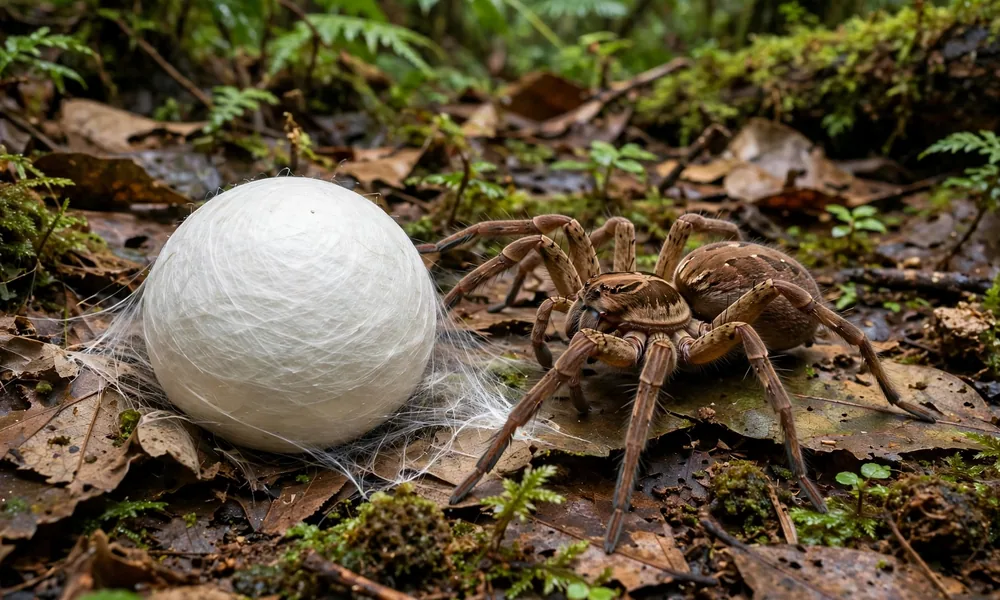
The female lays her eggs in a silk egg sac, and she can lay up to 1,000 eggs at a time, keeping them safe in a spun-silk sac that she carries with her or guards in her shelter. She may carry up to four egg sacs in her lifetime, collectively holding more than 3,000 eggs, and she guards each one for 20 to 30 days until the young hatch. The young spiders can capture prey immediately after leaving the egg sac, and they grow quickly, moulting several times as they grow, and reaching adult size within a year. The young are independent from the day they leave the sac, and they scatter through the leaf litter to hunt on their own.

The life of a Brazilian wandering spider is short, and the females live about one to two years, sometimes longer, while the males live for a shorter time and often die soon after mating. A spider that survives its first year in the forest has a good chance of seeing a breeding season, and a female that guards her egg sacs through the autumn has a good chance of leaving hundreds of young behind her. That short life is why the population turns over so quickly, and why a banana plantation that is cleared of its spiders in one year can be full of them again the next.
Conservation status
The conservation status of the Brazilian wandering spider is, on paper, a blank. The species has not been evaluated by the International Union for Conservation of Nature, and it is not listed by the Convention on International Trade in Endangered Species, which means that there is no formal conservation category for the animal at all. That is not because the animal is rare, but because it is abundant within its range, and because nobody has ever needed to protect a spider whose bite can put a person in hospital. The Brazilian wandering spider is common in the Atlantic forest and in the banana plantations and gardens of south-eastern Brazil, and it is not considered at risk, which is a very different story from the one told by the threatened frogs of the rainforest.
The main pressure on Brazilian wandering spiders is the same pressure on the whole Atlantic forest: the clearing of forest for farming, for logging and for building, which takes away the leaf litter, the fallen logs and the dense undergrowth the spider lives in. The spider is more tolerant of change than most forest animals, because it thrives in banana plantations and gardens, yet the loss of the Atlantic forest still matters, because the plantations and gardens are no substitute for the deep, damp forest floor where the spider evolved. There are no conservation efforts aimed at Brazilian wandering spiders themselves, and there is no need for any, yet the health of the Atlantic forest matters to them as much as it matters to the frogs and the lizards they share the leaf litter with.
Best seasons for brazilian wandering spider watching
The best time to look for Brazilian wandering spiders is the warm, wet season, when the forest is damp and the spiders are out hunting in the open, though no season will show you one from a garden. The spiders are present in the forest all year round, so there is no wrong season in the strict sense, but the warm months, from about October to March, are the time when the leaf litter is dampest and the spiders are most active, and a visit in the autumn, from March to May, will show you males wandering in search of females. In the cooler, drier months the spiders retreat into the dampest corners of the forest, into the shade beside streams and banana plants, and they are harder to find.

The best hours are the first hours after dark, when the spiders are out hunting on the forest floor and the air is still damp from the day. From about dusk until midnight, the spiders are at their most active, hunting and looking for mates, and they are at their most visible then, walking in the open where a careful observer with a torch can see them. A guided night walk with a local naturalist, in the warm season, is the best way to see one in the wild, and it is the only safe way, because a spider that is cornered in the dark is a spider that will rear up and bite.
Staying safe around brazilian wandering spiders
A Brazilian wandering spider is dangerous to people who meet it in the dark, and there is no safety warning that matters more than the obvious one: do not put your hand or your foot where you cannot see, and do not touch a spider that has reared up with its front legs raised. The spider will not chase a person, and it will not hunt a person, but it will bite if it is trapped against skin, in a shoe, in clothing or in a banana bunch, which is how most bites happen. The first aid for a bite is to keep still, keep the bitten limb down, and get to a hospital at once, where a specific antivenom is available, and never to cut the bite, or to suck the venom, or to apply a tourniquet, which can do more harm than good. Most bites cause only local pain and swelling, and deaths are exceptional, with only a handful across recent decades in Brazil, nearly all in children, yet a bite in a child is a medical emergency, and anyone bitten should get help at once.
Brazilian wandering spider watching checklist
A little preparation turns a night in a South American forest into a real chance of seeing a Brazilian wandering spider at its best, walking the leaf litter in the damp dark.
- A guided night walk with a local naturalist in the warm season, when the forest is damp and the spiders are most active.
- An evening walk after dark, when the spiders are out hunting on the forest floor and their eyes shine back in a torch beam.
- Sturdy boots and long trousers, so you can walk the forest paths without putting a bare foot where a spider is hiding.
- A torch with a red filter or a gentle beam, so you can find the spiders without blinding them.
- Binoculars and a camera that works in low light, so you can watch the forest floor without crowding the spiders.
- A field guide to the spiders of South America, so you can tell a wandering spider from a harmless wolf spider.
- Respect for the spiders and the forest, keeping your distance, keeping your hands off the spiders, and leaving the forest as you found it.
Frequently asked questions
How big do brazilian wandering spiders get?
Brazilian wandering spiders are large for a hunting spider, and the females are larger than the males. Adult females reach about 30 to 48 millimetres in body length, and adult males reach about 25 to 35 millimetres, so the species as a whole measures about 17 to 48 millimetres from the front of the body to the back. The leg span is what makes the animal look so big: usually about 13 to 15 centimetres, or about 5 to 6 inches, from the tip of one leg to the tip of the opposite leg, which is roughly the width of a human hand. A spider that size fits comfortably in the palm of a hand, though it should never be picked up, and most of them are smaller than a matchbox.
What do brazilian wandering spiders eat?
A Brazilian wandering spider eats crickets, katydids, cockroaches and other spiders, which it takes on the forest floor at night with a short, fast rush. The everyday food is crickets and katydids, and the spider hunts by touch and by vibration in the dark, seizing whatever comes within reach. It will also take tree frogs, small lizards and young mice when it gets the chance, and the young spiders eat smaller insects until they grow large enough to take bigger prey.
Are brazilian wandering spiders dangerous to people?
Yes, Brazilian wandering spiders are dangerous to people, and their venom is among the most potent of any spider. Their venom is a neurotoxin that causes immediate, radiating pain, sweating, salivation and changes in blood pressure and heart rate, and in men and boys a prolonged and painful erection. Brazil records about 4,000 wandering spider bites a year, yet deaths are exceptional, with only a handful across recent decades, nearly all in children, because a specific antivenom is available and most bites cause only local pain and swelling. A bite in a child is a medical emergency, and anyone bitten should get to a hospital at once.
Where do brazilian wandering spiders live?
Brazilian wandering spiders live in the tropical and subtropical forests of Central and South America, from Costa Rica and Nicaragua in the north to northern Argentina in the south. Phoneutria nigriventer, the best-known species, lives in south-eastern and southern Brazil, in the states of Minas Gerais, Espirito Santo, Rio de Janeiro, Sao Paulo, Parana, Santa Catarina and Rio Grande do Sul, extending into Paraguay, north-eastern Argentina and, at the margins of its range, Uruguay. They live on the forest floor and in low vegetation, and they also thrive in banana plantations, gardens, sheds and houses, resting by day in dark, sheltered places and hunting by night.
Can you keep a brazilian wandering spider as a pet?
You can, but only with the right setup and the right permits, and most people should think carefully before they try. Brazilian wandering spiders are kept by a small number of experienced keepers, where they need a warm, humid enclosure with leaf litter, bark and a hiding place, and a diet of live crickets and cockroaches. They are nocturnal, so they are most active when their keeper is going to bed, and they are not a spider for a beginner, and a spider that escapes into the wild must never be released where it does not belong, because it could bite someone who does not expect it.
How is this guide different from the box jellyfish guide?
This guide covers the Brazilian wandering spider, a single genus of spiders, Phoneutria, led by Phoneutria nigriventer, a large brown hunting spider of South American forests that walks the forest floor at night, hunts crickets and frogs on foot, and raises its front legs in a defensive stance when it feels threatened, while our box jellyfish guide covers a whole class of jellyfish, Cubozoa, led by the Australian box jellyfish, Chironex fleckeri, a transparent, cube-belled animal of warm coastal waters that swims by day and hunts prawns with venomous tentacles. One is a land hunter you meet in the leaf litter at night; the other is a sea hunter you meet in the warm shallows by day.
This guide also goes further than our general spider guide, which covers spiders as a whole, from garden web spiders to tarantulas, in a single broad sweep. That guide is the place to start if you want to know what a spider is, while this guide stays with one genus for its whole length, following the Brazilian wandering spider from its nine species and its record venom through its forest habitat, its insect diet, its night hunting and its famous defensive stance to the seasons and the checklist that will help you see one for yourself.
Conclusion
The brazilian wandering spider species is a reminder that a spider does not need a web, or bright colours, or great size to be unforgettable. A brown, hairy body, long banded legs, a defensive stance with raised front legs, and a venom that has held a record for potency have made the Brazilian wandering spider the most famous hunting spider of South America, at home in the forests, banana plantations and houses from Costa Rica to northern Argentina.
If you go looking for one, go on a guided night walk in the warm season, go after dark, and walk slowly through the forest with your eyes on the leaf litter. Find the damp ground beneath the banana plants, watch for a large brown spider walking in the open, and give it all the room in the world, and you will have met the Brazilian wandering spider that turns a quiet stretch of rainforest into a place of sudden, respectful caution.