The blue morpho butterfly species is one of the most recognisable insects in the Americas, a large tropical butterfly whose upper wings flash an electric blue that can be seen from fifty metres away through the rainforest. If you are asking what a blue morpho butterfly is, the short answer is Morpho peleides, the common blue morpho, a brush-footed butterfly of the family Nymphalidae with a wingspan of 13 to 20 centimetres, or 5 to 8 inches, that lives in the rainforests of Mexico, Central America and northern South America. The blue is not a pigment at all, but a trick of light played by microscopic scales, and when the butterfly closes its wings the flash vanishes and a dull brown underside patterned with eyespots takes its place.
That disappearing act is the heart of the blue morpho story. A blue morpho spends its short adult life, only a few weeks long, patrolling forest trails and streams by day, sipping the juice of rotting fruit instead of visiting flowers, and laying its eggs singly on the leaves of legume trees. The caterpillar is bright green with red and white markings, the chrysalis is a pale green jewel hanging from a twig, and the whole life cycle from egg to the end of adult life takes less than 120 days. What follows is the full picture: how the butterfly looks, where it lives, what it eats, how it behaves, how it breeds, and how to see one well without harming it.
Key takeaways
- The blue morpho butterfly species is Morpho peleides, a brush-footed butterfly in the family Nymphalidae, native to the rainforests of Mexico, Central America and northern South America.
- Adults have a wingspan of 13 to 20 centimetres, or 5 to 8 inches, with iridescent blue upper wings edged in black and a brown underside patterned with eyespots.
- The blue colour is structural, made by microscopic wing scales that reflect light, and it is not a pigment in the wing at all.
- Adults feed on the juice of fermenting fruit and tree sap, never on flower nectar, while caterpillars eat the leaves of legume trees.
- The whole life cycle lasts less than 120 days, the adult stage only a few weeks, and the species has not been evaluated by the IUCN, though forest loss is its main threat.
The blue morpho butterfly species and their relatives
The blue morpho butterfly belongs to the family Nymphalidae, the brush-footed butterflies, one of the largest butterfly families in the world, and it sits in the genus Morpho, a Neotropical group of large, showy butterflies famous for their metallic blue upper wings. The genus holds about thirty species, most of them forest butterflies of Central and South America, and nearly all share the same basic trick: brilliant blue above, dull brown with eyespots below. The name Morpho comes from the Greek word for shape or form, and the species name peleides refers to Peleus, a hero of Greek myth.
Morpho peleides is the lead species of this guide, and it is the butterfly most people mean when they say blue morpho. It is also the species most often flown in museum and zoo butterfly houses around the world, which is why so many people have seen one even if they have never set foot in a rainforest. Taxonomy here is not quite settled, and honest guides say so: many authorities now treat peleides as a subspecies of Morpho helenor, writing it as Morpho helenor peleides, and the University of Florida lists thirteen described subspecies under peleides. Like the butterfly, the blue morpho is a day-flying insect with four wings and a coiled proboscis, but the ordinary garden butterfly visits flowers for nectar, while the blue morpho ignores flowers altogether and feeds on rotting fruit and tree sap instead.
| Type | Animal | Where it lives | Best-known food | Length or Weight |
|---|---|---|---|---|
| Family | Brush-footed butterflies (Nymphalidae) | Worldwide, except Antarctica | Nectar, fruit juice and tree sap | About 13 to 20 cm long |
| Genus | Morpho butterflies (Morpho) | Central and South America | Fermenting fruit and tree sap | About 12 to 20 cm long |
| Species | Blue morpho butterfly (Morpho peleides) | Mexico to northern South America | Rotting fruit and tree sap | About 13 to 20 cm long |
| Species | Menelaus blue morpho (Morpho menelaus) | Central and South America | Rotting fruit and tree sap | About 12 cm long |
| Species | Helenor blue morpho (Morpho helenor) | Central and South America | Rotting fruit and tree sap | About 13 to 15 cm long |
The closest relative in the public mind is the Menelaus blue morpho, Morpho menelaus, a butterfly of Central and South America with a wingspan of about 12 centimetres. It looks very much like the common blue morpho at a glance, with the same flashing blue upper wings, and the two are often confused in butterfly houses, where both are flown. The Menelaus morpho is one of the most widespread members of the genus, found from Mexico south through the Amazon basin, and like its cousin it feeds on rotting fruit as an adult and on legume leaves as a caterpillar, flying through the forest understorey in the same slow, bounding way.
Within the genus, the blue morpho sorts itself from its relatives by range, by size and by the exact shade and pattern of its wings. The Helenor blue morpho, Morpho helenor, is a butterfly of Central and South America with a wingspan of about 13 to 15 centimetres, and it is the species that peleides is now so often grouped with, the two being so close that many taxonomists treat them as one species with many local forms. More than twenty subspecies of peleides have been described, and the only one found in Trinidad is Morpho peleides insularis, also known as the emperor butterfly, a local form that shows how a single widespread species can splinter into distinct island and mainland populations.
What a blue morpho butterfly looks like
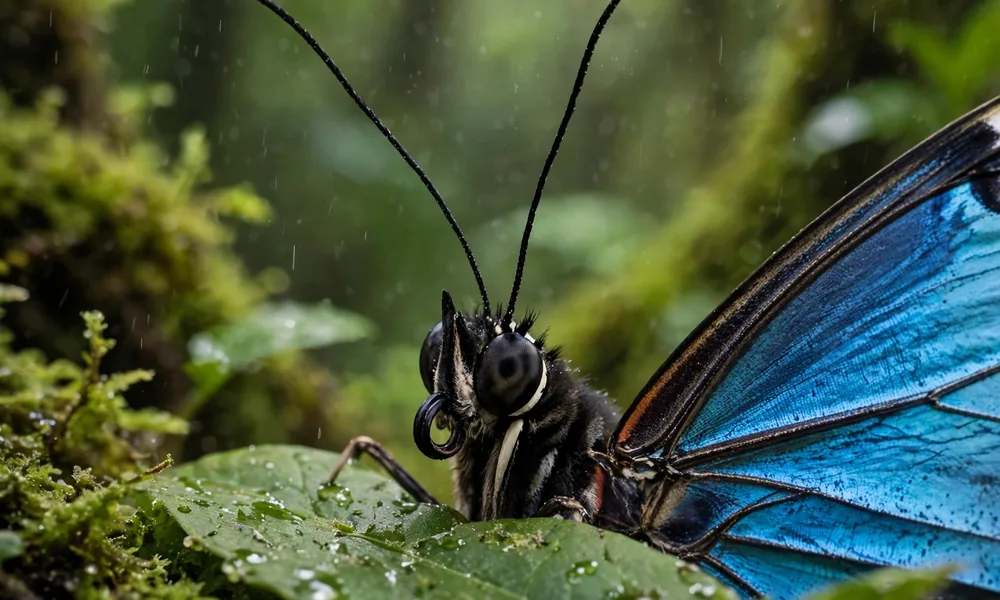
A blue morpho butterfly looks like a piece of the sky that has learned to fly through the forest. The upper side of the wings is a blazing, reflective electric blue that shifts through cobalt, cyan and violet as the angle of the light changes, edged with a black band and white dots along the margins, and the blue is visible from fifty to eighty metres away, which makes the species unmistakable in flight. The body is dark and sturdy for a butterfly, the antennae are long and clubbed, and the six legs are short, the front pair reduced to little brushes, which is the feature that gives the family Nymphalidae its common name of brush-footed butterflies.
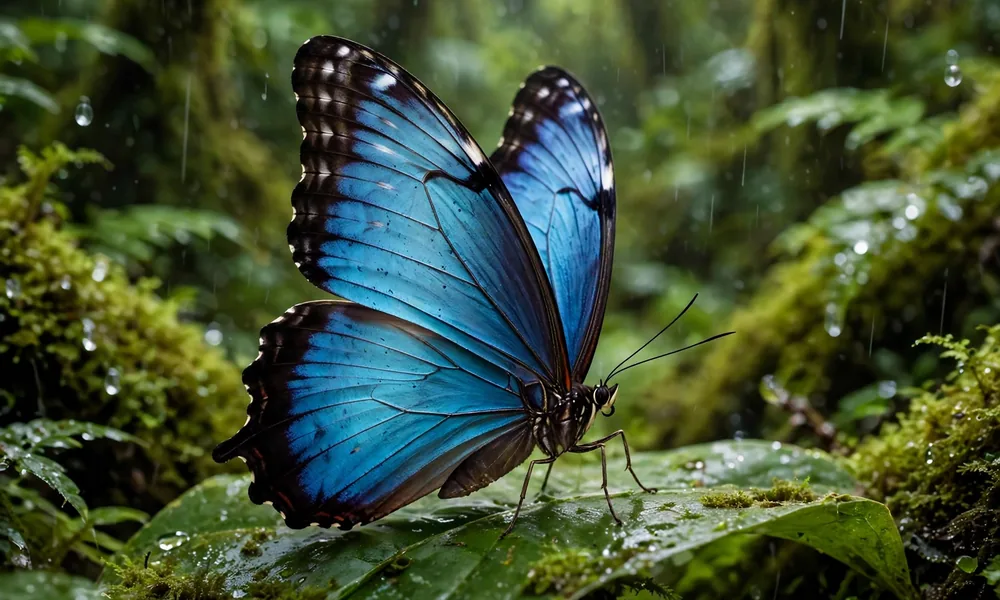
The blue is the famous part, and it is worth understanding properly, because it is not a colour in the ordinary sense. The wings carry no blue pigment at all. Instead, the upper surface is covered in microscopic scales, each one ridged and layered in a way that reflects blue light and cancels out the rest, a phenomenon called structural colour. The same physics makes a peacock feather shine, and it means the blue changes with the viewing angle, flaring bright when the sun catches it and dimming when the wing turns away.
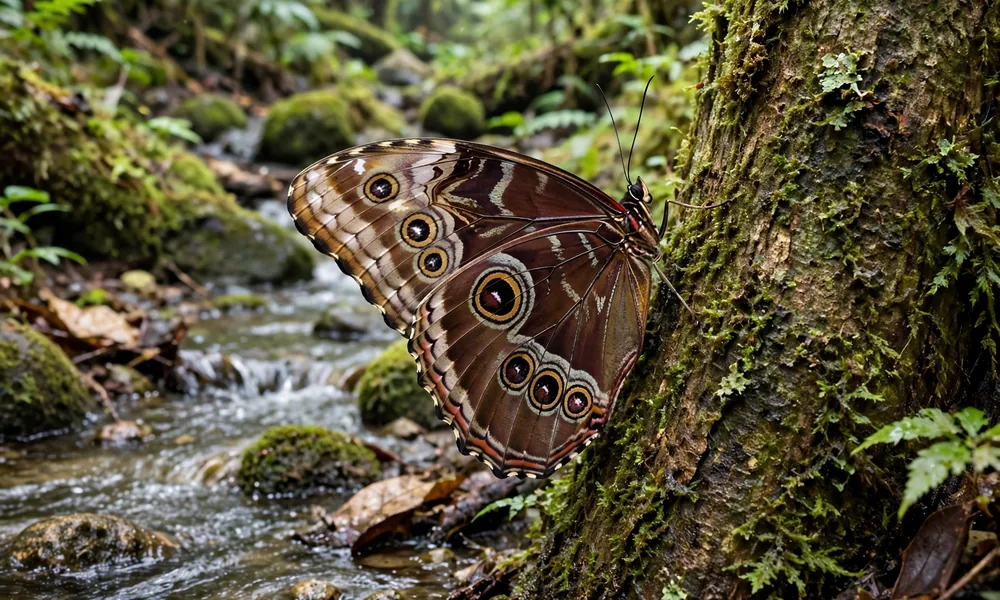
Turn the butterfly over, or watch it close its wings, and the show ends in an instant. The underside is brown, patterned with a row of large eyespots ringed in yellow and black, and when the wings are folded the butterfly looks like a dead leaf or a piece of bark, a piece of camouflage so good that a bird can lose track of it in the second it takes to land. This is the morpho’s real defence: flash blue to confuse a predator in flight, then vanish into brown the moment it settles. The eyespots add a second layer of protection, drawing a peck towards the wing edge and away from the body, so a butterfly can survive an attack with a torn wing and still fly.
Males and females differ in small but noticeable ways. Females are slightly larger, and their blue is often a little duller, sometimes washed with a paler or more violet tone, while males carry the brightest, most saturated blue. Females also tend to fly less conspicuously, keeping to the undergrowth and the canopy, while males patrol openly along forest streams and trails, which is why most of the morphos a visitor actually sees are males.
Where blue morpho butterflies live
Blue morpho butterflies live in the tropical and subtropical moist broadleaf forests of the Neotropics, from Mexico south through Guatemala, Belize, Honduras, Costa Rica and Panama, and into Colombia, Venezuela, Ecuador and Trinidad, with the wider genus reaching as far south as Paraguay. Within that range they use the understorey and edge zones of lowland and premontane rainforest, from sea level up to about 1,800 metres, though they are commonest in the lowlands. They are butterflies of the forest edge rather than the deep interior, preferring open spaces along the edges of forests and rivers, trails, streams and clearings, where the sun reaches the ground and the air is warm enough for flight.

The habitat a morpho chooses changes with the time of day and with the sex of the butterfly. Males are easily spotted because they fly in open areas, patrolling along forest streams and sunny gaps, while females prefer to remain hidden within the forest, flying through the undergrowth and the canopy where they are much harder to see. Both sexes need the same things, though: intact or semi-intact forest with plenty of legume trees for the caterpillars, fallen fruit on the forest floor for the adults, and damp ground for mud-puddling. They do not persist in degraded or agricultural landscapes.
Altitude matters too. In Costa Rica, morphos are found from the lowlands up into the mountains to about 1,800 metres, and in other parts of the range they are recorded up to about 1,400 metres, so a visitor walking a lowland trail in the morning has a far better chance than one hiking a cold ridge. They are also butterflies of secondary growth, the forest that springs up after a clearing or a storm, and they are often found in large numbers where forest is growing back, as long as the host plants and the fruit are there. They do not migrate, and a four-month recapture study in Colombia found marked adults moving at most about two to three kilometres, so a morpho you see on a trail is very likely a local, living its whole short life within a small patch of forest.
What blue morpho butterflies eat
Adult blue morphos do not feed on flower nectar, and that single fact surprises almost everyone who meets one. Instead, they feed exclusively on the juices of fermenting and rotting fruit, on tree sap, on fungi, on wet mud and on animal droppings, and they locate their food mainly by scent, often gathering in small groups around a single fallen fruit. Overripe mangoes, fallen figs and rotting bananas are favourites, and a morpho will unroll its long proboscis, a straw-like mouthpart, and sip the sweet, fermenting juice for minutes at a time. Males also gather at damp riverbanks to mud-puddle, drinking mineral salts from wet sand, a habit that gives them the sodium and other minerals they need for mating.
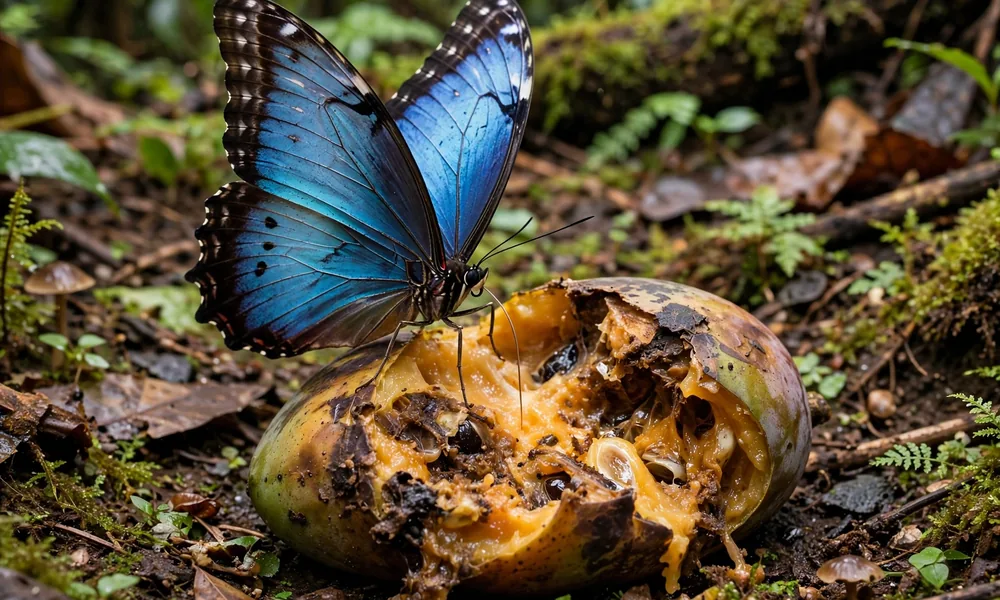
The caterpillars eat very differently, and their diet is what ties the species to the forest. On hatching, the first tiny caterpillar eats its own empty eggshell, a first source of nourishment, and then begins to feed on the leaves of its host plants, mostly members of the pea family, the Fabaceae or Leguminosae. The favoured hosts include Machaerium, Pterocarpus, Lonchocarpus, Dalbergia, Mucuna and Erythrina, all legume trees and vines of the rainforest, and in Trinidad the caterpillars have also been recorded feeding on a Bignonia vine. The caterpillars feed at night and rest motionless on a bare twig by day, and they feed only on older leaves, a habit that keeps them out of sight of the birds that hunt by day.
Feeding changes with the seasons, and a morpho that is easy to find in one month can be hard to find in the next. In the Costa Rican dry season, tree sap is used more than fruit, because fallen fruit is scarcer, and after the dry season fresh adults emerge in a peak that brings the brightest and most numerous morphos of the year. Adults are non-seasonal in the lowland tropics, with fresh adults emerging throughout the year, but the numbers still rise and fall with the fruit and the rain.
How blue morpho butterflies behave
Blue morphos are diurnal insects, active through the day between about ten in the morning and three in the afternoon, when the sun is high and the forest is warm. Their flight is powerful, erratic and extraordinarily deceptive, a slow, bounding flap that carries them in long, looping arcs along a trail or a stream, and the flash of blue appears and disappears with every wingbeat, which makes them very hard for a bird to track. Males patrol along forest streams, flying the same route again and again, and they will chase another male out of their stretch of trail.
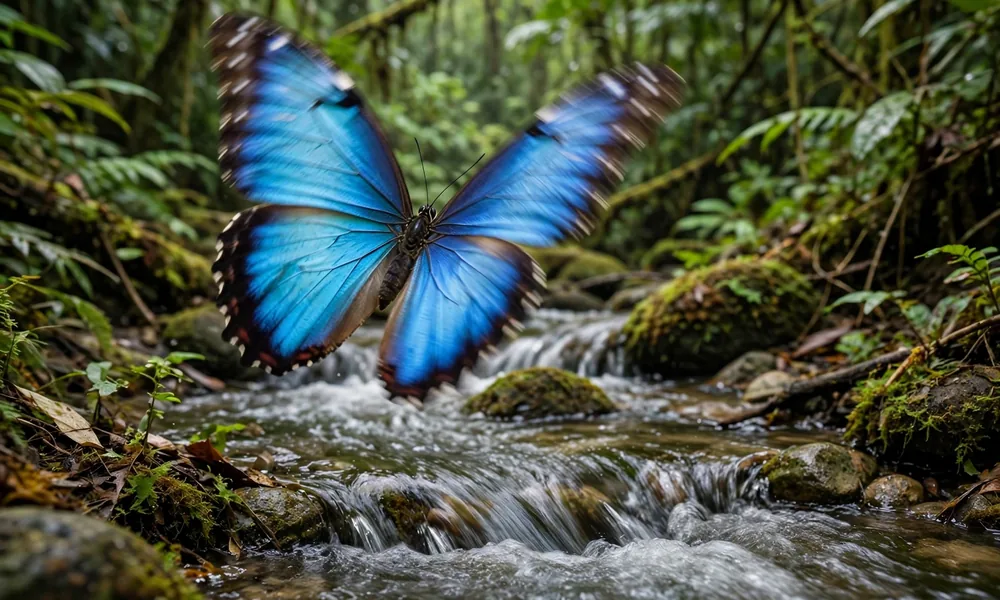
The flash-and-vanish trick is the centrepiece of morpho behaviour, and it works because the two sides of the wing do such different jobs. On the wing, the blue upper side catches the sun and shouts, and the moment the butterfly lands and folds its wings, the brown underside with its eyespots takes over and the insect becomes a leaf. The effect is so strong that the blue is said to be visible from fifty to eighty metres, and pilots have reported seeing the flash of colour as the butterflies warm themselves above the treetops.
Morphos are social in a loose, practical way, congregating in large groups around a good food source, and a single fallen fruit can draw several butterflies at once. They are not territorial in the way a bird is, and they do not defend a patch of forest, but males do patrol and do chase rivals, and the patrolling is tied to mating, since a male that holds a sunny stretch of stream is more likely to meet a female. Females fly less conspicuously, keeping to the undergrowth and the canopy, and they spend much of their time searching for the right legume leaf on which to lay an egg, a quieter and more careful business than the male’s showy patrol.

Breeding and life cycle
The life of a blue morpho begins with a single smooth, pale green egg, about one to two millimetres across, laid singly on the upper side of a young leaf of a legume host plant. The female lays her eggs one at a time, moving from leaf to leaf, and she chooses young leaves of Mucuna, Lonchocarpus, Erythrina and the other legumes, because the caterpillar that hatches will need soft, edible foliage. The egg hatches in seven to sixteen days, and the first thing the tiny caterpillar does is eat its own empty eggshell, a small meal that gives it a start before it turns to the leaf itself.
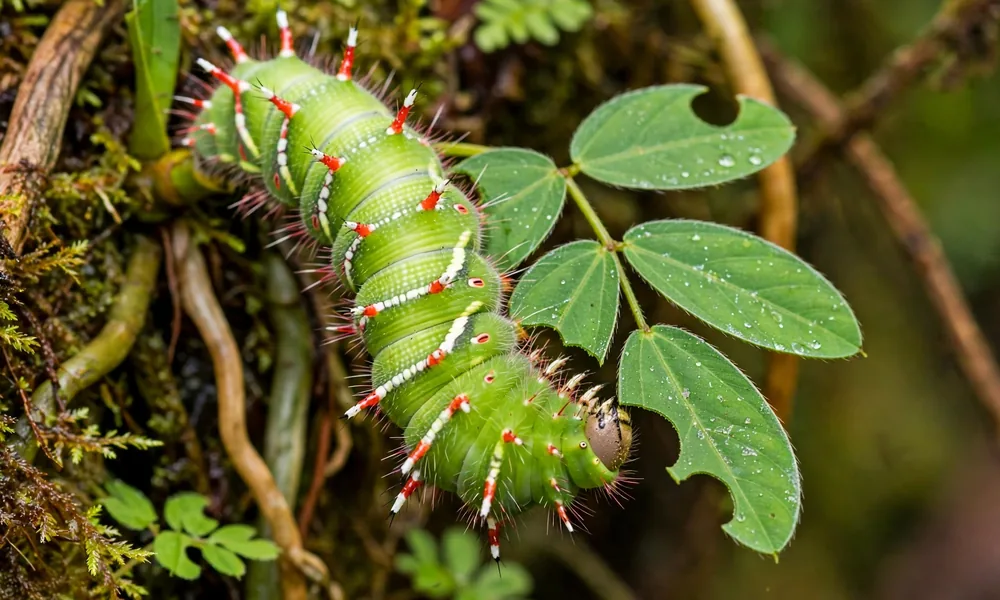
The caterpillar grows through five instars, or moults, and the larval stage lasts about ninety days. At hatching it is only about five millimetres long, and by the end it can reach up to 93 millimetres, a striking creature, bright green with red and white lateral markings, that feeds at night and rests motionless on a bare twig during the day. The hairs on its body can irritate skin, which is a useful defence, and the caterpillars feed only on older leaves. It is a long, slow childhood, and most of the morpho’s whole life is spent as a caterpillar rather than as a butterfly.
When the caterpillar is ready, it pupates, forming a pale green chrysalis that hangs from a twig like a small jewel, and the pupal stage lasts about two weeks. Then the adult climbs out, its wings soft and folded, and it must pump fluid into them and let them dry before it can fly, a vulnerable hour in which it is easy prey for anything that finds it. In Trinidad, the first butterfly followed through the whole cycle in detail took 74 days from egg to adult in warm weather, and other accounts put the egg-to-adult time at roughly nine to thirteen weeks. Mating follows soon after emergence, and pairs can stay joined for eight hours to three days, resting on plants while they are coupled.

Adult life is short, and the butterfly spends almost all of its time feeding and reproducing. In butterfly houses the adult stage lasts two to three weeks, and in the wild it is much the same, so the whole life span, from egg to the end of adult life, is less than 120 days, or under four months. Some accounts give an average total lifespan of 76 to 115 days, and in Trinidad one butterfly was followed through the whole cycle in 74 days.
Conservation status
The blue morpho butterfly has not been evaluated by the IUCN, and its Red List status is Not Evaluated, which means no formal assessment of its extinction risk exists. That is not the same as saying it is safe, and it is not the same as saying it is endangered. It is a widespread and common butterfly, one of the most abundant morphos, found in large numbers in mountain and lowland forests, often where forest is growing back, and it is the most widely bred butterfly in the world, with hundreds of butterfly houses on every continent maintaining captive colonies reared from eggs on legal farms in Costa Rica and Colombia.
The principal long-term threat is deforestation, and it is a threat that works quietly. Morphos require intact or semi-intact forest and do not persist in degraded or agricultural landscapes, because they need the legume trees for their caterpillars, the fallen fruit for the adults, and the damp, sunny forest edge for their daily life. Fragmentation is the other half of the problem: a forest cut into small pieces loses its fruiting trees and its legumes, and a butterfly that moves only two or three kilometres in its whole life cannot cross a cleared valley to reach the next patch. Collecting is a smaller pressure, and the butterfly is also taken as a trophy by collectors, but habitat loss dwarfs it, and the species is a reminder that a common animal can become rare very quickly if its forest goes.
There is a brighter side to the story, and it is the butterfly house. Because the blue morpho is so widely bred, with colonies maintained in hundreds of butterfly houses, the species has a safety net that many rainforest insects do not, and the farms that supply the eggs give local people in Costa Rica and Colombia a reason to keep the forest standing. The work that matters most, though, is keeping forest intact: protecting lowland rainforest, letting secondary forest grow back, and keeping the legume trees and the fruiting trees in the landscape.
Best seasons for blue morpho butterfly watching
Blue morphos are non-seasonal in the lowland tropics, with fresh adults emerging throughout the year, so there is no single month when they vanish altogether, and a visitor to a lowland rainforest has a chance of seeing one in any season. Emergence peaks after the dry season, when the rains bring fresh growth and fresh fruit, and the brightest and most numerous morphos of the year are often the ones that emerge in that peak. The dry season itself is still good watching, because the butterflies gather at the remaining fruit and sap flows, and in Costa Rica the dry season is when sap is used more than fruit, which concentrates the butterflies at the sap runs a watcher can learn to find.
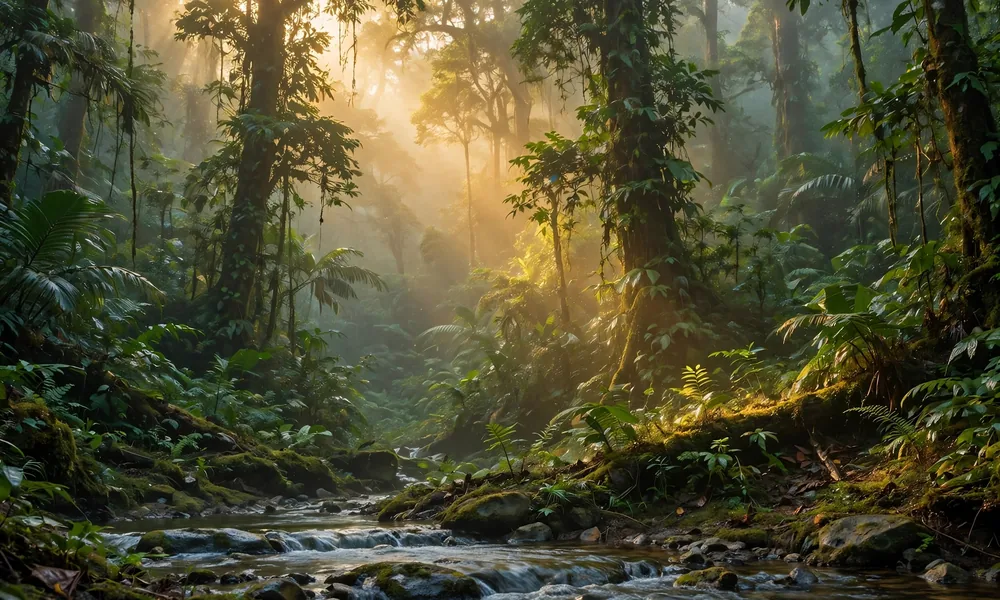
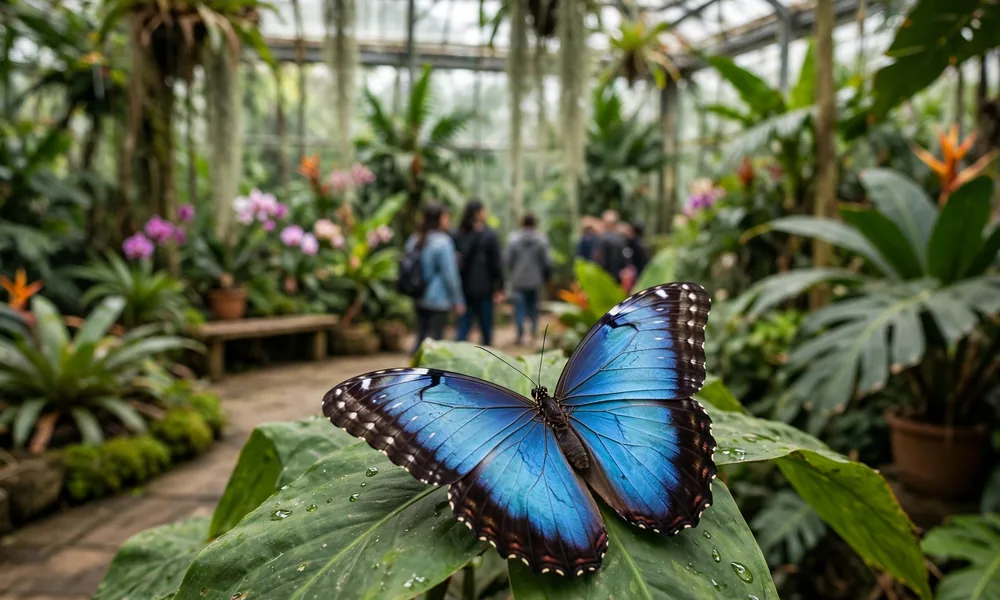
The time of day matters more than the month, and the best hours are between ten in the morning and three in the afternoon, when the sun is high and the forest is warm enough for flight. Early morning is for finding the places: walk the trail, look for fallen fruit, find a sap flow, check the damp mud at a riverbank, and then sit quietly and wait, because the morphos will come to the food. Butterfly houses are the exception to every seasonal rule, and they fly morphos all year round, so a morning in a butterfly house is the surest way to see one at close range.
Staying safe around blue morpho butterflies
Blue morphos are harmless, and they do not bite, sting or carry any toxin, so there is no danger in watching one, and no reason to be afraid of a butterfly that lands near you. The safety that matters is the butterfly’s, not yours. A morpho’s wings are covered in delicate scales, and a touch from a finger can strip the scales and damage the wing, so the rule is simple: look, photograph, and do not touch. If one lands on you, stay still and let it leave in its own time, and do not try to catch it, because a caught morpho is very likely a damaged morpho, and a damaged morpho may never fly properly again.
The forest itself needs a little respect too, and the usual rainforest rules apply. Wear sturdy shoes for a muddy trail, carry water, watch where you put your feet on a slippery riverbank, and keep an eye out for the animals that do demand caution, such as snakes and stinging insects, rather than worrying about the butterfly. Do not collect morphos, do not buy wild-caught specimens from a market, and do not take a caterpillar home, because the butterfly needs its forest and its host plant.
Blue morpho butterfly watching checklist
A little preparation turns a morning on a rainforest trail into a real chance of seeing a blue morpho at close range, and most of it fits in a small day pack.
- A morning walk on a lowland rainforest trail beside a stream, between ten in the morning and three in the afternoon, when the morphos are flying.
- A quiet spot near fallen fruit or a tree sap flow, where you can sit and wait for the butterflies to come to the food.
- Binoculars and a camera with a fast shutter, so you can follow the flash of blue without chasing the butterfly.
- A field guide to the butterflies of Central or South America, so you can tell a blue morpho from the Menelaus and Helenor morphos.
- Sturdy, waterproof walking shoes, because the best morpho trails run beside streams and the mud is slippery after rain.
- A notebook for the details, so you can record where you saw the butterfly, what it was feeding on and what time it was.
- Respect for the butterfly and the forest, keeping your hands off the wings, staying on the trail, and leaving the fruit and the leaves where they are.
Frequently asked questions
How big do blue morpho butterflies get?
Blue morpho butterflies have a wingspan of 13 to 20 centimetres, or 5 to 8 inches, with most individuals falling in the 13 to 15 centimetre range and large females reaching the top of the range. Females are slightly larger than males but less intensely coloured, and the wings are broad and rounded, with the forewings slightly pointed. The whole insect weighs only a gram or two, so a butterfly that looks big on the wing is in fact almost weightless.
What do blue morpho butterflies eat?
Adult blue morphos feed on the juice of fermenting and rotting fruit, on tree sap, on fungi, on wet mud and on animal droppings, and they do not visit flowers for nectar. Overripe mangoes, fallen figs and rotting bananas are favourites, and the butterfly sips the juice through its long proboscis, often gathering in small groups around a single fallen fruit. Caterpillars eat the leaves of legume trees, mostly Machaerium, Pterocarpus, Lonchocarpus, Dalbergia, Mucuna and Erythrina, and they feed at night.
Why are blue morpho butterflies blue?
Blue morphos are blue because of structural colour, not pigment. Their upper wings are covered in microscopic scales, each one ridged and layered so that it reflects blue light and cancels out the rest, and the blue shifts through cobalt, cyan and violet as the angle of the light changes. There is no blue pigment in the wing at all. When the butterfly closes its wings, the brown underside with its eyespots takes over, and the blue vanishes completely.
How long do blue morpho butterflies live?
The whole life cycle of a blue morpho, from egg to the end of adult life, lasts less than 120 days, or under four months, and most of that time is spent as an egg, a caterpillar and a pupa. The egg hatches in seven to sixteen days, the caterpillar grows through five instars over about ninety days, the chrysalis lasts about two weeks, and the adult stage lasts only two to three weeks. Some accounts give an average total lifespan of 76 to 115 days, and in Trinidad one butterfly was followed through the whole cycle in 74 days.
Can you keep a blue morpho butterfly as a pet?
You should not keep a wild blue morpho as a pet, and in practice you cannot, because the butterfly needs a warm rainforest, legume trees for its caterpillars, rotting fruit for the adults and room to fly, none of which a home can provide. The right way to see one up close is to visit a butterfly house, where morphos are flown all year round in a planted tropical greenhouse and reared from eggs on legal farms in Costa Rica and Colombia.
How is this guide different from the blue crab guide?
This guide covers the blue morpho butterfly, a large, day-flying, fruit-eating insect of the American rainforest with a wingspan of 13 to 20 centimetres and a life cycle of less than 120 days, while our blue crab guide covers a swimming crab of the Atlantic and Gulf coasts that lives in salt water, eats small fish and shellfish, and is caught for food. One is a butterfly you watch flashing blue along a forest trail in the morning; the other is a crab you meet in a tidal estuary, in water you wade into with a net.
This guide also goes further than our general butterfly guide, which covers butterflies as a whole, their shared anatomy and their common habits. Here you get the blue morpho in full: the structural colour of its wings, the eyespots on its brown underside, the rotting fruit diet, the five-instar caterpillar, the mud-puddling males, the subspecies from Mexico to Trinidad, and the forest loss that threatens it, all in one place, with the numbers, the host plants and the watching advice specific to Morpho peleides.
Conclusion
The blue morpho butterfly species is a reminder that the most beautiful thing in a rainforest can also be the most ordinary, a butterfly that eats rotting fruit, lives for a few short weeks as an adult, and spends most of its life as a green caterpillar on a legume leaf. Its blue is not a pigment but a trick of light, its disappearance is not magic but camouflage, and its whole life is tied to a forest that is still standing, with its legumes, its fruiting trees and its sunny trails intact.
If you go looking for one, go in the late morning, walk a lowland trail beside a stream, find a fallen mango or a damp patch of mud, and wait. The blue will come to you, flashing through the trees, and then it will land, fold its wings, and vanish into brown, and you will understand why the morpho has been the most famous butterfly of the Americas for two hundred years. Find the fruit, watch for the flash, and leave the wings untouched, and you will have met the butterfly that turns a quiet stretch of rainforest into a place of sudden, electric blue.