The bumblebee species is the big, fuzzy bee that hums low over a garden on a cool spring morning, a round, densely haired insect in the genus Bombus that most people recognise long before they know its name. If you are asking what a bumblebee is, the short answer is a social bee that lives in a small annual colony founded each spring by a single queen, flies in weather too cold and grey for most other bees, and pollinates flowers by shaking the pollen loose with a trick called buzz pollination. There are more than 250 species of bumblebee in the world, most of them in the northern hemisphere, and they range from the buff-tailed bumblebee of European gardens to the rusty patched bumblebee of North America.
What makes the bumblebee worth a whole guide is not only the fuzz or the buzz but the life it leads in a single summer. A queen wakes alone from a winter spent underground, builds a nest by herself in an old mouse burrow or a grass tussock, and raises the first workers with her own body heat before handing the work over to her daughters. By late summer the colony has grown to a few hundred bees, raised new queens and males, and then quietly died, leaving only the mated queens to carry the line. This guide follows that whole story: how bumblebees look, where they live, what they eat, how they behave, how they breed, and why so many of them are now in trouble.
Key takeaways
- The bumblebee species belongs to the genus Bombus, in the family Apidae, and there are more than 250 species worldwide, most of them native to the northern hemisphere.
- A bumblebee colony is annual and small, usually 50 to 400 bees at its peak, founded each spring by a single overwintered queen and dead by autumn, with only new queens surviving the winter.
- Bumblebees perform buzz pollination, vibrating their flight muscles to shake pollen from flowers such as tomatoes and blueberries, which honey bees cannot pollinate efficiently.
- A buff-tailed bumblebee queen is 20 to 22 millimetres long, workers are 11 to 17 millimetres, and a worker weighs as little as 68 milligrams and as much as 754 milligrams.
- The rusty patched bumblebee, Bombus affinis, is listed as Critically Endangered by the International Union for Conservation of Nature, having declined across 87 per cent of its historical range.
The bumblebee species and their relatives
Bumblebees belong to the family Apidae, the great family of long-tongued bees that also holds the honey bees, the carpenter bees and the stingless bees, and the family sits in the order Hymenoptera, alongside the ants, the wasps and the sawflies. The bumblebees are the tribe Bombini, a single tribe of robust, densely haired bees that live in the cooler parts of the world, and they are most at home in the temperate north, in meadows, moorlands, woodland edges and gardens from the Arctic fringe to the mountains of the tropics. There are more than 250 species of bumblebee known worldwide, native to the Americas, Europe, Asia and northern Africa, with the greatest diversity in the temperate north, where the cool summers suit them best.
The buff-tailed bumblebee, Bombus terrestris, is the lead species of this guide, and it is the bumblebee most people in Europe meet first, a large, loud, early bee that is out in the garden while the spring is still cold. Its queen is 20 to 22 millimetres long, its males are 14 to 16 millimetres, and its workers are 11 to 17 millimetres, and the workers vary so much in size that the smallest weighs about 68 milligrams and the largest about 754 milligrams, roughly eleven times as much. It is a short-tongued bee, and it is also the bumblebee most often reared commercially for greenhouse tomato pollination. Like the bee, the bumblebee is a social insect that gathers nectar and pollen for its young, but the ordinary honey bee lives in a perennial hive of tens of thousands that survives the winter together, while the bumblebee lives in a small colony of a few hundred that lasts a single summer and dies in the autumn.
| Type | Animal | Where it lives | Best-known food | Length or Weight |
|---|---|---|---|---|
| Family | Long-tongued bees (Apidae) | Worldwide | Nectar and pollen | About 9 mm to 25 mm long |
| Genus | Bumblebees (Bombus) | Northern hemisphere | Nectar and pollen | About 9 mm to 25 mm long |
| Species | Buff-tailed bumblebee (Bombus terrestris) | Europe and North Africa | Nectar and pollen | Queen 20 to 22 mm long |
| Species | Garden bumblebee (Bombus hortorum) | Europe and Asia | Nectar and pollen | About 17 mm to 22 mm long |
| Species | Common carder bee (Bombus pascuorum) | Europe and Asia | Nectar and pollen | About 9 mm to 20 mm long |
| Species | Rusty patched bumblebee (Bombus affinis) | Eastern North America | Nectar and pollen | About 10 mm to 21 mm long |
The closest relatives of the buff-tailed bumblebee are the other bumblebees of the genus Bombus, and the genus holds more than 250 species, from the garden bumblebee with its very long tongue to the common carder bee with its ginger thorax. The garden bumblebee, Bombus hortorum, is a bee of Europe and Asia, about 17 to 22 millimetres long, with a tongue so long it can reach the nectar at the bottom of deep flowers such as foxglove and honeysuckle. The common carder bee, Bombus pascuorum, is a smaller, ginger-coloured bee of Europe and Asia, about 9 to 20 millimetres long, that nests above ground in grass tussocks and old birds nests. The rusty patched bumblebee, Bombus affinis, is a bee of eastern North America, about 10 to 21 millimetres long, named for the rust-coloured patch on the second segment of its abdomen, and it is the species that shows how quickly a common bee can become rare.
What bumblebees look like
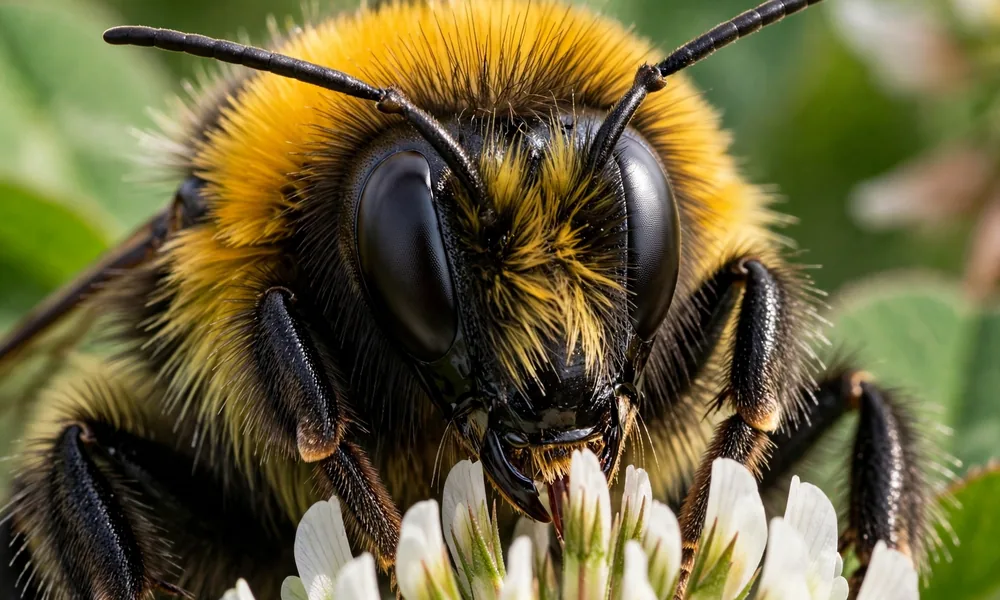
A bumblebee looks like a small, round, flying cushion, and the first thing anyone notices is the fuzz. The body is thick and plump, covered all over in dense, branched hairs that trap pollen and hold warmth, and the colours are bold bands of black, yellow, orange, white or ginger, arranged differently from species to species, so that a buff-tailed bumblebee wears two yellow bands and a buff tail while a common carder bee is ginger all over. The head carries large dark eyes, short elbowed antennae and a tongue that folds away beneath it, and the thorax is a solid block of flight muscle wrapped in fur, with two pairs of thin, translucent wings that hook together in flight.
The size of a bumblebee depends on the caste and the species, and the difference is easy to see once you know to look for it. A buff-tailed queen is 20 to 22 millimetres long, a male is 14 to 16 millimetres, and a worker is 11 to 17 millimetres, and the workers of a single colony vary so widely that the smallest weighs about 68 milligrams and the largest about 754 milligrams. The queen is not only longer but broader and heavier, built to survive the winter alone and to found a colony by herself, while the workers are smaller and lighter, built to fly out and forage. The males look much like the workers, though they have no sting and no pollen baskets, and they are often a little yellower and hairier, with longer antennae that they use to follow the scent of a queen.

The fuzz is not decoration. It is insulation, and it is what lets a bumblebee fly in weather that keeps other bees at home. A bumblebee warms its flight muscles by shivering, vibrating the muscles without moving its wings, until the thorax reaches about 30 degrees Celsius, and the fur holds that heat in while the bee is out in the cold air. The hairs are also branched, like tiny feathers, and pollen clings to them as the bee pushes into a flower, so a foraging bumblebee is dusted in pollen as it works. Like the butterfly, the bumblebee is a daytime flower visitor that moves pollen between blooms, but the butterfly is a delicate insect that drinks nectar through a long, coiled tongue and carries pollen almost by accident, while the bumblebee is a heavy, deliberate gatherer that packs pollen into baskets and carries it home to feed its young.
Where bumblebees live
Bumblebees live wherever flowers grow in cool country, and they are found across the northern hemisphere in a range that runs from the Arctic fringe of Alaska and Scandinavia to the mountains of Mexico and the highlands of East Africa. Their heartland is the temperate north, the meadows, moorlands, woodland edges, hedgerows and gardens of Europe, northern Asia and North America, and they are most diverse where the summers are cool. A few species reach the tropics, but only in the mountains, where the air stays cool, and no bumblebee is native to Australia or to sub-Saharan Africa south of the highlands, though the buff-tailed bumblebee has been introduced to New Zealand, Tasmania and parts of South America for crop pollination.
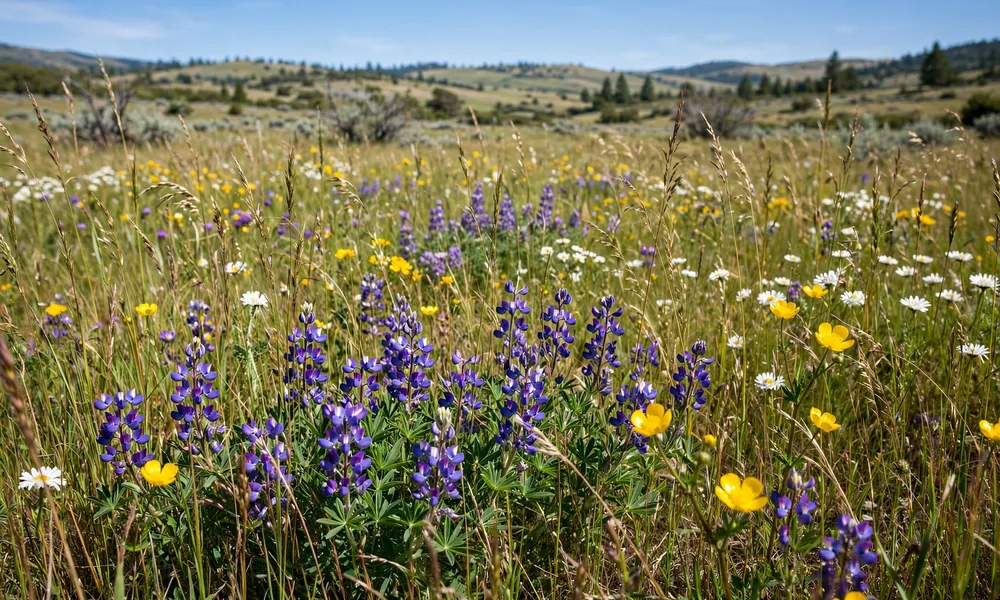
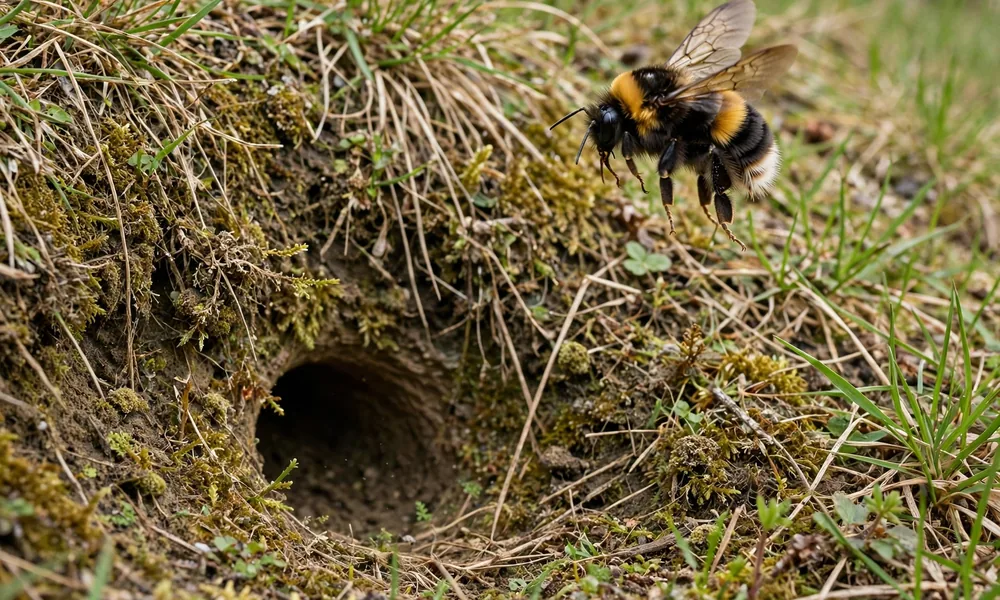
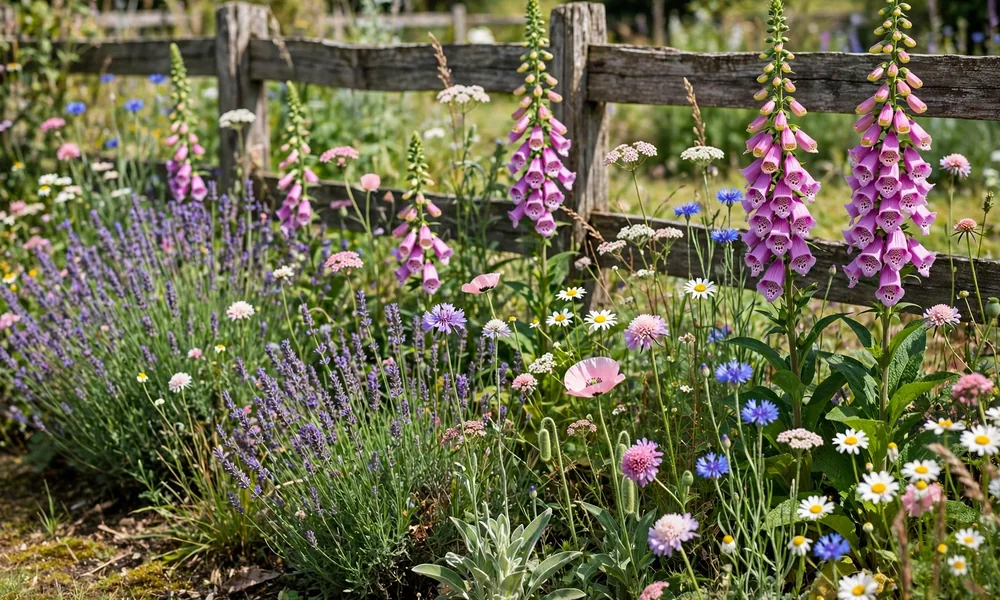
The habitat a bumblebee needs is not one place but three, close together: flowers to feed on, a nest site to raise the young, and a quiet place for the queen to spend the winter. The flowers matter most, because a colony needs nectar and pollen from early spring to late autumn, and no single flower lasts that long, so a good bumblebee patch is one where something is always in bloom, from willow and crocus in spring through clover and foxglove in summer to knapweed and ivy in autumn. The nest itself is usually underground, in an abandoned mouse or vole burrow, a hole under a shed, a compost heap or a thick grass tussock. The wintering place is different again, a shallow burrow a few centimetres into loose soil, often on a north-facing bank where the ground stays cool and the queen will not wake too early.
What bumblebees eat
Bumblebees eat nectar and pollen, and nothing else, and the two foods do different jobs. Nectar is sugar water, the fuel that powers the flight muscles and keeps the colony warm, and the bee drinks it from the flower and carries it home in its crop, a stretchy pouch in the gut, to share with the nest. Pollen is protein, the building material of new bees, and the bee gathers it on its hairy body, grooms it into the pollen baskets on its hind legs, and carries it home in bright orange or yellow lumps to feed the larvae. A foraging bumblebee visits hundreds of flowers in a single trip, and a colony in full growth can bring home a surprising weight of pollen in a day.
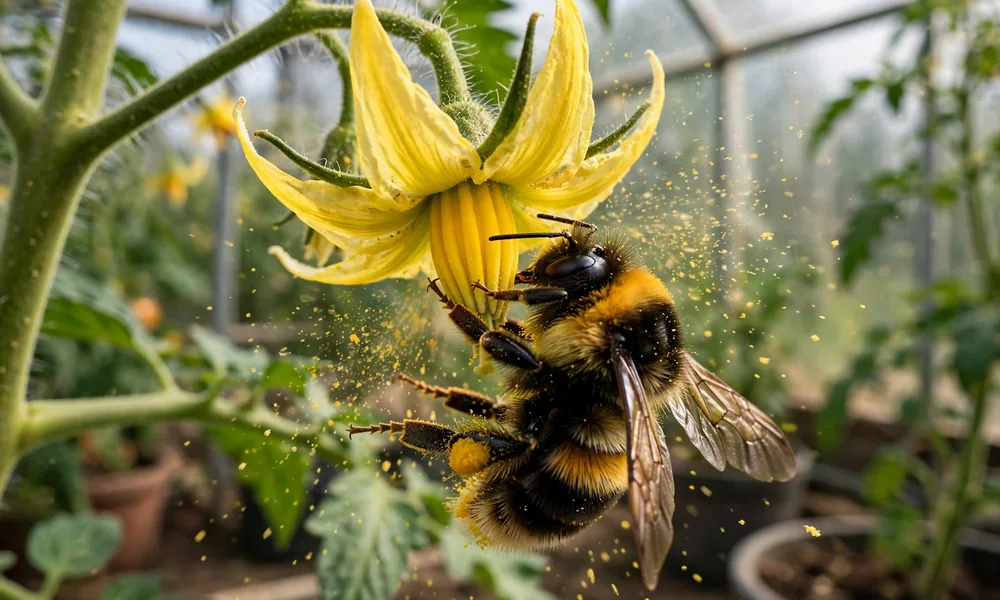
The most famous part of the bumblebee diet is buzz pollination, and it is the reason greenhouse growers prize bumblebees above every other bee. Some flowers, including tomatoes, aubergines, potatoes and blueberries, hold their pollen inside tube-shaped anthers that only release it when they are shaken at the right frequency, and a honey bee cannot do it at all. A bumblebee bites the flower, uncouples its wings from its flight muscles, and vibrates the muscles so hard that the whole flower hums, and the pollen shakes out onto the bee’s body in a small cloud. One buff-tailed bumblebee colony in a greenhouse can do the work of hours of hand pollination, and the tomatoes it pollinates set more and better-shaped fruit.
What a bumblebee eats depends on the length of its tongue, and the species divide the flowers between them by reach. The buff-tailed bumblebee is short-tongued, and it works open flowers such as clover, daisies, lavender and bramble, where the nectar sits near the surface. The garden bumblebee is long-tongued, and it works deep flowers such as foxglove, honeysuckle, red clover and monkshood, where the nectar sits at the bottom of a long tube. The larvae eat only what the adults bring them, a paste of pollen mixed with nectar, and a larva that is fed three times as much pollen as its sisters grows into a queen instead of a worker.
How bumblebees behave
Bumblebees are day bees, and their day starts earlier and ends later than most other bees. A worker leaves the nest as soon as her flight muscles are warm, and on a cold morning she will sit in the nest entrance and shiver for several minutes, vibrating her flight muscles until her thorax reaches about 30 degrees Celsius, before she lifts off into air that may be only 10 or 12 degrees. She can forage in cloud, in drizzle and in a cold wind that keeps honey bees in the hive, and she will work from dawn to dusk through the summer, visiting flower after flower in a steady circuit and returning to the nest with her pollen baskets full. She navigates by the sun and by landmarks, and she learns the flowers of her patch.
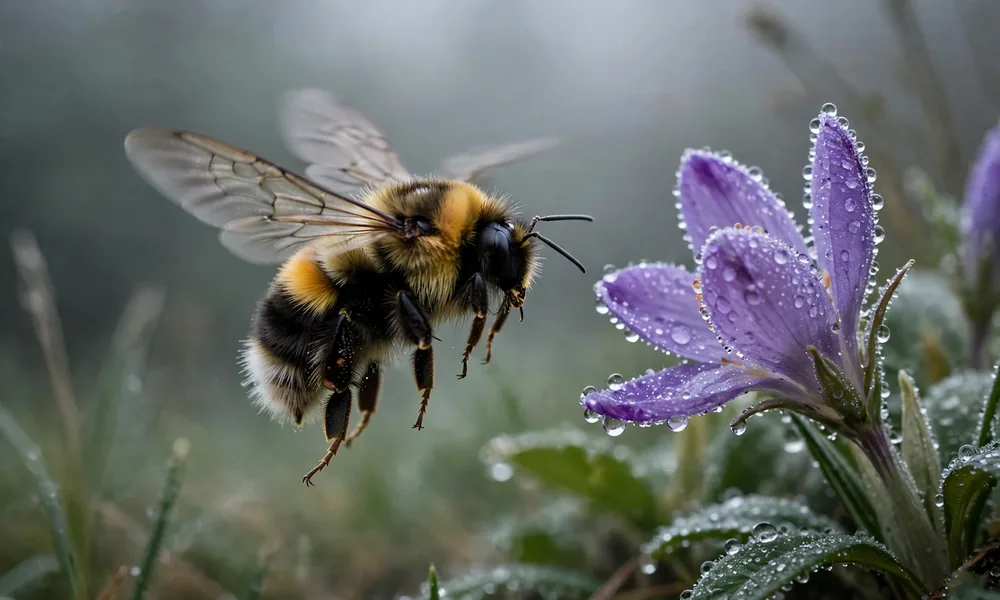
The colony is a family, but it is a small and loosely ruled one, and the queen does not command it the way a honey bee queen does. In spring the queen does everything herself, building the nest, laying the eggs, and keeping the first brood warm by sitting on them and shivering, and when the first workers hatch they take over the foraging and the feeding, and the queen stays at home to lay eggs. The workers are all daughters of the queen, and they are all female, and they divide the work by age and size, with the larger workers flying out to forage and the smaller ones staying in the nest to tend the young. The colony has no dance language like the honey bee, so each worker finds her own flowers and learns her own patch.

Bumblebees are gentle bees, and they sting only when they must. Only the females can sting, and the sting is smooth, so a bumblebee can sting more than once, unlike a honey bee worker, whose barbed sting stays in the skin and kills the bee. In practice a bumblebee almost never stings a person who leaves it alone, and a bee on a flower will simply move away if it is disturbed, while a bee at the nest entrance will buzz loudly and bump into an intruder before it stings. The males cannot sting at all, and a male bumblebee that flies up to your face in late summer is not threatening you but patrolling a circuit, leaving scent marks on twigs and leaves and waiting for a queen to pass.
Breeding and life cycle
A bumblebee colony lives for a single season, and the whole year turns on the queen. She is a mated queen from last year who spent the winter alone in a shallow burrow in the soil, and she wakes in early spring, often in March or April in Britain, when the first willow catkins and crocuses open. She feeds for a few days to rebuild her strength, then flies low over the ground looking for a nest, and when she finds an abandoned mouse burrow or a thick grass tussock she moves in. She makes a small wax pot, fills it with nectar, lays her first eggs, 8 to 12 of them, on a lump of pollen, and sits on them, shivering to keep them warm, until they hatch.
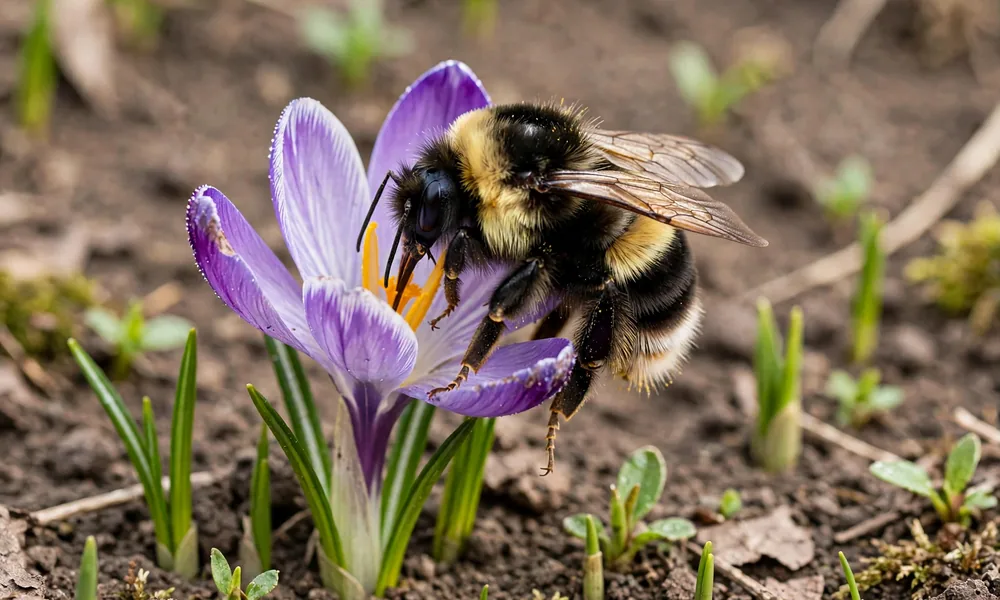
The first workers take about three to four weeks to grow from egg to adult, and they are small, because the queen could only feed them so much on her own. Once they hatch they take over the foraging and the feeding, and the queen stays in the nest and lays eggs, and the colony begins to grow. Each worker lives only about four to six weeks, so new workers must keep hatching all summer to replace the ones that wear out, and by midsummer a colony of buff-tailed bumblebees has grown to 50 to 400 bees, with a nest of wax pots, pollen stores and brood cells tucked into the dark. The nest is kept warm by the shivering of the bees inside it, at about 25 to 32 degrees Celsius, even when the air outside is cold.
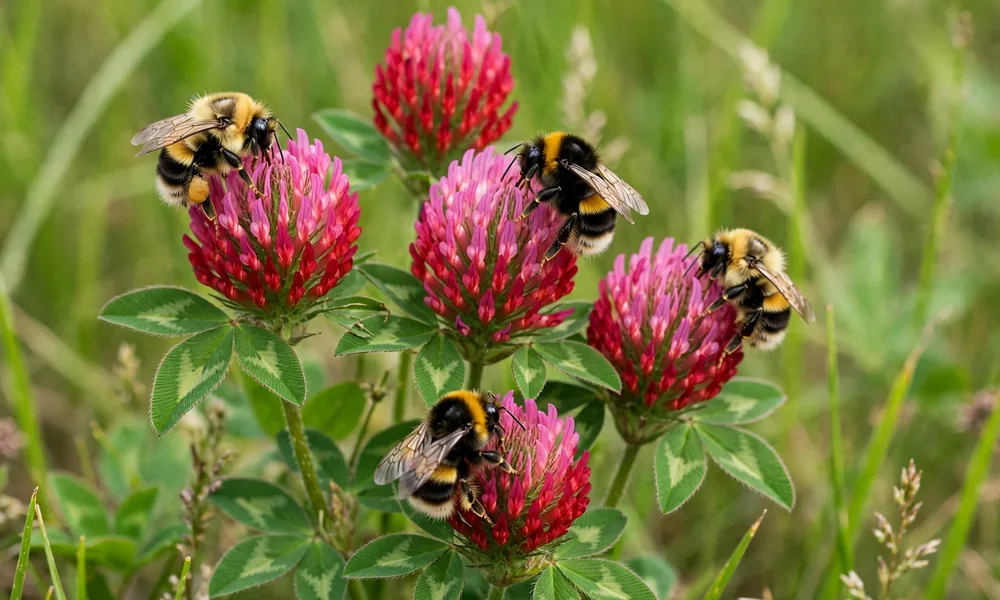
In late summer the colony changes its work, and the queen begins to lay eggs that will become males and new queens instead of workers. The new queens are fed up to three times as much pollen as larvae, so they grow big and fat, and when they hatch they leave the nest, mate with males from other colonies, and feed hard on late flowers such as ivy to build the fat reserves they will need for the winter. Then the old colony dies: the old queen, the workers and the males all perish in the autumn, and the nest falls silent. Each mated queen digs a few centimetres into loose soil and stays dormant for six to nine months, protected by substances in her body that work like antifreeze, and in spring she wakes and the whole cycle begins again, alone.
Conservation status
The conservation status of the bumblebee is not one story but many, because there are more than 250 species and their fortunes differ widely. Some, such as the buff-tailed bumblebee and the common carder bee, are common and widespread, and they are doing well in gardens and farmland. Others are in steep decline, and a few are on the edge of disappearing altogether. The rusty patched bumblebee is the starkest case: once one of the commonest bumblebees of eastern North America, it has declined across 87 per cent of its historical range, and the International Union for Conservation of Nature lists it as Critically Endangered, while the United States listed it as Endangered in 2017, the first bee of any kind native to the continental United States to receive that protection.
The pressures on bumblebees are the same ones pressing on pollinators everywhere, and they act together rather than one at a time. Habitat loss is the first, because a meadow ploughed up or a hedgerow grubbed out takes away the flowers a colony needs for months, and a landscape of single crops offers a feast for a few weeks and a famine for the rest of the year. Pesticides are the second, and the neonicotinoid insecticides that coat the seeds of many crops have been shown to reach the nectar and pollen the bees eat, and to leave colonies smaller and less able to raise queens. Disease is the third, and pathogens carried by commercially reared bumblebees have spilled over into wild colonies, while the warming climate is the fourth, pushing cold-loving species further north and uphill, where they may run out of ground.
The good news is that bumblebees respond quickly when the flowers come back. Farmers who leave field margins unsprayed and sow wildflower strips see numbers rise within a year or two, and gardens planted with the right flowers, left a little wild at the edges, can support a colony through a whole season. Leaving a nest alone when it is found in a garden costs nothing and saves a colony, and the rusty patched bumblebee now has a recovery plan in the United States, though the honest position is that many bumblebee species are still declining.
Best seasons for bumblebee watching
The best time to look for bumblebees is the whole warm half of the year, because there is always a bumblebee out somewhere between the first spring flowers and the last autumn ivy. The queens are the first to appear, in March and April in Britain, big and slow on the willow catkins and the crocuses, and they are the easiest to watch, flying low and stopping often to feed. The workers follow from May onwards, and by July and August the colonies are at their largest and the meadows are at their busiest, with a dozen bees on a single clump of knapweed. The males and the new queens appear in late summer, and the last bees of the year are usually out on the ivy in October, feeding hard before the winter.
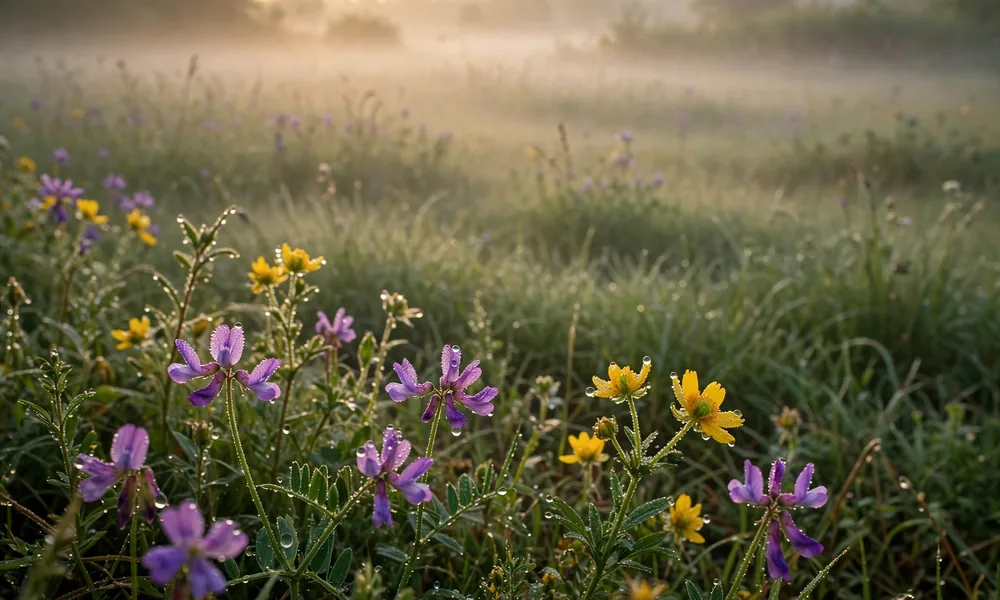
The best hours are the morning and the late afternoon, when the light is soft and the bees are working steadily, and the best weather is a warm, still day with a little cloud. Bumblebees will fly in weather that keeps other bees at home, so a cool, grey morning can be a good time to watch them, and a bee warming up on a flower in the early sun is a sight that rewards patience. The most famous bumblebee of all is the buff-tailed bumblebee, and National Geographic keeps a live profile of the bumblebee, so a morning in a wildflower meadow in July, field guide in your pocket, is the best way to meet one in the wild.
Staying safe around bumblebees
A bumblebee is not dangerous to people who leave it alone, and there is no safety warning that belongs to the bee itself beyond the obvious one: do not disturb a nest, and do not swat a bee. A bumblebee can sting, and the sting is painful, and anyone allergic to bee stings should carry medication and seek help at once if stung, but a bumblebee on a flower will not sting a person who walks past it, and a bee that blunders into a house is best shown the open window rather than chased with a rolled-up newspaper. If you find a nest in your garden, leave it alone and give it space, and it will be gone by autumn, when the colony dies and only the new queens move on.
Bumblebee watching checklist
A little preparation turns a morning in a meadow into a real chance of seeing bumblebees at their best, busy on the flowers in the warm air.
- A wildflower meadow or a bee-friendly garden in July or August, when the colonies are at their largest and the flowers are at their busiest.
- A morning walk in warm, still weather, when the bees are working steadily and the light is soft enough to see their colours clearly.
- A field guide to the bumblebees of your country, so you can tell a buff-tailed bumblebee from a common carder bee.
- Binoculars and a camera with a close-up setting, so you can watch the bees without crowding them or blocking their flight path.
- A patch of clover, lavender or knapweed to sit beside, because the bees come to the flowers and you only have to wait.
- A notebook for the species you see, the flowers they visit, and the time of day, so you can compare one summer with the next.
- Respect for the bees and the meadow, keeping your distance from any nest, keeping your hands off the bees, and leaving the flowers standing.
Frequently asked questions
How big do bumblebees get?
Bumblebees are the big bees of the garden, and a buff-tailed bumblebee queen is 20 to 22 millimetres long, a male is 14 to 16 millimetres, and a worker is 11 to 17 millimetres. The workers vary so much that the smallest weighs about 68 milligrams and the largest about 754 milligrams, roughly eleven times as much, and a queen is broader and heavier than any of them. Most bumblebee species fall in the same range, about 9 to 25 millimetres long, and a round, plump body and thick fur set a bumblebee apart from a honey bee.
What do bumblebees eat?
A bumblebee eats nectar and pollen, and nothing else. Nectar is the sugar water that fuels its flight and warms its nest, and pollen is the protein that feeds the larvae and builds new bees. The bee drinks nectar from flowers and carries it home in its crop, and it gathers pollen on its hairy body and packs it into the baskets on its hind legs. Some flowers, including tomatoes and blueberries, only give up their pollen when the bee vibrates them, a trick called buzz pollination that honey bees cannot do at all.
Do bumblebees sting?
Yes, but only the females can sting, and they almost never do unless the nest is threatened. The sting is smooth, so a bumblebee can sting more than once, unlike a honey bee worker, whose barbed sting stays in the skin and kills the bee. In practice a bumblebee on a flower will simply move away if disturbed, and a bee at the nest entrance will buzz loudly before it stings. The males cannot sting at all, and a male that flies up to your face in late summer is patrolling for a queen, not threatening you.
Where do bumblebees live?
Bumblebees live across the northern hemisphere, in meadows, moorlands, woodland edges, hedgerows and gardens, from the Arctic fringe to the mountains of the tropics. They need three things close together: flowers to feed on from spring to autumn, a nest site such as an abandoned mouse burrow or a grass tussock, and a quiet place for the queen to spend the winter underground. A garden with lavender, foxglove and clover can support a colony through a whole season.
Can you keep bumblebees as pets?
You cannot keep bumblebees as pets in the way you keep honey bees, and you should not try. A bumblebee colony lasts a single summer and then dies, leaving only new queens to overwinter, and it needs a whole landscape of flowers to feed on, not a single hive. What you can do is give them a home: plant bee-friendly flowers, leave a patch of long grass for nesting, and put up a bumblebee nest box in a quiet corner of the garden. If a colony moves into your garden, leave it alone and enjoy it, because it will be gone by autumn.
How is this guide different from the bullet ant guide?
This guide covers the bumblebee, a gentle, fuzzy pollinator of the genus Bombus that lives in a small annual colony of 50 to 400 bees, flies in cold weather, and shakes pollen from flowers by buzz pollination, while our bullet ant guide covers a single species of large, solitary-foraging tropical ant famous for one of the most painful stings in the insect world, a sting that is used for defence and hunting on the rainforest floor. One is a social bee you meet on a flower in a sunny meadow; the other is a ground-hunting ant you meet with great care on a forest path in Central and South America.
This guide also goes further than our general bee guide, which covers bees as a whole, from honey bees to solitary bees to bumblebees, in a single broad sweep. That guide is the place to start if you want to know what a bee is, while this guide stays with one group for its whole length, following the bumblebee from its buff-tailed lead species and its buzz pollination through its meadow habitat, its nectar and pollen diet, its one-summer colony and its decline to the seasons and the checklist that will help you see one for yourself.
Conclusion
The bumblebee species is a reminder that a small animal can carry a whole landscape on its back. A round, fuzzy bee, a colony that lives for a single summer, a trick of shaking pollen from a tomato flower, and a queen that wakes alone in spring and builds a family from nothing have made the bumblebee the most loved pollinator of the northern hemisphere, at home in meadows and gardens from the Arctic fringe to the mountains of the tropics.
If you go looking for one, go to a wildflower meadow in July, go in the morning, and sit beside a patch of clover or lavender and wait. Watch for a big, slow bee with a low hum, dusted in pollen and carrying orange lumps on its hind legs, and you will have met the bumblebee that turns a quiet stretch of meadow into a place of steady, humming work.