The bullet ant species is the rainforest ant with the most painful sting on Earth, a large reddish-black hunter of Central and South American forests that carries the top score on the Schmidt sting pain index. If you are asking what a bullet ant is, the short answer is a big predatory ant, Paraponera clavata, about 18 to 30 millimetres long, that lives in small colonies at the base of rainforest trees, forages alone in the canopy for nectar and small animals, and defends its nest with a sting that feels like being shot and can hurt for a full day. It is not aggressive, and it will not chase you, yet no other insect sting is rated as painful as this one.
What makes the bullet ant so famous is not only the sting but the size of the animal behind it. Most ants are small enough to ignore, but a bullet ant is as long as a thumbnail, as stout as a small wasp, and it walks the rainforest floor and the tree trunks in broad daylight, with a stinger you can see and mandibles built for grabbing prey. This guide follows the whole ant: how it looks, where it lives, what it eats, how it behaves, how its colonies breed, and how to walk safely through a forest where it lives.
Key takeaways
- The bullet ant species is Paraponera clavata, the only living species in its genus and subfamily, found in humid lowland rainforests from Honduras and El Salvador south to Brazil, Bolivia and Peru.
- Workers are about 18 to 30 millimetres long, roughly 0.7 to 1.2 inches, and weigh about 80 to 120 milligrams, making them among the largest ants in the world.
- The sting is rated 4.0 plus, the highest score on the Schmidt sting pain index, and the pain comes in waves and can last 12 to 24 hours.
- Colonies are small for ants, usually several hundred workers and sometimes up to a few thousand, nesting in the soil at the base of trees and foraging alone in the canopy.
- Bullet ants eat nectar, tree sap and small animals, and they are not aggressive, stinging only to defend the nest or to subdue prey, and warning intruders first with a stridulating sound and a foul smell.
The bullet ant species and their relatives
Bullet ants belong to the family Formicidae, the great family of ants that occurs on every continent except Antarctica, and the family sits in the order Hymenoptera, alongside the bees and the wasps. Ants are social insects, and the family holds more than 12,000 described species, from tiny garden ants a few millimetres long to giant hunting ants several centimetres long, all of them living in colonies built around a queen. Within the family, the bullet ant sits in the subfamily Paraponerinae, a small and ancient group, and it is the only living species in both its genus, Paraponera, and its subfamily, which makes it a lone survivor of a line that split away from the other ants long ago.
The bullet ant, Paraponera clavata, is the lead species of this guide, and it is the ant that defines its whole group, largely because it is so much larger and so much more painful than any other ant most people will ever meet. It lives in humid lowland rainforests from Honduras and El Salvador in the north to Venezuela, Colombia, Ecuador, Peru, Bolivia and Brazil in the south, from sea level to about 750 metres, with a few colonies found as high as 1,500 metres, and it grows to about 18 to 30 millimetres long, with the queen only slightly larger than the workers. Like the ant, the bullet ant is a social insect that lives in a colony built around a single queen, but the ordinary garden ant is a small creature of lawns and pavements that works in long trails, while the bullet ant is a large forest hunter that forages alone in the canopy and carries a sting no garden ant could match.

| Type | Animal | Where it lives | Best-known food | Length or Weight |
|---|---|---|---|---|
| Family | Ants (Formicidae) | Worldwide except Antarctica | Nectar, insects and seeds | About 2 mm to 30 mm long |
| Genus | Bullet ants (Paraponera) | Central and South America | Nectar and small animals | About 18 mm to 30 mm long |
| Species | Bullet ant (Paraponera clavata) | Honduras to Brazil and Peru | Nectar and small animals | About 18 mm to 30 mm long |
| Species | Giant Amazonian ant (Dinoponera gigantea) | Amazon rainforest | Insects and other small animals | About 20 mm to 30 mm long |
| Species | Bull ant (Myrmecia gulosa) | Australia | Insects and nectar | About 15 mm to 25 mm long |
| Species | Jumping jack ant (Myrmecia pilosula) | Australia | Insects and nectar | About 12 mm to 15 mm long |
The closest relatives of the bullet ant are the other large predatory ants, a loose group of hunters that share its size, its strong mandibles and its habit of foraging alone rather than in trails. The giant Amazonian ant, Dinoponera gigantea, is an ant of the Amazon rainforest that grows to about 20 to 30 millimetres long, much the same size as the bullet ant, and it hunts alone on the forest floor, though it has no queen and no sting to match the bullet ant’s. The bull ant, Myrmecia gulosa, is an ant of Australia that grows to about 15 to 25 millimetres long, with large eyes, strong mandibles and a painful sting of its own, and it is famous for jumping at intruders. The jumping jack ant, Myrmecia pilosula, is a smaller Australian cousin at about 12 to 15 millimetres long, and it is the ant whose sting causes more allergic reactions in Australia than any other insect.
What bullet ants look like
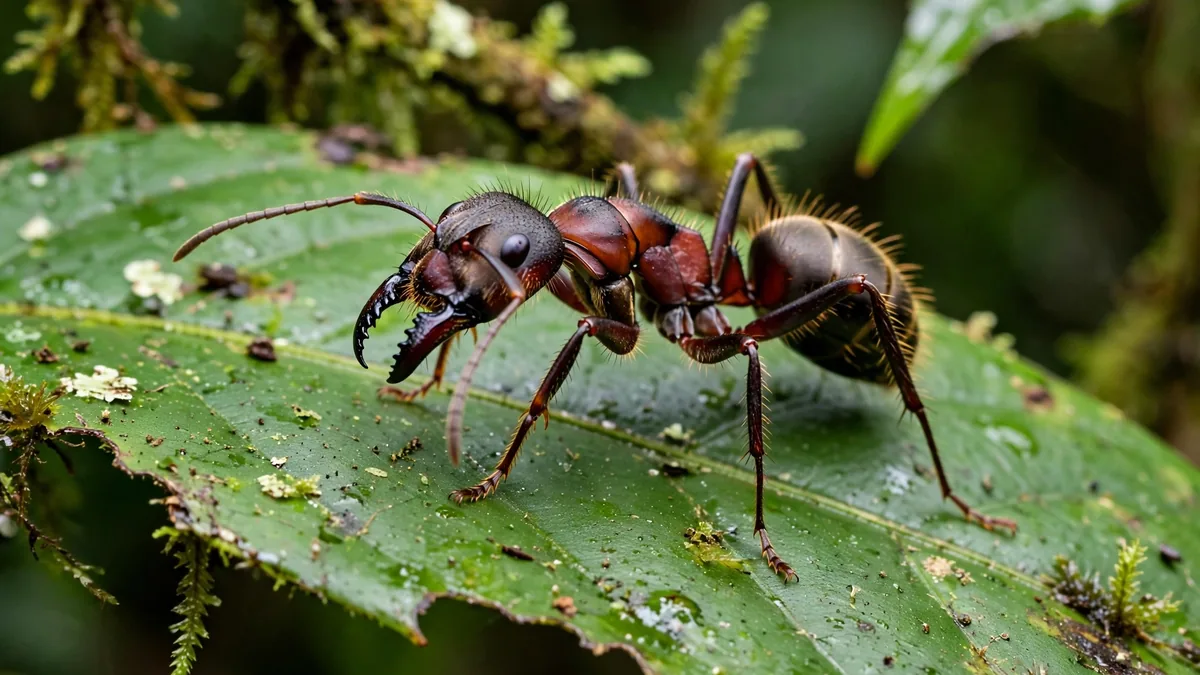
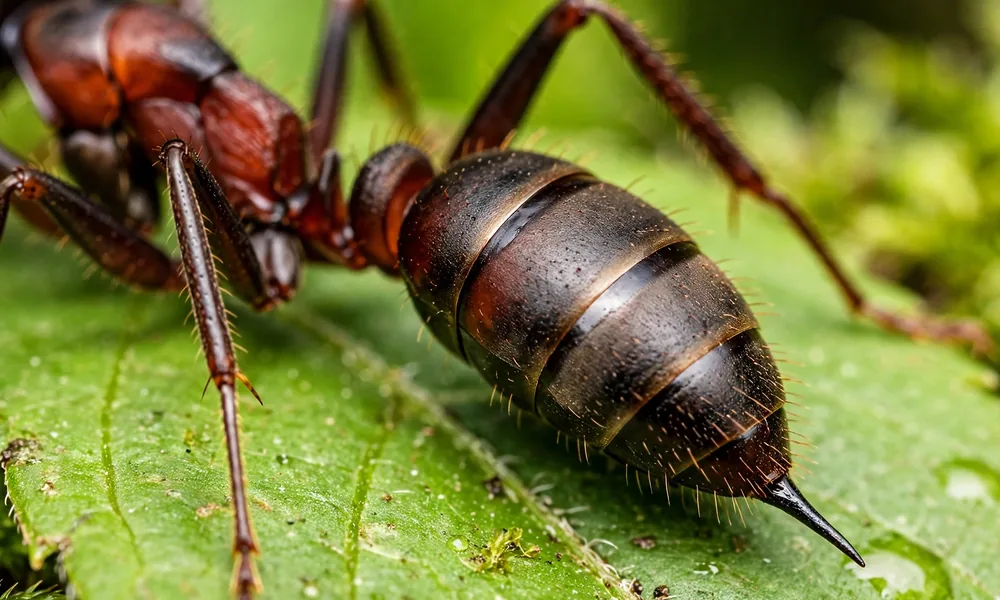
A bullet ant looks like a wasp that has lost its wings and decided to walk instead. The body is stout and heavily armoured, reddish-black in colour, with a head that is large for the size of the ant and mandibles that are long, curved and strong enough to grip a struggling insect. The name Paraponera clavata comes from the shape of that head, since clavata means club-shaped, and the ant’s body is covered in fine hairs that give it a slightly fuzzy look up close. The waist is narrow and pinched, the legs are long and strong, and the abdomen ends in a long dark stinger, up to 3.5 millimetres long, that is easy to see when the ant raises its rear end in warning.
The size of a bullet ant is what stops people in their tracks, because most ants are small enough to step over without noticing. Workers are about 18 to 30 millimetres long, roughly 0.7 to 1.2 inches, which makes them as long as a thumbnail and among the largest ants in the world, and they weigh about 80 to 120 milligrams, which is heavy for an ant. The queen is only slightly larger than the workers, and she has wings until she mates, after which she sheds them and starts a new colony. The workers do not vary much in size, and there is no soldier caste with oversized heads, so a bullet ant colony is a colony of near equals, each worker able to hunt, to carry and to sting.

The sting is the feature that matters most, and it is worth understanding before anything else. A bullet ant does not bite to hurt you, though its mandibles can give a sharp nip, and it does not spray acid the way many ants do. It stings, driving its long stinger into the skin and injecting venom that contains poneratoxin, a small peptide that jams the sodium channels nerves use to reset between signals, so the nerve keeps firing and the pain keeps coming in waves. The American entomologist Justin Schmidt, who tested stings on himself to build his pain index, rated the bullet ant at 4.0 plus, the top of his scale, and described the pain as pure, intense, brilliant pain, like walking over flaming charcoal with a three-inch nail in the heel. The pain can last 12 to 24 hours, and it is often joined by shaking, sweating and a temporary paralysis of the stung limb.
Young bullet ants look nothing like the adults, and the colony keeps them hidden away underground. The eggs are small and white, the larvae are pale grubs with no legs, and the pupae lie in silk cocoons while they change into adult ants, all of them tended by the workers in the dark chambers of the nest. A worker that has just emerged from its cocoon is paler and softer than an older worker, and it stays inside the nest for its first days before it joins the foragers outside.
Where bullet ants live
Bullet ants live in the humid lowland rainforests of Central and South America, and they are found nowhere else on Earth in the wild. Their range runs from Honduras and El Salvador in the north, through Nicaragua, Costa Rica and Panama, and on through Venezuela, Colombia, Ecuador, Peru and Bolivia to Brazil in the south, covering much of the Amazon basin and the forests of the Central American isthmus. They live mostly in lowland forest, from sea level to about 750 metres, though a few colonies have been found as high as 1,500 metres in the mountains of Costa Rica and Panama. They need warm, wet forest, and they are not found in dry country, in open grassland, or in cities.
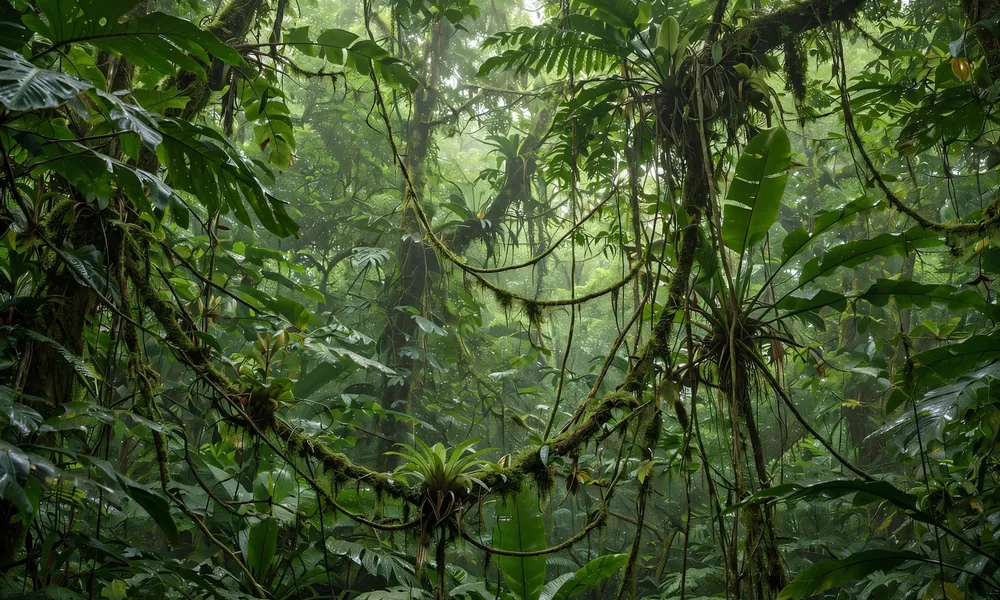
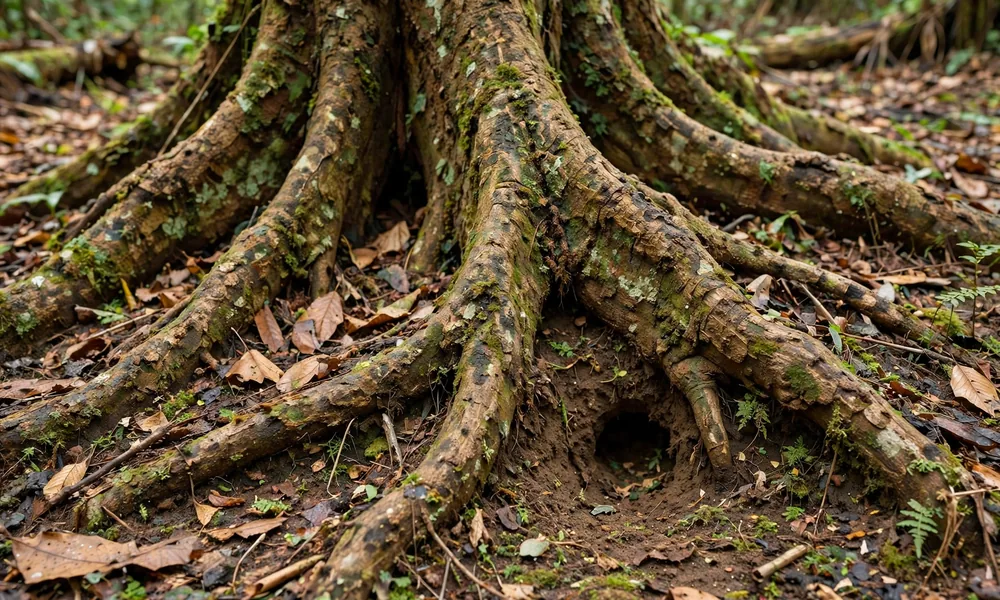
The nest is built in the soil at the base of a large tree, or at the base of a liana that climbs into the canopy, and the choice of tree seems to matter less than the position. On Barro Colorado Island in Panama, researchers found bullet ant nests under 70 species of trees, six species of shrubs, two species of lianas and one species of palm, which suggests the ants take whatever big tree is available rather than choosing a favourite. The nest itself is a cluster of chambers dug into the soil, with a single entrance hole at the base of the tree, and the colony uses the tree as a highway, climbing the trunk to reach the canopy where most of its food is found. About four nests have been counted per hectare of forest in studies in Costa Rica and Panama, which means a walker in good bullet ant forest is never far from a colony.
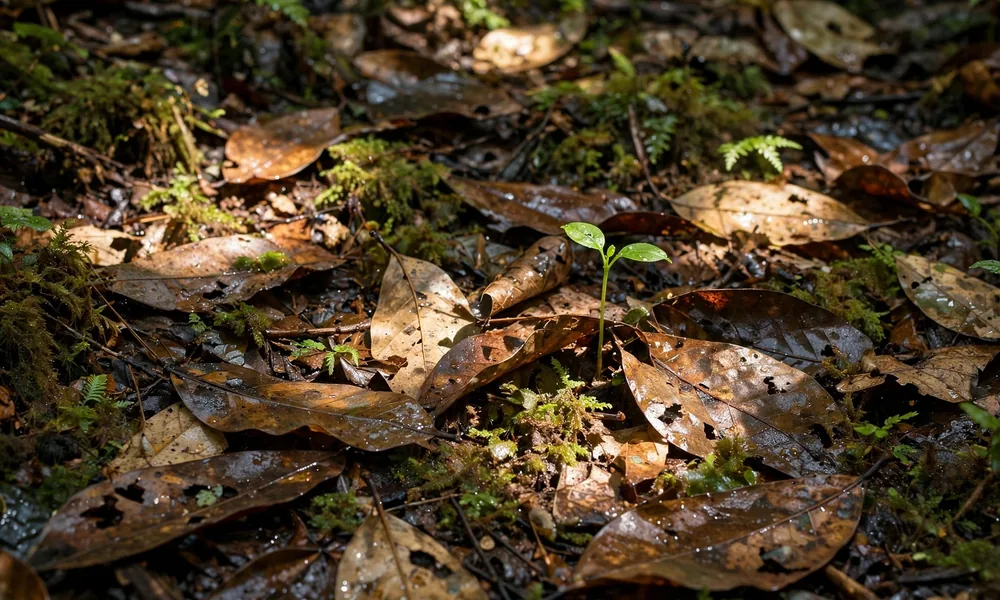
The forest the bullet ant needs is intact forest, with tall trees, a closed canopy and a damp floor of leaf litter. It does not do well in forest that has been cut into small fragments, and it is not found in plantations or in gardens, because a colony needs the canopy to forage in and the deep leaf litter to hunt through.
What bullet ants eat
Bullet ants eat a mix of sweet plant food and small animals, and that mix is what makes them so successful in the canopy. The sweet half of the diet is nectar from flowers and from extrafloral nectaries, the small glands on leaves and stems that plants use to feed the ants that protect them, along with tree sap and honeydew from sap-sucking insects. The animal half is small arthropods: grasshoppers, beetles, katydids, spiders and other insects, taken alive or scavenged dead, and the ants have even been seen scavenging the carcasses of small vertebrates such as mice. Like the ant, the bullet ant is an omnivore that feeds its colony on whatever the forest offers, but the ordinary garden ant gathers crumbs and seeds in long trails on the ground, while the bullet ant hunts alone in the canopy and brings back prey as large as itself.

The hunting is done alone, and that is unusual for an ant. Most ants forage in trails, following a chemical path laid down by their sisters, but a bullet ant forager walks out of the nest on its own, climbs a tree, and hunts by sight and by smell through the branches, sometimes travelling 125 metres on a single foraging trip, which is a long way for an ant. When it finds prey, it grabs it with its mandibles and stings it, and the venom paralyses the insect quickly, so the ant can carry it back to the nest whole. The food is brought back to the larvae, which need the protein to grow, while the adult ants themselves live largely on the sweet nectar and sap they collect.
The ants also protect the plants they feed from, and the plants pay them back. A tree that offers nectar from extrafloral nectaries gets a guard that will sting any caterpillar or beetle that tries to eat its leaves, and the bullet ant is a guard few insects will argue with. The glasswing butterfly has even evolved larvae that taste unpleasant to bullet ants, which is a measure of how much pressure this one ant puts on the insects around it.
How bullet ants behave
Bullet ants are not aggressive, and that is the first thing to understand about them, because everything about their size and their sting suggests otherwise. A bullet ant will not chase a person, and it will not attack without reason. It stings to defend its nest and to subdue its prey, and that is all. A forager met on a tree trunk will usually walk on past, and a colony that is left alone will leave you alone. The sting is a defence, not a weapon of attack, and the ant gives fair warning before it uses it, which is more than most stinging insects offer.

The warning comes in two parts, and both are worth knowing. The first is sound: the ant rubs parts of its body together to make a stridulating squeak, a faint rasping noise that says stay away. The second is smell: the ant releases a foul odour from its body, a chemical warning that other ants and many animals recognise. An ant that has raised its abdomen, pointed its stinger towards you and is making that sound is an ant that has told you plainly what will happen next, and the sensible response is to step back and give it room. Workers also defend the nest entrance against bullet ants from other colonies, and the fights between colonies can be fierce, with the losing colony sometimes destroyed altogether.
Inside the colony, the work is shared out by size. Smaller workers stay in the nest, tending the larvae and the queen, while larger workers forage in the canopy and guard the nest entrance, and the division is a matter of age as well as size, since young workers start inside and move outside as they grow older. The colony is fiercely territorial, and each colony defends the trees around its nest against its neighbours, so the forest is divided into small territories, each held by a single colony.
Breeding and life cycle
Bullet ant colonies breed once a year, and the season begins with the rains. A mature colony produces winged males and winged virgin queens, which leave the nest on a nuptial flight, usually at the start of the rainy season, when the air is warm and wet and the forest is full of new growth. The queens mate in the air, the males die soon after, and the mated queen sheds her wings and walks off alone to find a place to start a new colony. She digs a small chamber in the soil at the base of a tree, lays her first eggs, and rears the first workers entirely on her own, feeding them from the reserves in her own body until they are old enough to forage for themselves.

The eggs hatch in about 18 to 24 days, and the larvae feed for two to three weeks on the food the workers bring back, growing fat and pale in the dark chambers of the nest. They then spin silk cocoons and pupate for a similar length of time, changing inside the cocoon from a legless grub into a fully formed ant, before they chew their way out and join the colony as workers. The queen is the only ant in the colony that lays eggs, and she is the mother of every worker, every male and every future queen the colony produces, which is why the whole colony exists to feed her and to protect her.
Workers live for about 90 days, a short life spent first inside the nest and then outside in the canopy, and a worker that survives its first weeks has a good chance of seeing the end of its season. The queen lives far longer, and she can live for five years or more, laying eggs through season after season while her daughters come and go around her. A colony grows slowly at first, with only a few dozen workers in its first year, and then faster, until a mature colony holds several hundred workers, and some hold up to a few thousand, nearly all of them female workers, with a single queen at the centre of it all.
Conservation status
The bullet ant has no formal assessment on the International Union for Conservation of Nature Red List, and its numbers are not well known, because no one has counted bullet ants across the whole of their range. What is known is that the ant is still common in intact rainforest across Central and South America, and that it is found in many protected areas, from the forests of Costa Rica to the Amazon basin. It is not a rare ant, and it is not a threatened one in the formal sense, but it is an ant that depends entirely on intact forest, and that is a dependence that should not be taken lightly.

The main pressure on the bullet ant is the loss of its forest. When rainforest is cleared for farming, for cattle or for logging, the tall trees go, the canopy the ants forage in disappears, and the deep leaf litter dries out, and a colony that needs both is left with nowhere to live. A colony can survive in a fragment of forest, but a fragment holds fewer trees, fewer flowers and fewer prey, and the colonies in fragments are smaller and more isolated than the colonies in unbroken forest. Protecting large areas of intact rainforest, and keeping the forest connected so that new queens can fly out and found new colonies, is the best way to keep the bullet ant common for the future.
Best seasons for bullet ant watching
The best time to look for bullet ants is the wet season, when the forest is damp and the ants are out foraging in the open, though no season will show you one outside the rainforest. The ants are present in the forest all year round, so there is no wrong season in the strict sense, but the rainy months, when the flowers are open and the insects are abundant, are the time when the foragers are most active, and a visit in the early rains will show you workers climbing the trunks and hunting through the canopy. In the drier months the ants are quieter, and they spend more of their time inside the nest.

The best hours are the first hours after dark, and the early morning, when the foragers are out in the canopy and the air is still damp from the night. From about dusk until midnight, and again at dawn, the ants are at their most active, hunting, collecting nectar and carrying food back to the nest, and they are at their most visible then, big reddish-black shapes moving slowly up the trunks of the trees.
Staying safe around bullet ants
A bullet ant is not dangerous to people who give it room, and the safety rules around it are simple and practical. Wear boots that come up over the knee when you walk in bullet ant forest, watch where you put your hands on tree trunks, and look before you lean against a tree or sit down on a log. Do not poke at a nest entrance, do not shake a tree that holds a colony, and step back at once if an ant raises its abdomen and makes its warning sound. A guide who knows the forest will keep you well clear of the colonies, and a pair of eyes on the trunks ahead of you will keep you from walking into a forager.
If you are stung, stay calm and get away from the colony first, since there may be more ants nearby. The pain will be intense, and it will come in waves for 12 to 24 hours, often with shaking and sweating, and the stung limb may feel weak or numb for a while. Clean the sting, keep it still, and get medical help, especially if you have been stung more than once, or if you have trouble breathing, which can be a sign of an allergic reaction. Do not try to suck out the venom, and do not apply folk remedies, since nothing you put on the skin will stop the pain, and time is the only cure. The Sateré-Mawé people of Brazil, who weave bullet ants into gloves for their coming-of-age ritual, endure the stings deliberately, wearing the gloves for five to ten minutes at a time and repeating the rite twenty times over months or years, which is a measure of how much this sting is respected by the people who know it best.
Bullet ant watching checklist
A little preparation turns a walk in the rainforest into a real chance of seeing a bullet ant at its best, big and reddish-black on a tree trunk in the damp canopy.
- A guided walk with a local naturalist in the wet season, when the forest is damp and the foragers are most active.
- Boots that come up over the knee, so a forager on the forest floor cannot reach your skin.
- Long sleeves and long trousers, so your arms and legs are covered when you walk past a tree trunk.
- A torch with a gentle beam, for watching the trunks after dark when the ants are out hunting.
- Binoculars and a camera that works in low light, so you can watch the canopy without crowding the ants.
- A field guide to the ants of Central and South America, so you can tell a bullet ant from a giant Amazonian ant.
- Respect for the ants and the forest, keeping your distance, keeping your hands off the trunks, and leaving the forest as you found it.
Frequently asked questions
How big do bullet ants get?
Bullet ants grow to about 18 to 30 millimetres long, roughly 0.7 to 1.2 inches, which makes them as long as a thumbnail and among the largest ants in the world. The queen is only slightly larger than the workers, and she has wings until she mates, after which she sheds them. A worker weighs about 80 to 120 milligrams, which is heavy for an ant, and its stinger is up to 3.5 millimetres long, which is long enough to see with the naked eye.
What do bullet ants eat?
A bullet ant eats nectar from flowers and from extrafloral nectaries, tree sap and honeydew, along with small animals such as grasshoppers, beetles, katydids and spiders, taken alive or scavenged dead. The foragers hunt alone in the canopy, sometimes travelling 125 metres on a single trip, and they bring the food back to the larvae, which need the protein to grow, while the adult ants live largely on the sweet nectar and sap they collect.
How painful is a bullet ant sting?
A bullet ant sting is rated 4.0 plus on the Schmidt sting pain index, the highest score on the scale, and it is widely regarded as the most painful insect sting known. The entomologist Justin Schmidt, who tested the sting on himself, described it as pure, intense, brilliant pain, like walking over flaming charcoal with a three-inch nail in the heel. The pain comes in waves and can last 12 to 24 hours, often with shaking, sweating and a temporary weakness in the stung limb, and it is caused by poneratoxin, a peptide in the venom that jams the sodium channels in the nerves.
Where do bullet ants live?
Bullet ants live in humid lowland rainforests from Honduras and El Salvador in the north, through Nicaragua, Costa Rica and Panama, and on through Venezuela, Colombia, Ecuador, Peru and Bolivia to Brazil in the south. They live mostly in lowland forest, from sea level to about 750 metres, with a few colonies found as high as 1,500 metres, and they nest in the soil at the base of large trees, using the trunk as a highway to the canopy where most of their food is found.
Can you keep a bullet ant as a pet?
You should not, and in most places you could not even if you wanted to. Bullet ants need a warm, humid rainforest enclosure with tall trees to climb and a large territory to forage in, and a colony in a small tank would be stressed, short-lived and dangerous to keep, since a single sting can hurt for a full day. They are also fiercely territorial, and a colony that feels threatened will defend itself with a sting that no keeper wants to meet. Anyone who loves ants would do far better with a colony of leafcutter ants or carpenter ants, which are active, fascinating and safe to keep.
How is this guide different from the brown recluse spider guide?
This guide covers the bullet ant, a single species, Paraponera clavata, a large reddish-black ant of Central and South American rainforests that lives in small colonies at the base of trees, forages alone in the canopy for nectar and small animals, and defends its nest with the most painful sting of any insect, while our brown recluse spider guide covers a small shy brown spider of the central United States that hides in dry corners by day, hunts crickets and cockroaches on foot at night, and bites only when trapped against the skin. One is a social insect you meet on a rainforest trunk in the dark; the other is a solitary spider you meet in a cupboard.
This guide also goes further than our general ant guide, which covers ants as a whole, from garden ants to leafcutter ants to army ants, in a single broad sweep. That guide is the place to start if you want to know what an ant is, while this guide stays with one species for its whole length, following the bullet ant from its lone place among the ants and its giant relatives through its rainforest habitat, its nectar and hunting diet, its warning behaviour and its famous sting, its colonies and its long-lived queen, to the seasons and the checklist that will help you see one for yourself.
Conclusion
The bullet ant species is a reminder that the most painful animal in the forest is often the least interested in meeting you. A large reddish-black ant with a sting rated at the top of the Schmidt pain index, a body as long as a thumbnail, a life spent in small colonies at the base of rainforest trees and a night spent hunting alone in the canopy, it asks for nothing more than to be left alone, and it stings only when its nest is threatened or its prey is in reach.
If you walk in its forest, give it that room: wear your boots, watch the trunks, step back when an ant raises its abdomen and makes its warning sound, and let a guide show you where the colonies are. Do that, and the bullet ant will stay what it has always been, a great hunter of the rainforest canopy, doing its night work among the leaves while you watch from a safe distance.