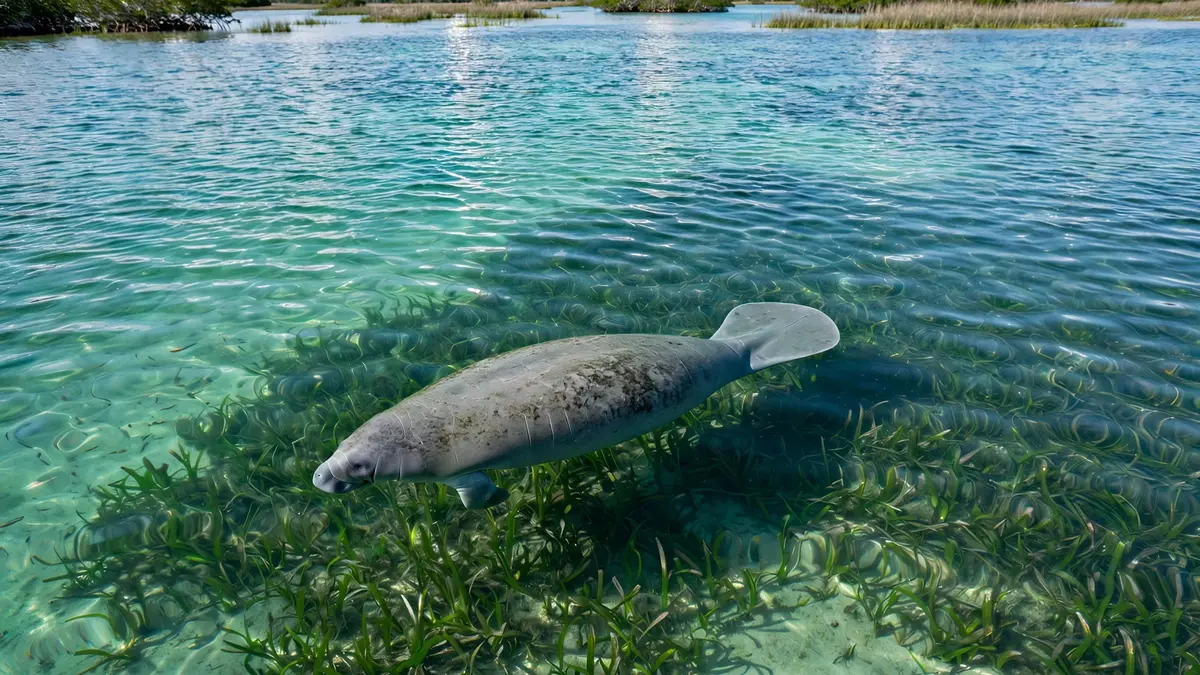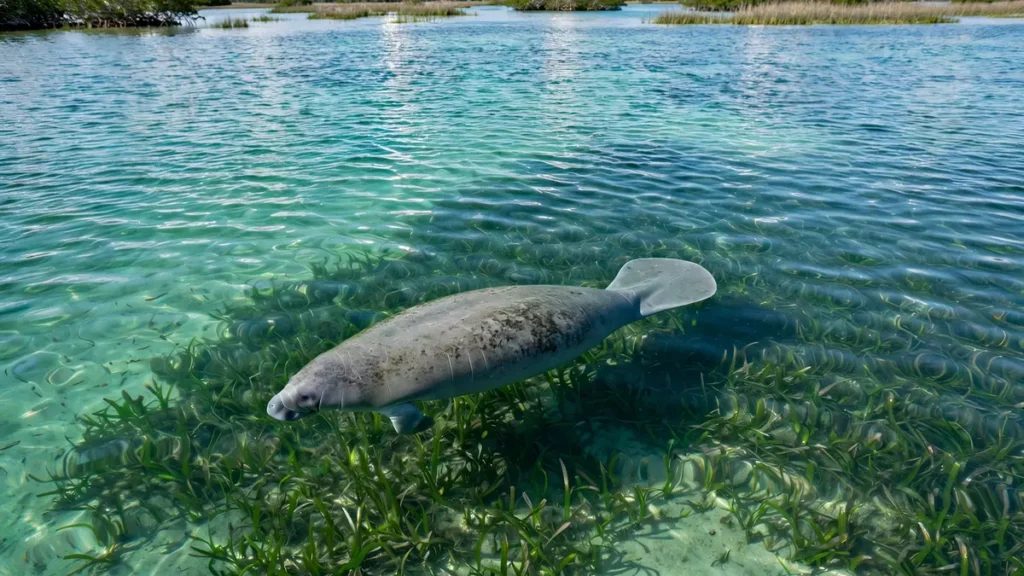
The manatee species number three, slow grey sea cows of warm coastal waters that graze on seagrass like cattle graze on grass, and they are among the gentlest large animals in the ocean. If you are asking how many manatee species there are, the answer is three: the West Indian manatee, the Amazonian manatee and the African manatee, and every manatee alive today belongs to one of them.
The manatee belongs to the order Sirenia, the sea cows, along with its closest relative the dugong, and it lives only in warm shallow waters, where the sea stays above 20 degrees Celsius all year round. Its round grey body, its paddle-shaped tail and its whiskered snout make it one of the most recognisable animals of the tropics.
Key takeaways
- There are three manatee species, all listed as Vulnerable, and the best-known is the West Indian manatee.
- Manatees are slow herbivores that eat up to 50 kilogrammes of seagrass and other plants every day.
- Manatees need warm water and suffer cold stress when the temperature falls below 20 degrees Celsius.
- About 13,000 West Indian manatees are estimated to live in the wild, most of them in Florida and the Caribbean.
- Boat strikes are the leading cause of manatee deaths in Florida, ahead of cold stress and habitat loss.
What makes a manatee a manatee
A manatee is a large grey marine mammal with a rounded body, a short blunt snout covered in whiskers, two front flippers and a flat paddle-shaped tail, and it has no hind limbs at all. An adult West Indian manatee measures roughly 2.5 to 4 metres long and usually weighs between 400 and 600 kilogrammes, with large males reaching more than 1,000 kilogrammes.
The snout defines the manatee: a flexible split upper lip that works like a pair of hands, pulling seagrass and other plants into its mouth, while its whiskers feel for food in murky water. Its flippers carry small nails, a reminder of the land mammal it once was, and its lungs are long and flat, running along its back, which helps it stay level in the water. Like other whales, the manatee breathes air through nostrils on top of its snout, and it can stay underwater for up to 20 minutes on a single breath.
The manatee species and its relatives
There are three manatee species. The West Indian manatee lives in the coastal waters of Florida, the Caribbean and the Gulf of Mexico, the Amazonian manatee lives only in the fresh waters of the Amazon river system, and the African manatee lives along the west coast of Africa, from Senegal to Angola. The Amazonian manatee is the smallest of the three and the only one that lives entirely in fresh water.
The dugong is the manatee’s closest living relative, being the only other member of its order still alive, but it lives in the Indo-Pacific, has a fluked tail like a whale and never enters fresh water. The Steller’s sea cow was a much larger relative that lived in the cold North Pacific and was hunted to extinction within 27 years of its discovery, in 1768. The manatee’s nearest land relatives are elephants, and the two groups share a distant ancestor.

| Type | Animal | Where it lives | Best-known food | Length or Weight |
|---|---|---|---|---|
| Species | West Indian manatee (Trichechus manatus) | Florida, Caribbean and Gulf of Mexico | Seagrass and water plants | 2.5 to 4 m, 400 to 600 kg |
| Close relative | Amazonian manatee | Amazon river system | Water plants and floating vegetation | 2.5 to 3 m |
| Close relative | African manatee | West coast of Africa | Seagrass and mangrove leaves | 3 to 4 m |
| Close relative | Dugong | Indo-Pacific coastal waters | Seagrass | 2.4 to 3 m |
| Close relative | Steller’s sea cow | North Pacific, extinct 1768 | Kelp | Up to 9 m |
| Close relative | Beluga whale | Arctic and sub-Arctic coasts | Fish, squid and crustaceans | 3 to 5 m |
| Close relative | Humpback whale | Oceans worldwide | Krill and small fish | 12 to 16 m |
How manatees live
Manatees are creatures of warm shallow water. A manatee lives alone or in small loose groups, drifting slowly through seagrass beds, river mouths and coastal lagoons, and mothers and calves stay close together for a year or two. Like other ocean animals, it follows the seasons, moving to warm-water refuges in winter and spreading out to feed in summer.
Seagrass makes up most of the diet, along with other water plants, mangrove leaves and floating vegetation, and a large manatee can eat up to 50 kilogrammes of plants in a single day. It grazes for hours at a time, using its split lip to tear off mouthfuls of grass, and it swims slowly, at about 5 to 8 kilometres per hour, though it can burst to 25 kilometres per hour when startled. Its teeth are replaced throughout its life, with new molars moving forward as the old ones wear out on sandy grit.
Breeding happens all year round, and after a gestation of about 12 to 13 months the female gives birth to a single calf, usually in quiet shallow water, where the calf can reach the surface easily. The calf is born about 1 metre long, weighing around 30 kilogrammes, and it stays with its mother for one to two years, learning where the seagrass beds and warm-water refuges are. Manatees live for around 50 to 60 years in the wild.
Where manatees live
The West Indian manatee lives in the coastal waters of Florida, the Caribbean islands, Central America and the northern coast of South America, and it is most common in Florida, where about 7,500 animals live. The Amazonian manatee lives only in the fresh waters of the Amazon basin, in Brazil, Peru, Colombia and Ecuador, while the African manatee lives in rivers, lagoons and coastal waters from Senegal to Angola.
Warm water is the key requirement. A manatee needs water above 20 degrees Celsius, and when the temperature falls it gathers at warm-water refuges, such as natural springs and the warm outflows of power stations, where hundreds of animals may crowd together. It depends on seagrass beds staying healthy, like the fish and turtles that share its waters, and when the grass dies the manatees starve.
All three species are listed as Vulnerable, and their numbers are falling in several regions. The main pressures are boat strikes, which kill more Florida manatees than any other cause, the loss of seagrass beds, cold stress in unusually cold winters, and entanglement in fishing gear. In 2021 more than 1,000 Florida manatees died, many of them starving after seagrass loss in the Indian River Lagoon. About 13,000 West Indian manatees are estimated to live in the wild.
Best seasons for manatee watching
There is no closed season, because manatees are active all year, but the best time to look for them depends on where you go. In Florida the best months are often November to March, when the water cools and the manatees gather in large numbers at warm-water springs such as Crystal River and Blue Spring. In the Amazon the best months are often the dry season, when the water is low and the animals are easier to find.
The winter has its own rewards: hundreds of manatees may gather in a single spring, and they are easy to watch from a boardwalk or a kayak, though the animals are resting and should not be disturbed. Good places to try include Crystal River and Blue Spring in Florida.
Staying safe around manatees
A manatee is a wild animal with great weight and strength, and it can hurt a person by accident, though manatees are gentle and almost never aggressive. Keep your distance, never chase a manatee, and never try to touch, feed or ride one, because a manatee that learns to approach people is more likely to be hit by a boat. If you see manatees from a boat, keep the engine slow, watch for their backs breaking the surface, and stay in marked channels.
Like other wild marine mammals, manatees can carry diseases, and any bite or scratch should be washed at once and checked by a doctor without delay. Admire from a distance, from the deck of a boat or a kayak, and never enter the water where manatees are resting.
Manatee watching checklist
A little preparation turns a Florida spring visit into a real chance of seeing a manatee, so pack for cool mornings, calm water and long quiet hours.
- Binoculars with good low-light performance, for picking a grey back out of the water.
- A camera with a zoom lens, because manatees should always be watched from a distance.
- Warm layers and a waterproof jacket, because winter mornings at the springs are cold.
- A booked kayak or boat tour with a guide who knows the manatee rules and the safe routes.
- A plan to be out in winter, when the manatees gather at the warm-water springs.
- Patience and silence, because manatees are shy animals and a noisy group will send them away.
- A polarised pair of sunglasses, for cutting the glare and seeing into the water.
Frequently asked questions
How many manatee species are there?
There are three manatee species: the West Indian manatee, the Amazonian manatee and the African manatee. All three are listed as Vulnerable, and the West Indian manatee is the best studied, with about 13,000 animals in the wild.
Are manatees related to elephants?
Yes, distantly. Manatees and elephants share a common ancestor that lived on land tens of millions of years ago, and the manatee’s flippers still carry small nails, like the toenails of an elephant. Their closest living relative in the sea is the dugong.
Why do manatees need warm water?
Manatees need warm water because they have very little body fat for animals of their size and a slow metabolism, so they lose heat quickly in cold water. Below 20 degrees Celsius they suffer cold stress, which can kill them, so they gather at warm springs and power-station outflows in winter.
Can you keep a manatee as a pet?
No. A manatee is a wild animal that needs warm shallow water, eats up to 50 kilogrammes of plants a day, and is fully protected by law in every country where it lives. Manatees in rescue centres are there to recover from injury, and they are not pets.
How is this guide different from the narwhal species guide?
This guide covers the three manatee species, gentle plant-eating sea cows of warm tropical waters, while our narwhal species guide covers the single narwhal species, a toothed whale of the icy Arctic seas. The manatee grazes on seagrass in water above 20 degrees, and the narwhal hunts under sea ice in water near freezing.
Are manatees endangered?
Manatees are listed as Vulnerable, so they are not classed as endangered, but their numbers are falling in several regions. About 13,000 West Indian manatees remain in the wild, and boat strikes are the leading cause of death in Florida.
Conclusion
The manatee species show how much gentleness one animal can hold: three species of sea cow, with split lips for grazing, flippers with nails, and a life spent drifting through warm shallow water eating seagrass. They are among the slowest and most peaceful large animals in the ocean, and they have lived in tropical waters for millions of years.
If you go looking for one, go in winter to a Florida spring, go with a guide, and go quietly. Watch a manatee surface slowly among the reeds and you will understand why it has earned its place as the gentle giant of the shallows, and why keeping its warm water and its seagrass matters most.