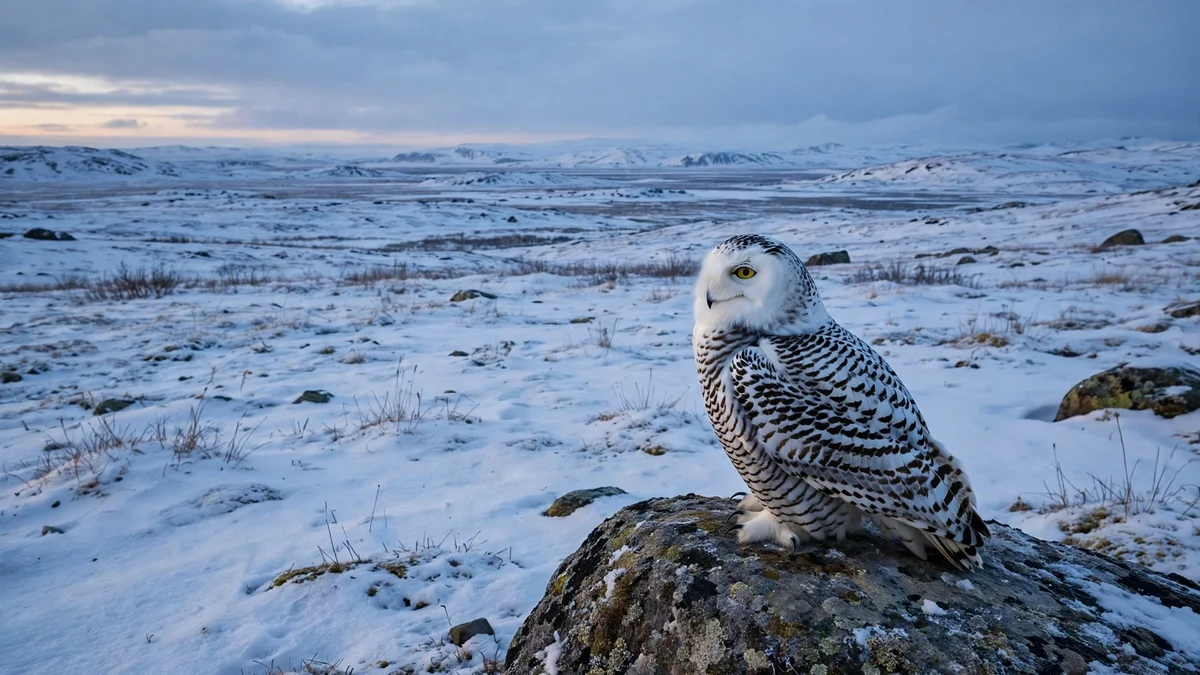
The snowy owl species is a single species, Bubo scandiacus, a great white owl of the Arctic tundra that hunts lemmings by daylight in a land where the summer sun never sets. If you are asking how many snowy owl species there are, the answer is one: there is only one snowy owl species in the world, and every snowy owl alive today belongs to it.
The snowy owl belongs to the owl family, Strigidae, and it is the largest owl of the North American Arctic, a bird that turns whiter as it ages. Its yellow eyes, its feathered feet and its silent flight make it one of the most recognisable birds on Earth.
Key takeaways
- There is only one snowy owl species, Bubo scandiacus, with only 14,000 to 28,000 mature birds left in the wild.
- Snowy owls are the heaviest owls in North America, with females weighing up to 3 kilogrammes.
- Snowy owls hunt mainly lemmings, and one owl can eat more than 1,600 lemmings in a year.
- Unlike most owls, snowy owls hunt by day, because the Arctic summer has 24 hours of daylight.
- Snowy owls are listed as Vulnerable, and their numbers have fallen by more than 30 percent in three generations.
What makes a snowy owl a snowy owl
A snowy owl is a large powerful owl with white plumage, piercing yellow eyes, a black beak and legs feathered right down to the toes, built for a life on the open tundra. An adult measures roughly 52 to 71 centimetres long, with a wingspan of 125 to 150 centimetres, and females weigh 1.6 to 3 kilogrammes, larger than the males.
The plumage defines the snowy owl: old males are almost pure white, while females and young birds keep heavy dark barring across their bodies for their whole lives, so a white bird is an old male and a barred bird is usually a female. Its feathered feet work like snowshoes and insulation against the frozen ground, and its hearing is so sharp that it can hear a lemming moving under the snow. Like other owls, it flies almost silently, because its wing feathers have soft fringed edges that muffle the sound of the air.
The snowy owl species and its relatives
Bubo scandiacus is the only snowy owl species, and it is not split into formally recognised subspecies. Snowy owls in different parts of the Arctic form one connected population, because the birds wander thousands of kilometres between one summer and the next, following the lemmings.
The great horned owl is the snowy owl’s closest relative in North America, and the two belong to the same genus, but the great horned owl is a brown forest hunter with ear tufts, while the snowy owl is a white tundra hunter with none. The Eurasian eagle-owl is a larger Old World cousin, and the great grey owl is a taller, greyer owl of the northern forests. The short-eared owl is another open-country hunter that shares the snowy owl’s tundra, and the barn owl and tawny owl are smaller owls of farmland and woodland.

| Type | Animal | Where it lives | Best-known food | Length or Weight |
|---|---|---|---|---|
| Species | Snowy owl (Bubo scandiacus) | Arctic tundra of the North | Lemmings and voles | 52 to 71 cm, 1.6 to 3 kg |
| Close relative | Great horned owl | Forests of the Americas | Rabbits, rodents and birds | 46 to 64 cm |
| Close relative | Eurasian eagle-owl | Europe and Asia | Rabbits, rodents and birds | 56 to 75 cm |
| Close relative | Great grey owl | Northern forests | Voles and mice | 61 to 84 cm |
| Close relative | Short-eared owl | Open country worldwide | Voles and mice | 34 to 43 cm |
| Close relative | Barn owl | Farmland worldwide | Mice and rats | 29 to 44 cm |
| Close relative | Tawny owl | Woodland of Europe and Asia | Mice, voles and birds | 37 to 46 cm |
How snowy owls live
Snowy owls are creatures of the open tundra. A snowy owl lives alone, perched on a rock or a mound where it can watch for lemmings, and pairs come together only to breed in summer, when the lemmings are plentiful. Like other tundra animals, it is built for cold that would kill most birds, and it follows the lemmings as their numbers rise and fall.
Lemmings make up most of the diet, along with voles, hares, ptarmigan and other birds, and a snowy owl can eat three to five lemmings in a single day. It hunts by watching from a perch and then swooping down, or by hovering and dropping onto prey, and it can catch a lemming under the snow by sound alone. It swallows small prey whole and coughs up pellets of bone and fur, and in a good lemming year a pair may raise ten or eleven chicks.
Breeding happens in summer, and the female lays her eggs in a shallow scrape on the ground, usually three to eleven eggs depending on how many lemmings there are. She incubates them for 31 to 33 days while the male brings her food, and the chicks leave the nest after about 50 days, though they depend on their parents for another nine to ten weeks. Snowy owls live for around 10 years in the wild, and much longer in captivity.
Where snowy owls live
The snowy owl’s range is circumpolar, spread around the Arctic across Canada, Alaska, Greenland, Scandinavia and Russia, and it is most common on the treeless tundra of the Canadian Arctic. It nests on the ground in summer and wanders south in winter, reaching the northern United States, Europe and Asia when the lemmings crash. It is one of the characteristic North American animals of the high Arctic, most famous as Hedwig, the owl in the Harry Potter stories.
Lemmings are the key requirement. A snowy owl needs a tundra full of lemmings to breed, so it moves hundreds or thousands of kilometres between summers, and in years when the lemmings fail, few owls breed at all. It depends on the lemming cycle staying strong, like the Arctic fox and the rough-legged hawk, and when the lemmings vanish the owls appear far south, in places they are rarely seen. These southern visits are called irruptions, and in big irruption years thousands of snowy owls reach the United States.
The species is listed as Vulnerable, and its numbers are falling. The main pressures are climate change, which disrupts the lemming cycle, collisions with vehicles and power lines, and poisoning from rodenticides. Scientists once thought there were 200,000 snowy owls, but satellite tracking showed the same wandering birds were being counted again and again, and the true figure is only 14,000 to 28,000 mature birds.
Best seasons for snowy owl watching
There is no closed season, because snowy owls are active all year, but the best time to look for them depends on where you go. In the Arctic the best months are often June to August, when the owls are nesting on the tundra and hunting in the long daylight. In the south the best months are often November to March, when irrupting owls visit beaches, airfields and farmland.
The winter has its own rewards: a white owl on a snowy beach or a fence post is easy to spot, and the birds are often calm and approachable, though they are resting and should not be disturbed. Good places to try include the Canadian Arctic in summer and the coasts of New England in irruption winters.
Staying safe around snowy owls
A snowy owl is a wild bird with sharp talons and a powerful beak, and it can hurt a person, so it must always be treated with respect. Keep your distance, never approach a nesting owl on the tundra, and never get between a parent and its chicks, because a defending snowy owl will dive at an intruder.
Like other wild birds, snowy owls can carry diseases, and any bite or scratch should be washed at once and checked by a doctor without delay. Admire from a distance, and never feed a snowy owl, because a fed owl becomes a danger to itself and to people.
Snowy owl watching checklist
A little preparation turns a winter beach walk into a real chance of seeing a snowy owl, so pack for cold wind, bright snow and long quiet hours.
- Binoculars with good low-light performance, for picking a white owl out of the snow.
- A camera with a long lens, because snowy owls should always be watched from a distance.
- Warm layers, windproof clothing and insulated boots, because the Arctic wind is cold even in winter.
- Water and snacks for long days, because the best sightings come after hours of searching.
- A booked local guide who knows the tundra, the owl movements and the safe routes.
- A plan to be out in daylight, when snowy owls are hunting and easiest to see.
- Patience and silence, because snowy owls are quiet birds and a noisy group will send them away.
Frequently asked questions
How many snowy owl species are there?
There is one snowy owl species, Bubo scandiacus. Snowy owls in different parts of the Arctic form one connected population, because the birds wander thousands of kilometres between summers. No second snowy owl species is recognised.
Why do male snowy owls turn white?
Male snowy owls turn whiter as they age, because the dark barring on their feathers fades with each moult, until old males are almost pure white. Females keep their heavy dark barring for their whole lives, so a heavily barred bird is usually a female and a pure white bird is an old male.
Do snowy owls hunt at night?
Not usually. Snowy owls are one of the few owls that hunt mainly by day, because in the Arctic summer the sun never sets and there is no night to hunt in. In winter they hunt in the short daylight hours and at dawn and dusk.
Can you keep a snowy owl as a pet?
No. A snowy owl is a wild bird that needs open tundra, eats several lemmings a day, and is fully protected by law in every country where it lives. Snowy owls in zoos need large aviaries and a constant supply of rodents, and they are not pets.
How is this guide different from the walrus species guide?
This guide covers the single snowy owl species, a white bird of prey that hunts lemmings on the Arctic tundra, while our walrus species guide covers the single walrus species, a tusked marine mammal that eats clams from the sea floor. The snowy owl hunts by sight and sound in the air, and the walrus hunts by whisker in the water.
Are snowy owls endangered?
Snowy owls are listed as Vulnerable, so they are not classed as endangered, but their numbers are falling. Only 14,000 to 28,000 mature birds remain in the wild, and climate change is disrupting the lemming cycle they depend on.
Conclusion
The snowy owl species shows how much specialisation one bird can hold: Bubo scandiacus, with plumage that whitens with age, feathered feet like snowshoes, hearing that finds lemmings under the snow, and a life spent wandering the Arctic after its prey. It is the heaviest owl in North America, and it has ruled the tundra for thousands of years.
If you go looking for one, go in summer to the Canadian Arctic or in an irruption winter to a snowy beach, go with a guide, and go quietly. Watch a snowy owl perched on a rock against the white tundra and you will understand why it has earned its place as the ghost of the north, and why keeping its lemmings and its ice matters most.