The walrus species is a single species, Odobenus rosmarus, a huge tusked pinniped of the Arctic that hauls itself out of the freezing sea onto ice and beaches in herds of thousands. If you are asking how many walrus species there are, the answer is one: there is only one walrus species in the world, and every walrus alive today belongs to it.
The walrus belongs to the pinniped family, the fin-footed marine mammals, along with seals and sea lions, and it is the only living member of its own family, Odobenidae. Its long ivory tusks, its bristly whiskers and its wrinkled pink-brown skin make it one of the most recognisable animals of the far north.
Key takeaways
- There is only one walrus species, Odobenus rosmarus, with about 225,000 to 250,000 animals left in the wild.
- Walruses are the largest pinnipeds after elephant seals, with Pacific males weighing up to 2,000 kilogrammes.
- Walruses find clams and mussels on the sea floor with their sensitive whiskers, then suck the meat from the shells.
- Their tusks are elongated upper canine teeth, used to haul out onto ice and to settle dominance, not to dig for food.
- Walruses are listed as Vulnerable, and the loss of Arctic sea ice is the main threat to their future.
What makes a walrus a walrus
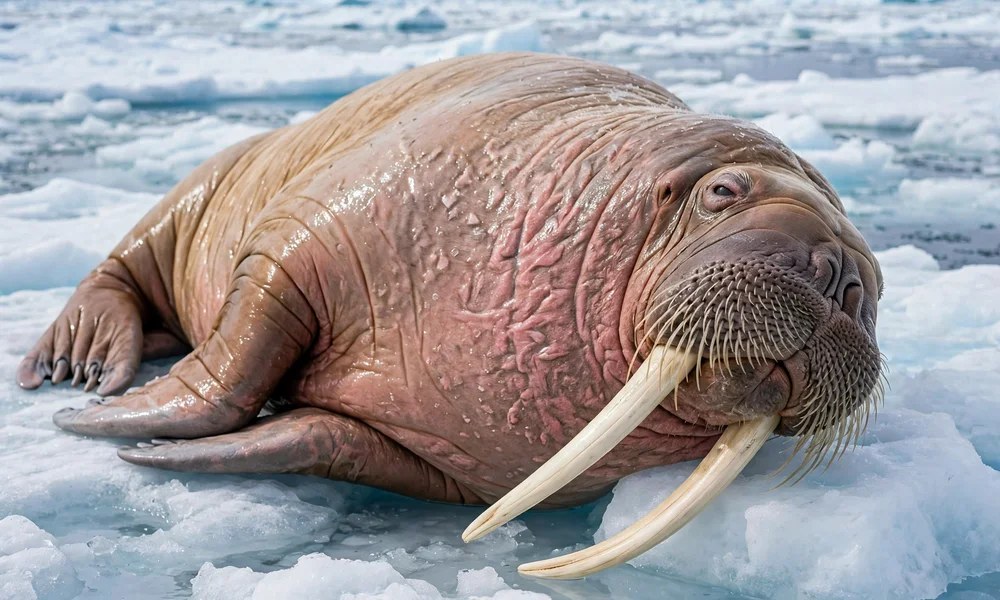
A walrus is a massive marine mammal with a thick wrinkled body, a broad blunt snout covered in stiff whiskers, two long ivory tusks and four flippers, and it has no external ears. An adult male measures roughly 2.7 to 3.6 metres long and usually weighs between 1,200 and 2,000 kilogrammes, while females weigh 600 to 1,000 kilogrammes.
The tusks define the walrus: elongated upper canine teeth that grow up to a metre long in large males, carried by both sexes and used to grip the ice and haul the huge body out of the water, a habit that gave the walrus its scientific name, Odobenus, meaning tooth-walker. Its whiskers are just as important, up to 700 stiff bristles that feel for clams buried in the mud of the sea floor. Like other seals, the walrus is insulated by a layer of blubber up to 15 centimetres thick, and its skin turns pink in the sun as blood flows to the surface to cool it down.
The walrus species and its relatives
Odobenus rosmarus is the only walrus species, and it is split into two recognised subspecies. The Pacific walrus lives in the Bering and Chukchi Seas between Alaska and Russia, and the Atlantic walrus lives in the waters of Canada, Greenland, Svalbard and northern Russia. A third group, the Laptev walrus of Siberia, is sometimes counted as a separate subspecies, but most scientists treat it as part of the Pacific walrus.
The bearded seal is one of the walrus’s closest relatives among the true seals, and it shares the walrus’s taste for clams and its whiskered snout, though it is far smaller and has no tusks. The ringed seal and the grey seal are smaller Arctic seals that live on the same ice, while the northern elephant seal is the only pinniped larger than the walrus. Walruses are more closely related to sea lions than to true seals, because like sea lions they can turn their hind flippers forward to walk on land.
| Type | Animal | Where it lives | Best-known food | Length or Weight |
|---|---|---|---|---|
| Species | Walrus (Odobenus rosmarus) | Arctic seas of the North | Clams, mussels and crabs | 1,200 to 2,000 kg, males |
| Close relative | Atlantic walrus | Canada, Greenland and Svalbard | Clams and molluscs | 900 to 1,500 kg |
| Close relative | Pacific walrus | Bering and Chukchi Seas | Clams and molluscs | 1,200 to 2,000 kg |
| Close relative | Bearded seal | Arctic seas | Clams, crabs and fish | 200 to 430 kg |
| Close relative | Ringed seal | Arctic seas and lakes | Fish and crustaceans | 50 to 110 kg |
| Close relative | Grey seal | North Atlantic coasts | Fish and squid | 150 to 300 kg |
| Close relative | Northern elephant seal | North Pacific coasts | Squid and deep-sea fish | 1,500 to 2,300 kg, males |
How walruses live
Walruses are creatures of the shallow Arctic sea. A walrus lives in large herds that haul out together on ice floes and beaches, with females and young in one group and adult males in bachelor herds of their own, and the animals lie packed flank to flank for warmth. Like other tundra animals, it is built for cold that would kill most mammals, and it follows the ice as it grows and melts with the seasons.
Clams make up most of the diet, along with mussels, crabs, shrimps and worms, and the walrus finds them by sweeping its whiskers across the sea floor in water less than 80 metres deep. It roots out the shellfish with its snout, then sucks the soft meat from the shell, and a large walrus can eat thousands of clams in a single day. It dives for 10 to 25 minutes at a time, using its flippers to swim and steer.
Breeding happens in winter, and after a gestation of about 15 to 16 months, including a long delay before the embryo starts to grow, the female gives birth to a single calf, usually in spring, on the sea ice. The calf is born about 1 metre long, weighing around 50 kilogrammes, and it stays with its mother for about two years, learning to dive and feed on the sea floor. Walruses live for around 30 to 40 years in the wild.
Where walruses live
The walrus’s range is circumpolar, spread around the Arctic across Alaska, Russia, Canada, Greenland and Svalbard in Norway, with about 200,000 Pacific walruses and about 25,000 Atlantic walruses. It lives on the sea ice over shallow continental shelf waters, where clams are plentiful, and it comes ashore on beaches and rocky islands when the ice melts in summer. It is one of the characteristic animals of the high Arctic, most common in the Bering Sea, where the ice and the clams are thickest.
Sea ice is the key requirement. A walrus needs ice as a platform to rest on between feeding dives, so it follows the ice edge as it moves with the seasons, travelling hundreds of kilometres in a year. When the ice retreats beyond the shallow shelf, the walruses are forced to haul out on land in huge crowds, where calves can be crushed in stampedes if the herd is startled.
The species is listed as Vulnerable, and its numbers are falling in several regions. The main pressure is the loss of Arctic sea ice as the climate warms, which forces longer swims to feeding grounds and crowded land haul-outs. Walruses were hunted nearly to extinction for their ivory and blubber in the 18th and 19th centuries, and they are still hunted in small numbers by Arctic peoples. About 225,000 to 250,000 walruses remain in the wild.
Best seasons for walrus watching
There is no closed season, because walruses are active all year, but the best time to look for them depends on where you go. In Svalbard the best months are often June to September, when expedition ships sail among the ice and the walruses are hauled out on beaches and floes.
The summer has its own rewards: the Arctic is at its brightest and the walruses are easy to spot lying in crowded groups on the shore, though the animals are resting and must not be approached. Good places to try include Svalbard and the Round Island haul-out in Alaska.
Staying safe around walruses
A walrus is a wild animal with huge weight, sharp tusks and great strength, and it can hurt a person, so it must always be treated with respect. Keep your distance, never approach a walrus on a beach, and never get between a walrus and the sea, because a startled herd can stampede and crush anything in its path.
Like other wild marine mammals, walruses can carry diseases, and any bite or scratch should be washed at once and checked by a doctor without delay. Admire from a distance, and never feed a walrus, because a fed walrus becomes a danger to people and to boats.
Walrus watching checklist
A little preparation turns an Arctic trip into a real chance of seeing a walrus, so pack for extreme cold, long days and remote places.
- Binoculars with good low-light performance, for picking a brown herd out of the ice and rock.
- A camera with a long lens, because walruses should always be watched from a distance.
- Warm layers, windproof clothing and insulated boots, because the Arctic is cold even in summer.
- Water and snacks for long days, because the best sightings come after hours of searching.
- A booked local guide who knows the haul-outs, the walrus movements and the safe routes.
- A plan to be out in the best light, when walruses are hauled out and easiest to see.
- Patience and silence, because walruses are easily startled and a noisy group can cause a stampede.
Frequently asked questions
How many walrus species are there?
There is one walrus species, Odobenus rosmarus. Scientists recognise two subspecies, the Atlantic walrus and the Pacific walrus, and some count a third, the Laptev walrus, but they are all the same species. No second walrus species is recognised.
Do walruses use their tusks to dig for food?
No, that is a myth. Walruses find clams with their sensitive whiskers and suck the meat from the shells, and their tusks are used to haul out onto the ice, to defend themselves and to settle dominance among males. The tusks are elongated upper canine teeth, not digging tools.
Why do walruses haul out in such huge groups?
Walruses haul out in huge groups because they need a platform to rest on between feeding dives, and when the sea ice melts they crowd onto the few beaches near their feeding grounds. Lying packed together also keeps them warm, though crowded haul-outs can be dangerous for calves.
Can you keep a walrus as a pet?
No. A walrus is a wild animal that needs cold Arctic water, eats thousands of clams a day, and can hurt a person with one sweep of its tusks. Keeping one is illegal in most places, and walruses in zoos need huge pools and tonnes of shellfish, and are not pets.
How is this guide different from the manatee species guide?
This guide covers the single walrus species, a tusked hunter of the Arctic ice that eats clams from the sea floor, while our manatee species guide covers the three manatee species, gentle plant-eaters of warm tropical waters. The walrus lives on the ice edge and dives for shellfish, and the manatee grazes on seagrass in water above 20 degrees.
Are walruses endangered?
Walruses are listed as Vulnerable, so they are not classed as endangered, but their numbers are falling in several regions. About 225,000 to 250,000 remain in the wild, and the loss of Arctic sea ice is the main threat.
Conclusion
The walrus species shows how much specialisation one animal can hold: Odobenus rosmarus, with ivory tusks for hauling out, whiskers that feel clams in the dark mud, blubber up to 15 centimetres thick, and a life spent between the ice and the shallow sea floor. It is the largest pinniped after the elephant seals, and it has ruled the Arctic shallows for thousands of years.
If you go looking for one, go in summer to Svalbard or Alaska, go with a guide, and go quietly. Watch a walrus herd lying packed on the shore and you will understand why it has earned its place as the tooth-walker of the north, and why keeping its sea ice frozen matters most.